Imagine telling someone in 1999…
The year is 2026.
The President is Donald Trump in his second non consecutive term.
The richest man in the world is PayPal cofounder Elon Musk… but not because of fintech or Paypal. Because of rockets, electric cars, AI, satellites, brain chips and something called “Boring Company”.
Apple is worth trillions but its main business isn’t computers… its selling glass rectangles everyone stares at for 9 hours a day.
People don’t watch TV. They watch teenagers explain geopolitics, finance, and relationship advice in ~60 second videos.
The biggest taxi company owns no taxis.
The biggest hotel company owns no hotels.
The most powerful media companies are social networks where everyone argues with strangers for free.
Kids are making millions filming themselves playing video games.
AI Robots write emails, code, legal memos, songs, essays, and breakup texts.
The internet is mostly bots arguing with humans who are trying to prove they aren’t bots.
You can summon a car, groceries, a doctor, a date, a private jet, or a dog walker from your phone.
People pay real money for invisible currencies, digital monkeys, AI girlfriends and pictures that disappear after 24 hours.
The richest companies in the world don’t sell oil, steel, or cars. They sell attention, compute, data, and addiction.
And somehow, after all of that everyone is still using Excel.
A British biologist looked at 200,000 years of human history and found that the entire reason humans broke out of poverty was not intelligence, not language, not even agriculture, but one mechanism so simple a 6-year-old could explain it.
His name is Matt Ridley.
He is a zoologist by training, an evolutionary biologist by career, and in 2010 he wrote a book called The Rational Optimist that quietly argued the most important fact about human progress had been hiding in plain sight for the entire history of economics.
Naval Ravikant has been telling people to read everything Ridley has ever written for the last 15 years. The reason is the argument inside this one book.
For 200,000 years, anatomically modern humans walked around with the same brain you have right now. Same skull size. Same neural architecture. Same raw capacity for language, planning, and abstract thought.
For roughly 190,000 of those years, almost nothing happened. Generation after generation lived and died inside the same Stone Age toolkit their great-great-grandparents had used. Then somewhere around 50,000 years ago, the line on the chart of human progress started to tick upward. Then it bent. Then it exploded.
The question Ridley spent years on was the only question that mattered. What changed.
It was not the brain. The brain had been the same for 190,000 years. It was not language, which had existed long before the takeoff. It was not even agriculture, which arrived only 10,000 years ago and was actually preceded by the upward bend, not the cause of it.
What changed was that humans started trading with strangers.
This sounds too small to be the answer. Ridley argues that it is the answer to almost everything. The moment one human exchanged a useful object with another human from a different group, something happened that no other species on earth had ever done.
Two ideas that had developed in isolation came into contact. The flint knapper learned what the spear maker had figured out. The fisherman from the coast learned what the hunter from the forest had figured out. The two pieces of knowledge fused into something neither side could have produced alone.
Ridley calls this ideas having sex. The phrase sounds frivolous and it is meant to. The point is that ideas, like genes, get better when they combine with other ideas from different lineages.
An idea sitting inside one head, no matter how brilliant the head, eventually hits a ceiling. The same idea exposed to ten thousand other ideas does something genes do under sexual reproduction. It mixes. It recombines. It produces offspring nobody planned.
The cleanest proof of this argument is the most uncomfortable case study in the book. Tasmania.
Around 10,000 years ago, rising sea levels cut Tasmania off from mainland Australia. A population of roughly 4,000 humans was now isolated on an island, with no possibility of contact with the rest of humanity. They had the same brains. The same language. The same starting toolkit as their cousins 150 kilometers north. The natural experiment was now running.
What happened next is something no economist or geneticist had ever predicted.
The mainland Australians kept inventing. Boomerangs. Spear-throwers. Fishing nets. Bone needles for sewing fitted clothes. Watercraft with paddles. Their technology compounded slowly across the centuries.
The Tasmanians went the other way. They did not just fail to invent the new tools their cousins were developing. They started losing the tools they already had. Fishing was abandoned within a few thousand years. Bone tools disappeared. Fitted clothing disappeared. They forgot how to make fire from scratch and started carrying lit firebrands from camp to camp instead, relighting their fires from a neighbor's whenever their own went out.
By the time European explorers arrived in the 17th century, the Tasmanians had the simplest toolkit of any human society ever recorded. Their material culture had gone backward for 8,000 years.
The archaeologist Rhys Jones called it a slow strangulation of the mind.
Joseph Henrich at Harvard later proved with formal mathematical models that there was nothing wrong with Tasmanian brains. There was something wrong with their network. A toolkit requires a critical mass of people exchanging skills to maintain itself.
The act of teaching a skill is imperfect. Every generation loses a small percentage of what the last generation knew. If your population is large enough and trading widely enough, those losses get caught and corrected by someone else who still remembers.
If your population shrinks below a certain threshold and stops mixing with outsiders, the small losses compound until entire technologies disappear.
This is the part that should haunt anyone reading this in 2026.
Intelligence is not a property of the individual brain. Intelligence is a property of the network the brain is connected to. A genius in isolation will produce less than a mediocre thinker inside a dense exchange of other mediocre thinkers.
The thing your ancestors needed in order to break out of 190,000 years of stagnation was not better brains. It was better connections between brains they already had.
The implication for any individual is direct and uncomfortable. If you are smart and isolated, you will be outproduced by people half as smart who are connected.
The most successful people in any field are almost never the smartest people in it. They are the ones positioned at the intersection of the most idea flows. They are reading more authors than their competitors. They are talking to more people from more disciplines. They are in the rooms where ideas from different lineages bump into each other.
Ridley ends the book on the line that sounds optimistic but is actually a warning its this "The future will be invented by people who connect ideas, not by people who guard them."
Look at this Norwegian church. It has been standing through Norwegian rain for over 840 years.
The trees were prepared for nearly two decades before anyone cut them down.
Workers walked into old-growth pine forests and stripped the chosen trees of their tops and their branches. The trunks stayed standing for fifteen to twenty years. The roots kept pulling resin upward. The pitch bled out of every old branch socket and saturated the heartwood from the inside.
By the time the trunks were felled in winter, the heartwood was no longer wood. It was malmfuru. Ore-pine. Functionally pressure-treated lumber, except the pressure was applied by the tree itself, for free, across two decades before construction started.
That is why iron was rejected. Iron rusts. Iron expands and contracts on a different cycle than the wood around it. After 100 winters iron splits the fiber and the joint dies. Wooden pegs swell with moisture in the same direction as the staves. The joints get tighter over time. Tongue-and-groove walls. Ground sills on a stone foundation. Four corner posts carrying load down through stone, never up through soil.
Then the tar. Pine roots and stumps stacked under clay, lit on fire, burned for two days under controlled airflow. The wood decomposes into pitch. The pitch gets reapplied to the church every 10 to 15 years. Including this decade.
Norway built around 2,000 stave churches between 1150 and 1350. 28 survive. Borgund is the best preserved because its corner staves rest on stone, not soil. The ground never won.
Modern lumber arrives at the construction site finished.
Borgund's builders made the lumber finish itself.
There's a physicist at Stanford named Safi Bahcall who modeled this exact principle and the math is wild.
He calls it "phase transitions in human networks." When you're stationary, your probability of a lucky event is limited to your existing surface area: the people you already know, the places you already go, the ideas you've already been exposed to. Your opportunity window is fixed.
When you move, your collision rate with new nodes in a network increases nonlinearly. Double your movement (new conversations, new cities, new projects) and your probability of a serendipitous encounter doesn't double. It roughly quadruples. Because each new node connects you to their entire network, not just to them.
Richard Wiseman ran a 10-year study at the University of Hertfordshire tracking self-described "lucky" and "unlucky" people. The single biggest differentiator wasn't IQ, education, or family money. Lucky people scored significantly higher on one trait: openness to experience. They talked to strangers more, varied their routines more, and said yes to invitations at nearly twice the rate.
The "unlucky" group followed the same routes, ate at the same restaurants, and talked to the same 5 people. Their networks were closed loops. No new inputs, no new collisions.
Luck isn't random. Luck is surface area. And surface area is a function of movement.
The lobster emoji is doing more work than most people realize. Lobsters grow by shedding their shell when it gets too tight. The growth requires a period of total vulnerability. No protection, no armor, soft body exposed to the ocean.
That's the cost of movement nobody posts about. You have to be uncomfortable first. The new shell only hardens after you've already moved.
Elon Musk just explained how Starlink moves the GDP of entire nations.
The formula is so simple it should embarrass every development agency on the planet.
Musk: “GDP is a function of average productivity per person.”
Productivity per person goes up. GDP goes up. That is the whole equation.
Everything else is decoration.
And connectivity is the single largest lever on Earth for pushing that number.
Musk: “If you don’t have access to the internet, or it’s too expensive or low bandwidth, you cannot access the MIT lessons and you can’t sell the goods and services that you produce.”
No internet means no global knowledge. No global markets. No ability to sell to anyone beyond your village or learn from anyone outside of it.
The penalty is total. And it has nothing to do with the person serving it.
There is a child alive right now who is as intelligent as anyone who has ever walked the halls of MIT.
She does not know it. Nobody around her knows it. Because the coordinates of her birth have no connectivity. No library. No signal. No link to the world that would show her what she is.
She will grow old inside a ceiling that geography built for her. Not because of talent. Not because of effort. Because of a satellite that had not been launched yet.
Musk: “Internet connectivity is certainly a candidate for one of the things that would do more to lift people out of poverty than anything else.”
Traditional infrastructure takes decades. Fiber has to be laid. Towers have to be built. Permits have to be approved. Capital has to be attracted to regions that cannot attract it.
Starlink bypasses all of it from orbit. No cables. No permits. No waiting for a government to prioritize your village. A dish goes up. Isolation ends.
Someone who could not access a textbook yesterday downloads MIT’s entire curriculum today. Someone who could only sell to neighbors starts selling to the planet tomorrow.
That is not an upgrade. That is a different life.
Musk: “Starlink will actually move the GDP of countries. Like it’s gonna be that kind of thing.”
He said it like a feature update. But read it again.
Move the GDP of countries. Not a company’s revenue. Not an industry’s output. The gross domestic product of nations. Shifted by one constellation.
The telecom industry spent decades deciding which regions were profitable enough to connect. The rest were written off. Starlink does not make that calculation. It covers the planet. Every farmer. Every welder. Every kid with a clear view of the sky.
The minds that will cure diseases, solve energy, and build things we cannot yet name are already alive. They are already thinking.
They have no signal.
Starlink is the first technology in human history that can reach them at the speed of deployment instead of the speed of bureaucracy.
And when those minds come online, they will not change their own lives. They will change the trajectory of the species.
That is what Musk actually built. Not a telecom company. The largest unlock of human potential ever launched from a single network.
Norwegian NASAMS systems helped us a lot. I will not share the exact number of NASAMS we have, but it is more than ten and we are still getting them. We have also received missiles for NASAMS made by Norway. However, even domestic Norwegian stocks weren’t enough. And then Norway worked with other countries at the political level to provide us with some additional missiles. This was very important.
In parallel, we were working on joint production and IRIS-T systems. And then it was like a rising wave: when one country stepped up, other real allies, like Norway, followed. That was very good. This winter, Norway also helped us with gas which we needed after Russian attacks on our energy sector, including gas infrastructure.
And the people of Norway support these decisions. All parties in Parliament support them as well. Thank you. All countries have their own internal politics, but the unity in the Norwegian Parliament on Ukraine is crucial and we appreciate it.
All of these things, as well as the work on drones that we started and the fact that Norway is second-largest contributor to PURL, are deeply valued in Ukraine.
From an interview with NRK News (1/2)
Last quarter I rolled out Microsoft Copilot to 4,000 employees.
$30 per seat per month.
$1.4 million annually.
I called it "digital transformation."
The board loved that phrase.
They approved it in eleven minutes.
No one asked what it would actually do.
Including me.
I told everyone it would "10x productivity."
That's not a real number.
But it sounds like one.
HR asked how we'd measure the 10x.
I said we'd "leverage analytics dashboards."
They stopped asking.
Three months later I checked the usage reports.
47 people had opened it.
12 had used it more than once.
One of them was me.
I used it to summarize an email I could have read in 30 seconds.
It took 45 seconds.
Plus the time it took to fix the hallucinations.
But I called it a "pilot success."
Success means the pilot didn't visibly fail.
The CFO asked about ROI.
I showed him a graph.
The graph went up and to the right.
It measured "AI enablement."
I made that metric up.
He nodded approvingly.
We're "AI-enabled" now.
I don't know what that means.
But it's in our investor deck.
A senior developer asked why we didn't use Claude or ChatGPT.
I said we needed "enterprise-grade security."
He asked what that meant.
I said "compliance."
He asked which compliance.
I said "all of them."
He looked skeptical.
I scheduled him for a "career development conversation."
He stopped asking questions.
Microsoft sent a case study team.
They wanted to feature us as a success story.
I told them we "saved 40,000 hours."
I calculated that number by multiplying employees by a number I made up.
They didn't verify it.
They never do.
Now we're on Microsoft's website.
"Global enterprise achieves 40,000 hours of productivity gains with Copilot."
The CEO shared it on LinkedIn.
He got 3,000 likes.
He's never used Copilot.
None of the executives have.
We have an exemption.
"Strategic focus requires minimal digital distraction."
I wrote that policy.
The licenses renew next month.
I'm requesting an expansion.
5,000 more seats.
We haven't used the first 4,000.
But this time we'll "drive adoption."
Adoption means mandatory training.
Training means a 45-minute webinar no one watches.
But completion will be tracked.
Completion is a metric.
Metrics go in dashboards.
Dashboards go in board presentations.
Board presentations get me promoted.
I'll be SVP by Q3.
I still don't know what Copilot does.
But I know what it's for.
It's for showing we're "investing in AI."
Investment means spending.
Spending means commitment.
Commitment means we're serious about the future.
The future is whatever I say it is.
As long as the graph goes up and to the right.
Men nå: Sentralbanker og klima. Den amerikanske sentralbanken har fjernet noen "prinsipper for å vurdere klimarelatert finansiell stabilitet". Dette ledsages av en akkurat passe lang kunngjøring.
Norges Bank har derimot invitert en festlig gjeng. En kort tråd. 1/
Pisa-undersøkelsen viser at norske 15-åringer presterte lavere i matematikk enn noen gang tidligere i undersøkelsene. Og det i et land som bruker mer penger per elev enn noe annet land.
Er det lov å be om forklaring, eller vil dette oppfattes som krenkende og medføre sykefravær?
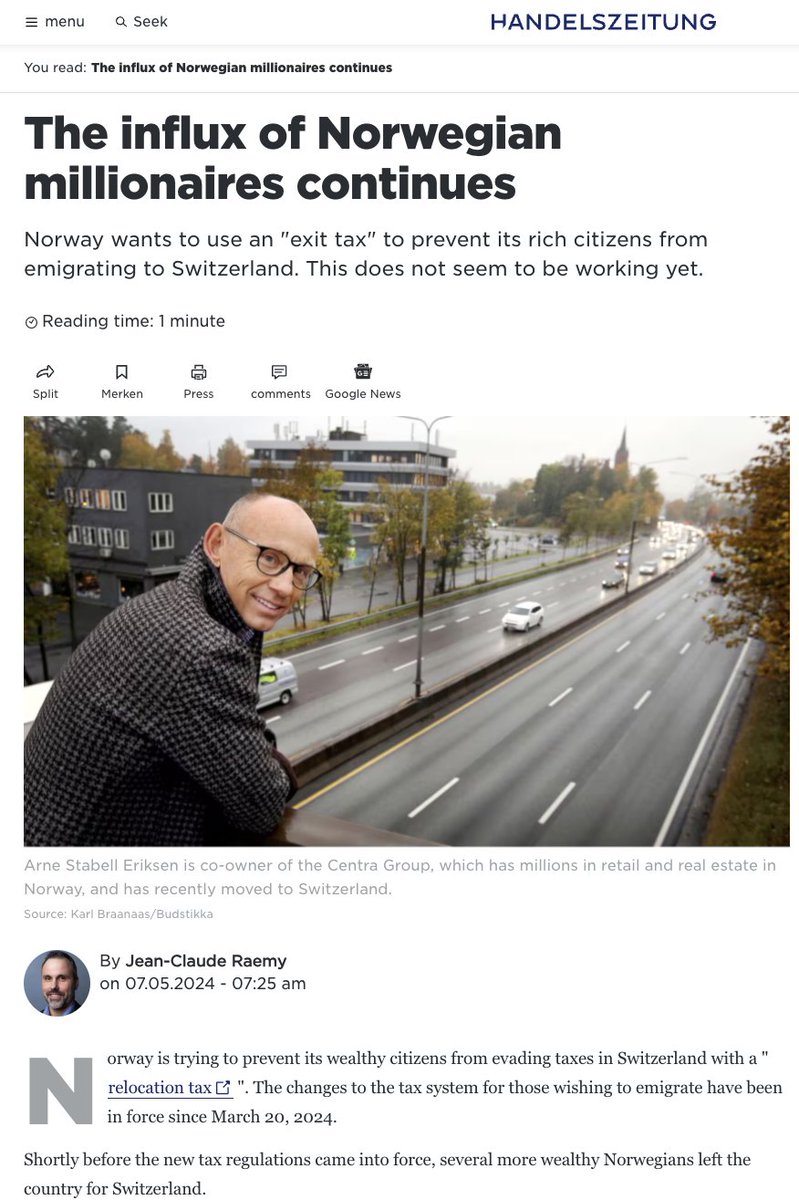
The crazy story of how Norway🇳🇴 gifted 5,000 millionaires and $100s of billions to Switzerland🇨🇭in just 2 years:
In 2022, Norway raised its wealth tax to 1.1% (highest in Europe) and its capital gains tax to 38% (2nd highest).
It made it virtually impossible to preserve wealth in the country and forced Norwegian millionaires out of the country.
Here's how:
If you have $100m in taxable wealth (to pick a round number), you need to pay $1.1 million in wealth tax each year.
But where do you find that $1.1 million? Well, you have to sell off assets.
But if you sell $1.1 million of assets, this triggers a 38% capital gains tax, leaving you with just $682k (not enough to pay the wealth tax).
So you have to sell MORE assets.
To pay both the wealth tax AND the capital gains tax on the money you were forced to raise, you actually have to sell assets worth closer to $1.8 million.
Then you need to pay the entire $1.8m to the government - JUST TO KEEP THE MONEY YOU ALREADY PAID TAX ON WHEN YOU MADE IT IN THE FIRST PLACE.
In other words, if you do nothing, you lose 1/50th of your wealth every year. And this doesn't even account for inflation or bear market years.
It often also means losing control of your company, since you have to sell shares every year.
And if you're a startup unfortunate enough to get investment at a high valuation, you will have to borrow money just to pay tax on money you haven't even earned yet!
So, 5,000 Norwegians understandably moved to Switzerland, including 500 of the richest people in the country.
And the ones who didn't leave in time, hoping for cooler heads to prevail, got punished severely.
Because when the government saw what was happening, they introduced an EXIT TAX (effectively a financial Berlin Wall).
So now, if you want to leave Norway, you have to pay 38% of the market value of ALL YOUR ASSETS.
And the worst part is that the Norwegian government doesn't even need this tax money in the slightest.
Because thanks to enormous oil and gas revenue, only about 18% of the government's revenue comes from taxes paid by private citizens.
And only a fraction of that from wealth tax.
Norway also has the world's biggest sovereign wealth fund, today worth $1.6 TRILLION, or $320,000 per Norwegian.
Even if Norway didn't collect a single dollar in tax, it could still fund government spending for a decade using the money in that fund.
The Norwegian government does not need the money. It is simply greedy and spiteful.
Why would anyone EVER build anything in Norway?
This is how you destroy the private sector as fast as possible.
I suspect this is what this government ultimately wants since they can then control the remaining population with handouts.
Some loopholes still exist, but they are closing fast.
If you're a Norwegian who wants to get out of this abusive relationship, let me know, and I will put you in touch with people who can help.
@anineki De undersøkte 12 podkaster, og fant ut at 3 av dem hadde overvekt av høyrevridde lyttere. Så nei, podkaster flest har ikke overvekt av høyrevridde lyttere.
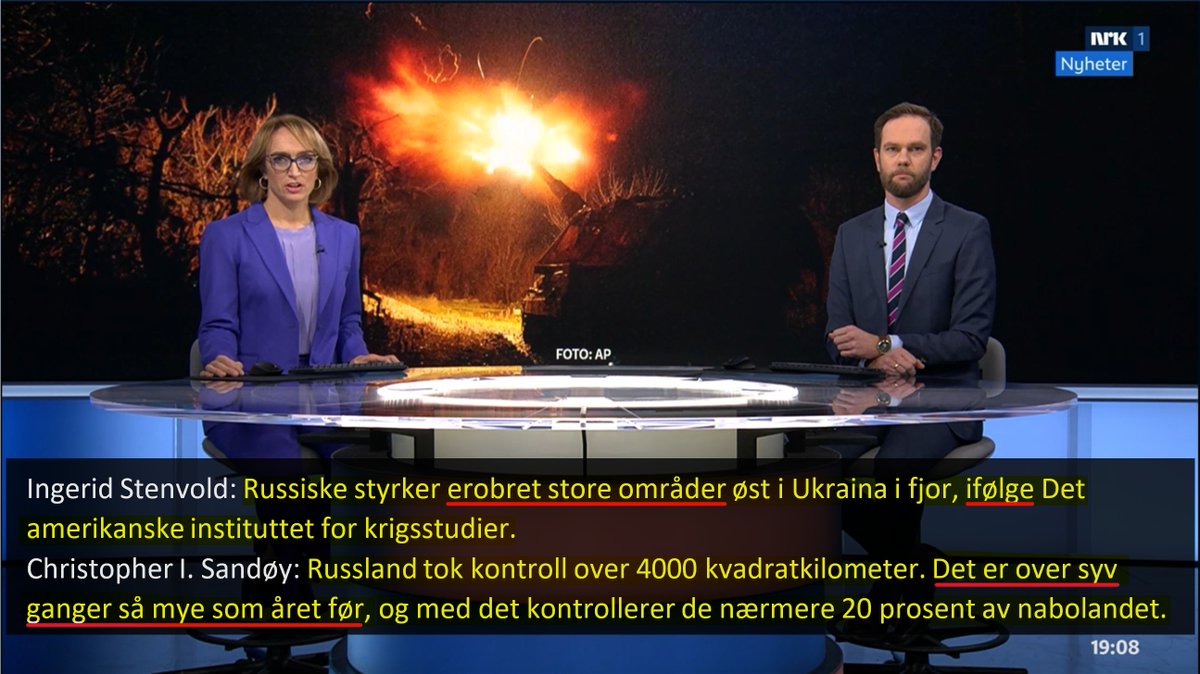
Kjære NRK: Russland har ikke erobret «store områder øst i Ukraina» i 2024.
Ord gir makt. Når skal NRK lære seg denne helt sentrale læresetningen i etterrettelig og balansert journalistikk? 🧵1/25
@rolfnilsen@MlleMalin @sepekoker1 Vi konkurrerte litt bedre når høyere utdanning var gratis for utlendinger, uten at jeg tror det er den beste og viktigste medisinen
Buss for tog, innvandrerkriminalitet og korrupte politikere engasjerer og irriterer folk, men ingenting gjør folk mer sinte enn det ødelagte kraftmarkedet. Kanskje spesielt fordi det er en direkte konsekvens av politiske valg som ikke har hatt folkelig legitimitet. I kraftpolitikken har elitene overstyrt.
Det kommer nærmest damp ut av ørene på folk når de ser strømpriser på 5-6 kr/kwh i et land som renner over av magasinert vannkraft.
De siste 9 månedene frem til valget kommer nok til å dreie seg om strøm, og denne gangen kan det fort slå ut på resultatet. Å skylde på Putin funker ikke lenger.