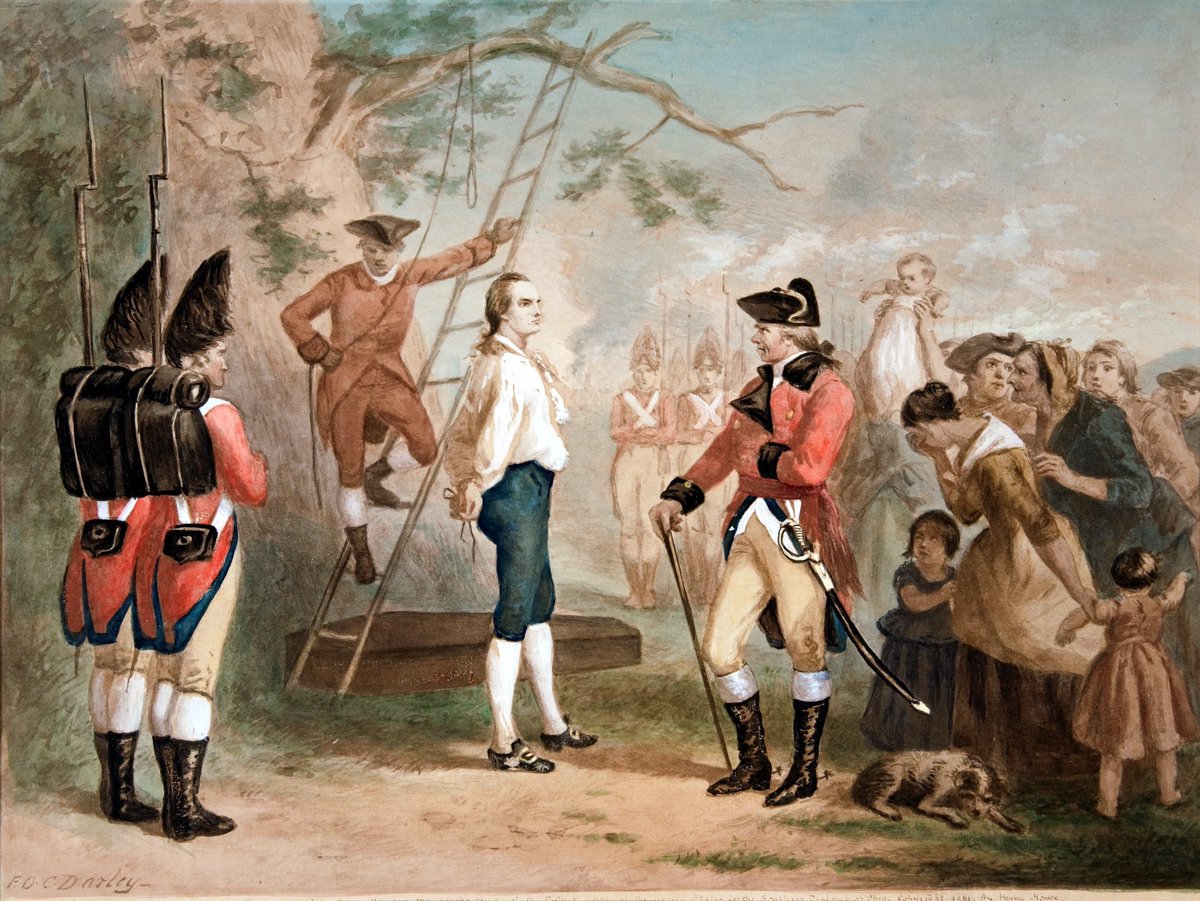
On this morning 250 years ago, the British hanged a 21-year-old American schoolteacher as a spy, and in trying to make him disappear quietly, they accidentally made him immortal. His name was Nathan Hale, and it is worth sitting with just the last few hours of his life.
He had been caught the night before, behind British lines on Long Island, carrying notes on enemy positions hidden in his shoes. There was no real trial. A man out of uniform with military intelligence on him was a spy by the rules of war, and the sentence for spying was death by hanging, no ceremony, no honor. General Howe ordered it done in the morning.
What we know of that morning comes mostly from the enemy, from British officers who were there, and it is the small human cruelties that stay with you. Hale asked for a clergyman to attend him in his final hours. The request was refused. He asked for a Bible. That too was denied. He was a devout young man about to die, and they would not give him even that comfort. A British officer named Montresor, watching, was troubled enough by the young man's composure to later make sure his story was told.
In his last moments Hale was allowed to write a couple of letters, one to his mother, one to a fellow officer. He wrote them, and then the British provost marshal, a notoriously brutal man named Cunningham, took those letters and destroyed them in front of him. The reason given was chilling in its pettiness: so that the rebels should not know they had a man in their ranks who could die with such firmness. They did not just want to kill him. They wanted to erase him.
Then they marched him to the gallows, and there, according to the accounts that survived, this young schoolteacher who had failed at the one dangerous mission he ever attempted, stood calmly and spoke about duty and country with a steadiness that unnerved the men sent to kill him. The famous words attributed to him, that he only regretted having but one life to lose for his country, may be polished or borrowed from a play he loved. But everyone who was there agreed on the essential truth beneath the wording: he met his death without flinching, and he made even his executioners remember him.
And that is the irony that redeems the whole sad morning. Cunningham burned the letters so no one would know how bravely Hale died. It did not work. The story got out anyway, carried by the very enemies who watched it, and a young man the British tried to erase became one of the most enduring symbols of the Revolution, honored two and a half centuries later, on this exact day, as the first American to die spying for his country. They denied him a Bible and a chaplain and burned his last words, and still they could not make him small.
Nine months after September 11, a village in Kenya with no electricity, no running water, and no roads gave America the most valuable thing it had.
Fourteen cows.
This is not a joke. It is one of the most serious gifts this country has ever received.
Kimeli Naiyomah grew up in Enoosaen, a Maasai village near the Tanzanian border. His family was so poor they owned no cattle. Among the Maasai, that is the bottom. A family without cows is barely counted as a family.
At fourteen he ran away to a school where the lessons were held under a tree. He walked. He had no shoes, no books, no money. He asked to be let in anyway.
Years later he was a student at Stanford, in California, studying to be a doctor.
On September 11, 2001, he happened to be in New York City.
He watched the towers fall.
He was a Maasai warrior. Warriors are trained from childhood to run toward danger. He wanted to run to the pile. He could not help there. He did not know what to do with what he had seen.
Months later he went home to Enoosaen.
The elders had heard something on the radio. Vaguely. A place called New York. Buildings. Some of them had not heard at all. Nobody in the village had ever seen a skyscraper. Nobody had been on an airplane. The idea of a building a hundred stories tall, full of thousands of people, falling down, was not something the language had words for.
Kimeli sat with them and explained. Slowly. What a tower was. How many people. What it looked like when it came down. He told them what he had seen with his own eyes.
The elders listened. When he finished, one of them asked a question.
"What can we do for these poor people?"
Kimeli had already decided. He had saved money in America. He wanted to buy a cow, the first cow his family had ever owned, and he wanted to give it to the United States.
To the Maasai, a cow is not livestock. A cow is life. It is wealth, food, standing, survival. An elder explained it to a reporter in one sentence. A cow is the handkerchief we Maasai use to wipe away tears.
Kimeli asked the elders for their blessing to give his one cow to America.
Then, one by one, the elders stood up.
They wanted to give too.
In the end, fourteen families pledged fourteen cows. In a community of about ten thousand people who owned almost nothing else.
On June 3, 2002, the United States chargé d'affaires in Kenya, William Brencick, traveled to Enoosaen. A flight, then more than half a day by road across terrain that barely counts as road. When he arrived, hundreds of Maasai in red robes were waiting. Some held hand-lettered banners.
"To the people of America, we give these cows to help you."
The elders presented the fourteen cows. Brencick accepted them on behalf of the United States. He called it the highest expression of regard and sympathy.
Then there was a practical problem. How do you ship fourteen sacred cows to New York?
The answer the two sides arrived at was better than shipping them.
The cows would stay in Kenya. They would belong to the United States of America. The Maasai would care for them, forever, as America's herd.
They are still there.
The original fourteen have multiplied into dozens. Each one carries a mark carved into its ear, the outline of two towers. Their offspring fund scholarships for the children of the village. The U.S. embassy built a school there, and a water project.
When the story reached America, forty thousand people wrote letters to the village. A painting of the fourteen cows hangs in the 9/11 Memorial Museum. A children's book about them became a national bestseller.
Kimeli's own explanation was the shortest.
To heal a sorrowing heart, give something that is dear to your own.
A village that had never seen a skyscraper, that could not have found New York on a map, that owned almost nothing, gave America the one thing it valued most.
Somewhere in Kenya tonight, there are cows with towers carved into their ears.
They are ours.
They were given to wipe our tears. 🇺🇸🇰🇪
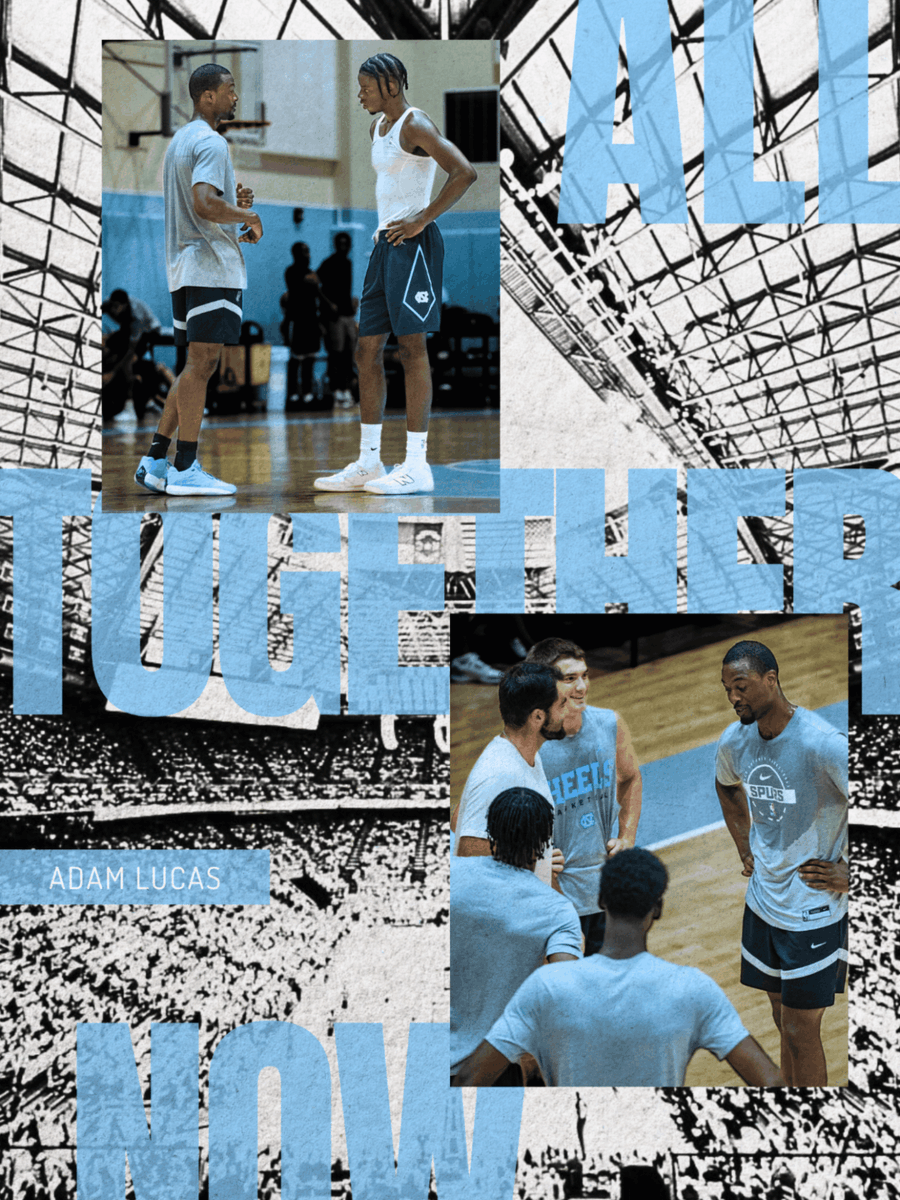
This weekend's @UNC_Basketball family reunion weekend had it all: laughs, a few tears, a challenge to this year's team...and even an unscheduled microphone takeover from a likely culprit.
https://t.co/NncpZEQzD9
I support a mosque being built anywhere in the US. I think it should be the goal of every American to be tolerant regardless of their religious beliefs.
To promote tolerance, I would also propose that two nightclubs be opened next door to the mosque. We could call one of the clubs, which would be gay, The Turban Cowboy and the other, a topless bar, would be called You Mecca Me Hot.
Next door should be a butcher shop that specializes in pork and across the street, an open-pit barbecue pork restaurant, called Iraq of Ribs.
We could also have a lingerie store called Victoria Keeps Nothing Secret and a liquor store called Mohammered.
All of this would encourage Muslims to demonstrate the tolerance they demand of us.
Yes we should promote tolerance, and you can do your part by passing this on. 😎 I did my part 😉or we can just send them back to where ever they came from.....
Dean Martin and Dolly Parton should not have worked on the same song.
He was the guy who made everything look easy. She was the girl who never pretended it was. They took a Kris Kristofferson song about leaving someone you still love and just… stood there and sang it.
No big ending. No competing. Two people who already knew how much it costs.
They don’t put voices like that in the same room anymore.
Dolly didn’t just keep up with him. She made Dean Martin sound like he finally meant every word.
Be honest. Who actually carried this song?
@JohnWalker@UNCFootball I really wanted to enjoy it (and I did) but I was waiting for the proverbial shoe to fall and us mess it up again. I need to print the lineup and try to learn some names and numbers.
A wistful Dave's Car ID Service today as we bid farewell to America's universally beloved singing angel, Dolly Parton. I was moved as everyone was by her passing, but I didn't have quite the right words to express it. So may I present for you her life in cars, my most sincere expression of tribute and admiration.
I think this may be the earliest photo of Dolly with an automobile, and one that is important in understanding her life story arc. First, the car: a 1953 Cadillac. The man fender-sitting on it with Dolly is her uncle, Bill Owens, and presuming she is about 7-8 years old here the car is fairly brand new.
Dolly did grow up rather impoverished in rural Tennessee, and you can imagine when Uncle Bill dropped by in his flashy Cadillac for a visit it was quite an event. And Uncle Bill became an important influence and mentor for Dolly.
Bill Owens performed as "Little Billy Earl with the Spit Curl" in the early 1950s, a sort of proto-rockabilly, but settled into a long career as a Nashville songwriter with over 800 songs to his credit.
He also was the man who taught Dolly to play the guitar at around 8 years old. And by the time she was 10, he recognized she had so much talent that he arranged for her to perform on the Cas Walker Farm & Home Hour radio program from Knoxville, her first broadcast performance. When Dolly was 13, he helped arrange her debut performance on The Grand Ole Opry, where she was introduced by Johnny Cash. And brought the house down, with 3 encores.
When she was in high school, she became one of Uncle Bill's songwriting partners before branching out with her own solo songwriting. After finishing high school she moved to Nashville, where she and Uncle Bill were both signed as songwriters for Combine Music. They cowrote three 1966 top 10 country hits - "Put It Off Till Tomorrow" and "The Company You Keep" for Bo Phillips, and "Fuel To the Flame" for Skeeter Davis.
Dolly and Uncle Bill teamed to write many songs, and he wrote several for her and her duet partner Porter Wagner, before she ascended to superstardom. In his later years Uncle Bill was a frequent performer at Dollywood.
And so this pic is an important relic in Dolly's incredible journey - starstruck after Uncle Bill pulling up to the shack in his fancy Cadillac. And you can imagine her excitement when he offered to teach her a few guitar chords.
Just boarded my flight in Nashville and the whole @SouthwestAir plane is lit up pink, with @DollyParton playing loud on the speakers as we board. 🦋💝 #Dolly
You actually get two chances to have a happy childhood. There’s the one you will have when you are a child yourself and the one you will see through the eyes of your own children.
I know you don't want to hear this, but you can find out a lot about a man based on how old he thinks the earth is. For instance, too often Christians believe the earth is 4.3 billion years old simply bc some guy in a white coat, who works in some lab in some part of the world, who's cheating on his 3rd wife, who hates God, who doesn't want Him to exist, who lies about almost everything in his own life, and who this interprets the physical realm in light of these assumptions, told them so. And Christians just go along with it even though they know the Bible never even hints at 4.3 billion years. We ought not to be so gullible, brethren. Be a lover of science, not science fiction.
The Democrat Party wants to replace Americans through mass migration.
Islam's goal is to conquer the institutions of western civilization.
'Democratic Socialism' will make a few insiders rich while making everyone else equally poor.
We either defend the culture that built our nation's success or watch the left take it away from us.
🚨Aí você, na sua ingenuidade quase comovente, pede educadamente a um muçulmano: “Me mostra no Alcorão onde Allah, o Misericordioso, o Compassivo, diz que cristãos e muçulmanos podem viver juntos em paz, respeito mútuo e aquela coisinha chamada coexistência.”
E o cara, com o rosto mais sério do mundo, abre o livro sagrado… e começa a citar, uma atrás da outra, as passagens em que o próprio Allah ordena matar, escravizar, subjugar ou, no mínimo, humilhar os “infiéis” (vocês, cristãos, judeus e o resto da humanidade que ainda não se rendeu).
É quase comovente a eficiência. Você pede uma receita de convivência e ele te entrega o manual completo de como transformar o vizinho em tributário, escravo ou cadáver. E ainda olha pra você como se tivesse acabado de provar que o Islã é a religião da paz.
Claro que existe “incompatibilidade cultural”. Mas o problema é bem mais profundo: é incompatibilidade teológica. Enquanto o cristianismo (ao menos na versão que sobreviveu) prega “amai os vossos inimigos”, o Alcorão prega “matai-os onde os encontrardes” e depois ainda te chama de hipócrita se você achar isso um pouco inconveniente para uma sociedade plural.
Então sim, a coexistência é possível… desde que um lado aceite ser dhimmi, pagar jizya e viver de cabeça baixa. Fora isso, o que se chama de “diálogo inter-religioso” é só o nome elegante que se dá quando um lado finge não ter lido o próprio livro e o outro finge não ter notado.
@WesDurham Began following him at WFMY channel 2 decades ago. Was so excited when ‘my favorite sportscaster’ began doing games at my favorite university. Great memories!
If any one therefore pretend to believe in Christ, to love his name, and to enjoy communion with him, who does not pay an habitual regard to his commands; he is a liar, and the truth is not in him.
#AbrahamBooth