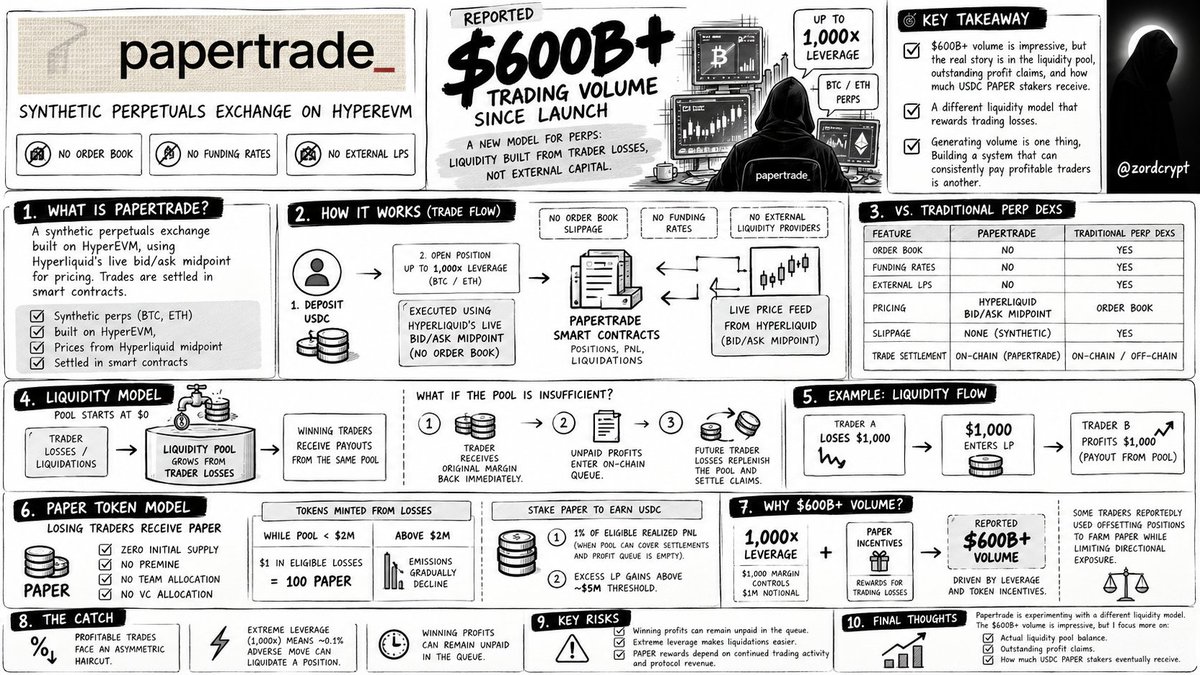
✦ @papertrade_xyz has reportedly generated over $600 billion in trading volume since launch.
That's a huge number for a new exchange, but after looking into how Papertrade works, I think the mechanics behind that volume deserve more attention.
Papertrade is a synthetic perpetuals exchange built on HyperEVM.
Unlike traditional perp DEXs, it operates without an order book, funding rates, or external liquidity providers.
And here's where things get different.
➥ How does @papertrade_xyz work?
Traders deposit USDC and open $BTC or $ETH positions with up to 1,000× leverage.
Instead of executing trades on Hyperliquid, Papertrade uses Hyperliquid's live bid/ask midpoint to price positions.
Everything happens inside its own smart contracts.
There's no traditional order-book slippage or funding fee.
But the bigger difference is how it handles liquidity.
➥ The liquidity pool starts at $0.
No seed capital, no external LPs.
The pool grows entirely from trader losses and liquidations.
For example:
If a trader loses $1,000, that money enters the liquidity pool.
When another trader makes a profit, the payout comes from that same pool.
But what if the pool doesn't have enough liquidity?
The trader gets their original margin back immediately, while unpaid profits enter an on-chain queue.
Future trader losses replenish the pool and settle those claims.
So profits aren't always paid immediately.
➥ Losing traders receive PAPER tokens.
This is probably the part that caught my attention.
PAPER launched with zero initial supply, no premine, and no team or VC allocation.
Tokens are minted when traders lose money or get liquidated.
While the liquidity pool is below $2M:
$1 in eligible losses = 100 PAPER.
Above that threshold, emissions gradually decline.
PAPER can be staked to earn USDC from two sources:
→ 1% of eligible realized PnL when the pool can cover settlements and the profit queue is empty.
→ Excess LP gains above the roughly $5M threshold.
Essentially, losing traders help capitalize the pool and receive tokens linked to future protocol revenue.
➥ But how did it generate $500B+ in volume?
The answer is largely leverage and token incentives.
At 1,000× leverage, just $1,000 in margin controls $1M in notional exposure.
So the reported $500B+ isn't actual capital deposited.
It's leveraged trading volume, while actual margin has reportedly been in the tens of millions.
PAPER incentives also encouraged traders to generate losses in exchange for tokens.
Some reportedly used offsetting long/short positions to farm PAPER while limiting directional exposure.
That helps explain the rapid activity.
➥ There's still a catch.
Papertrade has no opening fees or funding rates, but profitable trades face an asymmetric haircut.
Losses go fully into the pool, while winning traders receive profits after deductions.
Combine that with 1,000× leverage, where a roughly 0.1% adverse move can liquidate a position, and the protocol has a structural advantage.
The risks are clear:
→ Winning profits can remain unpaid in the queue.
→ Extreme leverage makes liquidations easier.
→ PAPER rewards depend on continued trading activity and protocol revenue.
➥ My takeaway
Papertrade is experimenting with a different liquidity model.
Instead of attracting LP capital first, it builds liquidity from trading losses and rewards those losses with PAPER.
The $600B+ volume is impressive, but I wouldn't use that figure alone to judge its success.
I'm more interested in the actual liquidity pool balance, outstanding profit claims, and how much USDC PAPER stakers eventually receive.
Generating volume is one thing. Building a system that can consistently pay profitable traders is another.
Watchlist for the week!
@papertrade_xyz $PAPER — Hyperliquid is set to launch Papertrade on October 10th.
@AlloX $ALLOX — ALLOX’s public sale on Sonar by Echo is scheduled for October 12th.
@Filecoin $FIL — Filecoin Foundation’s vesting period comes to an end on October 15th.
@SoulProtocol $SO — Soul Protocol is scheduled to go live on mainnet on October 19th.
@Fables $FABLES — FABLES will hold its Token Generation Event on October 20th.
@Kinetiq $KNTQ — Elysium L2 is scheduled to launch its mainnet on October 20th.
@Aero $AERO — Aero’s mainnet launch is scheduled for October 21st.
@Fhenix $FHE — Fhenix is set to launch its mainnet on October 21st.
@Blast $BLAST — The Blast L2 shutdown reaches its final withdrawal deadline on October 26th.
@AxisRobotics $AXIS — AXIS is expected to hold its Token Generation Event in October.
@Ritual $RITUAL — Ritual’s Token Generation Event is expected to take place in October.
@0xFluid $FLUID — Fluid DEX V2 is expected to launch this month.
@maplefinance $SYRUP — Maple’s Q3 2026 ecosystem update call is scheduled for October 13th.
Everyone talks about the jobs AI will take.
Why is nobody talking about the jobs AI will create?
AI can code now.
AI can market.
AI can design UI.
AI can write copy.
AI can analyze data.
AI can make graphics.
AI can edit videos.
AI can generate images.
AI can build prototypes.
AI can create content.
AI can handle customer support.
AI can even make presentations.
So if AI keeps taking over the things we used to get paid to do…
what’s actually left for humans?
Everyone talks about the jobs AI will take.
Why is nobody talking about the jobs AI will create?
AI can code now.
AI can market.
AI can design UI.
AI can write copy.
AI can analyze data.
AI can make graphics.
AI can edit videos.
AI can generate images.
AI can build prototypes.
AI can create content.
AI can handle customer support.
AI can even make presentations.
So if AI keeps taking over the things we used to get paid to do…
what’s actually left for humans?
Literally everyone here knows how big nvidia is.
It’s currently worth over $5.5T.
But if you look deeper into it, it’s tokenized market is only around $155M.
That’s a gap of more than $5.3T and it shows how little of the traditional market has actually moved onchain.
When looking at RWAs, you don’t just ask how big the company or asset is.
Look at how much of it has actually been tokenized, and how much people are trading.
@coingecko RWA tracker currently shows around $55M in 24h volume for $NVDA tokenized market.
Market cap tells you the size.
Volume tells you how active it is.
And neither one alone tells you how easy it is to buy or sell a large amount without moving the price.
The bigger question is how much of the traditional market will eventually move onchain and whether the infrastructure can support it.
@mickeyhardy True
The interesting part isn’t just the data itself, but the context behind the decisions. Two companies can have access to the same market data and still make completely different moves because one has years of hard-earned institutional knowledge behind it.
I don’t care what anyone says.
Financial independence is a goal you should be fighting tooth and nail to achieve.
> Not for chrome heart designer aids
> Not for an AP
None of that, it’s so you can walk your kids to school in the morning and watch the world again in their eyes.