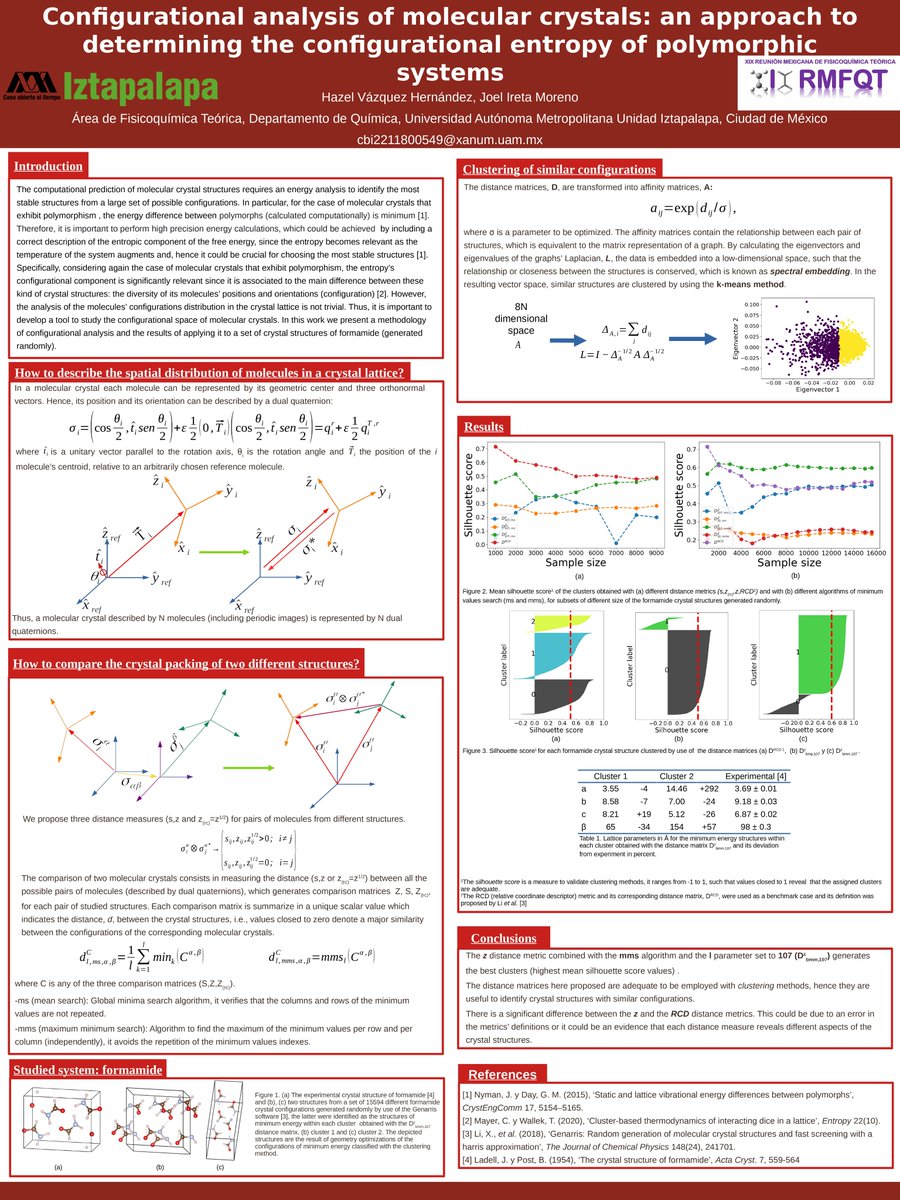
@ed_chamorro9@LatinXChem@digital_rsc@PCCP@ChemRxiv@LufacIDT 2/2 Moreover, quaternions can be used to define relative orientations unequivocally in contrast to Euler angles that present a singularity problem. Additionally, dual quaternions (8 elms.) offer a more compact form for representing molecular configurations than matrices (12 elms)
@ed_chamorro9@LatinXChem@digital_rsc@PCCP@ChemRxiv@LufacIDT 1/2 Hi Eduardo. Thanks. Dual quaternions are a unified representation of translations and rotations; hence we can propose metrics in a same metric space as opposed to measuring distances and angles separately.
@Trujillo_Group @LatinXChem@digital_rsc@PCCP@ChemRxiv@LufacIDT 5/n This approach can help to reduce the number of structures to analysis before considering an exhaustive energetic screening and it can improve the prediction of the crystal structures by providing additional information to discern between polymorphs.
@Trujillo_Group @LatinXChem@digital_rsc@PCCP@ChemRxiv@LufacIDT 4/n We propose an analysis based on dual quaternions because they allow us to define the relative orientations of the molecules in a crystal lattice unequivocally. This is important because the relative orientations are related to intermolecular interactions.
@GroupQuintana@LatinXChem Thanks. We considered also the RCD descriptor (reference in the poster), which is a vector descriptor, and the mean square error (MSE) of the euclidean distances between the atoms for each pair of molecules. So far we've found better agreement between the MSE and the z measures.