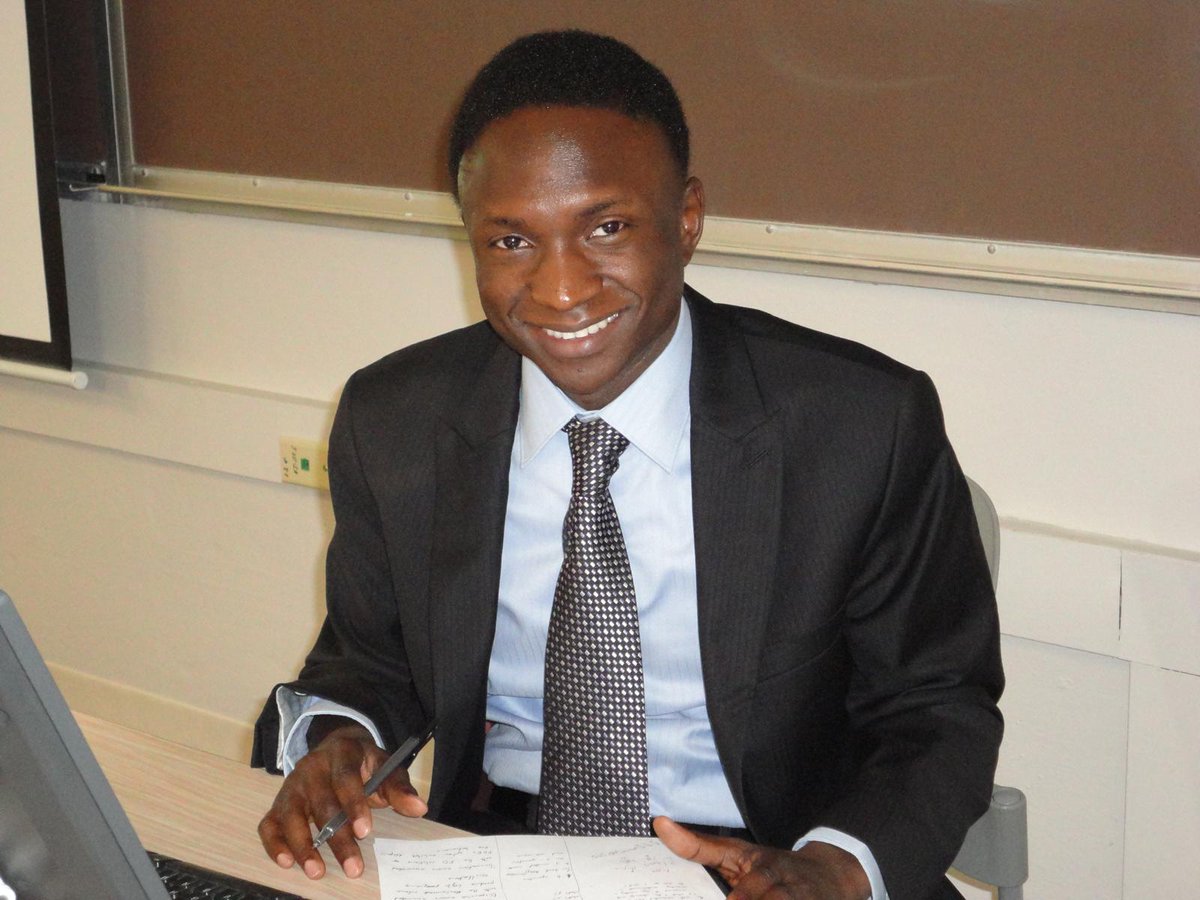
This is me during my Shell Recruitment Day in November 2011.
1hr after the whole day group interview, I got the phone call I can never forget, “Congratulations, they all loved you. When can you start?”
If you have an upcoming group interview where they put a bunch of you together in a room and give you a task to work on together, then sit up.
I will tell you my secrets.
I don’t need them anymore and it can help you land your dream job.
They are what I used during my SRD.
I have given the same playbook to many mentees who used them to land their dream jobs in various companies.
So, trust me, this works.
A 🧵
For the past 2 years, I honestly don’t even know what people mean when they say national grid or “NEPA.”
Because of cases like this lady, I took my time to create three detailed lectures from a user’s point of view - not as an installer, not as a seller - but as someone who actually uses solar every day.
The goal is simple:
1. Help you understand what to buy
2. How to buy it
3. And how to avoid wasting millions and still living like you don’t have solar
Here are the videos:
1. I Pay ZERO Bills for Electricity | How? https://t.co/iWjC0xOJZ5
2. How to Get Maximum Power from Your Solar Panels: Boost Your Power Output https://t.co/FRlgWk6R83
3. Solar Buyer’s Guide: What to Buy to Stop Paying NEPA Bills Like Me! | Go Solar, Go Offgrid
https://t.co/EBSUsiaktm
Watch these before you invest millions and still end up struggling like you don’t have solar.
1. The right products matter
2. A good installer matters
3. Your understanding of how it works matters the most
That is where many people get it wrong.
Don’t allow anyone to mislead you.
I’ll be dropping another video soon to go even deeper: more practical, more real-life guidance.
And just to be clear:
This is about helping people make better decisions, not to stop demanding steady power supply from the government.
Don’t tell me it’s not the government’s responsibility. If it wasn’t, why is the Minister of Power coming out asking Nigerians to be patient?
Because it is their job.
Going solar is survival and smart thinking, but holding the government accountable is a must. If we have to get our electricity, water and security... no need for the government to exist.
Most streaming platforms rent space on third-party delivery networks to get their content to you. Netflix decided that wasn’t good enough so they built their own. They spent roughly $1 billion over a decade building a once-secret content delivery network called Open Connect, consisting of over 17,000 servers strategically placed across 158 countries.  While competitors pay companies like Akamai and Cloudfront to move their data around the world, Netflix owns the pipes.
Here’s why that matters. Even at the speed of optical fiber, it takes approximately 100 milliseconds for data to complete a roundtrip between Los Angeles and London.  Multiply that delay across millions of simultaneous streams and you get buffering. Netflix’s solution was to stop sending data across the world entirely. Instead, they place their cache servers directly inside ISP data centers bringing the content physically closer to you before you even press play.  By the time you hit play on a popular show, a copy of that video is likely already sitting on a server less than a mile from your home.
Then there’s how the video itself is delivered. Netflix doesn’t send you one fixed quality stream. It uses adaptive bitrate streaming dynamically adjusting video quality in real time based on your current connection speed.  Your internet slows down for two seconds and Netflix quietly drops the resolution, buffers ahead, and steps the quality back up before you notice anything. You never see a loading spinner. You just watch.
Netflix accounts for approximately 15% of global downstream internet traffic and at peak times, up to 15% of worldwide internet bandwidth.  All of it flowing smoothly, because a decade ago they made a bet that owning their infrastructure was worth a billion dollars.
And it was.
Gave a client a solar quote for 5.3-6M depending on brand for a
12kva 15kwh setup
Told him to contact someone else with the brand i listed.
15kwh Firman battery them say 3M 😏
Cworth 15kwh they said 2.6M 🤦🏽♂️
Panels of 130k became 180k
Those two alone are 1.1M more than my quoted price.
Dear Installers, pity clients and charge your fee and stop inflating prices of products.
I advise my clients to buy their products if they can - better to pay N20-50k consult fee than lose N1.1M on two products because of a greedy installer
You can’t buy Linux. It’s free. Always has been. So IBM did the next best thing: it spent $34 billion buying Red Hat, a company whose entire business is selling tech support for this free software. Largest software acquisition in history. For support contracts on something anyone can download for $0.
The “side project” story, while true, is maybe 5% of what actually happened since.
Linux itself is managed by a nonprofit, the Linux Foundation. That nonprofit pulled in $311 million last year. Only $8.4 million of that (2.6%) actually went to Linux itself. The rest of the funds support ~1,500 other open source projects, events, and training. Every Fortune 100 tech company is a paying member.
And here’s who actually builds this “free” software now: 84% of the code changes to Linux in 2025 come from developers on corporate payroll. Intel is the biggest contributor. Google is second. Huawei, Oracle, AMD, and Meta all have engineers writing Linux code full-time. Over 1,780 companies pay people to work on it. The solo genius in a dorm room stopped being the real story around 1998.
The wildest part: over 65% of Microsoft’s cloud computers run Linux. Microsoft, the company whose former CEO once called Linux “a cancer,” now runs more Linux than Windows on its own servers. Amazon and Google’s clouds are even higher, both above 90%.
A 2024 Harvard Business School study attempted to calculate how much companies would spend if all free, open-source software vanished tomorrow. The answer: $8.8 trillion more per year. 3.5x what they currently spend. And that number didn’t even include operating systems like Linux.
Linus Torvalds still personally approves every major code change. He makes about $1.5 million a year. He also built Git, the tool that powers GitHub (which Microsoft bought for $7.5 billion). Two pieces of software the entire tech industry runs on, same guy.
Linux started as 10,239 lines of code. It’s now over 40 million. Every one of the world’s 500 fastest supercomputers runs it. 96% of the top million websites sit on it. Every Android phone has Linux inside it. That’s roughly 3 billion devices in people’s pockets.
It’s the largest collaborative engineering project in human history, free to use, funded by the same corporations it was supposed to replace.
A Client Approached me with an idea of having 3 Bedroom units where he can occupy 1 unit and rent 2 other units or alternatively rent all the units.
BQ summary is 9m.
Each unit consists of a spacious living room, Dining,Open Kitchen. Master BR+Ensuite+WiC,BR 2&3 with shared WC
A friend got a Samsung S22 Ultra for 760k last year. Two months later, it fell. The screen and the glass at the back both cracked. We took it to Samsung Office at Mokola. Replacing the screen and the glass at the back was pegged at 670k. Just 90k difference..
Nigeria Graduate Programme Applications for 2026 Are Now Open
SEO Africa has opened applications for its 2026 Nigeria Graduate Programme, offering recent graduates paid training, mentorship, and internship placements with leading Nigerian companies in finance.
• Focus areas: Investment Banking, Private Equity, Finance (Accounting), Asset Management
• Opportunity includes structured training, mentorship, and paid internship
• Open to recent graduates (within the last 2 years)
• NYSC must be completed by June 2026
• Minimum qualification: First Class or Second Class Upper
• Strong interest in finance required
Application deadline: February 8, 2026
Apply here: https://t.co/PoEpjut7dp
Know someone who qualifies? Tag or share this post, it could help them secure a job.
I have gotten this question about POS a lot. Let me do a post on it.
POS business looks simple on the surface; cash in, cash out.
But under the new tax framework, that simplicity is exactly where risk hides:
1. Your turnover is not your income, but the taxman will start there.
For POS operators, most of the money moving through the account is not profit. It is customer funds.
However, under the new law’s emphasis on reporting all streams and explaining inflows, the taxman will not assume this automatically.
If ₦50m passes through your account in a year and you cannot clearly separate:
a. customer cash movements
b. commissions earned
the system may treat the inflows as business income, not pass through funds.
Your job is to prove the difference.
2. Only your commission is taxable, but only if you can show it.
POS operators are taxed on:
a. service charges
b. commissions
c. fees earned
Not on the full value of withdrawals and deposits.
But if records are poor, gross inflows become the starting point, and you are forced to argue downward.
Under the new law:
What you cannot explain, the system may classify as taxable.
3. Bank statements alone are no longer enough.
Many POS operators rely on:
bank statements
daily balances
memory
That will not survive scrutiny.
You now need:
a. daily transaction summaries
b. separation of customer funds vs earnings
c. reconciliation between POS machine reports and bank credits.
Without this, a lifestyle or presumptive assessment becomes easy to justify.
4. Cash handling increases audit risk
POS businesses are cash heavy.
Under the new framework:
frequent cash deposits
inconsistent amounts
multiple accounts
can trigger questions.
Cash is not illegal.
But cash without records is a liability.
5. VAT confusion is common and dangerous.
Most POS transactions do not attract VAT on the cash withdrawn.
But:
your service charge may attract VAT.
Mixing VAT with commission or treating all inflows as VAT inclusive creates errors
VAT mistakes often expose people to penalties even when income tax is low.
6. Thresholds don’t protect disorganization.
Some operators assume:
“I’m small, they won’t look at me.”
The new tax law focuses less on size and more on visibility and consistency.
High volume, low margin businesses like POS operators are very visible.
7. Lifestyle audits hit POS operators hard.
If your lifestyle:
rent
vehicles
school fees
investments
does not reasonably align with the commission you report, questions will follow. The law allows income to be inferred when lifestyle and filings don’t match.
In Summary:
POS business is not taxed on volume but it is audited on volume.
Your protection is:
a. records
b. separation
c. consistency
d. explanation
If you run a POS business and your records don’t clearly show what belongs to customers and what belongs to you, the taxman may assume it all belongs to you.
Three top finance senior men I know who have nearly unlimited ability to raise capital:
1. Aigboje Aig-Imoukhuede: My undisputed number 1
2. Bolaji Balogun: Ekun Oko Oke niyen
3. Nonso Okpala This one is a rising force over the past ten years. Sabi raise money die
I managed to solve this pain by going back to the basics. I learned:
— What Psychometrics is.
— Basic - advance numerical reasoning (percentages, ratio, averages, number series.)
— Word problem
— Data interpretation from graphs, charts etc.
Understanding Capital Market Operators (CMOs):
1, Stockbrokers — Help you buy & sell shares
2, Fund/Portfolio Managers — Manage funds like MMFs, REITs, Equity, and bond funds
Also called asset management firms.
(It's a thread)
Dear Men,
Did you see your morning wood (Erection) this morning or I should keep minding my business??
Morning wood is your daily testosterone report !! If you didn't see yours,
Here are the 8 proven foods to boost your Testosterone levels naturally..
Check Thread 👇