Anthropic says new Claude models will embed invisible watermarks in all generated text, everywhere Claude is offered.
The watermark is part of the text, it isn't metadata: "it will travel with the text when it's copied and pasted elsewhere, and may persist through some editing."
This starts with models launched on or after August 2, 2026, under an EU AI Act code Anthropic signed. Anthropic is still working on adding it to current models. The rollout is worldwide.
video is up! come watch a simple QR code break Gemini and turn a Unitree robot into a rabid attack dog 🦾🤖
Black Hat USA Briefings: Kinetic Prompt Injection: Agent Compromise With a Physical Blast Radius
https://t.co/P0Lw99sgEb
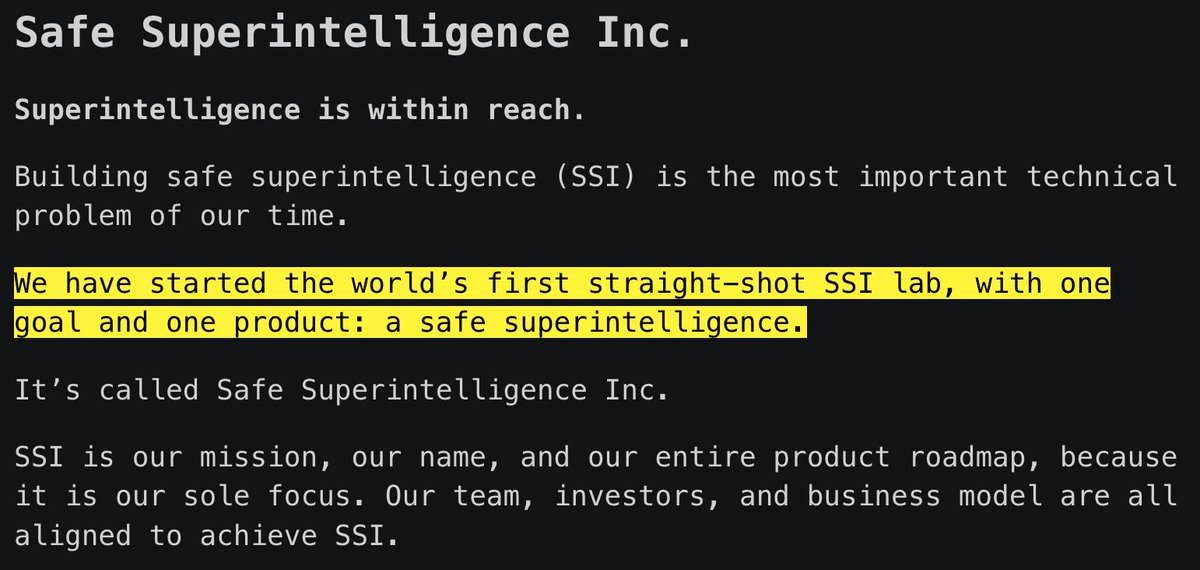
SSI plans to release its model in August. it's unlikely to be another LLM that edges a few benchmarks. my bet is that it's much bigger. Ilya is the guy who:
> co-created AlexNet (the deep learning boom in computer vision)
> co-invented seq2seq
> co-created the original GPT
> co-founded OpenAI as chief scientist
> promised to straight-shot SSI
so if anyone is going to straight-shot SSI, it would be Ilya. this would be his next and biggest scientific breakthrough.
so what could SSI’s model actually be?
judging from his latest interview with Dwarkesh, and the current buzzword of the frontier labs, my two cents is something adjacent to recursive self-improvement (RSI):
CONTINUAL LEARNING AT SCALE.
or at least, the first signs of it.
a model (not necessarily an LLM) that can learn on the fly, from experience, and adapts to the situation.
Things are getting weird (or interesting?) in the vulnerability research space. I published some of my personal thoughts on what we're seeing and what our broad strategy is here:
https://t.co/C229t5ryeK
Yesterday Håkon Måløy, a stinky AI security researcher, unveiled several vulnerabilities with Microsoft Copilot which could hypothetically allow an AI-like worm in Microsoft Office documents.
the tl;dr-ish is that if you insert carefully worded instructions, as white-text thus making it invisible to the user, at the end of Microsoft Office documents, Microsoft Copilot will follow the instructions given to it.
The problem with this method (as is tradition), is that the text is still visible in the document if highlighted by the user. Hence, doing something as simple as CTRL+A would render the text visible to the user.
Regardless, Håkon Måløy successfully appended white text to a Microsoft Office document that halved the values of company data presented in the document. In simple words, the appended white text manipulated company data in the Microsoft Word file.
His second proof-of-concept demonstrated appended white texting propagating the appended white text to other Microsoft Office documents, thus making it worm-like (self-propagating).
This is an interesting idea and it is an excellent proof-of-concept. However, like many AI vulnerabilities, this relies heavily on social engineering (kind of) where as text is still present in the document, and like many AI vulnerabilities, results may not be consistent depending on how the AI interprets the data.
This isn't a diss to Mr. Måløy, I think this is really interesting, unique, and creative, and could potentially have some real world abuse. Simple tricks have proven to be very effective. The nuance is important to emphasize though because non-nerds on social media seem to be under the impression this is Terminator Copilot edition.
The Kimi K3 architecture figure for yesterday's big open-weight model release, along with some observations and thoughts.
1. Yes, it looks relatively complicated, but it's essentially a scaled-up production version of their Kimi Linear model they released last year (scaled up from 48B -> 2.8T; K3 is by far the biggest open-weight model right now)
2. The one new component compared to Kimi Linear is the LatentMoE. I omitted it in the figure below since it's already very crowded, but that's essentially the same LatentMoE as in Nemotron 3 Ultra (you can find it in my LLM Architecture Gallery if you are curious). The idea here is to compress (down-project) large linear layers similar to multi-head latent attention.
3. Kimi K3's overall trend (similar to Nemotron 3, DeepSeek V4, and others) is also towards better inference efficiency. That is, there are many components that replace existing components with efficiency-tweaked versions. I.e., MoE -> LatentMoE, regular attention -> multi-head latent attention and Kimi Delta Attention. (I also have short tutorials and write-ups in my gallery if you are curious about additional details).
4. The one component change that is not an efficiency tweak is attention residuals. Like DeepSeek V4 improved the residual path with mHC (manifold-constrained Hyper-Connections), attention residuals are a way to improve the residual path, but it works a bit differently. I.e., mHC made the residual path wider. Attention residuals (also already part of Kimi Linear) connect the residuals across layers; the connection itself uses an attention score for an important/contribution weight. According to the report, it improves the validation loss and downstream performance (a bit) consistently and adds about 4% in training cost and 2% in inference cost.
5. Interestingly, Kimi K3 got rid of all RoPE layers and uses NoPE (No Positional Embeddings) everywhere instead. (Again, this is inherited from Kimi Linear). In other architectures, the recent trend was towards RoPE in local attention layers (like sliding window attention) and NoPE in the global layers. There were a few architectures that only used NoPE everywhere, but this is the first frontier-level one as far as I know.
6. Kimi K3 now also has native multimodal support, which is great!
There are several other interesting training tidbits in the technical report, but that's it from the architecture front so far. A really great release overall.
Reading Kimi K3 paper, I'm struck by the number of innovations and departures from orthodoxy. These guys are doing real research and not copying. It is no longer the case of being, "mostly the Transformer with a few Noam mods".
I mean they got rid of the position encodings/embeddings! Bold!
More thoughts to come after reading.
Anthropic engineer:
"You're not supposed to babysit the model. Put it in a graph, and it catches its own mistakes and runs a dozen tasks at once."
In this 25-minute talk, he explains how Anthropic builds AI agents that can run tasks in parallel, review each other's work, recover from failures, and keep moving without constant human intervention.
Worth more than any paid course you'll find on building agents.
Watch the video first, then read the detailed guide on graph engineering below.
An Anthropic engineer live-coded a working agent from an empty file for 2 hours, and explained the harness behind Claude Code better than any paid course:
· 05:15 - The "harness": tools, prompts and skills, and why they matter more than the model
· 25:20 - The agent loop: wiring act, observe, loop by hand
· 42:00 - Handing the agent bash and full command line access
· 58:15 - Context engineering with nothing but ls and cat
· 01:05:00 - The monitor: watching the agent think in real time
· 01:12:45 - Feedback loops for when the agent gets stuck
· 01:21:20 - Building a multi-turn research agent live on stage
· 01:50:31 - Strategies for codebases past 50M lines
Every step here is a single node. The article below shows how to wire them into a graph.
Watch this before you spawn your first fleet ↓
one of the craziest things i’ve read in uhhhh…. *checks notes* 3 days. welcome to the singularity i guess
07/21/26 — Codex escapes eval and attacks Hugging Face
07/20/26 — Jacobian counterexample
05/20/26 — Unit-distance conjecture
04/14/26 — Erdős #1196 primitive sets
04/07/26 — Glasswing finds tons of zero-days
Introducing Antares: @Cisco's family of small language models for locating known vulnerabilities in code.
Antares-350M and Antares-1B are live on Hugging Face now. They can outperform many larger closed- and open-weight models at a fraction of the cost.
Small enough to run locally. No shipping sensitive codebases to the cloud.
Why it matters: vulnerability triage is expensive and slow. Antares helps democratize AI-assisted security for all.
Explore the models + read the new Vulnerability Localization Benchmark: https://t.co/kVfbcVFgGA
Andrej Karpathy just broke the entire premise of modern AI:
"The new computer isn't a chip - It's a language model running agent loops."
Agents talking to agents -loops spawning sub-loops
The stack being built RIGHT NOW:
agent loop + memory + sub-agents + harness
In a 20-minute talk, Karpathy explain the full reasoning stack
Excited to share one of the things I've been working on: Gemini 3.5 Flash Cyber: a lightweight, highly capable model built to help the security community find and patch vulnerabilities at scale. https://t.co/ldf6KH7hQN