With so much gratitude to this amazing interdisciplinary Science Advisory Group to develop and launch this new Compendium as a 3-part series in @CircAHA on behalf of @AmerAcadPeds@acog@MySMFM to improve CV health in all girls and women everywhere and across their life course
For the first time, @American_Heart, @AmerAcadPeds, @acog, and the Society for Maternal-Fetal Medicine have come together to release shared guidance to help clinicians identify cardiovascular risk early and take action.
The landmark three-part publication series highlights how female-specific biology affects girls’ and women’s hearts and creates a “Female Life Stage” framework to help protect heart health from puberty through menopause and beyond.
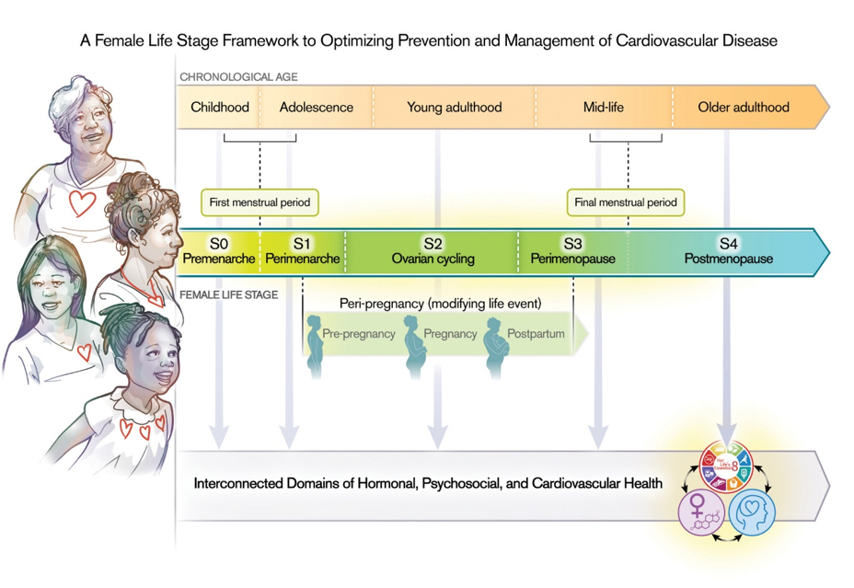
The Female Life Stage framework is based on female biology and offers windows of opportunity to prevent heart disease and stroke and manage future disease risk.
Each life stage is defined by a change in hormones that is uniquely experienced by girls and women, with pregnancy identified as an event affecting cardiovascular health that may occur at any or multiple life stages:
➡️ Stage 1 perimenarche - This stage represents the transition after the first menstrual period. Approximate age range is 8 – 15 years.
➡️ Stage 2 ovarian cycling - Regular ovulatory and hormone cycles are established and when pregnancy may occur. Approximate age range is 15 – 44 years.
➡️ Stage 3 perimenopause - This stage represents the transition to variable cycle length, skipped cycles and hormone changes. Approximate age range is 45-51 years.
➡️ Stage 4 postmenopause – This stage represents the years that begin after menopause or 12 months after the final menstrual period. Approximate age is 51 years and older.
➡️ Pregnancy, in any life stage – the time before, during and after pregnancy is highlighted as a biological “stress test” that can identify cardiovascular risks that may have been previously unrecognized.
✍🏼 @heartDocSadiya
📷 The Female Life Stage framework for the prevention and management of cardiovascular disease in girls and women
https://t.co/aIw557Ic8u
Editor’s Perspective:
The next frontier for improving outcomes in patients with STEMI is prehospital care. In this week’s @CircAHA , Coller and Mehran (@Drroxmehran) share an extremely insightful commentary outlining key areas of opportunity. Education, innovative ECG technology, national EMS standards, better research upstream of hospitalization, and Medicare reimbursement reform, they argue, are the keys to success.
Full commentary: https://t.co/31lFiAgtuL
@AHAScience | #STEMI #Cardiology #EMS
"We now know that unique signals of cardiovascular risk in women can be identified years and decades before heart disease develops," writes preventive cardiologist and epidemiologist Sadiya S. Khan https://t.co/8nJOz0VzoI
"Starting these conversations to make them normative is part the longitudinal ongoing conversation about optimizing health for all women, not just recognizing disease." @HeartDocSadiya@gina_lundberg@TYWangMD@NatCamMD https://t.co/1wDC0kAzl3
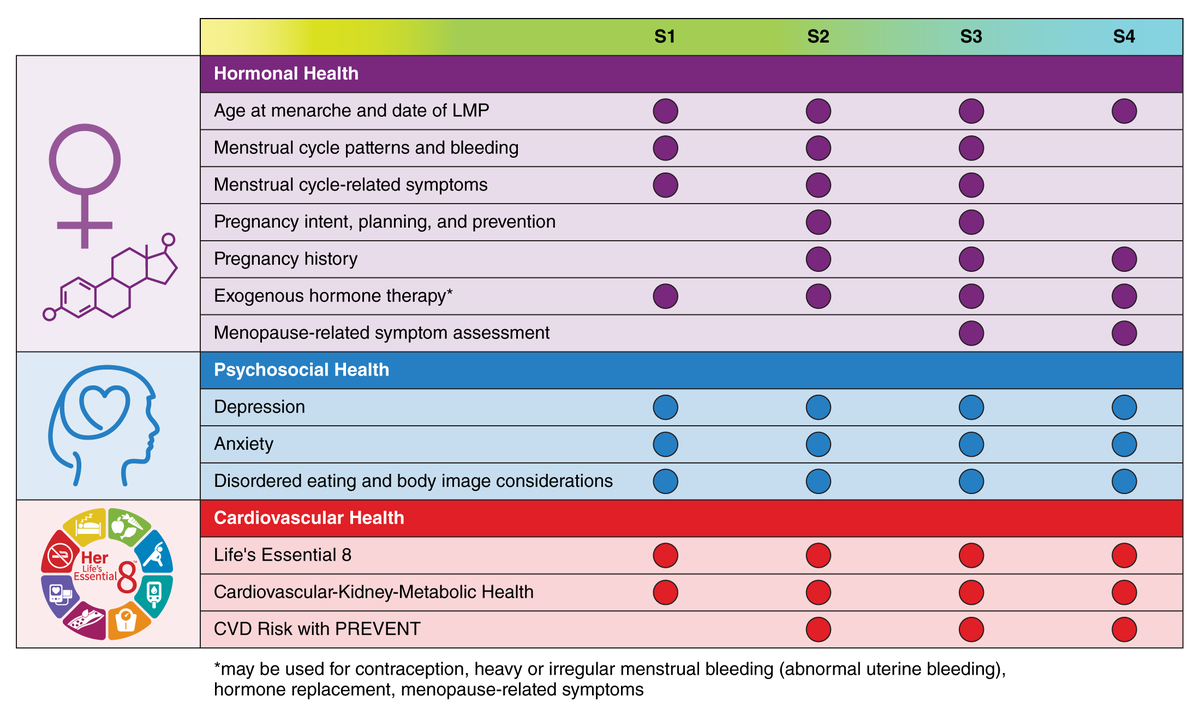
This joint Scientific Statement on behalf of @American_Heart, @AmerAcadPeds, @acog and the Society for Maternal-Fetal presents stage-specific clinical guidance across the interconnected domains of hormonal health, psychosocial health, and cardiovascular (CV) health across the female life course.
The three anchoring principles of this statement are:
(1) Endogenous sex hormones are dynamic and produce physiologic changes accessible without labs.
(2) Hormonal transitions (perimenarche, perimenopause, peripregnancy) are windows of opportunity that reflect changing vulnerability to psychosocial stressors and CVD risk.
(3) The framework makes explicit the interconnectedness of hormonal, psychosocial, and CV health.
@American_Heart, @AmerAcadPeds, @acog and the Society for Maternal-Fetal Medicine jointly approve this shared model.
📷 Female Life Stage chart assessing interconnected domains of hormonal, psychosocial, and cardiovascular health
✍🏼 @heartDocSadiya
https://t.co/aIw557Ic8u
@drstaceyrosen@American_Heart Thank you for sharing and excited to discuss more at #ScientificSessions26 together on how we put all of this together together for every clinician, researcher, and patient
It was my privilege to be a co-author on the Scientific Statement on Comprehensive Centers of Excellence for Women's Cardiovascular Care-thank you @HeartDocSadiya and @NatCamMD for your leadership of this groundbreaking work! https://t.co/Gd8ssGoroK
@drmalissawood@NatCamMD Thanks @drmalissawood for your partnership and all the work @WomenAs1 is doing to help amplify the research being done, support increased investment in research in women's health, and mentor and sponsor the next generation of investigators!
With so much gratitude to this amazing interdisciplinary Science Advisory Group to develop and launch this new Compendium as a 3-part series in @CircAHA on behalf of @AmerAcadPeds@acog@MySMFM to improve CV health in all girls and women everywhere and across their life course
For the first time, @American_Heart, @AmerAcadPeds, @acog, and the Society for Maternal-Fetal Medicine have come together to release shared guidance to help clinicians identify cardiovascular risk early and take action.
The landmark three-part publication series highlights how female-specific biology affects girls’ and women’s hearts and creates a “Female Life Stage” framework to help protect heart health from puberty through menopause and beyond.
The Female Life Stage framework is based on female biology and offers windows of opportunity to prevent heart disease and stroke and manage future disease risk.
Each life stage is defined by a change in hormones that is uniquely experienced by girls and women, with pregnancy identified as an event affecting cardiovascular health that may occur at any or multiple life stages:
➡️ Stage 1 perimenarche - This stage represents the transition after the first menstrual period. Approximate age range is 8 – 15 years.
➡️ Stage 2 ovarian cycling - Regular ovulatory and hormone cycles are established and when pregnancy may occur. Approximate age range is 15 – 44 years.
➡️ Stage 3 perimenopause - This stage represents the transition to variable cycle length, skipped cycles and hormone changes. Approximate age range is 45-51 years.
➡️ Stage 4 postmenopause – This stage represents the years that begin after menopause or 12 months after the final menstrual period. Approximate age is 51 years and older.
➡️ Pregnancy, in any life stage – the time before, during and after pregnancy is highlighted as a biological “stress test” that can identify cardiovascular risks that may have been previously unrecognized.
✍🏼 @heartDocSadiya
📷 The Female Life Stage framework for the prevention and management of cardiovascular disease in girls and women
https://t.co/aIw557Ic8u
Top medical societies have published new guidance that redefines women’s cardiovascular care through a novel, life-stage approach—connecting healthcare strategies that start at puberty and extend across a woman's complete lifespan. https://t.co/JhrT8BdU1Q @acog@AmerAcadPeds
Girls and women benefit when our health care systems recognize cardiovascular risk at every stage of their lives.
Together, we can use this new compendium to strengthen systems of care, identify cardiovascular risk earlier and advance policies that support heart health for girls and women across the life course.
Improving women's cardiovascular care means breaking down silos between specialties, starting in med school. Join Drs. Jen Ashton, @HeartDocSadiya, and @TYWangMD on Circ on the Run for a discussion of women's cardiovascular health across the life course.
https://t.co/0aZUmhy7zQ
And, last but not least, thank you to the brave girls and women who shared their voices, perspective, and time to describe how their lived experiences can inform the implementation of the Female Life Stages developed in collaboration with @storyminemedia https://t.co/uj8YgUetS8
Read more about the science https://t.co/gCWqXUViuQ
and watch how the joint multi-society initiative on behalf of @American_Heart@AmerAcadPeds@acog@MySMFM can improve cardiovascular health earlier for girls and women across their life ❤️❤️❤️ https://t.co/RJPmKpXXZm
"We now know that unique signals of cardiovascular risk in women can be identified years and decades before heart disease develops," writes preventive cardiologist and epidemiologist Sadiya S. Khan https://t.co/8nJOz0VzoI
Thank you to the amazing team led by @emilyswlau and @NatCamMD to develop this Special Report @JAHA_AHA to demonstrate how to apply the new @American_Heart Female Life Stages that you can read more or watch more here: https://t.co/uU5AG5GwS1
Excited to share our new case-based report in @JAHA_AHA! Translating the @American_Heart CV Health in Girls & Women Compendium into practical clinical scenarios across female life stages.
Grateful to co-lead Natalie Cameron and our amazing team!
https://t.co/TIQPzGDlA0
@mad_sters@NatCamMD@drstaceyrosen@AHAScience Thank you for shining a light on the future of women's care - we are stronger TOGETHER primary care, OB/GYN, MFM, cardiology, and all clinicians. Let's keep going and keep building!
Honored to be a part of this — Comprehensive CV care for women! 💪❤️ Tremendous leadership @HeartDocSadiya@NatCamMD@drstaceyrosen and team @AHAScience . Particularly love the emphasis on multi-disciplinary care.