@essbio en #Talcahuano, calle Yungay altura N°203 en el Cerro David Fuentes, hace más de 1 semana hay una filtración abundante de agua que cae por la única calle de acceso. El reclamo está ingresado, pero informan que no habría solución sino hasta el 17 de Julio @munitalcahuano
🚨Next week🚨
Join our next talk featuring @manuelvaras and discover how extracellular vesicles in the tumour microenvironment drive chemoresistance, angiogenesis, and metastasis.
🕒TimeZone: https://t.co/YCoiF9YTED
🎯Subscribe to SNEV mailing list: https://t.co/cRj39IDXWf
I finally made it!! Today I successfully defended my PhD thesis in #extracellularvesicles loading. I'm finally a PhD in Sciences and Analytical Technology
https://t.co/6bXjgRLJlz
Respecto a los dichos del Gobernador Diaz @rdiazworner , en su intervención en #Erede de @iradebiobio, sobre el no pago de los derechos federativos de la fecha Mundial de Rally, lo siguiente (1/3)
Informamos a nuestros clientes de los sectores Janequeo, Lautaro, Barros Arana y aledaños, comuna de #Concepción, la interrupción del suministro eléctrico. Nuestro personal de emergencia ya está informado.
I once saw someone refer to their PBMC ficoll process taking 2.5 hrs so I want to put our lab's SOP out there. Saves tonnes of ⏱ without compromising quality 👌
Just pop and drop those pipettes of ficoll 😎
What else is in our preparations of #ExtracellularVesicles? Might these co-isolates contribute to effects of an #EVPreparation? Join #EVClub with Tom Roberts this week to learn more about the importance of "dose, collection medium, and isolation method"
Wed 11 Oct 12 noon EDT/5 PM UK/18.00 CEST
Need the login? https://t.co/rlKrHe0rTg
See the paper: https://t.co/i7NuChCjjF
@IdrmOxford@RiboMedicine@IsevOrg @IsevComms @LabWitwer
Here’s an interesting PCR method for working with extremely low concentrations of DNA: “Booster PCR”.
It looks like a rarely used and now obsolete method for most research, but it may be worth a try to give a PCR a boost if you can't access other more sensitive amplification or detection methods.
Source article:
Ruano et al. (1989). Biphasic amplification of very dilute DNA samples via 'booster' PCR. Nucleic Acids Research, 17(13), 5407.
https://t.co/nSULtibFi6
Booster PCR was developed to allow amplification of DNA over a very large number of cycles without an increased occurrence of primer dimers.
It does this by splitting the amplification into two steps:
1) An initial PCR where the primers are diluted to an estimated 10^7x concentration compared to that of the template DNA, or more simply a 1/10th dilution of standard primer concentrations in some versions.
In this step, some template amplification should occur, but primer dimers are much less likely to occur because the primers are also low in concentration.
2) A second standard PCR that uses the PCR product of the first PCR as a DNA template.
In this step, the small amount of target amplicons are further amplified to detectable levels.
Modifications include a) adding more primer to the PCR tubes after the first 20 cycles and then continuing for another full set of cycles, b) also using a lower concentration of dNTPs in the first PCR (presumably to minimise any additional non-specific amplification), and c) various variations in primer concentration. But the principle of these is essentially the same - an initial boost to the target DNA before the main PCR.
It's been reported to be up to 10 to 20x as sensitive as a single PCR, and able to detect a single colony-forming unit of Salmonella in a gram of chicken droppings:
Cohen et al. (1994). Detection of Salmonella enteritidis in feces from poultry using booster polymerase chain reaction and oligonucleotide primers specific for all members of the genus Salmonella. Poultry Science, 73(2), 354-357.
https://t.co/TgDvaGIBtS
And it's also been modified into a reverse transcription booster PCR where it was found to be up to 100x as sensitive as a single RT-PCR:
De Medici et al. (2004). Reverse transcription-booster PCR for detection of noroviruses in shellfish. Applied and Environmental Microbiology, 70(10), 6329-6332.
https://t.co/utnR1Car4H
So if you're having trouble amplifying an important specimen, and you think it's due to a low concentration of DNA, why not give it a boost with an initial PCR with a 1/10th dilution of primers, then run a normal PCR using the PCR product as a template, and see what happens!
If it does work, please let us know!
Disclaimer: we haven't tried Booster PCR ourselves yet, but we may give it a go soon on some extremely tiny specimens that are proving difficult to amplify from using other methods...
EV Societies in the World series will be launched!🚀
SNEVs will start a new segment in their online meetings by presenting updates from EV-researching societies 🗺️.
Find your time zone here: https://t.co/hpfORNIiQW
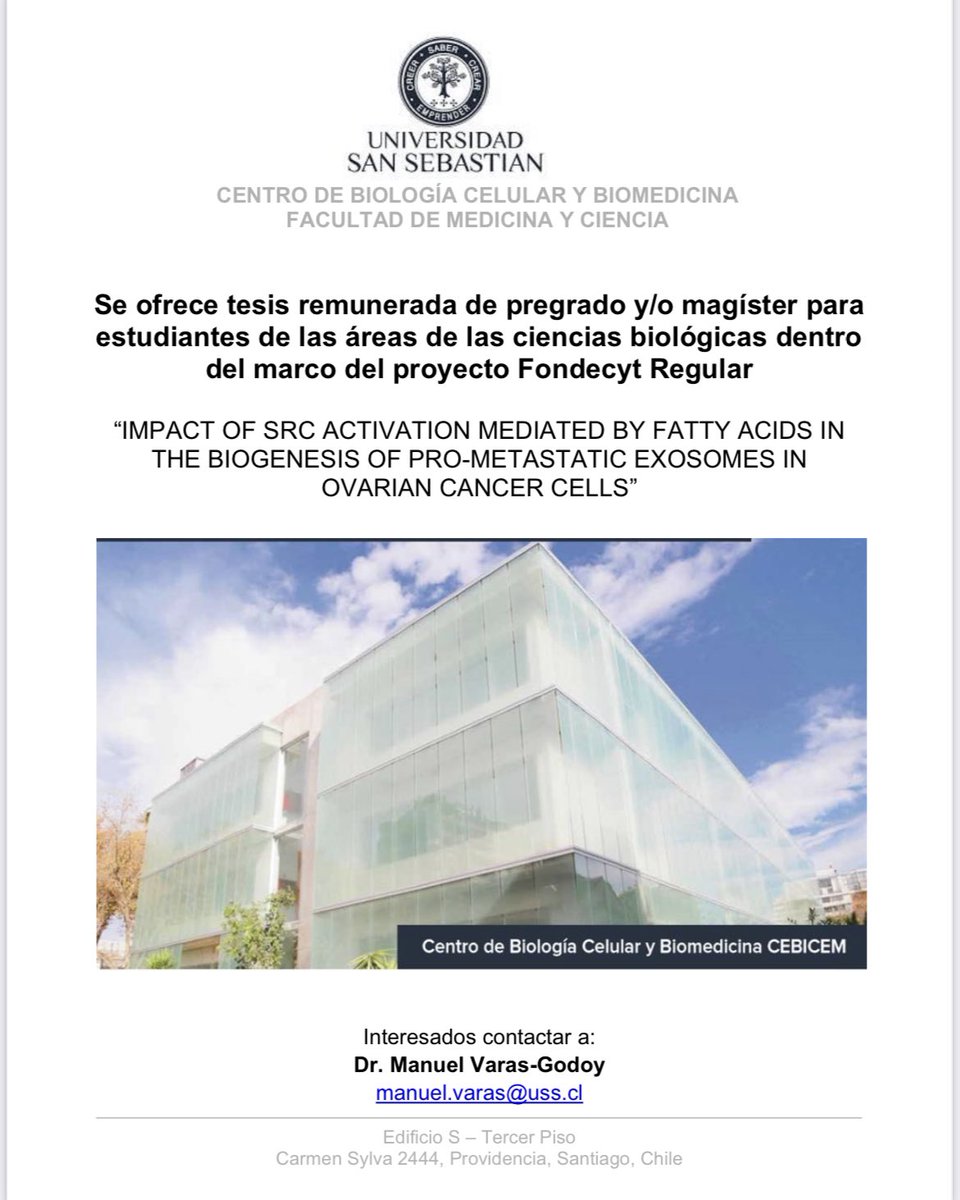
Se ofrece tesis remunerada de pregrado y/o magíster para estudiantes de las áreas de las ciencias biológicas dentro del marco del proyecto Fondecyt Regular @_SBCCh@FunCienciayVida@VRID_USS
We are delighted to announce our fantastic line up of keynote speakers for the annual UKEV forum 2023 in Cambridge!
Registration will be opening on the 1st August! #UKEV2023
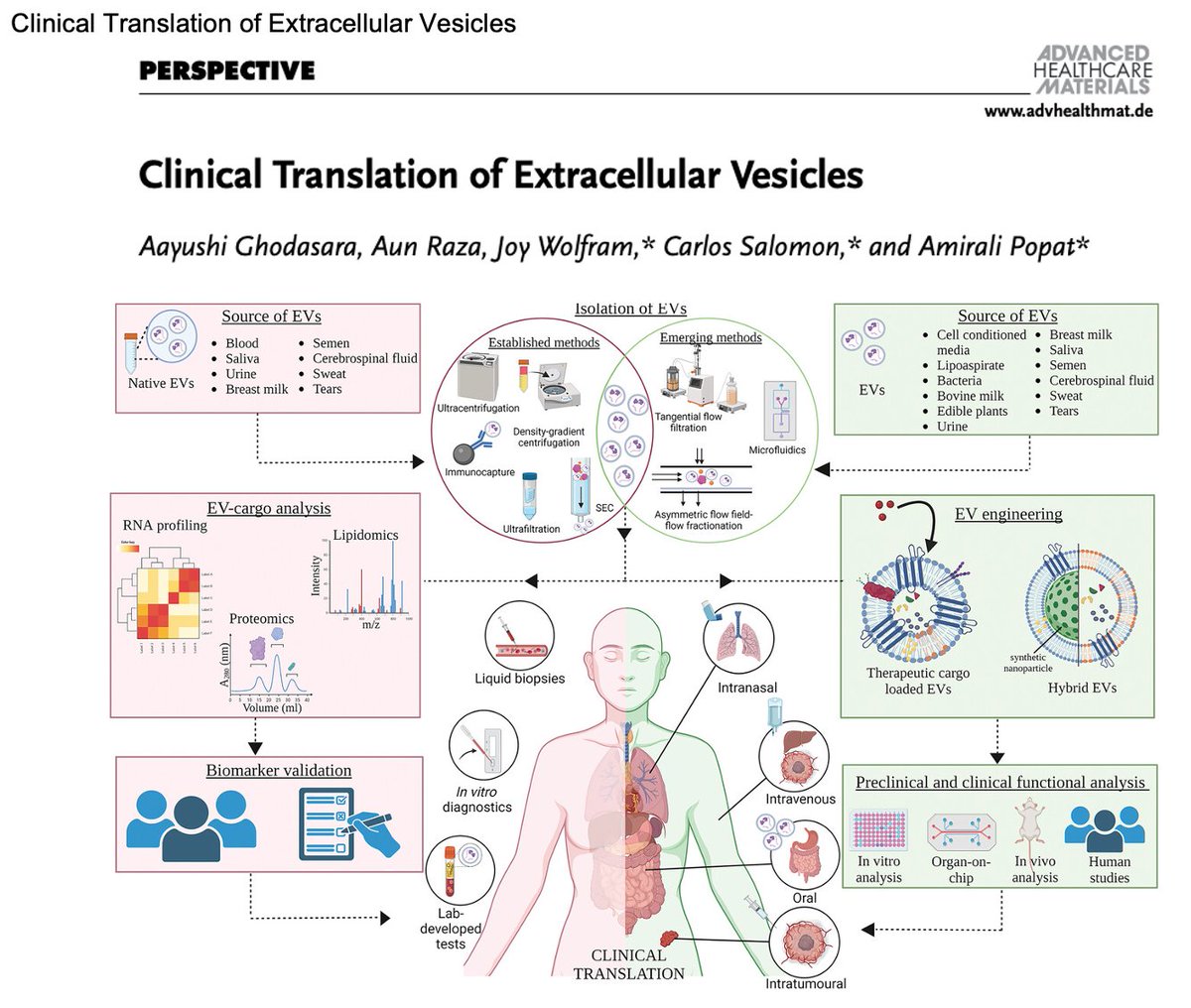
I'm thrilled to share this publication @AdvSciNews led by @__Aayushi___ in collaboration with @WolframJoy and @popatlab, discussing the unique characteristics of EVs, clinical trends, challenges and future perspectives of EVs in clinical use @UQMedicine @EVsinObsGynOnc@nhmrc