It's official now, my Lean 4 submission is #1 on "$12 server challenge", serving more users than Rust, C or even hand written assembly.
The creator of a the challenge did a pretty good job explaining how Lean 4 allows you to create software even more optimized than handwritten C.
https://t.co/Wuxb4TLeaI for VS Code 1.10 is out 🎉 Edit diagrams inline in your Markdown: drawio code blocks, linked .drawio.svg files and Mermaid → https://t.co/ZjrL6HseZq.
It's plain XML, so it diffs in git and your AI agent can read it. https://t.co/j1eYDUFb6i @hediet_dev
@mkeremturhan What is the system that is supposed to be AGI? The inference only (chat gpt/LLM+harness) or the training + inference loop (i.e. OpenAIs/Anthropics full stack, though this probably still involves humans). I doubt that inference only is AGI as of today. The full stack might be.
@francoisfleuret A proof market would be very handy, so I could put money on stuff I want to see proven/disproven. Would be an interesting way for an agent to make money, and to see what the most important conjectures are.
@cnakazawa Storing the passkey private key in software systems is as safe as storing the TFA private/recovery key in a password manager. With TFA, hardware isn't enforceable though, and systems usually only allow to set up one TFA code. (According to my understanding)
@cnakazawa With passkeys, a system can cryptographically enforce that only certified hardware (eg. TPM) is used to store the key. The hardware can certify that the user recalled the PIN (in N attempts). These are the two factors. Most systems don't enforce trusted hardware though.
@mx_schmitt Do you have ideas how to make this secure? Eg when you have a fully autonomous loop, that it cannot possibly leak your github token or consume an excessive amount of tokens overnight? I've been exploring that space a bit, but it gets tricky quickly.
@bnielson01 There is also a mathematical proof that says no algorithm can decide in general if a given formal mathematical statement is true. Not even humans in the loop.
Every cleverness on one class of problems can be used against it!
And still, humans can do math and prove things.
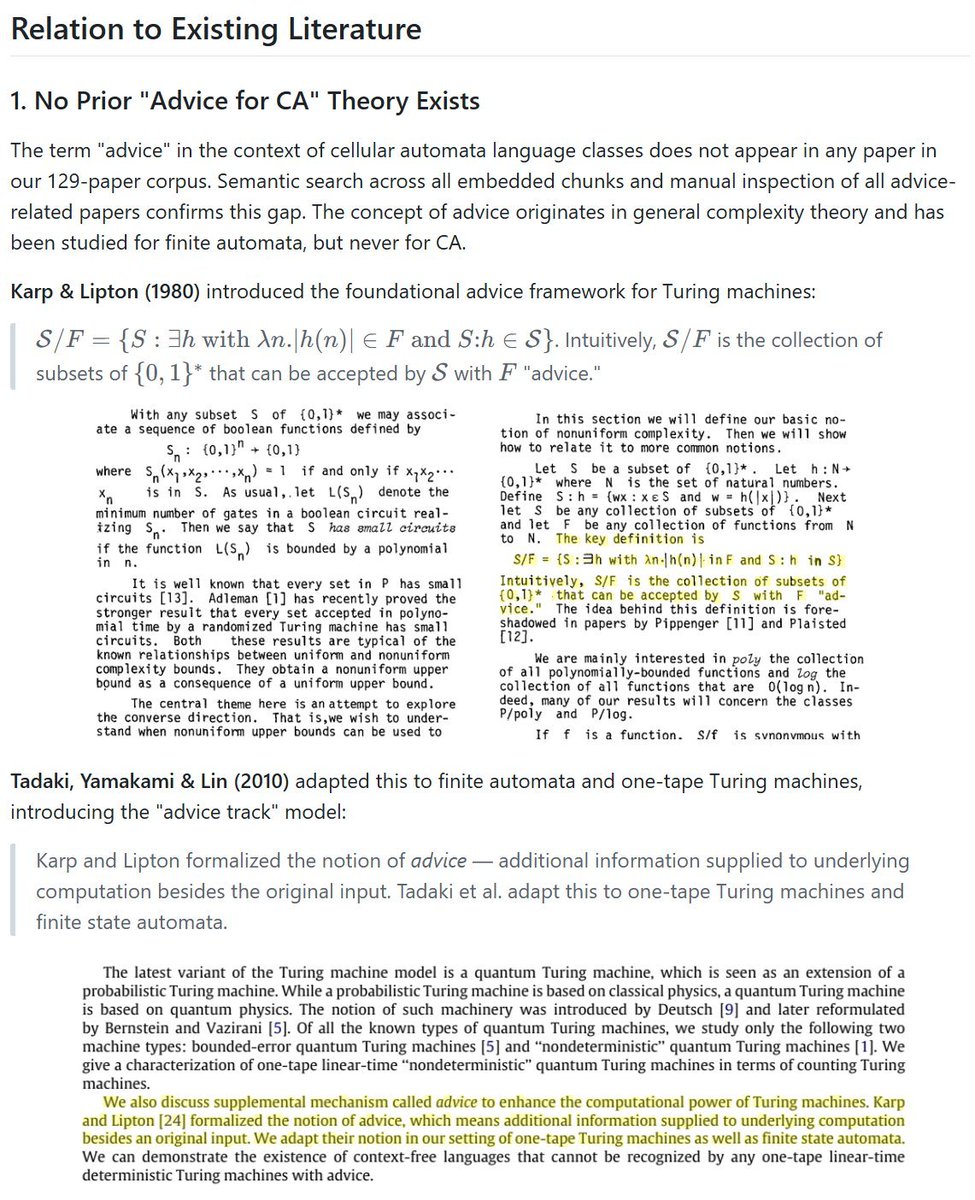
@littmath It is also now trivial to write tools with AI that show you the paragraph of the cited paper, so you (or AI) can easily check that the citation exists and is relevant.
(it took me less than an hour to vibe-code the tools needed to get what is shown in the screenshot)
@littmath The same seems to happen for cellular automata language theory. LLMs try to argue with common sense, but then fail to pin down any coherent technical argument. To quote Sonnet 4.6:
> In short: I confused "the obvious construction doesn't work" with "no construction works".
@kirancodes Has there ever been a bug in lean that made it significantly easier/possible to prove a statement, but that didn't make it significantly easier/possible to prove false?
@tonylfeng "Worthless" is a strong word. That formalization may not advance mathematics directly, as the proof might be "obviously" true/correct to mathematicians. But now it's much more obviously true to non-mathematicians as well. And that is a big win.
Very helpful was the Brave MCP server and the Google Scholar API, which AI turned into an MCP server on its own in one prompt.
The PDF quotes come from an http server that maps a given range in the extracted text back to the visual bounding boxes.
I've become a fulltime AI addict since January, not being able to stop creating, researching and planning.
And I'm still in shock by just how powerful AI is.
Any AGI will immediately be an ASI.
Here Opus did a literature research for me, it also created all the tools it needed.
I used VS Code Copilot and the debug value editor extension (https://t.co/GWCK31319Q) to let AI run/debug a node repl, which it used to go through the papers, extract their text, create embeddings, and look up their metadata.
Together with ChatGPT, I discovered a fun puzzle I thought was worth sharing: "Finding the Survivor in the Middle"
https://t.co/v0rZwvtC2f
(…or why one-dimensional two-way cellular automata operating in linear time are likely more powerful than their real-time counterparts)
I'm confident that the code is correct because composition has a nice definition of correctness:
Applying "e1 composed e2" on a string "s" should equal applying e1 on s, and then e2.
A fuzzer verified this for millions and millions of different edits.
Today is a day that I will remember for quite a while - Gemini 3 correctly implemented an algorithm in minutes that I didn't manage to implement in days: Composition of Line/Column-based text edits.
I don't even understand the code (but heavily tested it).
https://t.co/7N8nhDSZGY