CRISPR screens on CREs can reveal how disease-associated mutations work and point to sequences worth editing therapeutically.
I hope this review is useful to anyone interested in CRISPR screening approaches or in perturbing CREs therapeutically. (6/6)
Excited to share my review with @brian_b_liau, just out in Current Opinion in Chemical Biology! 🧬
Interested in CRISPR-based functional screens of noncoding regulatory sequences? Check out our review here: https://t.co/0oOJ1pzndv
Highlights below (1/6)
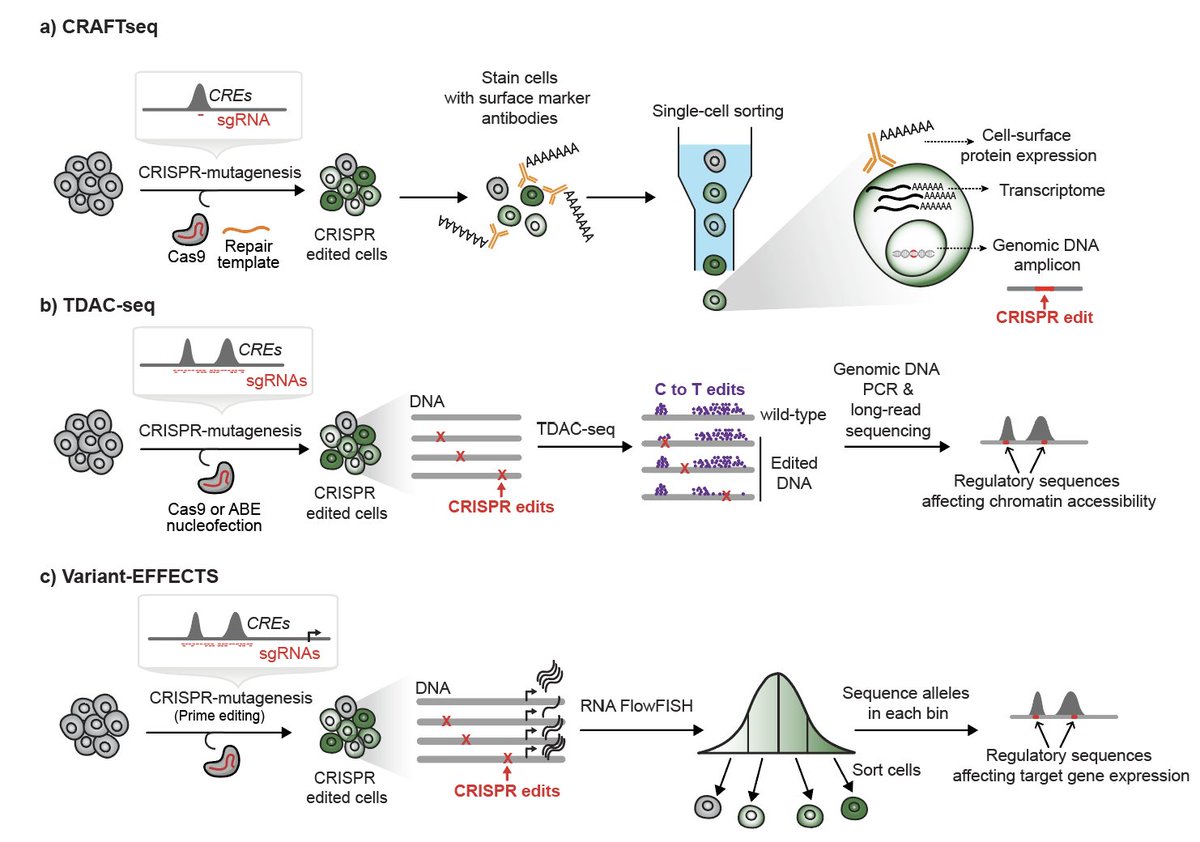
However, sgRNA identity alone cannot reveal the exact edit installed in each cell.
Emerging genotype-resolved methods — CRAFTseq, TDAC-seq, and Variant-EFFECTS — sequence the edited locus itself, tying each readout to the actual DNA sequence. (5/6)
CRISPR screens on CREs can reveal how disease-associated mutations work and point to sequences worth editing therapeutically.
I hope this review is useful to anyone interested in CRISPR screening approaches or in perturbing CREs therapeutically. (6/6)
However, sgRNA identity alone cannot reveal the exact edit installed in each cell.
Emerging genotype-resolved methods — CRAFTseq, TDAC-seq, and Variant-EFFECTS — sequence the edited locus itself, tying each readout to the actual DNA sequence. (5/6)
TDAC-seq is a method for targeted chromatin accessibility profiling that uses cytidine deaminases and long-read sequencing to resolve the effects of CRISPR edits on single chromatin fibers.
@brian_b_liau@heejin_roh@sshen8@YanHu41082612
https://t.co/KxVbE6iPnx
Today in @naturemethods we present TDAC-seq, a method to profile chromatin accessibility across long chromatin fibers at targeted loci using double-stranded DNA cytidine deaminases. 1/4 https://t.co/82sYsnmwnA
Excited to share our latest work, where we develop TDAC-seq to simultaneously map CRISPR-induced genetic variants & chromatin accessibility at targeted genomic loci by leveraging a dsDNA cytidine deaminase, DddA. Highlights below: 1/11
https://t.co/iNyb9ywVzi