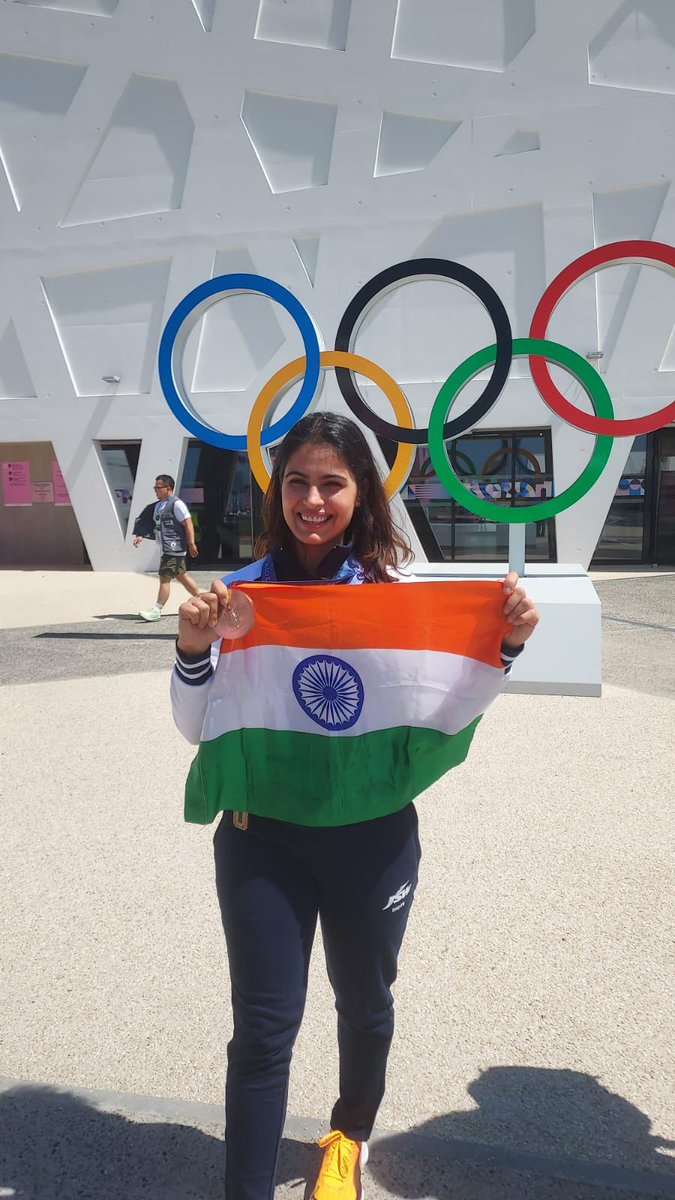
Extremely humbled by the support and wishes that have been pouring in. This is something that I've always dreamt of. Proud to perform at the biggest stage for my country 🇮🇳 ❤️
Winning this medal is a dream come true, not just for me but for everyone who has supported me. I am deeply grateful to the NRAI, SAI, Ministry of Youth Affairs & Sports, Coach Jaspal Rana sir, Haryana government and OGQ. I dedicate this victory to my country for their incredible support and love.
📽️ New 4 hour (lol) video lecture on YouTube:
"Let’s reproduce GPT-2 (124M)"
https://t.co/QTUdu8b0qh
The video ended up so long because it is... comprehensive: we start with empty file and end up with a GPT-2 (124M) model:
- first we build the GPT-2 network
- then we optimize it to train very fast
- then we set up the training run optimization and hyperparameters by referencing GPT-2 and GPT-3 papers
- then we bring up model evaluation, and
- then cross our fingers and go to sleep.
In the morning we look through the results and enjoy amusing model generations. Our "overnight" run even gets very close to the GPT-3 (124M) model. This video builds on the Zero To Hero series and at times references previous videos. You could also see this video as building my nanoGPT repo, which by the end is about 90% similar.
Github. The associated GitHub repo contains the full commit history so you can step through all of the code changes in the video, step by step.
https://t.co/BOzkxQ8at2
Chapters.
On a high level Section 1 is building up the network, a lot of this might be review. Section 2 is making the training fast. Section 3 is setting up the run. Section 4 is the results. In more detail:
00:00:00 intro: Let’s reproduce GPT-2 (124M)
00:03:39 exploring the GPT-2 (124M) OpenAI checkpoint
00:13:47 SECTION 1: implementing the GPT-2 nn.Module
00:28:08 loading the huggingface/GPT-2 parameters
00:31:00 implementing the forward pass to get logits
00:33:31 sampling init, prefix tokens, tokenization
00:37:02 sampling loop
00:41:47 sample, auto-detect the device
00:45:50 let’s train: data batches (B,T) → logits (B,T,C)
00:52:53 cross entropy loss
00:56:42 optimization loop: overfit a single batch
01:02:00 data loader lite
01:06:14 parameter sharing wte and lm_head
01:13:47 model initialization: std 0.02, residual init
01:22:18 SECTION 2: Let’s make it fast. GPUs, mixed precision, 1000ms
01:28:14 Tensor Cores, timing the code, TF32 precision, 333ms
01:39:38 float16, gradient scalers, bfloat16, 300ms
01:48:15 torch.compile, Python overhead, kernel fusion, 130ms
02:00:18 flash attention, 96ms
02:06:54 nice/ugly numbers. vocab size 50257 → 50304, 93ms
02:14:55 SECTION 3: hyperpamaters, AdamW, gradient clipping
02:21:06 learning rate scheduler: warmup + cosine decay
02:26:21 batch size schedule, weight decay, FusedAdamW, 90ms
02:34:09 gradient accumulation
02:46:52 distributed data parallel (DDP)
03:10:21 datasets used in GPT-2, GPT-3, FineWeb (EDU)
03:23:10 validation data split, validation loss, sampling revive
03:28:23 evaluation: HellaSwag, starting the run
03:43:05 SECTION 4: results in the morning! GPT-2, GPT-3 repro
03:56:21 shoutout to llm.c, equivalent but faster code in raw C/CUDA
03:59:39 summary, phew, build-nanogpt github repo
Let's delve into how AI is reshaping the future of shopping, from predictive analytics to virtual assistants. Join the conversation on the innovative use cases of AI in retail stores! #AI#Retail#Innovation
Early thoughts on the Apple Vision Pro (I ended up buying directly in store last evening). I'm about 3 hours in, between late last night and this morning.
The first major thing that must be said is WOW - the visual clarity is way beyond anything that came before. But, a bit unexpectedly, this is so in some strange mixed way - your surroundings (the passhtrough) are a bit blurry and even a tiny bit laggy. But anything rendered fully virtually, e.g. a screen is very sharp and easily readable. Super cool. I mean, just the simple experience of arranging a few windows around your living room and moving around them is incredible. I feel very creative thinking through and designing my ideal setup of all the apps in my space. Mind is blown and goes places.
The second major thing is a bit less upbeat. This launch is not like the other Apple launches. It is off-brand. It is selectively and inconsistently either highly polished, or highly raw/undercooked, poorly throught through, janky or even straight up buggy. It's like some parts of the org get an A+ and some get an F. Or it's like some of them had 4 years to work on their part, and some had 4 months. It's like it was rushed a bit to "just ship" and basic UI/UX interactions weren't finished, thought-through or debugged.
Jank
Let me describe a bit some of the jank. The setup was a bit too long and janky for me. At one early point you're asked to bring your unlocked iPhone close, but you can't unlock your iPhone because your face is obviously covered so FaceID doesn't work... ?. Then I had some error connecting the phone to it so I had to go through "manual" setup. Then the sound wasn't working until I rebooted. Then I got an iMessage from a friend and I was shown a notification inside the Vision Pro about it, but when I clicked into iMessage app, it was fully empty - where is the message? When launching Guest Mode to show a friend, nothing tells you that you're supposed to also press the digital crown to activate. Very simple interactions are buggy - e.g. in the app store when I select an app to preview it and then hit back, I'm forced to for some reason go back 10 times through previously previewed apps to get back to the main screen, some bug or something. My Disney+ app never opened, it just spins forever, I'm not sure how to launch this app. When you launch Apple TV, there is zero indication or recognition of the fact that you're inside Vision Pro. No featured content, no custom content, no text indicating anything, no nothing. I'm not sure, I thought there would be a few surround videos or something? Also my brain: "$3500 for a Vision Pro? Yes two please! $9.99 for AppleTV+? Absolutely not." More generally, as you access Apple apps, a lot of them are just ignoring that you're inside a Vision Pro, and just pretending like nothing happened. I'd want new Spatial Content and interactions to be 100% front and center and featured. The "copy pasting" of stuff seems pervasive.
The raw Spatial Computing OS is there, but it's almost like the OS is all there is. The apps that take advantage in any way of "Spatial Computing" seem few and are somehow also hard to find and/or not prominently featured. There's the little blue guy app who you can poke and he laughs. There's the jet engine app, which is kind of cool, but I wasn't actually really learning anything, it felt gimmicky, like an early demo. There are some really cool environments, but why are there only 5 of them?. There's what seems to be some early grifter content on the app store, from people trying to sell you e.g. a super basic looking watch app that just shows time, for $2.99. The ability to look at your laptop and just "connect" worked the second time, and it was glorious, wow. Your screen just shows up in your living room and you can use the keyboard/mouse. Very cool.
The Vision Pro is sadly a little bit too heavy and it doesn't "disappear" due to this, even with the double strap (which is essential). I feel a bit pressure from the device on my head. But it's okay, we're at the edge of what is possible. A bunch of other small things. The world shakes a little bit with every step, especially if you land a bit harder on a heel. You have to unlearn and relearn some UIUX, because your eye gaze is now your active pointer. So you can't just look somewhere else a bit too early, before you "click" it. It's very cool that the eye tracking is so high quality.
Anyway, I'm rambling. Conclusions. The hardware itself and the core Spatial Computing OS aspects exceed my expectations. I loved sprawling on my couch, opening up a few windows, and I half-watched a movie while scrolling through web. I loved pacing around my room arranging my digital work/entertainment space. I FaceTimed a friend and we laughed about how silly my digital avatar looks, haha. I pulled up Music and played the only thing I have in it - that U2 album that was given to everyone back in 2014. nice. I'm very happy with this early preview of what could be possible, and using the current experience as a prompt to explore it.
Few recommendations to Apple come to mind: 1) eliminate simple bugs and jank. 2) fight early grifter content by featuring very very prominently any apps that are actually good, don't use dark patterns, are ideally free to try, and acknowledge in any way that the user is in a Vision Pro. 3) Consider a free subscription of AppleTV+, or maybe a $100 app gift card to those who purchase Vision Pro, so people don't lock up (?). It feels bad to pay that much money just to get in, and then immediately feeling like you're blocked behind additional pay walls, for experiences that could very well be very very raw and undercooked. 4) In general, feature a lot more prominently any content that is actually designed for spatial computing. I don't want to just put up iPad apps around me.
I am simultaneously wearing a revolution in computing, and the software to actually show me around is not just absent but what is there is mildly janky and annoying.
Ok, this concludes the section where I just "wing it" based on what I'm seeing, going in fairly blind, over the first ~3 hours. I will now do a bit more research, read more, watch some videos/tutorials, and come back for round 2.
🌟 Delighted to announce my paper presentation at AIMLSNLPC conference! 📝 Explored the delicate balance between model precision and training performance with Dr. Akansha & Sushnata. Huge thanks to @reliancejio, KMIT Hyderabad & ACMHDC for the platform. Exciting strides in #AI.
ChatGPT can now browse the internet to provide you with current and authoritative information, complete with direct links to sources. It is no longer limited to data before September 2021.
🚀 Just posted on LinkedIn: "A Closer Look at Accuracy in Machine Learning!" 🤖 Dive into the world of ML metrics with me. Learn about accuracy, its applications, and its limitations. Check it out here 👉 https://t.co/zpJFQ8ry3c #MachineLearning#DataScience#AIInsights
🎉🥳 Just hit the 200 FOLLOWERS milestone! 🙌🎈 Thank you all for being part of this incredible journey. Your support, engagement, and conversations make this Twitterverse truly special! 🌟 Here's to many more tweets, insights, and connections ahead! 🚀💬 #200Followers#Twitter
ANYONE can now have their own personal data analyst
Successfully analyzing your business KPIs could be the difference between winning or failing
Below are 20 ChatGPT code interpreter prompts to analyze your business
[Bookmark to save🔖]
1. Descriptive Statistics:
Prompt: "Using our sales dataset, provide measures of central tendency (mean, median) and dispersion (variance, standard deviation) to summarize its key features."
2. Time Series Analysis:
Prompt: "Given our monthly revenue data over the past five years, can you apply ARIMA modeling to forecast the next 12 months?"
3. Hypothesis Testing:
Prompt: "Given the A/B test results from two different webpage designs, can we statistically determine if one design led to more conversions than the other?"
4. Regression Analysis:
Prompt: "Using our advertising spend and monthly sales data, can we build a regression model to predict the effect of increasing our advertising budget by [X%]?"
5. Cluster Analysis:
Prompt: "Given a dataset of our customer demographics and purchase behaviors, can we use k-means clustering to segment our customer base?"
6. Principal Component Analysis (PCA):
Prompt: "Considering our extensive customer survey data with multiple variables, can PCA be applied to reduce dimensionality while retaining most of the data's variance?"
7. Chi-Squared Test:
Prompt: "Given observed frequencies of product returns across different categories, can we employ a chi-squared test to see if product category affects return rates?"
8. Survival Analysis:
Prompt: "Using our subscription data, can survival analysis help understand the median time until a user cancels their subscription?"
9. Path Analysis:
Prompt: "Using the data from our user journey on our website, can we employ path analysis to determine which sequences of interactions lead most effectively to conversions?"
10. Logistic Regression:
Prompt: "Given customer attributes and purchase histories, can we create a logistic regression model to predict the likelihood of a customer making a purchase in the next month?"
11. Factor Analysis:
Prompt: "In the context of our market research survey with multiple correlated variables, how might factor analysis help in identifying underlying factors?"
12. Bayesian Analysis:
Prompt: "Given prior data on marketing campaign successes and new campaign data, can we apply Bayesian methods to update our beliefs about the efficacy of certain marketing strategies?"
13. Non-Parametric Tests:
Prompt: "If our data isn't normally distributed, which non-parametric tests can we apply, like the Mann-Whitney U test, to compare two independent samples?"
14. Power Analysis:
Prompt: "Before launching a new A/B test, can we conduct a power analysis to determine the required sample size ensuring meaningful results?"
15. Cross-Validation:
Prompt: "When building our predictive machine learning models, how can we implement k-fold cross-validation to assess their performance reliably?"
16. Sentiment Analysis:
Prompt: "Given the customer reviews and feedback from our digital products, can sentiment analysis help categorize and quantify the sentiments into positive, negative, or neutral?
17. Multivariate Testing:
Prompt: "If we're considering multiple changes to our website, how can we set up and analyze a multivariate test to assess the combined effect of these changes on conversions?"
18. Cohort Analysis:
Prompt: "Using sign-up data, can we group users into cohorts based on their join date and analyze their behavior over time to detect patterns or trends?"
19. Multilevel (Hierarchical) Models:
Prompt: "Given sales data from individual salespeople within different regional teams, how can multilevel models help account for both individual and group-level variations?"
20. Correlation Analysis:
Prompt: "With data points across various business metrics, can we determine which pairs of metrics are strongly correlated, and might one be influencing the other?"
🚀🤖 AI's Role in Future Space Exploration 🌌🔬 #Chandrayaan3
Autonomous Navigation: AI can guide spacecraft through treacherous space terrains, adjusting trajectories in real-time for safe landings on distant planets. 🛰️🪐
Praggnanandhaa is the runner-up of the 2023 FIDE World Cup! 🥈
Congratulations to the 18-year-old Indian prodigy on an impressive tournament! 👏
On his way to the final, Praggnanandhaa beat, among others, world #2 Hikaru Nakamura and #3 Fabiano Caruana! By winning the silver medal, Praggnanandhaa also secured a ticket to the #FIDECandidates.
📷 Stev Bonhage #FIDEWorldCup
INCREDIBLE CHESS MOMENT! Congratulations to Magnus Carlsen for clinching the FIDE World Cup title with an outstanding performance! And a special shoutout to Praggnananda for his remarkable journey to the finals – making India immensely proud as the youngest finalist ever! 🇮🇳








![theaipreneursof's tweet photo. ANYONE can now have their own personal data analyst
Successfully analyzing your business KPIs could be the difference between winning or failing
Below are 20 ChatGPT code interpreter prompts to analyze your business
[Bookmark to save🔖]
1. Descriptive Statistics:
Prompt: "Using our sales dataset, provide measures of central tendency (mean, median) and dispersion (variance, standard deviation) to summarize its key features."
2. Time Series Analysis:
Prompt: "Given our monthly revenue data over the past five years, can you apply ARIMA modeling to forecast the next 12 months?"
3. Hypothesis Testing:
Prompt: "Given the A/B test results from two different webpage designs, can we statistically determine if one design led to more conversions than the other?"
4. Regression Analysis:
Prompt: "Using our advertising spend and monthly sales data, can we build a regression model to predict the effect of increasing our advertising budget by [X%]?"
5. Cluster Analysis:
Prompt: "Given a dataset of our customer demographics and purchase behaviors, can we use k-means clustering to segment our customer base?"
6. Principal Component Analysis (PCA):
Prompt: "Considering our extensive customer survey data with multiple variables, can PCA be applied to reduce dimensionality while retaining most of the data's variance?"
7. Chi-Squared Test:
Prompt: "Given observed frequencies of product returns across different categories, can we employ a chi-squared test to see if product category affects return rates?"
8. Survival Analysis:
Prompt: "Using our subscription data, can survival analysis help understand the median time until a user cancels their subscription?"
9. Path Analysis:
Prompt: "Using the data from our user journey on our website, can we employ path analysis to determine which sequences of interactions lead most effectively to conversions?"
10. Logistic Regression:
Prompt: "Given customer attributes and purchase histories, can we create a logistic regression model to predict the likelihood of a customer making a purchase in the next month?"
11. Factor Analysis:
Prompt: "In the context of our market research survey with multiple correlated variables, how might factor analysis help in identifying underlying factors?"
12. Bayesian Analysis:
Prompt: "Given prior data on marketing campaign successes and new campaign data, can we apply Bayesian methods to update our beliefs about the efficacy of certain marketing strategies?"
13. Non-Parametric Tests:
Prompt: "If our data isn't normally distributed, which non-parametric tests can we apply, like the Mann-Whitney U test, to compare two independent samples?"
14. Power Analysis:
Prompt: "Before launching a new A/B test, can we conduct a power analysis to determine the required sample size ensuring meaningful results?"
15. Cross-Validation:
Prompt: "When building our predictive machine learning models, how can we implement k-fold cross-validation to assess their performance reliably?"
16. Sentiment Analysis:
Prompt: "Given the customer reviews and feedback from our digital products, can sentiment analysis help categorize and quantify the sentiments into positive, negative, or neutral?
17. Multivariate Testing:
Prompt: "If we're considering multiple changes to our website, how can we set up and analyze a multivariate test to assess the combined effect of these changes on conversions?"
18. Cohort Analysis:
Prompt: "Using sign-up data, can we group users into cohorts based on their join date and analyze their behavior over time to detect patterns or trends?"
19. Multilevel (Hierarchical) Models:
Prompt: "Given sales data from individual salespeople within different regional teams, how can multilevel models help account for both individual and group-level variations?"
20. Correlation Analysis:
Prompt: "With data points across various business metrics, can we determine which pairs of metrics are strongly correlated, and might one be influencing the other?"](https://pbs.twimg.com/media/F4tAx5AbEAA011z.jpg)