Introducing Claude Fable 5: a Mythos-class model that we’ve made safe for general use.
Its capabilities exceed those of any model we’ve ever made generally available.
Since Opus 4.8 is out and more and more designers are getting into Design Engineering, I thought I’d share some of the interaction patterns I use most often:
Use proximity, not just hover. When the cursor gets close, nearby elements can subtly scale and darken based on distance.
It makes interfaces feel more responsive, less binary, and way more alive
onpointermove = e =>
document.querySelectorAll(".dock>*").forEach(el => {
const r = el.getBoundingClientRect();
const t = Math.max(0, 1 - Math.abs(e.clientX - r.x - r.width/2) / 120);
el. style.scale = 1 + t * .5;
});
Unpopular opinion: I don’t care if most web apps look the same. All I care about is whether it does what it says and does it fast.
Make it fast. Make the UX obvious. Put the right things in the right place and little to no animations.
Since @OpenAIDevs Codex /goal is trending, I decided to open source a loop system a bit more powerful I've been using lately 🔥
Introducing Codex Loop plugin — keeps Codex running as many hours you wish, N deliberate rounds, or an independently verified goal.
More details 👇🏻
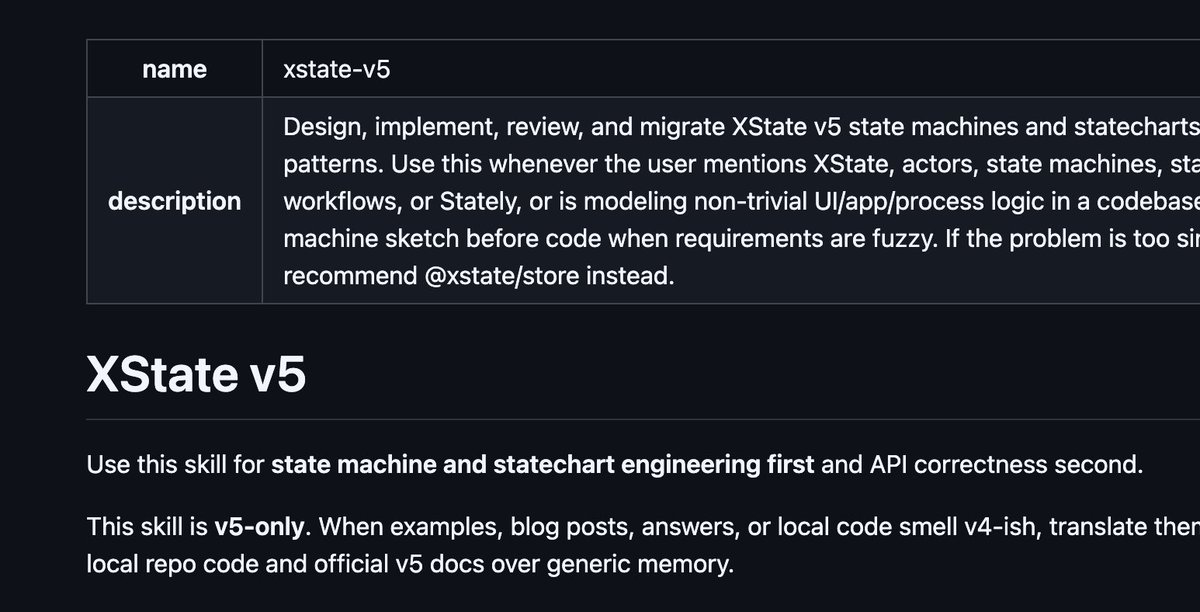
Released the XState v5 skill 🚀
The goal isn't just "know the API" but rather "help agents make really good state machines"
Tuned & tested against real examples, common anti-patterns, and the mistakes* LLMs tend to make with XState
npx skills add statelyai/skills
every skeleton screen you've ever hand-coded is a waste of time
you're literally measuring padding and guessing widths to build a worse version of a layout that already exists in your DOM
so I made a package that just reads the real one
TypeScript 6.0 is now available!
This release brings better type-checking for methods, new standard library features, new module features for Node.js, and more!
But most important, this release brings us one step closer to the upcoming native-speed 7.0!
https://t.co/hon0RU1L5B