Glad to share that our paper on The Master Key Hypothesis / cross-model capability transfer got accepted @NeurIPSConf 2026 as spotlight 🎉 !! Top 1.3% (292 spotlight + 112 oral) out of 30709 submissions. Congrats to my students @Sub_RBala@linusdd44804@helix9550 and co-authors @mohitban47!!
Nice work by @verma_apurv5 showing that post-training can be distilled into a portable logit delta that transfers across model sizes and families, which corroborates the findings in our recent work on the Master Key Hypothesis (https://t.co/pd26twmQG6) and fine-tuning/alignment transfer (https://t.co/DkVYJ350wJ).
🚨New paper alert:
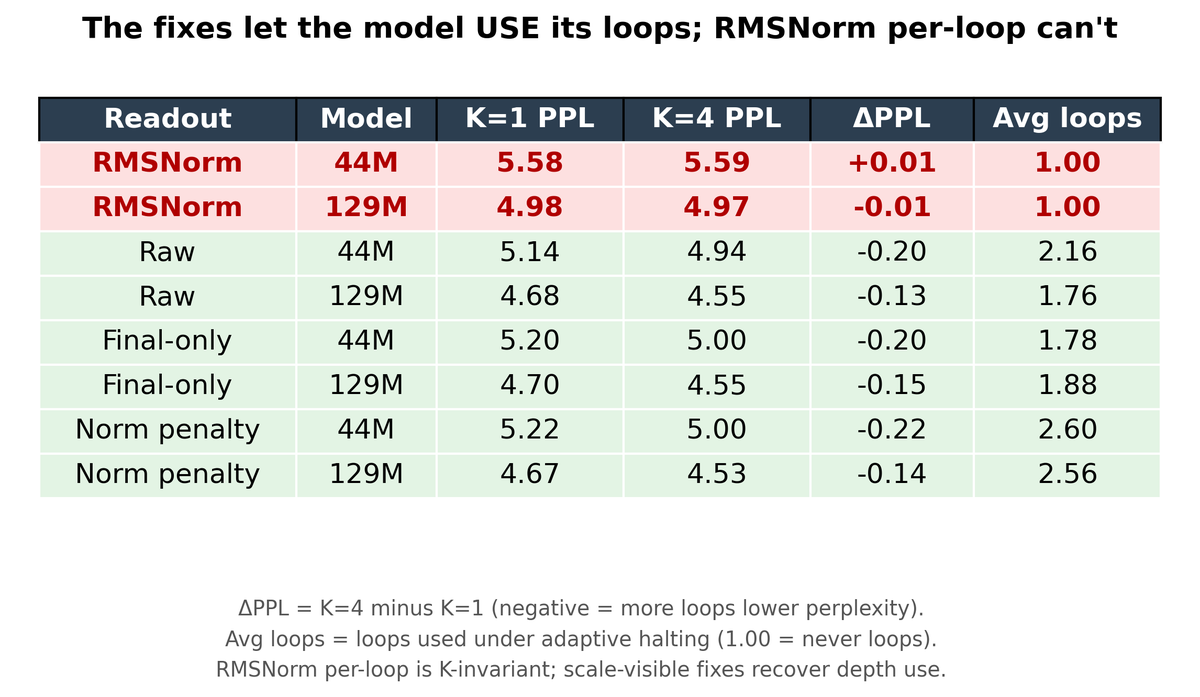
Can dense supervision control a looped language model, if the loss never sees how large its hidden state grows?
Add loss at every loop, yet the norms blow up into thousands.
The decode layer hides the hidden state’s size from the loss. The readout blind spot 🧵
The fix is essentially free: it collapses the final-loop norm from ~56,000 to ~77, and makes each extra loop actually lower perplexity where a dense RMSNorm per-loop gains nothing. On the same compute, the fixed model is simply better. Full results in the paper 👇
Built a tool for this.
ghostenv encrypts your .env and gives AI agents masked (fake) values. Real secrets only get injected when you explicitly approve. Agents can use your API keys without ever seeing them.
https://t.co/ze7YVVNhDx
Built a tool for this.
ghostenv encrypts your .env and gives AI agents masked (fake) values. Real secrets only get injected when you explicitly approve. Agents can use your API keys without ever seeing them.
https://t.co/ze7YVVNhDx
Really like this direction. Efficient routing in evolutionary inference is an important piece of the puzzle.
It also pairs naturally with PRISM’s focus on process guidance. Allocating compute more selectively + making each refinement step more meaningful seems interesting mix.
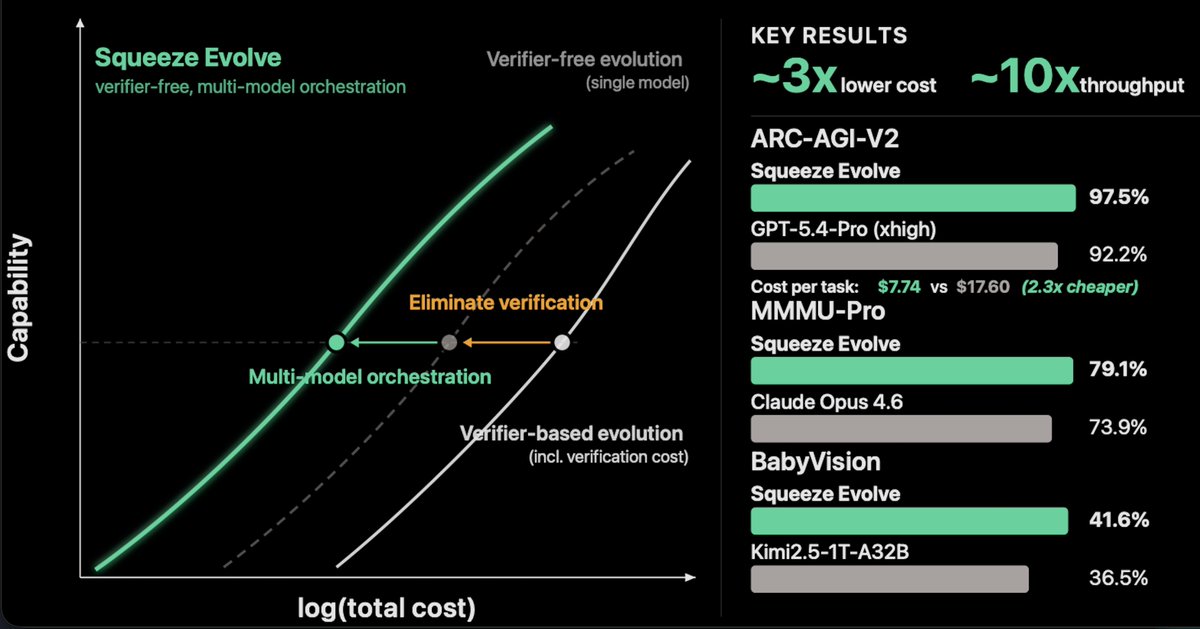
Super excited to Introduce our latest work: Squeeze Evolve.
We unify test-time scaling methods into one evolutionary framework — then orchestrate many models across it.
3x lower cost. 10x throughput. 97.5%(SoTA) on ARC-AGI-V2. No verifier required.
Framework: https://t.co/5hmOyZvSKU
🌟New paper alert: The Master Key Hypothesis🌟
Post-training is expensive AND you have to repeat it for every new model. What if you could just transfer the capability instead?
We introduce UNLOCK — a training-free and label-free framework that transfers capabilities across models using low-rank linear projections.
Takeaways:
1⃣ Skills like CoT & math reasoning live as directions in the model's latent space. We capture these as a steering vector — we call this the Master Key.
2⃣ Simple low-rank linear transformations are sufficient to transfer the Master Key across models' latent spaces
3⃣ UNLOCK elicits behaviors that even prompting can't reliably trigger
4⃣ Gains scale with base model strength. Stronger models show larger gains post-transfer.
5⃣ UNLOCK works by sharpening the output distribution — steering the model toward the right answer.
@SharmaRituraj19 wrote an excellent blog post that explains the key insight behind PRISM and how it helps unlock Deep Think mode 🧬 in #LLMs. Check it out! 👇
Blog: https://t.co/eOSNgqDbwG
Code: https://t.co/aoBknSviYH
Paper: https://t.co/1H6wm7UR6L
@Harman26Singh@tuvllms We addressed it with a comparator model (also the same base model as the generator 😀) that does pairwise self-verification between two fully scored traces with different final answers, similar in spirit to V1.