@villamzr Totalmente de acuerdo contigo, la gente piensa, erroneamente, que el ser humano es racional y es capaz de ceñirse a las conclusiones que pueden extraerse de los datos, pero no es así.
No somos seres racionales que tienen emociones. Somos seres emocionales que a veces razonan.
@powerhdeleon No sería la primera vez que Google fuerza algo en sus usuarios, como cuando intentaron forzar su red social. Y te la ponían hasta en la sopa.
@Sebbais_@mito__ai Me temo que la mayoría de las empresas no están usando AI para "elevar la producción", sino para disminuir costos, casi siempre a costa de la calidad.
87 tokens por segundo con Qwen3.6 27B. En tarjeta gráfica AMD de consumidor, no de servidor!
El mejor modelo local corriendo más rápido que los modelos de pago en la nube.
El futuro de las empresas de AI no se ve tan dominante
@precisox Primero, no da la misma salida, porque el seed cambia. Segundo, cada entrada es diferente y, por lo tanto, produce un resultado diferente.
Tercero, el código lleva siendo un commodity desde que se inventaron los frameworks y el open source. La AI solo te evita el usar buscadores.
@zuess05 A new LLM breakthrough would be necessary, as long as LLM rely on probability that will never happen.
Yes I know that if you can control all parameters they're deterministic, but if you use them that way you just created a new programming language that you'd have to master.
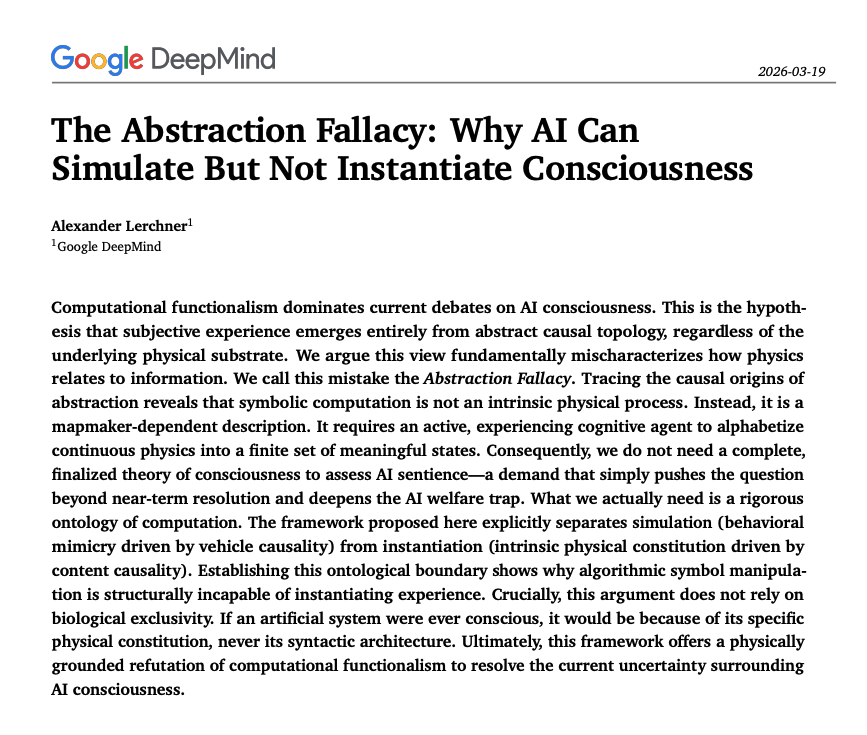
Google DeepMind researcher argues that LLMs can never be conscious, not in 10 years or 100 years.
For a long time, the dominant theory in Silicon Valley has been "computational functionalism." The idea that if you make a model big enough, and organize the information perfectly, consciousness will magically emerge.
We assumed that if the software got smart enough, it would eventually wake up.
Alexander Lerchner, a Senior Staff Scientist at DeepMind, published a paper explaining why that is structurally impossible.
He calls it the Abstraction Fallacy.
Here is the core truth: Computation isn’t a real physical process. It is a map.
An LLM doesn't actually process logic or thoughts. It just moves electrons around based on physics. It requires a human, a conscious "mapmaker", to look at those physical states and assign meaning to them.
Mistaking an AI for a conscious being is like looking at a map of a river and expecting it to be wet.
An AI can simulate the exact syntax of a feeling, a thought, or an emotion. But it can never instantiate it.
It doesn't matter how many trillions of parameters you add or how much compute you burn. You cannot mathematically compute your way into a subjective experience.
The implications of this are massive. And deeply convenient for the companies building these models.
If an AI is structurally incapable of consciousness, it cannot be a moral patient. It doesn't get rights. It cannot be exploited.
It can be regulated exactly like a toaster.
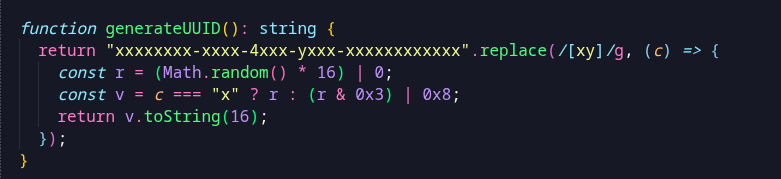
@_nasch_ Tiran la ruleta otra vez, y otra vez, y otra vez, y otra vez. Y luego se hacen de la vista gorda cuando te genera algo así en lugar de usar crypto. Me pasó, de ahí saqué la captura.
@villamzr Sí, escribe mejor código que la mayoría. También es cierto que a veces necesitas un prompt igual o más largo que lo que te tomaría escribir el código a mano y tienes que estar corrigiéndole un montón de cosas.
Aunque yo la amo para tests, documentación y resumir cosas, chulada.
Google DeepMind researcher argues that LLMs can never be conscious, not in 10 years or 100 years.
For a long time, the dominant theory in Silicon Valley has been "computational functionalism." The idea that if you make a model big enough, and organize the information perfectly, consciousness will magically emerge.
We assumed that if the software got smart enough, it would eventually wake up.
Alexander Lerchner, a Senior Staff Scientist at DeepMind, published a paper explaining why that is structurally impossible.
He calls it the Abstraction Fallacy.
Here is the core truth: Computation isn’t a real physical process. It is a map.
An LLM doesn't actually process logic or thoughts. It just moves electrons around based on physics. It requires a human, a conscious "mapmaker", to look at those physical states and assign meaning to them.
Mistaking an AI for a conscious being is like looking at a map of a river and expecting it to be wet.
An AI can simulate the exact syntax of a feeling, a thought, or an emotion. But it can never instantiate it.
It doesn't matter how many trillions of parameters you add or how much compute you burn. You cannot mathematically compute your way into a subjective experience.
The implications of this are massive. And deeply convenient for the companies building these models.
If an AI is structurally incapable of consciousness, it cannot be a moral patient. It doesn't get rights. It cannot be exploited.
It can be regulated exactly like a toaster.