@dennis_kortsch Audience-captured is the right framing. I enjoyed the first couple of videos but then figured he’s doing the same thing that he’s accusing Anthropic of doing - doomaxxing and pandering to his audience’s thirst for negativity.
every time, I try to give Gemini + Google Docs a shot, I feel disappointed. It either doesn’t work or doesn’t work well - and it doesn’t fail gracefully either.
In this case, it doesn’t give me a simple “try again” button. And, in other cases, it tells me to copy paste a formula or click on 6 menu items instead of doing the work for me.
This is the Youtube moment for app development. For everyone who’s mocking non-technical people for “vibe coding” apps in production, imagine mocking hobbyists making Youtube videos 10 years ago - a skill that was limited (and gate-kept) by only professional videographers.
I understand the complexity and risk of maintaining an app is greater than that of a shipped video. But, just like traditional TV didn’t get replaced by Youtube channels, similarly vibe-coded apps can create an alternate universe of apps without replacing “processionally developed apps”.
@starter_story@thepatwalls You’re able to get deep work done at the airport? I am impressed. Actually, it may even be one of the most productive places to work.
@Mattihcq1@qualtrim Does it matter if people are still paying for it? It’s like saying - no ever made real friends on Facebook. People pay to be entertained (or not be bored) on Facebook, Duolingo, etc.
@themgmtconsult A “job” doesn’t have to be the default economic state. “Founder” is someone who sells something of value - and that has existed for ages. We should all learn how to hunt for ourselves.
If someone desires to do artisan coding just because they enjoy writing code by hand, no one’s stopping them, just like no one stops an artist from creating art. It’s a free world.
But, the purpose of a “job” is to get the job done for the business to make money so it can then pay salaries. Money doesn’t grow on trees. And, whatever makes it more efficient to make money will often be adopted to pay the bills. It applies to individuals and organizations, unless they have an abundant supply of money.
By making extreme statements like “AI is not working for anyone”, and “the top person on the leaderboard is reviewing zero code” - you’re perpetuating similar exaggerated narratives like Dario but on the other end. “Speaking the truth” here simply means pandering to your AI-skeptic audience. That ecosystem really enjoys this narrative. ^
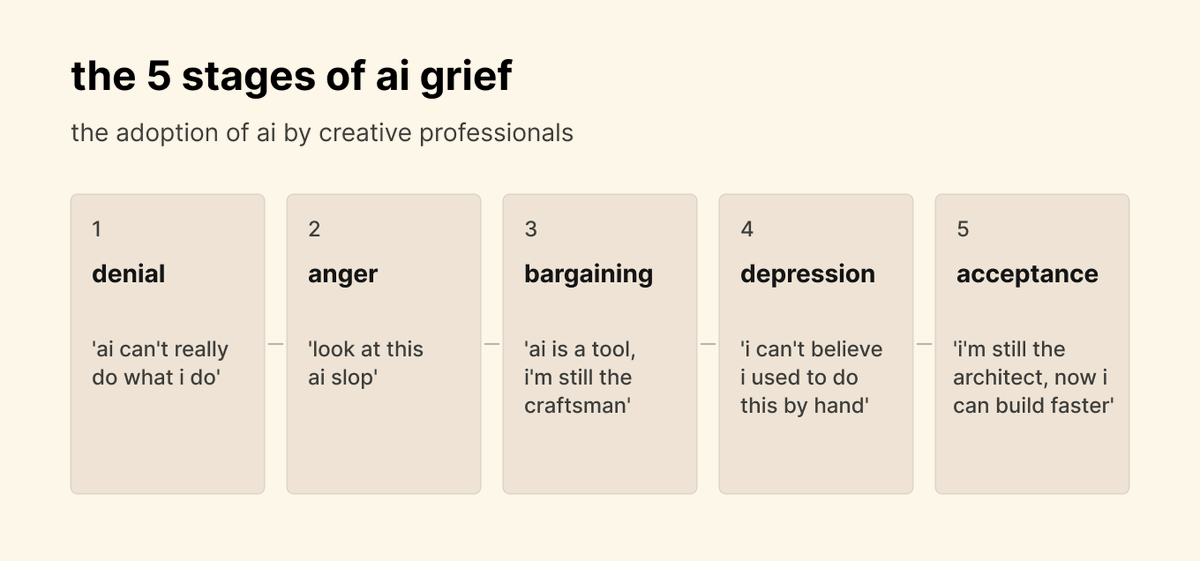
the 5 stages of ai grief
since Claude Design launched, designers are grappling with the same existential recoil as when engineers first saw ai could code. the process maps to the stages of grief.
1. denial.
"but design is more than just producing designs." engineers said the same thing. "coding is more than just writing code." both true.
2. anger.
look how bad the output is. look at the people shipping slop. look at the execs who don't understand what we actually do.
3. bargaining.
it's just a tool. i'll use it for the boring parts and focus on the strategic work. the craft is safe if i stay in charge of it.
4. depression.
i can't believe i used to do all of this by hand. all those hours. all that time.
5. acceptance.
i understand the nuance better than ever. i'm still the architect. and now i can actually build the thing.
as a software engineer and designer of 25+ years, i've watched this cycle from both sides. the designers grieving now are where engineers were 18 months ago.
when our core competency is threatened, we’re quick to defend what’s unique about it, romanticize it, and dig our heels in. what follow is a process of assimilation.
i believe designers will eventually see Figma as an awfully archaic and cumbersome way to explore ideas. most designs already become interactive prototypes, so we'll just get there faster. much faster.
in the end, taste and judgment is still what remains. creating successful work ultimately breaks down to a series of choices that add up to net value creation.
those who win will continue to be involved in the most important choice-making, with a keen ability to discern between what choices are important for the human to make.
think slow, move fast.