I am hereby presenting a selection of prophecies that the Muslim Ummah may experience within the next 2.5 years SEQUENTIALLY.
All these prophecies are derived from hadith, and my role here is solely to outline a possible timeline for their occurrence.
As a brief disclaimer, if this timeline does not unfold as I have outlined, it does not imply that the corresponding hadiths are fabricated. It rather indicates that these events will occur at a different time in future which is beyond my present understanding.
Prophecy 1: Regimes in Persia (Iran) and subsequently in many Arab countries will collapse or experience significant weakening in 2026.
Prophecy 2: A conflict will arise in 2026 in Egypt between the locals and the followers of Abdullah Abd al-Rahman. Abdullah ibn Abd al-Rahman will be a ruler from North Africa (a tall man with a long moustache).
Prophecy 3: A weak successor will be appointed in Sham (region encompassing today’s Syria, Jordan, Palestine, Israel, Lebanon) and he will be removed from his position two years after his pledge of allegiance. I anticipate this figure is Syrian President Ahmed al-Sharaa, and his removal will take place toward the end of 2026.
Prophecy 4: Following the battle in Egypt (between the locals and the army of Abdullah Abd al-Rahman), two armies will confront each other in Syria in 2026: one of which will be led by a ruler named Abdullah, and the other by the ruler Abdullāh Abd al-Raḥmān.
Prophecy 5: The followers of Abdullāh Abd al-Raḥmān will rule over Homs (a city in Syria), for a period of 16 to 18 months beginning in 2026.
Prophecy 6: After a landslide in Harasta (near Damascus), a ruler known as the Sufyani (i.e. from the family of Hazrat Abu Sufyan radiallahu) will emerge. He will overcome most of the rival groups and armies across Sham, Iraq, Iran, Saudi Arabia, Egypt and the wider region during 2027–2028.
Prophecy 7: A comet (or asteroid) will strike the earth during Ramadan 2028 (February 2028). This will be followed by numerous earthquakes, three major landslides, and widespread smoke across the world.
Prophecy 8: After this celestial event, the Euphrates River will uncover a mountain of gold. Large number of people will die in attempting to collect gold, with this occurring between February and May 2028.
Prophecy 9: The people carrying black banners from Khurasan (bordering region of Iran & Afghanistan) will come out in search of Imam Mahdi, and they will prevail across the lands stretching from Beit Lahiya (Gaza) to Harasta (Damascus), between February and May 2028.
Prophecy 10: The army of the Sufyani (that will come to kill Mahdi, his family members & his followers) will be swallowed up in the desert of al-Baydah in the Hejaz region of Saudi Arabia, in May or June 2028.
Prophecy 11: Imam Mahdi will emerge in Makkah, Saudi Arabia, during the month of Muharram 1450 Hijri (around May or June 2028), shortly after the swallowing of the Sufyani’s army.
Ultimately, these projections are shared as a means of reflection and heightened awareness, rather than as a source of fear or absolute certainty. True knowledge of the Unseen and the exact decree of time belongs to Allah SWT alone. As we witness the shifts in our world, our primary focus should remain on strengthening our faith, perfecting our character, and remaining steadfast in our worship.
May we be among those who are prepared in heart and soul for whatever trials or triumphs lie ahead, and may Allah SWT grant us the wisdom to recognize the truth and the strength to follow it.
#Hadith #EndTimes #Sunnah #Sham #Khurasan #MiddleEast #Syria #Iran #Egypt #EndOfTimes #SignsOfTheHour #Qiyamah #Mahdi #Sufyani #BlackBanners #IslamicProphecy #Dajjal #SpiritualAwakening #MustRead #Breaking #Awareness #StayInformed
I am hereby presenting a selection of major prophecies that the Muslim Ummah may experience within the next 2.5 years. These are all derived from hadith, and my role here is solely to outline a possible timeline for their occurrence.
As a brief disclaimer, if this timeline does not unfold as I have outlined, it does not imply that the corresponding hadiths are fabricated. Rather, it indicates that these events will occur at a different time in the future which is beyond my present understanding.
Prophecy 1: A weak successor will be appointed in Sham (region encompassing today’s Syria, Jordan, Palestine, Israel, Lebanon) and he will be removed from his position two years after his pledge of allegiance. I anticipate this figure is Syrian President Ahmed al-Sharaa, and his removal will take place toward the end of 2026.
Prophecy 2: Regimes in Persia (Iran) and subsequently in many Arab countries will collapse or experience significant weakening in 2026.
Prophecy 3: A conflict will arise in 2026 in Egypt between the Egyptians and the followers of Abdullah Abd al-Rahman (a ruler from North Africa who will be a tall man with a long moustache).
Prophecy 4: Following the battle in Egypt, two armies will confront each other in Syria in 2026: one of which will be led by a ruler named Abdullah, and the other by the ruler ʿAbdullāh ʿAbd al-Raḥmān.
Prophecy 5: The followers of ʿAbdullāh ʿAbd al-Raḥmān will rule over Homs (a city in Syria), for a period of 16 to 18 months beginning in 2026.
Prophecy 6: After a landslide in Harasta (near Damascus), a ruler known as the Sufyani (i.e. from the family of Hazrat Abu Sufyan radiallahu) will emerge. He will overcome most of the rival groups and armies across Sham, Iraq, Iran, Saudi Arabia, Egypt and the wider region during 2027–2028.
Prophecy 7: A comet (or asteroid) will strike the earth during Ramadan 2028 (February 2028), followed by numerous earthquakes, three major landslides, and smoke across the world.
Prophecy 8: After this celestial event, the Euphrates River will uncover a mountain of gold. Large number of people will die in attempting to collect gold, with this occurring between February and May 2028.
Prophecy 9: The people carrying black banners from Khurasan (bordering region of Iran & Afghanistan) will come out in search of Imam Mahdi, and they will prevail across the lands stretching from Beit Lahiya (Gaza) to Harasta (Damascus), between February and May 2028.
Prophecy 10: The army of the Sufyani will be swallowed up in the desert of al-Baydah in the Hejaz region of Saudi Arabia, in May or June 2028.
Prophecy 11: Imam Mahdi will emerge in Makkah, Saudi Arabia, during the month of Muharram 1450 Hijri (around May or June 2028), shortly after the swallowing of the Sufyani’s army.
I hereby outlined eleven major prophecies to provide a sequential picture of what lies ahead, without overwhelming you with the many other prophecies that exist between or beyond these prophecies.
May Allah subhanahu wa taala grant all muslims the correct understanding of His religion, protect the muslim ummah from trials and tribulations, and keep us steadfast upon the truth. Subhanaka Allahumma wa bihamdika Ashhadu Allah ilaha illa Anta Astaghfiruka wa Atubu Ilayk.
#Hadith #EndTimes #Sunnah #Sham #Khurasan #MiddleEast #Syria #Iran #Egypt #EndOfTimes #SignsOfTheHour #Qiyamah #Mahdi #Sufyani #BlackBanners #IslamicProphecy #Dajjal #SpiritualAwakening #MustRead #Breaking #Awareness #StayInformed
I’m voting yes on @RepThomasMassie’s
amendment to zero out all aid to Israel, including aid for offensive and defensive weapons like the Iron Dome.
I cannot vote for aid to a country that committed genocide and has used tax dollars to detain Americans like me.
What happened to me in the West Bank was an outrage. But it is nothing compared to what Palestinians face every day.
It is time to share their stories that American politics have silenced and ignored. This is our first video about Palestinians we met.
That time when an unarmed Iranian ship was invited to take part in an Indian naval exercise alongside the United States.
Its sailors were welcomed on land and paraded before Indian President Modi as a gesture of respect.
Then, at the last moment, the United States suddenly abruptly withdrew from the exercise,only to wait and torpedo the very ship it had just stood beside.
What followed was even more grotesque.
After attacking an unarmed vessel, the US refused to rescue the sailors it had blown into the sea, abandoning them to drown.
The grim work of recovering bodies was left to the Sri Lankan Navy.
This wasn’t warfare,it was treachery of the most disgraceful kind: an ambush carried out under the pretense of diplomacy, followed by a cold refusal to show even the most basic human decency to the dying.
It would represent a collapse of every norm that supposedly governs civilized conduct at sea.
And yet, instead of outrage, much of the American media response has been indifference or rationalization.
The bombing of a girls’ school is brushed aside; talk of carpet-bombing Tehran is floated as if it were just another policy option.
When atrocities are normalized and cruelty is laundered into “strategy,” the line between reporting and complicity begins to disappear......
I am hereby presenting a selection of prophecies, based on hadiths, that the Muslim Ummah will experience sequentially in the coming days.
Prophecy 1: Regimes in Persia (Iran) and subsequently in many Arab countries will collapse or experience significant weakening.
Prophecy 2: A conflict will arise in Egypt between the locals and the followers of Abdullah Abd al-Rahman. Abdullah ibn Abd al-Rahman will be a ruler from North Africa (a tall man with a long moustache).
Prophecy 3: A weak successor will be appointed in Sham (region encompassing today’s Syria, Jordan, Palestine, Israel, Lebanon) and he will be removed from his position two years after his pledge of allegiance. I anticipate this figure to be Syrian President Ahmed al-Sharaa who will leave the power by late 2026 or early 2027.
Prophecy 4: Following the battle in Egypt (between the locals and the army of Abdullah Abd al-Rahman), two armies will confront each other in Syria: one of which will be led by a ruler named Abdullah, and the other by the ruler Abdullāh Abd al-Raḥmān.
Prophecy 5: The followers of Abdullāh Abd al-Raḥmān will rule over Homs (a city in Syria) for a period of 16 to 18 months.
Prophecy 6: After a landslide in Harasta (near Damascus), a ruler known as the Sufyani (i.e. from the family of Hazrat Abu Sufyan radiallahu) will emerge. He will overcome most of the rival groups and armies across Sham, Iraq, Iran, Saudi Arabia, Egypt and the wider region.
Prophecy 7: A comet (or asteroid) will strike the earth during Ramadan. This will be followed by numerous earthquakes, three major landslides, and widespread smoke across the world.
Prophecy 8: After this celestial event, the Euphrates River will uncover a mountain of gold. Large numbers of people will die in attempting to collect gold.
Prophecy 9: The people carrying black banners from Khurasan (bordering region of Iran and Afghanistan) will come out in search of Imam Mahdi, and they will prevail across the lands stretching from Beit Lahiya (Gaza) to Harasta (Damascus).
Prophecy 10: The army of the Sufyani (that will come to kill Mahdi, his family members and his followers) will be swallowed up in the desert of al-Baydah in the Hejaz region of Saudi Arabia.
Prophecy 11: Imam Mahdi will emerge in Makkah, Saudi Arabia, during the month of Muharram, shortly after the swallowing of the Sufyani’s army.
Ultimately, these projections are shared as a means of reflection and heightened awareness, rather than as a source of fear. True knowledge of the Unseen and the exact decree of time belongs to Allah SWT alone. As we witness the shifts in our world, our primary focus should remain on strengthening our faith, perfecting our character, and remaining steadfast in our worship.
May we be among those who are prepared in heart and soul for whatever trials or triumphs lie ahead, and may Allah SWT grant us the wisdom to recognise the truth and the strength to follow it.
#Hadith #EndTimes #Sunnah #Sham #Khurasan #MiddleEast #Syria #Iran #Egypt #EndOfTimes #SignsOfTheHour #Qiyamah #Mahdi #Sufyani #BlackBanners #IslamicProphecy #Dajjal #SpiritualAwakening #MustRead #Breaking #Awareness #StayInformed
@PressTV But this time unfortunately is different as per Hadith. Iran and many Arab countries will be destroyed almost consequently with Iran getting destroyed first.. see my pinned post for sunni list of chronological prophecies happening until mahdi
@JamesJstuartb@Tasnimbrk Because we have Hadiths that say about the start and end of a particular trial that will befall on the nation of prophet Muhammad in the end time and same Hadiths also mention the timeline between the start and end of that trial
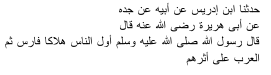
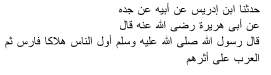
There is a hadith in Kitab al Fitan that predicts the fall of Persia in the end time. The hadith further says about the fall of Arab countries immediately after that. Looks like these prophecies will materialise this year. See my pinned post for 11 prophecies leading to Imam Mahdi and first one of these 11 talks about the fall of Persia and other Arab countries. The hadith is attached herewith
Respected brother Zulfiqar: I wish to let you know about a hadith from Kitab al Fitan that predicts the fall of Persia in the end time. The hadith further says about the fall of Arab countries immediately after that. Looks like these prophecies will materialise this year. See my pinned post for 11 prophecies leading to Imam Mahdi and first one of these 11 talks about the fall of Persia and other Arab countries. The hadith is attached herewith
The following article highlights a few primary theological and methodological contradictions found within modern Wahhabi discourse, presenting critical questions that Wahhabi scholars remain unable to answer:
1. Wahhabi scholars are unable to answer why they textually elevate religious innovation (bid‘ah) to the position of the second greatest sin after shirk, despite lacking explicit scriptural justification for this specific ranking. While the Qur'an and Sunnah emphatically condemn shirk and explicitly categorise major sins (Kaba'ir) such as, murder, magic, interest (riba), and misbehaving with parents, nowhere in the Quran and Sunnah is bid‘ah explicitly codified as the second most severe transgression. By inventing a rigid theological hierarchy not explicitly defined by the Lawgiver, does this methodology not inadvertently commit the very act of unauthorised textual innovation it claims to fight?
2. Wahhabi scholars are unable to answer why they consider the majority or a significant portion of the Ummah are engaged in shirk, while Rasulullah ﷺ clearly stated in Sahih al-Bukhari: “By Allah, I am not afraid that you will worship others along with Allah after my death”.
3. Wahhabi scholars are unable to answer the theological inconsistency in their absolute prohibition of tawassul (seeking intercession) via the righteous deceased. While their paradigm strictly condemns asking Allah SWT through the status of the Prophets, the truthful (Siddiqin), the martyrs, and the righteous (Salihin) as a form of shirk, it completely ignores a vast corpus of authentic classical texts confirming that these noble souls remain conscious and actively pray for the living. Since traditional Islamic theology establishes that the intercession (shafa'ah) and supplication (du'a) of the deceased righteous are real, ongoing realities, on what consistent theological grounds do these scholars criminalise the living for merely seeking the benefit of those very prayers?
4. Wahhabi scholars are unable to answer a fundamental question regarding the scope of their textual reliance: If Imam al-Bukhari evaluated approximately 600,000 hadith narrations but selected only around 7,000 (including repetitions) for his Sahih, what is the status of the remaining 593,000 narrations? By restricting their methodology to a narrow corpus of hadiths, these scholars overlook the overwhelming majority of the same that early classical jurists relied upon to comprehend the Sunnah and derive Islamic rulings.
5. Wahhabi scholars are unable to answer a critical question regarding the original intent of the early scholars: When Imam al-Bukhari filtered hundreds of thousands of narrations to isolate the highest tier of authenticity for his Sahih, did he ever intend for Muslims to dismiss all remaining narrations as "innovations" or entirely "unsuitable for practice"? If not, on what methodological grounds do Salafi/Wahhabi scholars reject many hadiths found in many classical collections, simply because they do not meet the uniquely stringent criteria set by Bukhari or Muslim?
6. Wahhabi scholars are unable to answer the inherent contradiction in their stance on legal conformity (taqlid). Historical accounts indicate that Imam al-Bukhari memorised between 100,000 and 300,000 authentic hadiths, yet preserved only a small fraction of them within his Sahih. Because subsequent generations do not possess the vast majority of the narrations he committed to memory, contemporary Muslims must completely rely on his personal expert judgment regarding what is authentic. If relying on his authentication is, in practice, a form of taqlid of Imam al-Bukhari, then on what consistent basis do these same scholars criticise the taqlid of the major Imams of fiqh (jurisprudence)?
7. Wahhabi scholars are unable to answer how a layman can practically resolve conflicting textual evidence without a structured legal framework. For instance, authentic narrations exist supporting both the loud and the quiet recitation of the Bismillah, just as authentic narrations lead to differing conclusions on whether touching one's spouse invalidates wudu. If an ordinary Muslim bypasses the established madhhabs to derive rulings directly from these texts, how can they reconcile such contradictions without inadvertently creating a highly subjective, personal madhhab?
8. Wahhabi scholars are unable to answer the critical epistemic flaw inherent in bypassing the traditional chain of learning. When a Muslim who lacks mastery of classical Arabic and the foundational principles of Usul al-Fiqh (legal theory) reads an English or Bengali translation of a hadith to independently derive rulings, are they truly following the Prophet ﷺ directly? Or are they, in reality, merely following their own limited, uneducated interpretation of a translator's subjective rendering of the text?
9. Wahhabi scholars are unable to answer what systemic safeguards exist to protect the integrity of Islamic law under their paradigm. If every Muslim is encouraged to bypass the traditional framework and independently derive rulings directly from hadith books, what prevents unqualified individuals from misinterpreting texts and declaring lawful matters forbidden, or forbidden matters permissible? By eroding the authority of highly developed and regulated schools of jurisprudence, does this methodology not inevitably risk replacing a rigorous scientific tradition with an anarchy of personal interpretations shaped by casual internet searches and superficial study?
10. Wahhabi scholars are unable to answer the deep historical and methodological contradiction regarding authority and scholarship. When ordinary Muslims are discouraged from following the established legal schools of Imam Abu Hanifa, Imam Malik, Imam al-Shafi'i, or Imam Ahmad ibn Hanbal under the guise of "following the evidence," they are instead directed to rely on modern figures like Sheikh al-Albani, Sheikh ibn Baz, or Sheikh ibn al-Uthaymeen to determine textual authenticity. Why is dependency upon contemporary scholars framed as adhering to evidence, while following the foremost jurists of the righteous early generations (Salaf) is condemned as blind imitation (taqlid)?
This contradiction fundamentally undermines their claim to the title "Salafi." By definition, the four Imams are from the true masters of the Salaf, having lived in or immediately adjacent to the golden eras of Islam. By discarding their classical methodologies in favour of the foundational shifts introduced by 17th or 20th century scholars, this movement is not following the Salaf at all; rather, they are practicing taqlid of the Khalaf i.e. the later generations while ironically using the name of the Salaf as a badge of exclusivity.
11. The Prophet ﷺ said:
“O Allah, bless our Shaam. O Allah, bless our Yemen.”
The people said:
“And our Najd?”
The Prophet ﷺ again said:
“O Allah, bless our Shaam. O Allah, bless our Yemen.”
The people again said:
“And our Najd?”
On the third occasion, the Prophet ﷺ did not pray for Najd, but instead said:
“There are earthquakes and tribulations, and from there emerges the horn of Satan.”
This narration is recorded in Sahih al-Bukhari.
Another narration in Sahih Muslim further strengthens the geographical identification. The Prophet ﷺ stood near the house of Aisha bint Abi Bakr and pointed towards the east, saying:
“Indeed, tribulation is there. Indeed, tribulation is there, from where the horn of Satan emerges.”
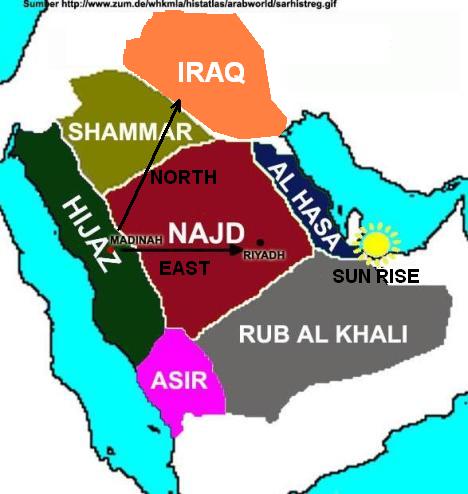
From Madinah, the eastern direction points directly towards the Najd region of central Arabia. This narration becomes highly significant because the Prophet ﷺ not only mentioned the region verbally, but physically indicated its direction.
One of the greatest contradictions within Wahhabi theology appears in their treatment of the hadiths regarding Najd. Wahhabi methodology constantly insists upon literal interpretation of texts, specially regarding the Attributes of Allah SWT. Metaphorical interpretation is frequently condemned as deviation. Yet when confronted with this authentic narration from Sahih al-Bukhari, many Wahhabi writers abruptly abandon literalism and claim that “Najd” does not actually refer to Najd, but instead refers to Iraq.
This selective literalism exposes a glaring inconsistency. Literal interpretation suddenly becomes flexible whenever the apparent meaning creates discomfort for the movement’s historical origins. If texts must always be understood according to their apparent wording, then why is that principle abandoned here? Why is metaphorical reinterpretation acceptable when it serves to distance the movement from a region explicitly mentioned in the hadith?
Linguistically, this defence is extremely weak. The Prophet ﷺ was in Madinah addressing Arabs who clearly understood the geography of Arabia. In classical Arabic usage, Najd referred to the elevated central region of the Arabian Peninsula. To claim that the Prophet ﷺ actually intended Iraq instead of Najd forces an unnatural reading onto the text and implies that the Companions somehow misunderstood a straightforward geographic reference.
The inconsistency becomes even more obvious when examining the wording of the narration itself. In the very same sentence, the Prophet ﷺ mentioned Shaam, Yemen, and Najd. Wahhabi scholars accept that Shaam literally means historical Shaam (encompassing Jordan, Syria, Palestine, Lebanon & occupied territories) and Yemen literally means Yemen. Yet when it comes to Najd, suddenly the same literal approach is discarded. There is no consistent linguistic, grammatical, or methodological basis for treating the third geographic term differently from the first two.
Another important question arises from the narration in Sahih Muslim where the Prophet ﷺ physically pointed eastward from Madinah. Iraq lies northeast from Madinah, whereas the Najd plateau lies directly east of Madinah. If the Prophet ﷺ intended Iraq specifically, why would he repeatedly use the term Najd instead of Iraq, specially when Iraq was already a known region during the lifetime of the Companions?
Furthermore, many Wahhabi scholars themselves acknowledge in other contexts that Najd historically refers to the central Arabian plateau. When discussing genealogy, geography, or tribal history, they use the term in its obvious and literal meaning. Yet when this hadith is discussed, the meaning suddenly changes. This inconsistency suggests that the reinterpretation is motivated more by theological discomfort than by objective scholarship.
Another logical problem appears when Wahhabi writers argue that “Najd” can refer to any elevated land east of Madinah. If this broad and flexible interpretation is accepted, then the hadith still includes the Najd region of Arabia because it is the most famous and central elevated eastern land relative to Madinah. Therefore, the argument does not actually exclude central Arabia, but unintentionally includes it even more strongly.
There is also the question of historical outcomes. The hadith mentions tribulations, extremism, and the horn of Satan emerging from Najd. Centuries later, one of the harshest takfiri movements in Islamic history emerged precisely from Najd and proceeded to excommunicate and fight large sections of the Muslim Ummah. Critics therefore argue that the historical reality appears far closer to the apparent wording of the hadith than the later reinterpretations attempting to redirect it elsewhere.
Muslims therefore argue that these reinterpretations are not driven by consistent scholarship, but by attempts to shield the historical origins of the Wahhabi movement from authentic narrations found across numerous hadith collections with varying wordings that collectively point towards the same region and the same pattern of tribulation.
This is another significant issue that the Wahhabi scholars are unable to answer.
12. On the authority of Abdullah ibn Umar (ra), the Messenger of Allah ﷺ said: "In the end of times, a man will emerge from the town of Musaylamah, the Liar, who will alter the religion of Islam."
This narration is recorded by Imam al-Tabarani in Al-Mu'jam al-Kabir, Imam Abu Ya'la al-Mawsili in his Musnad and Imam al-Haythami in Majma' al-Zawa'id.
Wahhabi scholars are unable to answer how precisely Muhammad ibn Abd al-Wahhab fits the geographic and descriptive profile of this prophecy. Born in 'Uyaynah within the region of Al-Yamamah (Najd), the exact homeland of Musaylamah, the Liar, he initiated a movement that fundamentally altered the practice of Islam by branding centuries of mainstream Sunni consensus, classical jurisprudence, and traditional spiritual practices as forms of polytheism (shirk). By dismantling the historical framework of the religion from this specific locality, do his actions not perfectly match the textual warnings left by the Prophet ﷺ?
If the Prophet ﷺ specifically singled out the region of Al-Yamamah/Najd as a breeding ground for severe trials, earthquakes, and a figure who would alter the religion, how can his historical crusade be reconciled with such explicit warnings? Furthermore, why should the global Muslim Ummah accept a reform movement as the ultimate truth when it originated exclusively from the very locality prophesied to produce religious subversion?
@Megatron_ron My pinned post predicted months ago how Iran and other gulf countries will be destroyed in 2026. Prophecies are revealing as per Hadith..