Bitcoin, security, and power systems. Adversaries, incentives, and the gap between how systems work and how people think they work.
Bitcoin ad infinitum
Nearly eight months into the Iran war, Brent crude is back above $110 a barrel. Gas is averaging $4.27 a gallon. no meaningful direct relief in sight.
Americans left holding the bill.
https://t.co/OTQbupC01w
@BeccaAmilee It's efficiency. EV drivers quickly and naturally get to understand basic physics- kinetic energy increases with the square of speed. A heavy foot means more energy consumed, more energy lost to braking, and fewer miles per charge or tank.
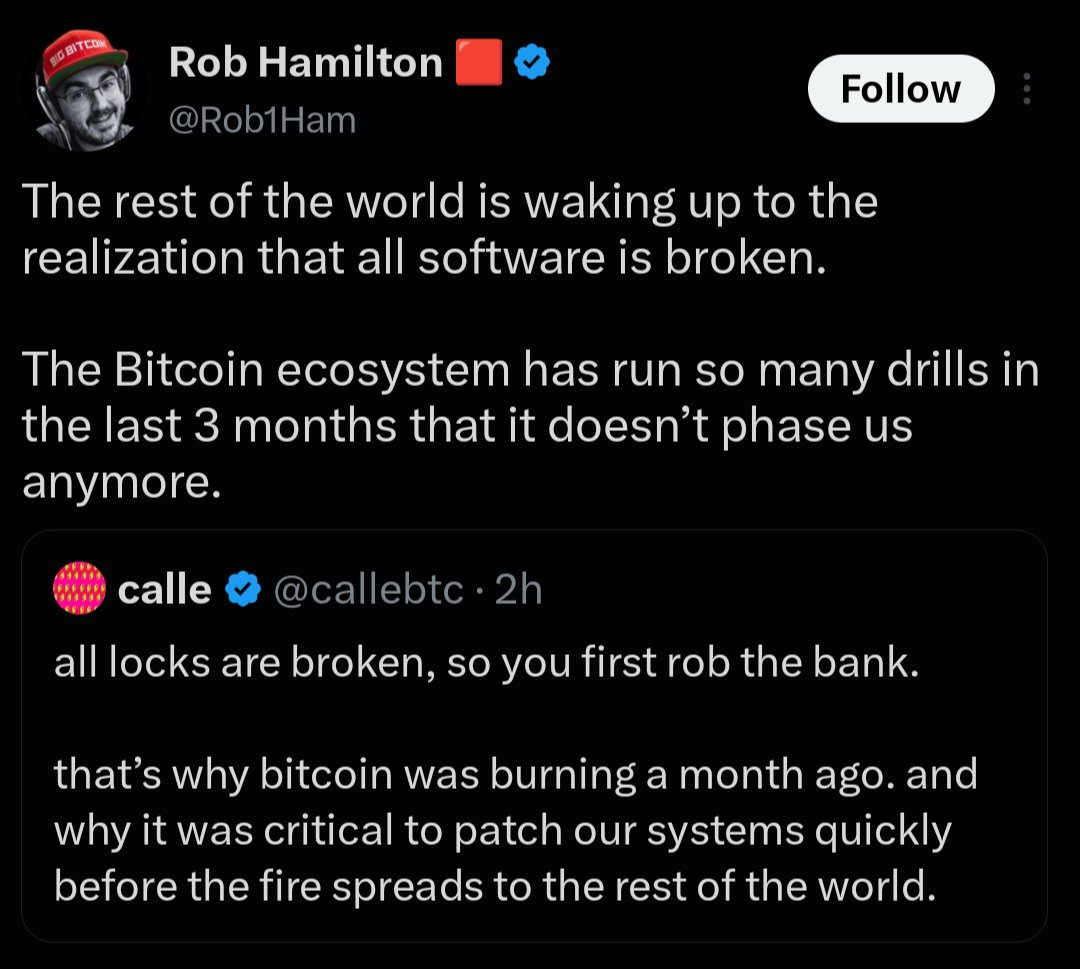
The story Bitcoin is telling itself goes like this. Kimi arrived, Coldcard got hit, the Red Team mobilized, and now we're battle tested. Most of that story is wrong. Kimi trailed frontier models that were already out, and the Red Team scanned 390 repos for about $40,000 of compute. That was available all along. The ecosystem waited until Coldcard cost self-custody users $100 million to pay for it, and Ledger users lost roughly another $90 million this month.
Code is also the smaller attack surface. The bigger one is the social graph. The opening strike on Iran killed its top leadership in one morning. In Venezuela the US went after one man. The fewer people a system depends on, the less force it takes to break it. Five people hold merge access to Bitcoin Core, and Brink's own report shows one of them merged 56% of all changes in 2025. The usual answer is that miners and nodes decide, not maintainers. Three pools produce roughly 63% of all blocks, and a small set of exchanges and custodians decide which rules stick. Add the five maintainers and everyone who decides Bitcoin's rules fits in one conference room. Nobody needs to break the code if they can pressure, capture, or replace the people in that room.
Harden the graph the way we harden code, by removing single points of failure. Put the rules in a written spec, which the Orange Paper does. Run enough independent implementations that two can be compromised and the network still holds. Let miners build their own block templates. End self-merge and make exit cheap. Bitcoin solved consensus between machines. It still hasn't solved consensus between the people who write the code, run the pools, and operate the nodes. I've been red teaming that room, and the findings are public. Nobody else has picked it up.
https://t.co/oeqTp0WeMP