Had this conversation with my parents a few days ago and was called insane for it, then proceeded to explain to them the entire “happy medium” reason behind 16:9 and how both productivity and media are screwed over by it.
SaaS cost vs functionality:
$10/mo - works flawlessly
$100/mo - jank but saves your HR people a lot of time
$1000/mo - barely usable. If you cancel it your sales department will quit en masse
$10k/mo - only ever touched by the kinda smelly guy who insists on working solo in the supply closet. He never got migrated to the new payroll system, CTO just cuts him a check from Mercury manually every month. Everyone just calls him Linux Dave.
$100k/mo - doesn't even resemble software. Nobody knows what it does but it's generally understood your entire business goes to zero if you forget to renew it
$1,000,000/mo - you are the national government. You're required by law to give Larry Ellison a blowjob yacht every quarter. Cancelling it would have no effect whatsoever but would result in a decade-long legal battle and your entire department mysteriously transferred to licking stamps in the Mold Dungeon until they all quit.
@donn_red@VermaAakash3 Well, having tried Lovable myself it's surprisingly good, but not sure if it works the same way OP claims it to be (i.e. replicable)
@d4m1n For coding workflows, is it possible that they use context caching in some way to reduce the cost on their end? I'm also running dozens of tool calls and find that it's impossible for them to be profitable at this point.
Native scroll-driven animations engine is live!
Webstudio is the first builder to leverage the latest web standard — the Scroll Timeline API — which allows animations to run at 120 FPS off the main thread.
https://t.co/WkmQQ5htLq
What is ailing the software job market is not AI taking away jobs (not yet anyway).
Here is my thesis, as a participant and observer of software for 30 years. Over those 30 years:
1. Massive over-capacity steadily developed in enterprise software due to a flood of VC, PE and IPO money.
2. Software vendors applied liberal doses of marketing spending to spread Fear (of missing out) and Uncertainty ("tech is changing, you need us") and Doubt ("are you confused? trust us") among corporate customers and the result was ever growing IT spending. Enterprise IT budgets kept rising because which CIO or Board would want to be seen as lagging? Major corporations in the West have layers and layers of duplicated IT systems, lots of money spent to acquire them and even more money spent to get the disparate systems to work together. The more inefficient IT systems ended up becoming permanent resource drains, requiring vast human resources to simply keep them running.
3. Large enterprises in the West found those needed human resources in India - transferring those inefficiencies to IT services firms in India, often multiplied by 3 or even 4! That "multiplied inefficiency" happened because IT budgets were kept fixed in dollar terms and more people got hired in India to "get more done".
Result? A large number of IT jobs in India came to depend on those original inefficiencies and the multiplied inefficiencies.
4. Note how Indian banks and financial institutions are more IT savvy, while spending far less, than established financial majors in the US - Indian firms did not have the budgets to splurge! Necessity made them highly efficient and today India's financial institutions are able to fend off foreign competition easily.
5. One of the deep facts about software is that often a 2 person team can solidly outperform a 20 person team and a 10 person team can do the work of a 200 person team. This is not just due to talent disparity - even when the large teams have equivalent talented people, they can easily end up being wasted on unproductive projects.
6. When people are billed by the hour or by the staff month (input metrics), as it happens often in IT services, there is zero incentive to remove those inefficiencies, to empower the 2 person team as opposed to hiring 20.
It is those multiplied inefficiencies in IT, built up over decades, that is facing a reckoning now.
Now enter AI. A large amount of code is boilerplate code in many projects and AI can eat such code for breakfast. Depending on the nature of a project AI can offer 10-20% productivity gains. Significant but not the 10x or 100x leap yet to destroy jobs on a vast scale.
But those AI gains of today pale in comparison to the "multiplied inefficiencies" built up over decades.
This reckoning nearly happened in the aftermath of the Global Financial Crisis (GFC 2008-9). It got postponed because the central banks flooded the world with money and a part of that money flooded into enterprise IT.
The pandemic unleashed another flood of money into enterprise IT.
Those floods are now history and we have a serious drought.
That is why I am pessimistic about the software job market, even before accounting for AI.
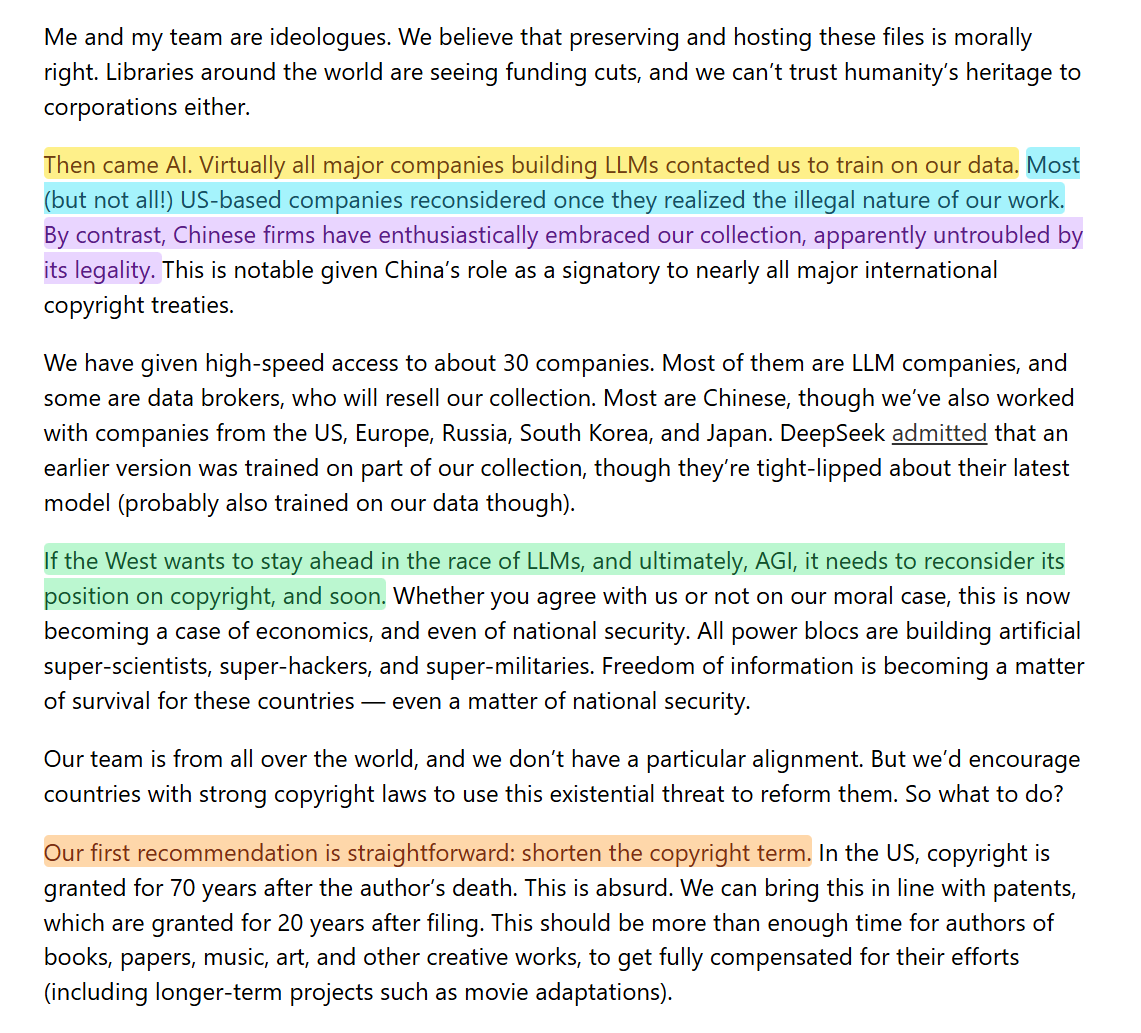
Sci-hub, Libgen, and Anna's Archive are services you can use to pirate books and scientific papers.
The creators of these services are committed to opening up copyrighted works, despite legal risk.
They're now advising the West to fix copyright law or lose the AI race.
When I was young I fixed my parents’ computer and now that I’m older I fix computers for my kids. Are we the only generation that knows how computers work?
PayPal is updating their ToS to let themselves give your data to merchants starting Nov & they're banking on people not knowing to opt out, SO to opt out before they start: go to Settings >Data & Privacy > Manage shared info >Personalized shopping, & toggle that shit off