$MU $DRAM $SNDK A Bloomberg journalist just asked @MicronCEO a $200 billion dollar question today
Q: Is Micron overbuilding? Could the next bust be coming?
A: Sanjay's answer centered on one word. Discipline. The shell gets built. How it gets equipped depends on real time demand assessments. His exact words: "bring up this supply with discipline." That is not a company repeating the mistakes of previous cycles. That is a company that learned from every single one of them.
Full Question:
"Historically, memory is a cyclical business. Right? Periods of boom, periods of bust. I'm wondering if a $200,000,000,000 investment here in The US signals perhaps more of a confidence that that demand, that high demand is going to be permanent, or are there concerns here that, the industry could be overbuilding capacity?
Sanjay's Full Answer:
"What we are doing is building these fabs, which are very long lead time item, as you can see in in terms of what we are doing at Boise and New York, it really takes several years just to build, construct the shell. How we equip that shell [empty cleanroom] really very much depends on our latest assessments of demand at a given time. So important thing is to have that preparedness to meet the market demand, and memory has become a key enabler. It is a strategic asset for AI across consumer as well as data center industries. Because without memory, you don't really have that intelligence that is critically import important for the future road maps that our customers have.
"Our investments, of course, will always be managed with discipline. Today, we are able to meet the demand of our key customers only about 50% to about two thirds in many cases. And it's really important that we, of course, bring up this supply with discipline and continue to really, fuel the growing demand provide and serve the necessary demand that is ahead."
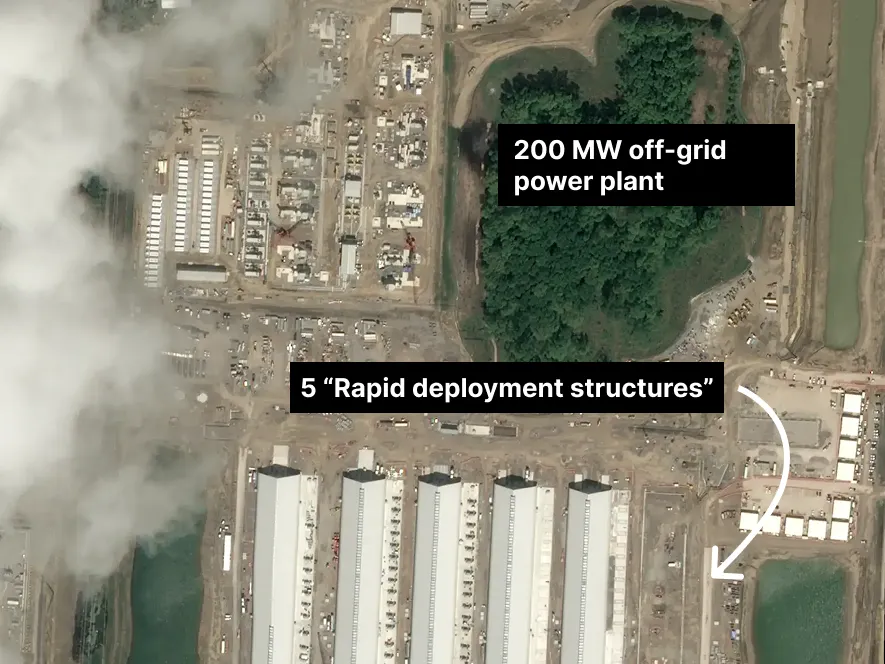
Meta is building dozens of massive tents at campuses across the US, sticking billions of dollars of chips inside, and powering them with off-grid turbines.
The AI race has officially entered its Mad Max phase.
Over the last month, I reviewed hundreds of documents and satellite images for Cleanview's latest report on behind-the-meter data centers. Meta's data center strategy, which is very visible from space, was one of the weirder approaches I came across.
Mark Zuckerberg recently ditched the data center designs that Meta had perfected over the last decade and told his team to stick tens of thousands of chips in tents outside their data center in New Albany, Ohio. Each of these chips costs about $60,000. Zuckerberg plans to stick billions of dollars worth of them in the tents.
The strategy has helped cut the time to build compute in half. The first five buildings at Meta’s New Albany, Ohio data center took between two and three years to build. Meta started building five ~125,000 square foot tents between April and June of 2026, according to city permits. Satellite images show the structures have all been built.
To power those "rapid deployment structures", as they are officially named, Meta signed a 10-year deal with Williams to build a pair of 200 MW off-grid power plants. Those power plants began construction about a year ago and are nearly complete.
Meta is using the same strategy to build a data center in Tennessee, bringing the total count of tent data centers to three.
Strategies like this are part of the reason behind-the-meter data center capacity is growing so quickly.
In Cleanview's report, I found that there's currently about 2 GW of BTM capacity online today. By the end of the year, it will likely be 3 GW—equivalent to three nuclear power plants. By the end of 2027, it could be as high as 13 GW—more than the power demand of NYC.
I've been talking to a lot of reporters about this research. When I told one reporter about these tents and other companies powering their data centers with jet engines, he said, "It's like a scene out of the movie Mad Max."
He just did it again.
$NVDA CEO keeps telling you which stocks to buy.
In 2025 he called:
$INTC at $18 → $114 (+533.33%)
$AMD at $78 → $516 (+561.54%)
$ONDS at $0.7 → $13 (+1757.14%)
$GOOG at $144 → $376 (+161.11%)
$SNDK at $99 → $1,694 (+1628.57%)
Now he’s telling you to buy space stocks:
$RKLB at $143
$ASTS at $113
$PL at $51
$SIDU at $4
Are you going to ignore him again?
If you’re not following us with notifications turned on, you might miss our next alerts.
Andrej Karpathy spent 4 minutes in an interview explaining a single idea
about how most people haven’t even started learning how to use AI
and everyone paying $20/month for a subscription.. that's not really using Claude at all
his point is that the real skill gap is the ability to build with AI
he identified 4 behaviors that break Claude Code and put them all into one file
a developer expanded it into 21 rules and published it - 82,000 stars and #1 on GitHub Trending
coding accuracy jumped from 65% to 94%
here's what these 21 rules actually are and why most developers using Claude every day have never configured them
the full breakdown is covered in the article below 👇
Ex-Citadel analyst and Millennium PM revealed what $500K/year hedge fund life actually costs you - he turned down Citadel's return offer to find out.
Doug Garber worked at Citadel as an analyst, ran his own pod at Millennium, then turned down a return offer from Citadel to build something of his own
- he spent years inside both of the most competitive multi-manager funds on earth and has never given an interview like this before
you will watch 53 minutes of the most honest Citadel vs Millennium comparison ever put on camera:
centralized machine vs entrepreneurial pods, why the best PMs leave, and what $500K/year actually costs you personally
Bookmark & watch - then ask yourself if you'd turn down Citadel the way he did.
Some more Mythos cybersecurity nuggets:
A) The model is so good at hacking that users with *zero* formal security-training could find and exploit sophisticated code vulnerabilities, some of which were 10 or 20 years old.
B) They didn't even train the model for cyber capabilities. It simply developed them from general improvements in code, reasoning, and autonomy. Sounds AGI-esque.
C) Anthropic believes it must give security companies a head-start in understanding and applying Mythos, to ensure Defenders have the upper hand versus Attackers over the short and long-term.
It's easy to take @DarioAmodei for granted. But we should all be thankful that the #1 frontier AI company in the world is taking responsibility and safety so seriously.
Medical oncology is witnessing a transformative shift with histotripsy, an innovative, incision-free therapy that uses precisely focused ultrasound waves to mechanically disintegrate liver tumors.
Developed over two decades at the University of Michigan and commercialized by HistoSonics through the Edison system, this approach creates microscopic "bubble clouds" within the tumor tissue. These bubbles rapidly expand and collapse, producing intense mechanical forces that liquefy and destroy cancerous cells at the cellular level—without heat, radiation, or surgical cuts.
Unlike conventional treatments such as surgery, ablation, or radiotherapy, histotripsy is entirely noninvasive and highly targeted. Real-time imaging guides the ultrasound pulses to spare adjacent healthy liver tissue and vital structures. The outpatient procedure often allows patients to return home the same day, minimizing recovery time, pain, and risks associated with invasive interventions. It is particularly valuable for individuals with inoperable primary liver cancers (like hepatocellular carcinoma) or metastases from colorectal, breast, or other sites.
Clinical evidence from pivotal trials, including the international #HOPE4LIVER studies, has been compelling. The trials achieved a technical success rate of approximately 95% in fully targeting and ablating tumors, with low major complication rates (around 6-7%).
Longer-term follow-up data indicate strong local tumor control, with rates approaching 90% at one year in many cases, alongside favorable safety profiles. These results supported the U.S. FDA's clearance of the Edison system in late 2023 for treating liver tumors, accelerating its adoption at centers worldwide. By early 2026, thousands of patients have undergone the procedure, with ongoing expansions to other organs like kidneys and pancreas in clinical trials.
This "sound-based surgery" marks a paradigm change from destructive "cutting and burning" methods to gentler, precision-guided disruption. As research progresses, histotripsy holds promise for broader applications, potentially enhancing immunotherapy responses and improving outcomes for patients facing limited options.
[Ziemlewicz, T. J., et al. "The #HOPE4LIVER Single-arm Pivotal Trial for Histotripsy of Primary and Metastatic Liver Tumors." Annals of Surgery, vol. 282, no. 6, 2025, pp. 908–916. (1-year outcomes, local control rates, and efficacy data.)]
Ex-Point72 Proprietary Research Head Kirk McKeown on building edge, alpha decay, & why everything that happened on Wall Street is about to happen on Main Street.
Kirk McKeown (8.5 years @ Point72 under Steve Cohen | Built primary research at Glenview under Larry Robbins | Now founder of Carbon Arc @CarbonArcAI)
"Alpha rewards those who value assets in a cold way. You want to get it right — not be right."
We cover:
- How alpha creation differs across multi-manager vs. concentrated shops
- The 3 vectors every middle office function must move to justify its existence
- Why he worked 6-hour Sundays from 2006-2020 — and the math behind it
- The TSMC call that signaled semiconductor cancellations before anyone else knew
- What the quant revolution on Wall Street tells us about the AI economy today
- His framework: 4 market structures, 9 business models, & why they have rules
- The MIT beer game & why every business problem is really an inventory problem
- His hot take: a top hedge fund launches an enterprise AI lab in 2026
Highlights:
00:00 Intro
04:47 Tutor vs Glenview vs Point72: how edge differs
12:29 How to build “lift” for PMs: at-bats, hit-rate, sizing
18:44 Building research edge: outwork, read, fieldwork
27:16 Personal moat in 2026: analogs, history, decision trees
40:08 “Main Street becomes Wall Street”: what that actually means
44:30 Carbon Arc thesis: “decimalization” of data market structure
46:43 Why the edge migrates to data plus domain context
51:00 How to win in commoditized research: sample size beats anecdotes
01:03:26 Factorizing everything: themes, market structure, business models
01:08:37 Pruning decision trees: signals, scale points, inventory dynamics
01:14:18 Contrarian 2026 take: hedge funds launching enterprise AI labs
01:23:32 Final question: one habit to build career alpha
Palantir CEO Alex Karp just exposed the absolute mathematical failure of the American education system.
We’re actively filtering out our apex builders.
The system is still training the biological workforce to be compliant, administrative cogs for an industrial machine that superintelligence is currently overwriting.
Karp: “All of our tests are built around things that were valuable in the Industrial Revolution.”
Sitting perfectly still and memorizing compliance metrics is a zero-margin commodity.
The highest-output operators of the next decade are the exact people the archaic system actively punishes.
The neurodivergents. The dyslexics. The hyper-kinetic builders.
Karp: “Everybody who can’t sit or needs to build or wants to build have to go into a separate slot.”
Don’t force apex cognitive talent to beg for a mid-level banking job at Goldman Sachs.
Weaponize their chaotic, non-linear execution to build the physical infrastructure of the future.
And here’s the brutal reality check.
Karp: “Vocational training in Germany is very technical. The people building the cars at BMW or even in the French version Airbus, very complicated jobs, they didn’t go to college. They went to a very, very high-end high school. And they come out without any debt.”
The elite establishment treats vocational training as a biological failure state.
It’s the ultimate sovereign moat.
We’re mass-producing millions of debt-saddled knowledge workers whose entire skill set is about to be absorbed by an LLM.
The algorithm cannot manufacture a jet turbine.
It cannot secure a power grid.
The nations that win the next decade will completely bypass the bloated university system.
Aggressively route the highest-IQ operators directly into elite, zero-debt physical execution.
Karp: “You also need to change our testing system. Different forms of intelligence. Pull out all the dyslexics, all the neurodivergent.”
Standardized testing doesn’t measure cognitive velocity.
It measures biological obedience.
The system measures the entire species on a single, archaic axis of compliance.
Fail to sit in a chair and memorize the curriculum?
The system discards you.
The AI arms race won’t be won by compliant valedictorians who are excellent at filling out rubrics.
It’ll be won by hyper-obsessive, neurodivergent builders who mathematically cannot tolerate the friction of a traditional classroom.
By actively filtering these operators out, the current education system is bleeding out its most valuable resource.
And it doesn’t even know it’s doing it.
Karp: “We should have gotten you before you got turned down at Goldman and said this is a waste of your time. You could be building something important.”
Identify the builders before the system breaks them. Hand them the compute.
Because the system is filtering out the exact people who will build what replaces it.
They won’t come back to reform it. They won’t ask for permission.
They’ll just build over it.
And they already started.
i can't believe nobody caught this.
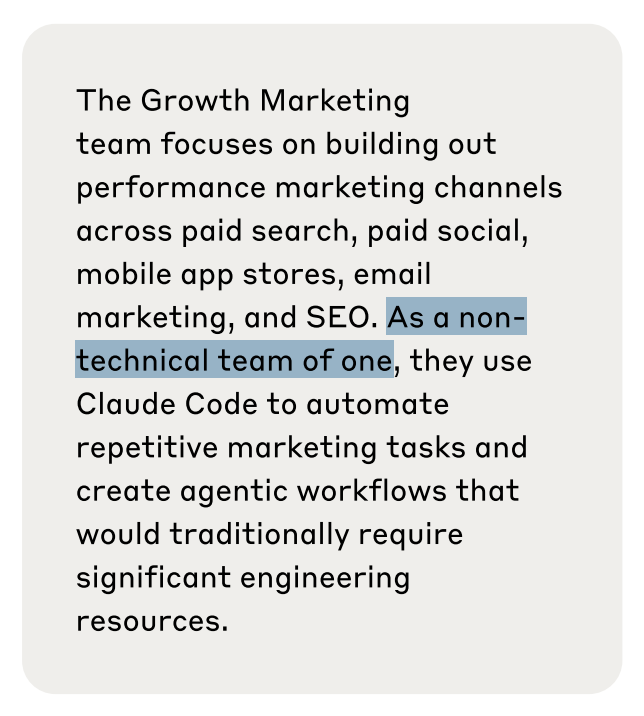
Anthropic's entire growth marketing team was just ONE PERSON
(for 10 months, confirmed)
a single non-technical person ran paid search, paid social, app stores, email marketing, and SEO for the $380B company behind claude
here's exactly how one human is doing the job of a full marketing team:
it starts with a CSV.
1. he exports all his existing ads from his ad platforms along with their performance metrics (click-through rates, conversions, spend, etc)
2. feeds the whole file into claude code
3. and tells it to find what's underperforming.
claude analyzes the data, flags the weak ads, and generates new copy variations on the spot
this is where he gets clever:
he then splits the work into 2 specialized sub-agents:
1. one that only writes headlines (capped at 30 characters)
2. and one that only writes descriptions (capped at 90 characters).
each agent is tuned to its specific constraint so the quality is way higher than cramming both into a single prompt
so now he's got hundreds of fresh headlines and descriptions.
but that's just the text.
he still needs the actual visual ad creative, the images and banners that go on facebook, google, etc.
so he built a figma plugin that:
1. takes all those new headlines and descriptions
2. finds the ad templates in his figma files
3. and automatically swaps the copy into each one.
up to 100 ready-to-publish ad variations generated at half a second per batch.
what used to take hours of duplicating frames and copy-pasting text by hand
so now the ads are live.
the next question is which ones are actually working.
for that he built an MCP server (basically a custom integration that lets claude talk directly to external tools) connected to the meta ads API.
so he can ask claude things like:
• "which ads had the best conversion rate this week"
• or "where am i wasting spend"
and get real answers from live campaign data without ever opening the meta ads dashboard
and the part that ties it all together and closes the loop:
he set up a memory system that logs every hypothesis and experiment result across ad iterations.
so when he goes back to step one and generates the next batch of variations...
claude automatically pulls in what worked and what didn't from all previous rounds.
the system literally gets smarter every cycle.
that kind of systematic experimentation across hundreds of ads would normally need a dedicated analytics person just to track
the numbers from the doc:
ad creation went from 2 hours to 15 minutes. 10x more creative output.
and he's now testing more variations across more channels than most full marketing teams
a $380 billion company.
and their entire growth marketing operation (not GTM) = just one person and claude code lol
truly unbelievable
Breaking: OpenAI fired Leopold Aschenbrenner at 22. Three years later, he manages $5.5 billion.
And is quickly becoming one of the best AI investors out there
Today, we're launching a tracker to trade alongside his picks, automatically. Here's his full portfolio:
1. Power & Energy:
$BE — Bloom Energy (29%) → fuel cells powering data centers
$EQT — EQT Corp (4%) → largest US natural gas producer
$CRWV — CoreWeave (4%) → GPU cloud infrastructure for AI
$SEI — Solaris Energy (3%) → energy infrastructure
2. Bitcoin Miners:
$CORZ — Core Scientific (14%) → Bitcoin miner turned AI data center host
$IREN — Iris Energy (11%) → Bitcoin mining + AI cloud
$APLD — Applied Digital (9%) → AI data center infrastructure
$CIFR — Cipher Mining (5%) → Bitcoin mining / HPC
$RIOT — Riot Platforms (3%) → largest US Bitcoin miner
3. Semiconductors & AI Hardware:
$SNDK — Sandisk (8%) → memory/storage for AI workloads
$COHR — Coherent (3%) → laser/photonics for data centers
$TSEM — Tower Semiconductor (3%) → analog chip foundry
$INTC — Intel (2%) → US chip manufacturing bet
$LITE — Lumentum (2%) → optical networking for AI infra
You can now mirror the portfolio automatically on Autopilot.
Just connect your broker, choose his tracker, and you're good to go
Link below
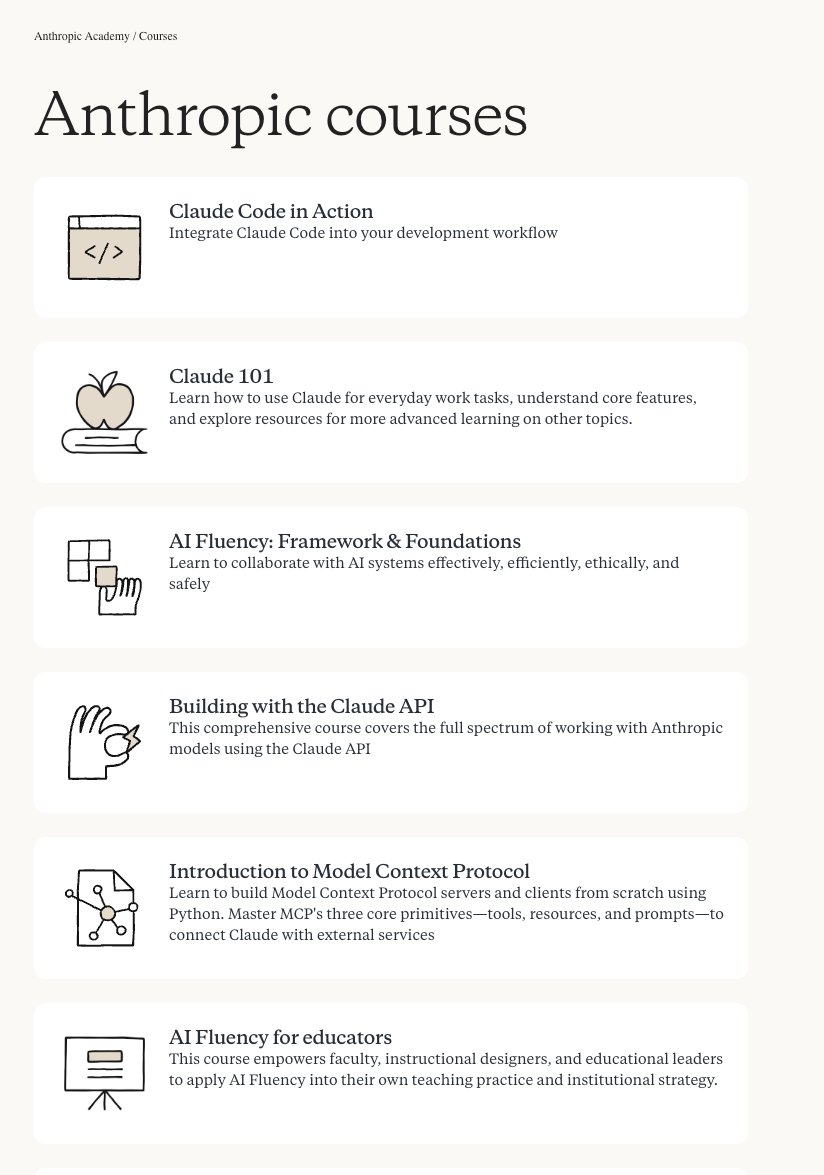
Anthropic has quietly dropped a massive curriculum of free courses covering the entire AI ecosystem
The syllabus is STACKED 🔥
→ Claude Code: CLI automation for your workflow
→ MCP Mastery: building custom tools and resources in Python
→ API: a complete guide to the Anthropic backend
→ AI Fluency: frameworks for safe and efficient collaboration
→ Claude 101: core features for everyday work
I added the link to the free @AnthropicAI Academy in the 🧵↓










![Rainmaker1973's tweet photo. Medical oncology is witnessing a transformative shift with histotripsy, an innovative, incision-free therapy that uses precisely focused ultrasound waves to mechanically disintegrate liver tumors.
Developed over two decades at the University of Michigan and commercialized by HistoSonics through the Edison system, this approach creates microscopic "bubble clouds" within the tumor tissue. These bubbles rapidly expand and collapse, producing intense mechanical forces that liquefy and destroy cancerous cells at the cellular level—without heat, radiation, or surgical cuts.
Unlike conventional treatments such as surgery, ablation, or radiotherapy, histotripsy is entirely noninvasive and highly targeted. Real-time imaging guides the ultrasound pulses to spare adjacent healthy liver tissue and vital structures. The outpatient procedure often allows patients to return home the same day, minimizing recovery time, pain, and risks associated with invasive interventions. It is particularly valuable for individuals with inoperable primary liver cancers (like hepatocellular carcinoma) or metastases from colorectal, breast, or other sites.
Clinical evidence from pivotal trials, including the international #HOPE4LIVER studies, has been compelling. The trials achieved a technical success rate of approximately 95% in fully targeting and ablating tumors, with low major complication rates (around 6-7%).
Longer-term follow-up data indicate strong local tumor control, with rates approaching 90% at one year in many cases, alongside favorable safety profiles. These results supported the U.S. FDA's clearance of the Edison system in late 2023 for treating liver tumors, accelerating its adoption at centers worldwide. By early 2026, thousands of patients have undergone the procedure, with ongoing expansions to other organs like kidneys and pancreas in clinical trials.
This "sound-based surgery" marks a paradigm change from destructive "cutting and burning" methods to gentler, precision-guided disruption. As research progresses, histotripsy holds promise for broader applications, potentially enhancing immunotherapy responses and improving outcomes for patients facing limited options.
[Ziemlewicz, T. J., et al. "The #HOPE4LIVER Single-arm Pivotal Trial for Histotripsy of Primary and Metastatic Liver Tumors." Annals of Surgery, vol. 282, no. 6, 2025, pp. 908–916. (1-year outcomes, local control rates, and efficacy data.)]](https://pbs.twimg.com/media/HEHBgMHaIAMS14O.png)