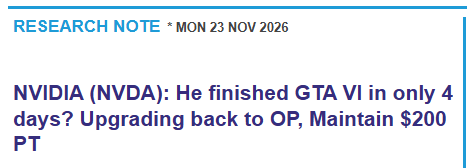
“We’ve had enough.”
Nvidia gets its second downgrade of the day, this time from Bernstein, as the crisis surrounding CEO Jensen Huang deepens.
Analyst Stacy Rasgon (@Srasgon / @BernsteinRasgon) warns the full extent of the scandal may not yet be known, slashing his price target in half from $400 to $200.
Shares were down 8% after hours.
As a Muse power user, I’m very pumped for this. I’m communicating with my Muse constantly. A little voice-enabled device will be so much better for many of my interactions than pulling out my phone, opening the app and typing. Hoping it’s well-executed. I am for sure buying one @alexandr_wang@karthikabinav
@GrousARK Also would add better to complement than compete directly against the iPhone. And we will always want our phones/screens/apps (at least as far out as I can see). But mini devices for voice-enabled agentic interactions can be super interesting. We’ll see.
As a Muse power user, I’m very pumped for this. I’m communicating with my Muse constantly. A little voice-enabled device will be so much better for many of my interactions than pulling out my phone, opening the app and typing. Hoping it’s well-executed. I am for sure buying one @alexandr_wang@karthikabinav
What an absolute debacle.
Still, $NVDA is the best computing platform and ecosystem in the world. That won't change overnight no matter who's CEO. Platforms and ecosystems have staying power, just as $AAPL demonstrated when Tim Cook took over.
If I try to look 6 months out (which seems impossible right now), and unless the company itself faces a criminal trial, things will be a lot more normal then versus now, there will be a new CEO, and while it wont be the same, it will likely be business as usual.
There is no replacing Jensen as an executive, but the board must find someone who can push the company with the same sense of relentless innovation that allowed them to defy the odds time and time again and remain on top for more than two decades. This mentality has been deeply ingrained into the company and its employees, and in my view, is one of its biggest assets.
Not to mention the stock is already dirt cheap at ~8x 2027 EPS. Handicap that number by 50% and it's still reasonable at 16x.
Again, this is a mess that will take time to clear, and there are still lingering risks, but the potential for Nvidia as a company is tremendous, as is the opportunity for the new CEO who will become a leader and spokesperson for all of global AI.
I'm not defending Jensen. His actions were disgraceful.
But at the same time, based on what we know, it makes no sense for the board to fire him. Jensen is completely irreplaceable and $NVDA will suffer. If his behavior was shameful but not criminal, he should repent and remain.
Agreed. It depends on why price dropped.
If a better algorithm cuts the cost of a workload and the savings are passed through, everyone wins via Jevons.
But if it's because customers are unwilling to pay higher prices, that's just a price cut and the provider earns lower margin per token (though volumes can still increase enough to produce more profit dollars in aggregate).
People point to Jevons every time but the reality is token prices are falling for both reasons.
At least for end-customers, though, better model capabilities combined with falling prices result in meaningfully higher ROI in either instance, which has been driving the ongoing inflection in token volumes, and imo is positive for the broader ecosystem.
Today was a clear wake-up call for the market. It’s apparent that most investors weren’t, and perhaps still aren’t, prepared for each of the big 5 (incl. SPCX) to potentially raise multiple hundreds of billions of equity/debt capital through 2030, and multiple trillions collectively. These investors also weren’t prepared for the capex growth to have no end in sight.
Ironically, many of the executives of these companies have been out in public clearly communicating their intention to keep spending very aggressively, with no plans to stop anytime soon.
And yet, for whatever reason, street estimates called for capex to slow dramatically into 2028 and basically plateau thereafter. The street modeled 50-60% capex growth across the big 5 in 2027 (which itself is low), and then MSD% growth annually. There is no good fundamental reason to model that unless you think companies spend less because the returns on the technology slow, or you think there are severe physical/power/financing constraints (though this would just result in slower growth, not the plateau that’s been modeled).
But it seems just as likely that out-year estimates simply defaulted to a plateau. Companies only guide a year out, and few on the sell-side are willing to model years of cash burn at this scale, so in their models, burn peaks in 2027 before FCF flips back positive in 2028 and scales from there. That path doesn’t require nearly as much capital issuance. To be clear, this would be a much happier and easier world for equity investors, who could go back to reaping the rewards instead of writing the checks. But for those who took the companies at their word and modeled continued elevated capex growth through the balance of this decade, these levels of issuance were a mathematical inevitability.
Yesterday’s filing from $META probably forced many to contemplate for the first time that each of these companies could actually burn and issue multiple hundreds of billions of dollars in the coming years. The credit markets have already shown signs of strain under the sheer magnitude of issuance, so more of this may need to be done through equity. That means there was also some front-running of eventual, unknown but likely material levels of dilution.
Equity markets don’t like being diluted, and they generally don’t like companies spending money at all. Especially not when the dollars get this big and when, rightly or wrongly, many still doubt the viability or magnitude of the returns, or at the very least don’t care to wait around to find out. Add in the crowding and leverage, along with a continued rise in oil on Middle East flare-ups, and you get a meaningful stock correction.
And so that’s what I believe the market priced in today: more burn, more issuance, more dilution, more leverage, more risk, more financing constraints (esp. for the most rate-exposed stuff, which got hit the worst today), along with some uptick in the chance this all falls apart.
This is going to sound perverse, but I think a day like today is very healthy. The companies are ambitious and the markets are stingy. And they will have to work with one another to get what they want. The companies want unprecedented capital to invest in what they believe is a re-platforming of the entire global infrastructure for an AI future, and the markets demand sufficient evidence that they’ll earn above the required return on the capital they lay out and the risk they take on. Ultimately, this forces the companies to be more disciplined and to show ROI as early and visibly as possible. That doesn’t mean they spend less, just that they have to prove the spend is working. I don’t think Zuck’s comment about monetizing Muse so much more rapidly than previous platforms was a coincidence. He knows what he needs, and he knows what he needs to show to get it.
So what now? Is AI a powerful enough driver to muscle its way through the fears being expressed by markets?
I think so. The big 5 may grow capex from >$1.3 trillion in 2027 to >$2.5 trillion in 2030, a ~25% CAGR. That implies a lot of paper, but in general, the hyperscalers can afford to pay higher rates, and there still seems to be demand from credit investors for it. At yesterday’s Robin Hood conference, execs at Diameter and HPS expressed a view that 7-8.5% yields on bonds from these companies are interesting. And I’d argue that’s for good reason: aside from SPCX, these companies generate massive operating cash flow and have largely benign net debt/EBITDA levels.
On the other hand, the more speculative companies that sit further out on the risk curve, pay higher spreads, and often don’t generate any cash at all will likely be forced to spend less. If you thought CRWV and NBIS would spend a combined ~$150-200 billion of capex in 2030 (vs. ~$60 billion in 2026), that might get cut in half because of financing constraints. But even a $100 billion reduction is only a 3-4% hit relative to the big 5’s 2030 capex, which, on net, is very manageable. That may be an issue for those companies, but it’s not enough to derail the ecosystem as a whole.
Ultimately, you have to believe there are attractive returns in AI, which I strongly believe are inflecting and wrote about here: https://t.co/53umFQdntz.
So even while things remain turbulent, the path still appears bright.
Some thoughts on AI ROI, which I believe is misunderstood and severely understated. TL;DR: AI ROI is inflecting for end customers (most important) and infra providers. Pure model provider ROI is less clear, but models will keep improving regardless, driving the industry forward.
Of all the debates on AI, the biggest and most persistent is around ROI. The problem is that the debate revolves around a single, inconsistently applied definition, when in reality there are three: 1) ROI for model providers, 2) ROI for model customers, and 3) ROI for infrastructure providers
While cooperative, #1 and #2 are fundamentally at odds with one another. All else equal, the higher the margin a model provider captures on the tokens it sells, the lower the margin the customer of those tokens captures on the work being done. This is driving enterprises to rationalize spend where they can: if a job can be done as effectively with a cheaper model, the ROI on that job is proportionally higher than if it were done with a more expensive model. That’s not 'bad' for AI. It just represents margin shifting from the provider to the customer.
Meanwhile, the ROI for infrastructure providers is a collective function of both. And while there are nuances around returns for individual infra providers depending on the concentration of and share between the model and customer cohorts, the reality is that infrastructure ROI overall benefits as long as demand for tokens keeps growing, regardless of the ongoing push-pull between model providers and customers.
In the last couple of months, we seem to be heading in a certain direction: aggregate model customer ROI is accelerating as customers benefit from the utility of increasingly intelligent tokens (and apps) at falling prices. This is evidenced by nearly all of the token-volume metrics across the industry, which continue to show growth and/or acceleration. Both the qualitative and quantitative data points on positive customer ROI are growing in concert, most recently with AWS CFO John Felton remarking that he studied AWS’ own token usage and found that, in general, more is better. And for those who still don’t believe in return on token spend, I implore you to model out the number of tokens needed to complete a job of your choice and measure the value of that job relative to the underlying cost of the tokens, with or without the model provider margin. Sure, there can always be waste. But when utilized properly, the returns on tokens are extraordinary, which is exactly what's driving continued volume growth.
We’ve subsequently seen this flow through to the cloud infrastructure providers, whose payback periods have compressed and whose returns have also increased, primarily as a function of rising rental prices for GPUs/accelerators. And as those returns have increased, so has demand for the underlying infrastructure, benefiting the AI supply chain at large.
So far, so good.
That leaves the model providers, where the biggest question really lies. The fact that inference gross margins can be so high is certainly positive in addition to being obvious: the prices at which tokens are sold are multiples higher than the miniscule cost of the underlying FLOPs needed to generate them. And again, the value of the work being done by the end customer is multiples higher than the token prices, so everybody wins. However, inference gross margins paint an incomplete picture, because token prices are primarily a function of model quality, which is primarily a function of training spend. That spend, in aggregate, is causing model providers to burn lots of cash. And because competition remains so intense, it’s unlikely in my view that any model provider can retain its inference margins without continued aggressive training spend. So the two go hand in hand and should be assessed together. While Anthropic’s reported positive FCF in 3Q was a nice surprise, I don’t expect it to continue, especially as OpenAI remains committed to investing aggressively and burning cash for the foreseeable future.
So that’s the predicament. The market is unsure what the long-term business and economic model of a 'lab' is, and rightly so. That raises the question: if the labs can’t make money, who’s going to fund the training, and how will the models keep getting better, which is the critical ingredient in continued AI adoption and end-customer ROI?
I see a few outcomes to this question:
Scenario 1: Concerns about model-provider economics prove overstated, and the market expands rapidly enough to accommodate multiple profitable frontier developers alongside a thriving open-source and open-weight ecosystem, supporting broad-based growth with attractive margins. This is probably the cleanest outcome which is why the market tends to like it so much. I still think this is the most likely path in the fullness of time, but it’s admittedly unclear. The mega-pilled RSI scenario also fits within this outcome, mainly in the sense that the investment pays off.
Scenario 2: Because of heightened competitive intensity and elevated training costs, the aggregate model provider ecosystem simply operates at maturity with razor-thin margins and very tight/minimal free cash flow generation, like other extremely competitive and/or commoditized industries. This is at least where we seem to be today, and where we will likely remain for some time.
Scenario 3: Financial pressure causes weaker participants to exit, merge, or scale back large training programs, eventually giving way to consolidation and reduced frontier training intensity, which allows the remaining players to expand margins. This seems both logical and likely to happen to some unknown degree, which would be positive for the value of the remaining players. Note that megacap tech hyperscalers, who collectively generate hundreds of billions in operating cash flow from their core businesses and are also training models, can continue to tap into that cash flow for ongoing training (ie GOOGL, META, and more recently NVDA). That will persist regardless of what happens with OpenAI or Anthropic.
Scenario 4: Frontier labs eventually convert into true public benefit corporations (in more than just name), owned and funded by a broad coalition of companies and the USG, all with incentives aligned toward the ongoing training and development of new models, effectively making the labs public utilities rather than private corporations. I do believe there is tremendous value in the IP at both OpenAI and Anthropic, and consequently see this as a far more likely outcome than either of them “going bust” and ceasing operations. While this may seem scarier to markets and in the headlines, the actual end result could be quite positive and well distributed across the entire AI ecosystem (rather than concentrated in the two labs). And at the very least, I believe there is strong merit in a pool of government-funded dollars for model development, much like the CHIPS and Science Act of 2022, which authorized $280 billion in federal funding and incentives. The US federal government spends >$7 trillion annually. Point being, there is both ample budget and precedent for the USG (and megacaps/others) to contribute to this national cause.
All in, some combination of these four outcomes should play out. And while some paths are smoother than others and there will be inevitable volatility and hiccups along the way, they all ultimately lead to positive ROI on AI spend: better models drive better end-customer returns, which drive better returns on infrastructure. That flywheel is already in motion (as evidenced by rising token volumes, GPU rental prices, and infra returns), and it’s much more sustainable than the market fears. It will take time to get from here to there, but the endgame appears to be quite positive, almost any way you slice it.