#Sensors developed to respond to jaw movement can be connected wirelessly to different devices for hands-free control. Read more on Advanced Science News:
https://t.co/FcbWr3a6lA
The e-skins developed by @RavinderSDahiya and co-workers contain artificial thermoreceptors with high sensitivity and fast response.
When integrated on a robotic hand, a thermal reflex is achieved via a localized learning scheme @Grp_BEST@UofGlasgow
👉 https://t.co/F3mCqQ8y4j
E-Skin with real skin-like morphology & functionality has attracted good interest in recent years. However, the main focus has been on pressure & force sensors. Shifting the focus towards temp. sensation (hot & cold), this work brings a new perspective. Good work @Grp_BEST.
Skin-Inspired Thermoreceptive Electronic Skin for Biomimicking Thermal Pain Reflexes in Robots. See our new art (https://t.co/YHhUOeQ1oK) in Adv. Sc. Congrats Neto et al. Thanks @EPSRC & @MSCActions. @UofGlasgow, @RavinderSDahiya, @AdvSciNews
https://t.co/FB9H8dBFSu via @YouTube
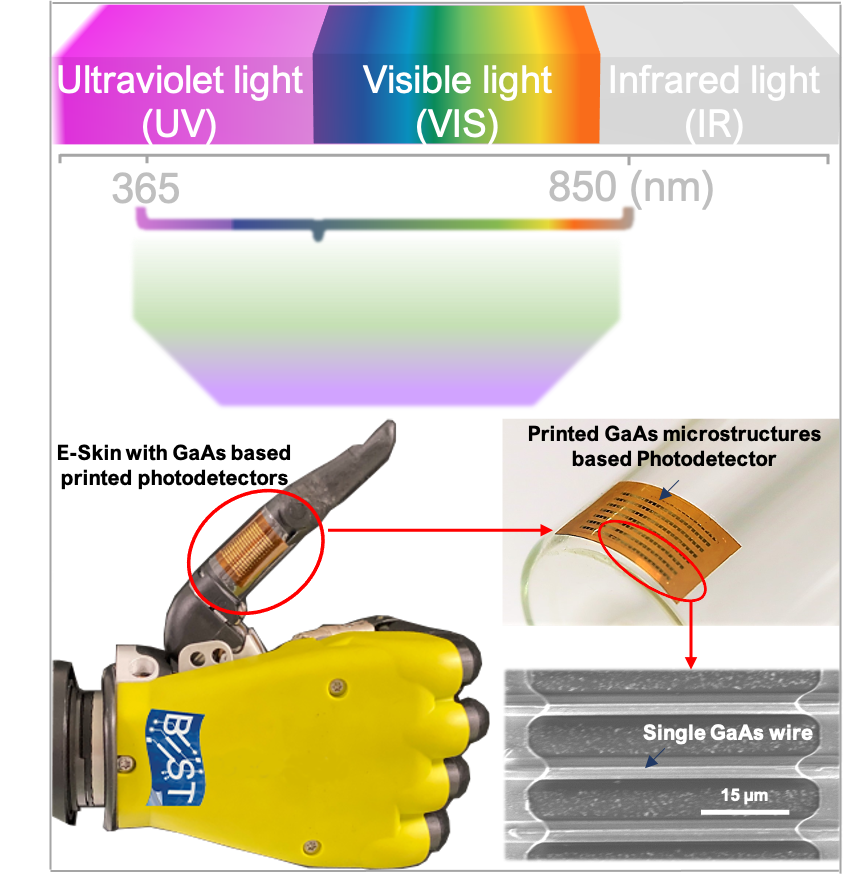
Printed GaAs based Broadband flexible Photodetectors allowing e-Skin with new capability. See our paper (https://t.co/nvfPS7f8EP) in Adv. Matt. Tech. Congrats Zumeit et al. Thanks @EPSRC. @UofGlasgow, @RavinderSDahiya@UofGEngineering
https://t.co/mma6whJ6KG via @YouTube
A new form of flexible photodetector developed by a team from @UofGEngineering led by @RavinderSDahiya could provide future robots with an electronic skin capable of ‘seeing’ light beyond the range of human vision.
Read the full story here 👉 https://t.co/wp9Bh2iQ9Z
A new Review contextualizes the latest #robotics research involving neuro-inspired electronic skin and spotlights recent advances in hardware, local computation, and touch sensing⤵️
https://t.co/34cyl15c0I
Our skin interprets touch data far more efficiently than the state-of-the-art electronic skins for robots today - suggesting the need for neural-like hardware for e-skin. In this regard, this paper is timely. Good job @BEST_UofG & thanks to our collaborators from @intel & @BMW.
"Neuro-inspired electronic skin for robots". See our latest art in Science Robotics - https://t.co/xXTRt3tK5N, which discusses the ways to realize human skin–like functionalities Congrats Fengyuan et al. Thanks @EPSRC. @UofGlasgow, @RavinderSDahiya, @UofGNews, @UofGEngineering.
Smart Bandages: Professor @RavinderSDahiya explores the potential of new scientific interventions designed to help predict and prevent disease, and improve diagnosis.
Read more:
https://t.co/Wh88r7RYV8
"[D]evelopment of a new electronic skin which can mimic uncomfortable sensations ... uses a new type of processing system ... mimics the brain's neural pathways in order [for robots] to learn to feel pain." In @SciRobotics
Image credit: Ravinder Dahiya https://t.co/49nySgCiTZ
A #robotic electronic skin from @UofGlasgow synthesizes sensing and processing, responding to external stimuli such as pain locally without outsourcing data to a centralized computer.
https://t.co/adijNi4x0n
A new type of electronic skin capable of feeling 'pain' could help create a new generation of smart robots and prosthetics.
The skin was developed by @RavinderSDahiya and his @BEST_UofG group at @UofGEngineering.
Read the full story here 👉 https://t.co/EE94KiwgNH
The use of energy harvesters as sensors is interesting as such multifunctional operations lead to reduced number devices needed in a system, and hence lower the integration complexities. In this regard, TEGs based sensing is a promising approach. Good work @BEST_UofG.
Modulating the output of Triboelectric Generators by chemical and biological analytes to develop self-powered active sensors. See our latest art. (https://t.co/68EfiQOqvk) in Adv. Mater. Congrats Gaurav et al. Thanks @EPSRC. @UofGlasgow, @UofGEngineering, @RavinderSDahiya







![scipak's tweet photo. "[D]evelopment of a new electronic skin which can mimic uncomfortable sensations ... uses a new type of processing system ... mimics the brain's neural pathways in order [for robots] to learn to feel pain." In @SciRobotics
Image credit: Ravinder Dahiya https://t.co/49nySgCiTZ https://t.co/qCfNXoJiqL](https://pbs.twimg.com/media/FUQVTRPXEAgLNLa.jpg)


