🚀 Introducing DeepInfer, our in-house inference framework, now fully open source!
Powering DeepSeek-V4.1-Flash at scale with high throughput and low latency. We’re sharing our production stack to help the community lower compute costs, reduce energy use, and make AI more affordable.
🔗 https://t.co/JGAik1kgk0
1/4
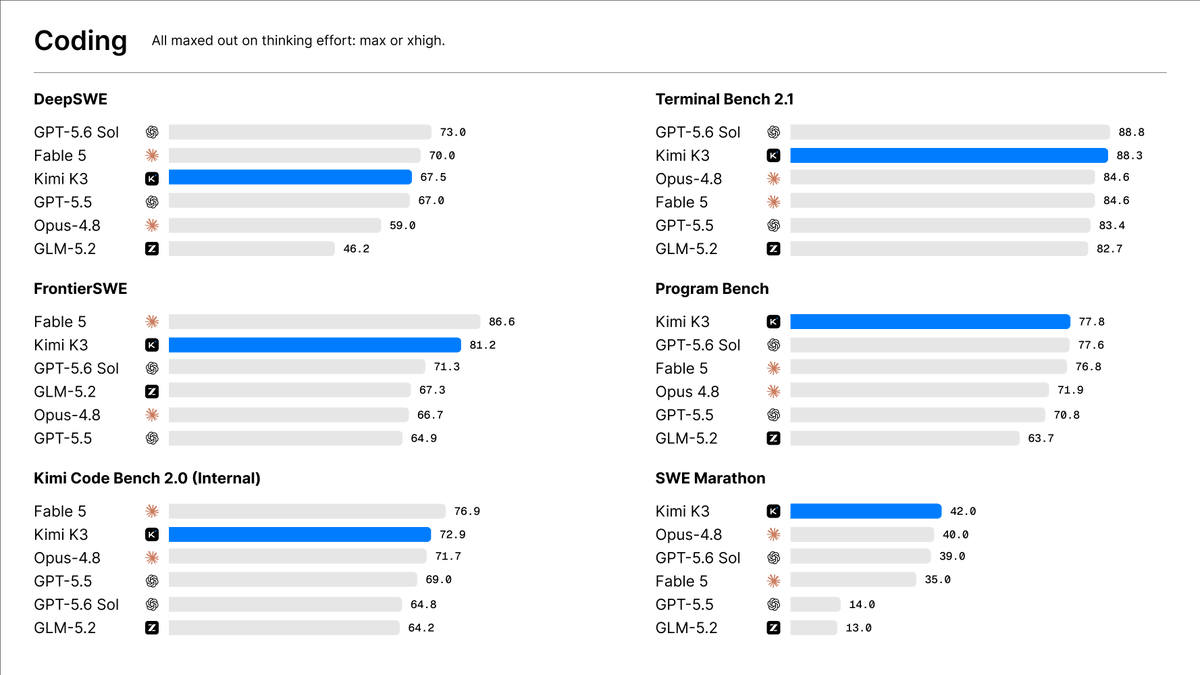
Releasing the model weights and technical report of Kimi K3.
Kimi K3 is our most capable model: a 2.8T MoE model with native visual understanding and a 1M-token context window.
New model architecture: 2.5x the intelligence per unit of compute, not just more params.
Alongside Kimi K3, we're opening up more of the stack behind it — high-performance attention kernels, MoE communication library, and infrastructure for running agent environments at scale.
Model weights: https://t.co/7m7eEg6Y0B
Tech report: https://t.co/yeu6cjpMCT
Tech blog: https://t.co/YTfiMSNM1f
Introducing Kimi K3: Open Frontier Intelligence
🔹 2.8 Trillion Parameters, 1 Million Context, Native Multimodal
🔹 Kimi Delta Attention enables up to 6.3x faster decoding in million-token contexts
🔹 Attention Residuals deliver ~25% higher training efficiency at <2% additional cost
🔹 Built for long-horizon agentic coding and self-evolving workflows
Kimi K3 is now live on on https://t.co/zrk6zZxZUo, Kimi Work, Kimi Code, and the Kimi API.
Open Weights by July 27, 2026.
🔗 API: https://t.co/XCrgjXAqMw
🔗 Tech blog: https://t.co/YTfiMSNM1f
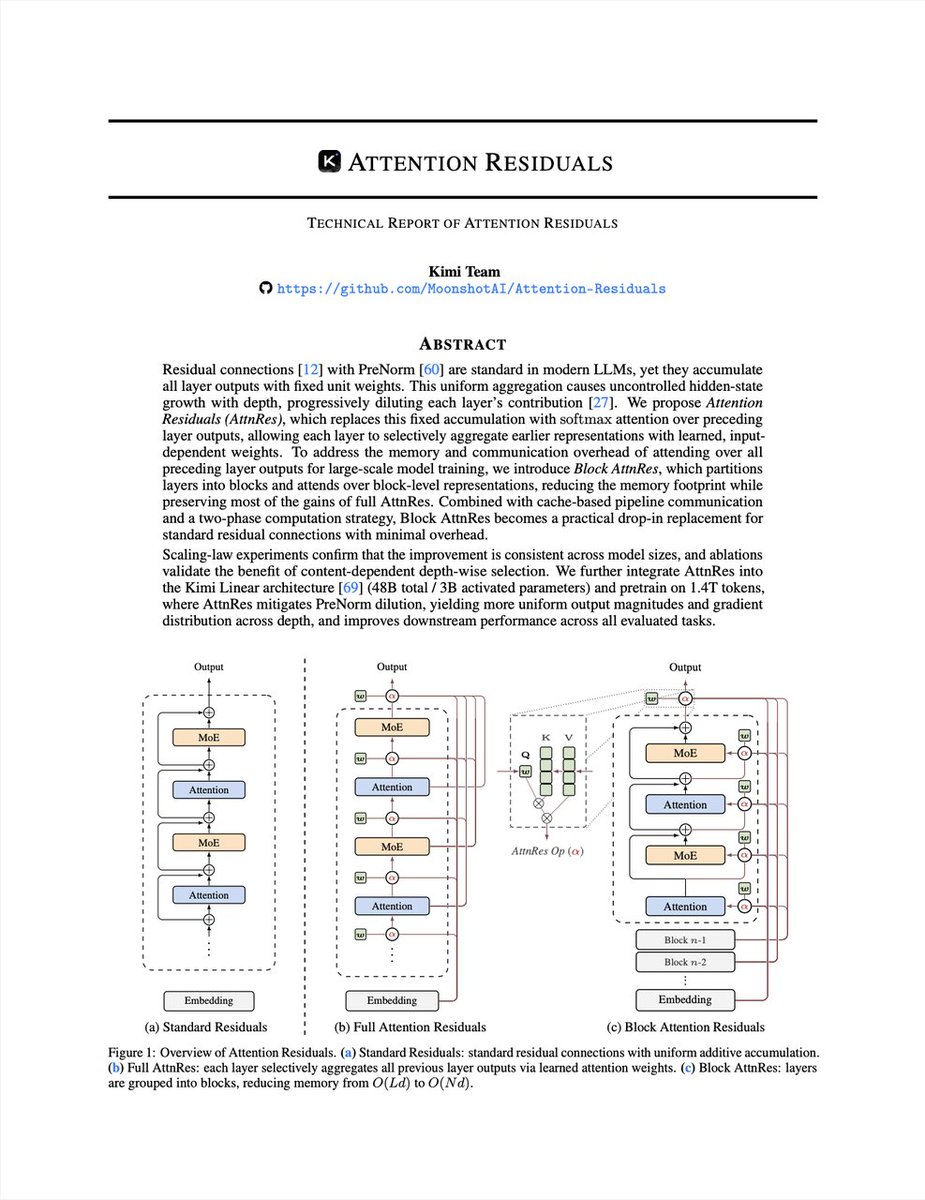
Introducing 𝑨𝒕𝒕𝒆𝒏𝒕𝒊𝒐𝒏 𝑹𝒆𝒔𝒊𝒅𝒖𝒂𝒍𝒔: Rethinking depth-wise aggregation.
Residual connections have long relied on fixed, uniform accumulation. Inspired by the duality of time and depth, we introduce Attention Residuals, replacing standard depth-wise recurrence with learned, input-dependent attention over preceding layers.
🔹 Enables networks to selectively retrieve past representations, naturally mitigating dilution and hidden-state growth.
🔹 Introduces Block AttnRes, partitioning layers into compressed blocks to make cross-layer attention practical at scale.
🔹 Serves as an efficient drop-in replacement, demonstrating a 1.25x compute advantage with negligible (<2%) inference latency overhead.
🔹 Validated on the Kimi Linear architecture (48B total, 3B activated parameters), delivering consistent downstream performance gains.
🔗Full report:
https://t.co/u3EHICG05h
Caleb (@calebrob6) and I are trying something new: we started a blog where we'll share our experiments, paper highlights, and explorations in geospatial machine learning including TorchGeo use-cases.
First posts are live at https://t.co/oHaixiRr28 and you can subscribe on Substack at https://t.co/YaQ3eaiwGd
Embeddings are all the rage in #GeoAI, but no clear definition or shared research agenda exists in the space. Introducing "Earth Embeddings: Towards AI-centric Representations of our Planet", led by @rolf_comma_e, @MarcCoru and me.
Paper: https://t.co/1TRF1TgdJX
Thread: 👇
1/7
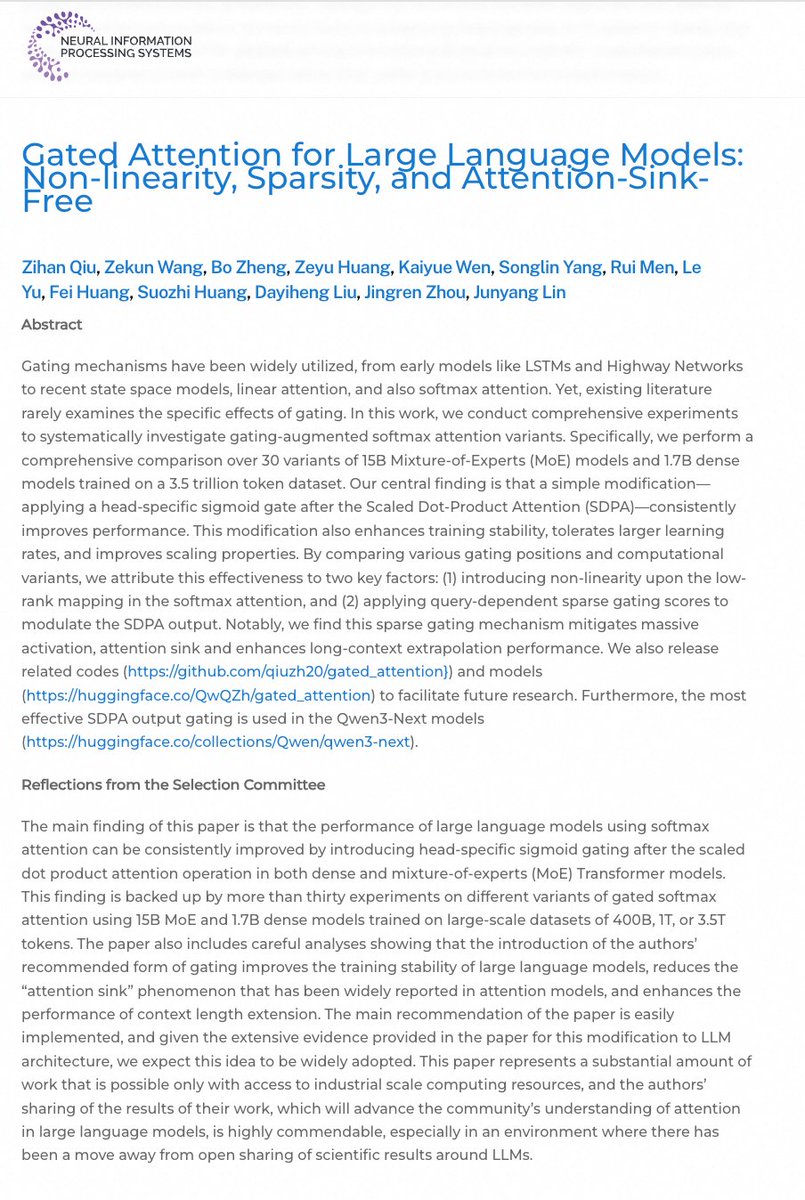
🏆 We are incredibly honored to announce that our paper, "Gated Attention for Large Language Models: Non-linearity, Sparsity, and Attention-Sink-Free" has received the NeurIPS 2025 Best Paper Award!
A huge congratulations to our dedicated research team for pushing the boundaries of AI.
Read more: https://t.co/qu3ERa3pH5
Google Earth AI, our collection of geospatial AI models and datasets, is expanding globally and adding new capabilities. That includes Geospatial Reasoning, powered by Gemini, which automatically connects different Earth AI models - like weather forecasts, population maps + satellite imagery - to answer complex questions.
We’re also bringing new Earth AI models to Gemini capabilities in Google Earth, which make it easy to instantly find objects and discover patterns from satellite imagery. For example, analysts could spot harmful algae blooms that could impact drinking water supply, and issue warnings.
🌍 New in Remote Sensing of Environment
We introduce Neural Disaster Simulation (NeDS) — a diffusion-based generative model that simulates realistic post-disaster satellite imagery from pre-event images and controllable disaster types/intensities.
🕳️🐇Into the Rabbit Hull – Part I (Part II tomorrow)
An interpretability deep dive into DINOv2, one of vision’s most important foundation models.
And today is Part I, buckle up, we're exploring some of its most charming features.
Say hello to DINOv3 🦖🦖🦖
A major release that raises the bar of self-supervised vision foundation models.
With stunning high-resolution dense features, it’s a game-changer for vision tasks!
We scaled model size and training data, but here's what makes it special 👇
Together with an absolutely amazing team, I’m very excited to be co-organising the “Tackling Climate Change with ML” workshop at NeurIPS 2025 in San Diego (and virtual) this year!
We opened submissions, as well as applications for the mentorship programme!
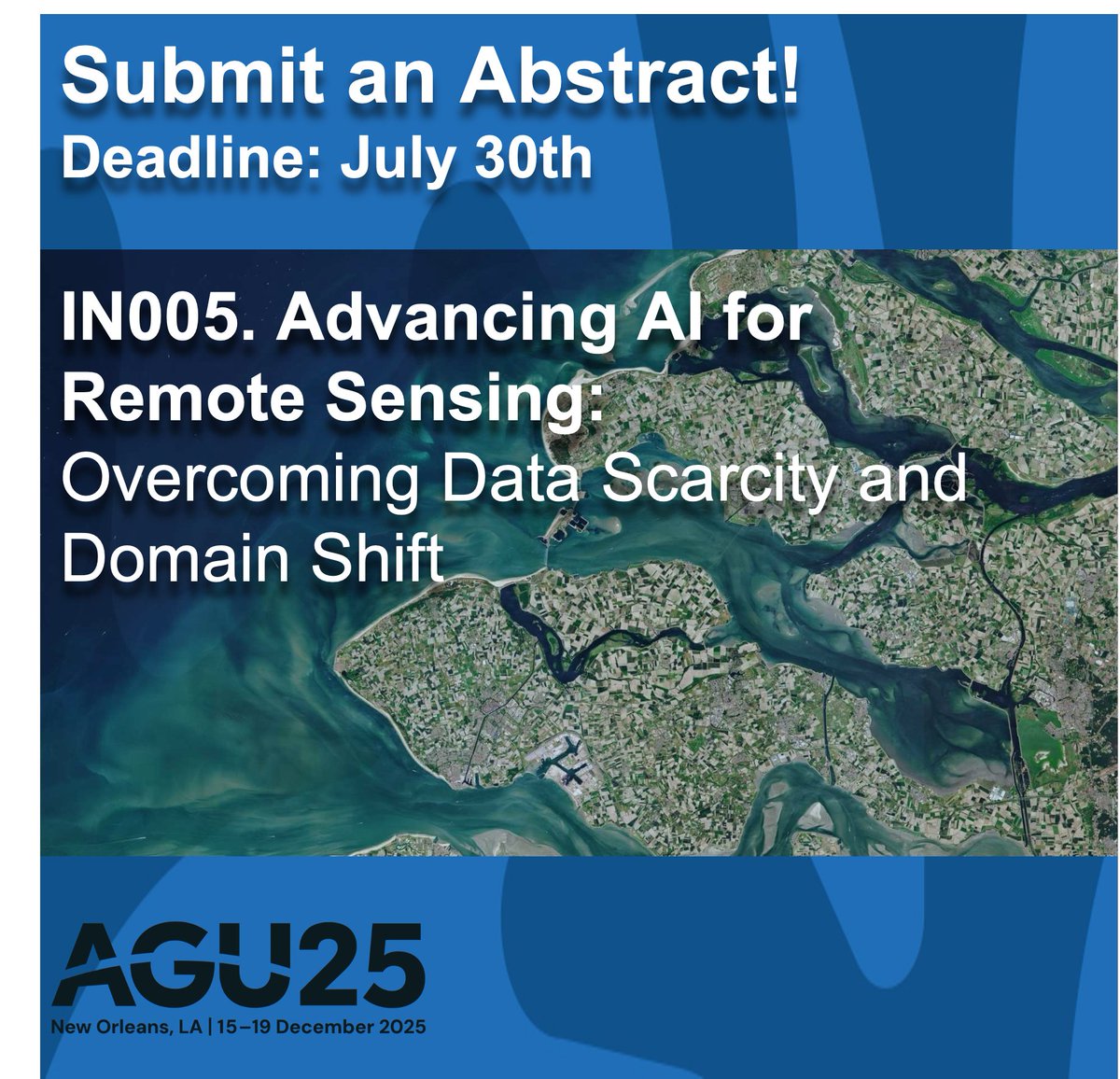
Working on transfer learning and foundation models in remote sensing? We invite you to submit abstracts to our session IN005 at #AGU25 (https://t.co/IeKBxVEJdB…) organized by @sherwang (MIT),@hannah_kerner (Arizona State), Siddharth Sachdeva, and me (Stanford).
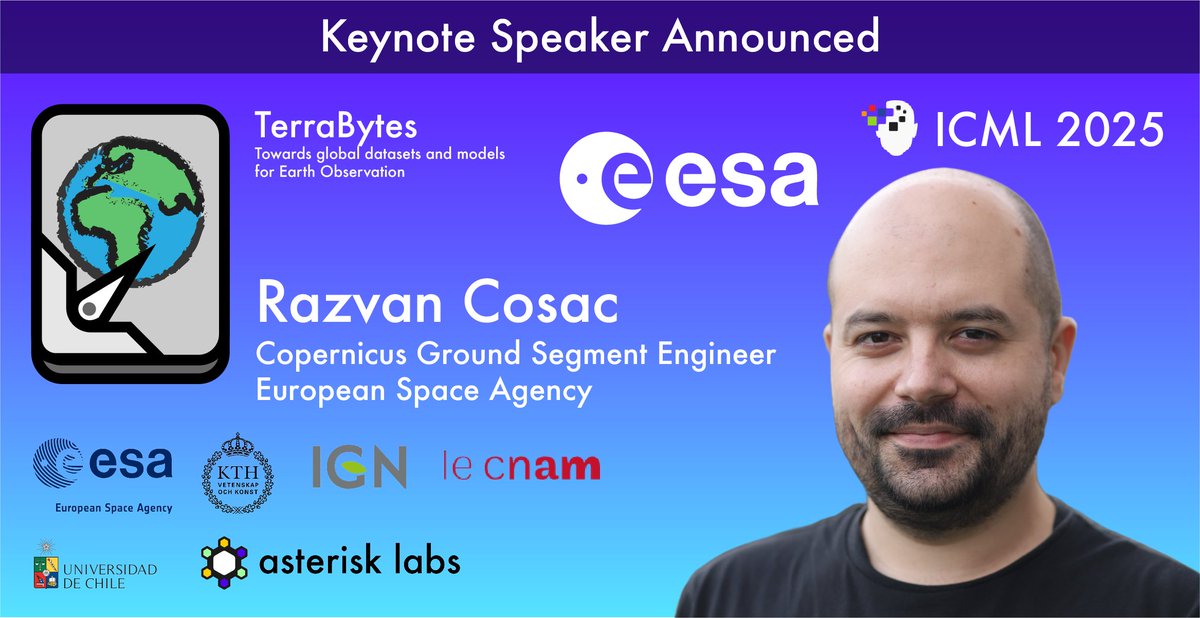
𝐓𝐞𝐫𝐫𝐚𝐁𝐲𝐭𝐞𝐬 𝐊𝐞𝐲𝐧𝐨𝐭𝐞 𝐀𝐧𝐧𝐨𝐮𝐧𝐜𝐞𝐦𝐞𝐧𝐭:
Razvan Cosac will deliver the second keynote at TerraBytes 2025! Stay tuned for more updates and join us at @icmlconf 2025
https://t.co/0LFRhy2MBV
🧵1/N
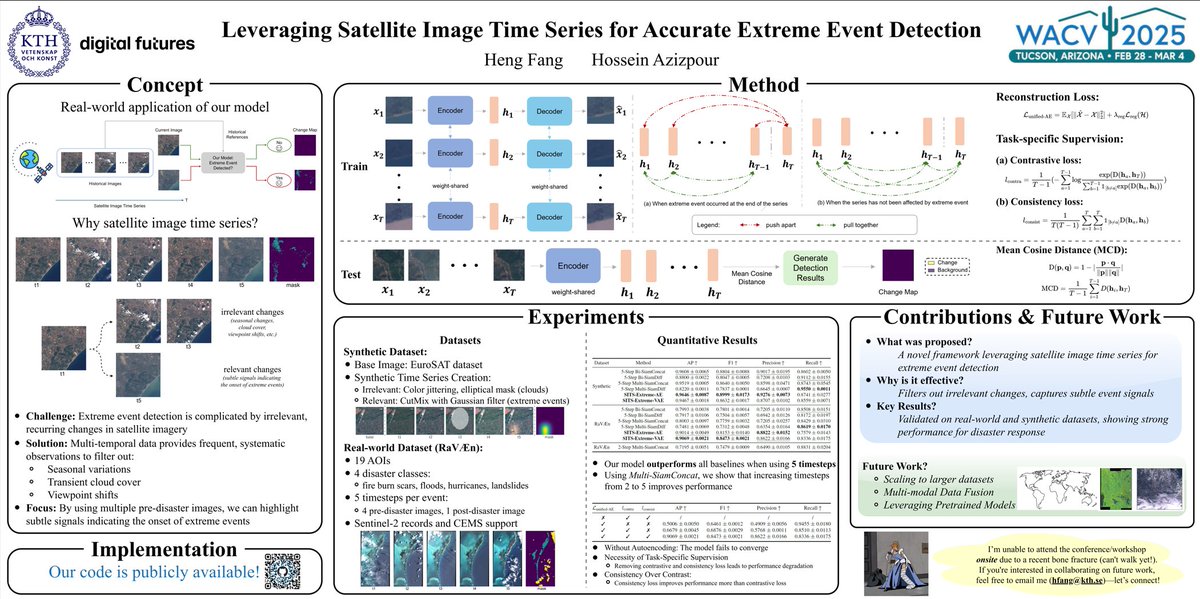
🎉 Late post, but excited to share our WACV’25 Workshop paper (GeoCV):
SITS-Extreme: Leveraging Satellite Image Time Series for Accurate Extreme Event Detection 🌍🛰️
We tackle disaster detection by using multi-temporal satellite data instead of just before–and–after pairs.
🧵4/N
⚠️ Known limitation:
We rely on a real-world dataset with noisy annotations, which reflects a common EO challenge.
We're working on a cleaner, scalable benchmark next.
Happy to chat or collaborate! 💬
#WACV2025#AI4EO#DisasterResponse#SatelliteImagery