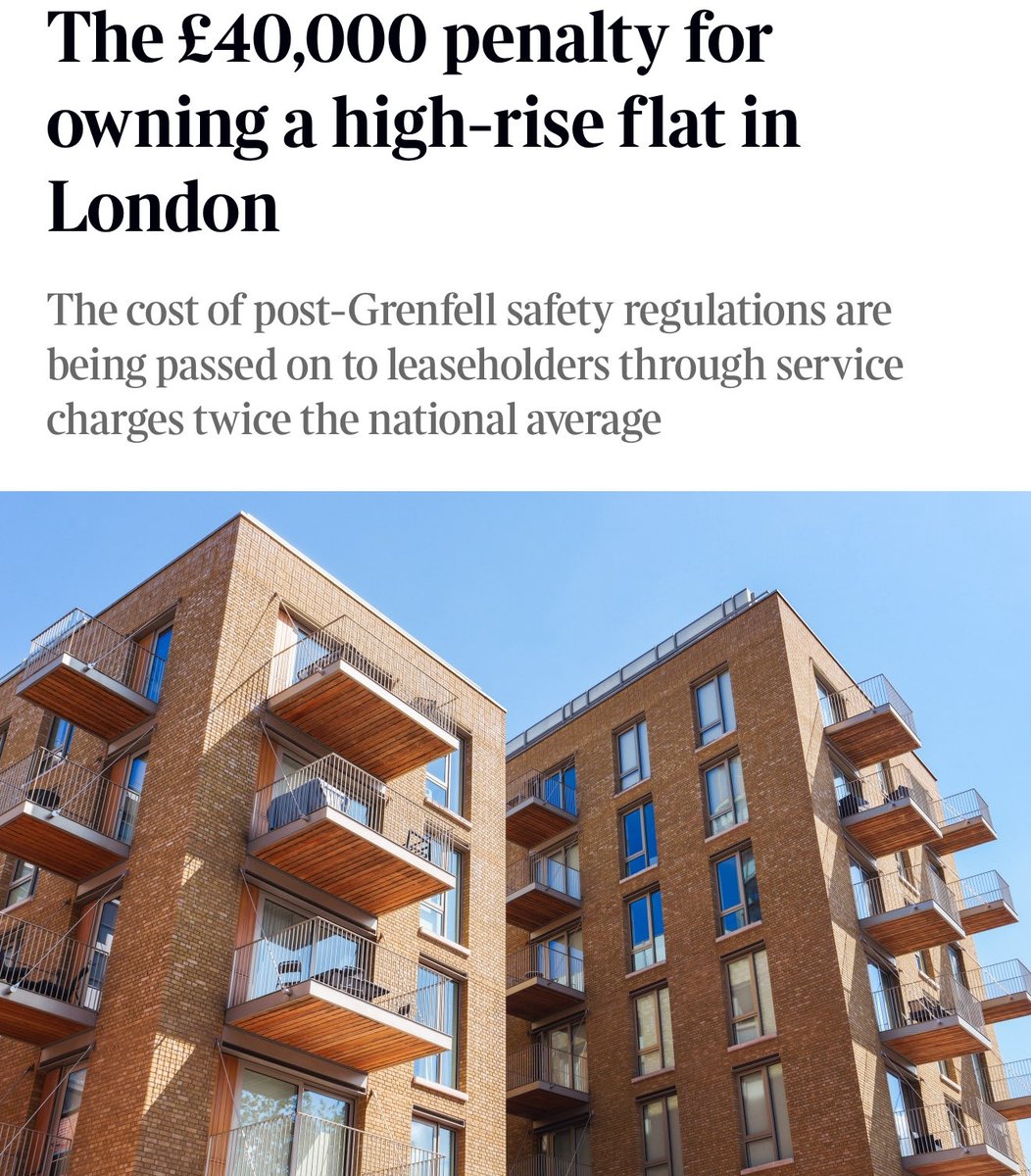
Flat out. “Many banks won’t lend money on a property if the service charge is more than 1 per cent of the purchase price, which has made some flats unsellable. @Hamptons1869 estimated this month that 37 per cent of flats in England and Wales — almost 2 million — have a service charge that could stop buyers getting a mortgage.” The government are focused on building more, not the welfare of those who went before and are now paying the price. @JSimpsonjourno@thetimes
https://t.co/I8nWme9vHi
There are plenty of people the scheme worked for, particularly those who bought when it was first introduced and then benefited from years of rising property prices. You may well fall into that initial group.
But your individual experience all those years ago doesn’t prove the scheme is fit for purpose today. The test isn’t simply whether it helps somebody buy their first home. It’s whether they can afford to own it, sell it and move on afterwards.
Getting someone onto the first rung isn’t a success if the structure of the scheme leaves them unable to climb to the second. That’s the entire point of my post.
Okay, so let’s play your game. And play this out in a real life scenario.
The equity is lost and we can’t sell.
When I bought, I was single. I’ve since met someone, we’ve been together for a while and we’re now expecting our first child. We desperately need to move from this one-bed flat on the second floor, with no storage and a lift that keeps breaking down. Because of that and increased inflation the service charge keeps increasing and, because the five-year interest-free period has ended, we’re now paying interest on the 20% Help to Buy loan as well.
Okay, so we can’t sell. Let’s get consent to let and do a let-to-buy (as per your suggestion). The rent covers the mortgage, but it doesn’t cover the Help to Buy interest or the increasing service charge. We now also have to pay additional stamp duty on our next home, which is difficult because those extra monthly costs have made it harder to save.
We haven’t inherited any money. However, we do earn more now because there’s a second salary and we’ve had a couple of pay rises, but we also have a dependent on the way, which affects affordability. Once we factor in the extra additional second home stamp duty, buying again is going to be extremely difficult.
Okay, let’s rent somewhere bigger instead because we desperately need the space. Hang on a second - isn’t renting exactly what you’ve been advising against? Anyway, carry on…
We’re now stuck with an asset that has fallen in value and is costing us money every month. That’s before factoring in maintenance and repairs for the tenants. At the same time, we’re also stuck paying rent to somebody else - the very thing you advised against in the first place.
As you can see, I’m not looking at this from the perspective of wanting to keep selling these properties to new buyers. In fact, it’s the complete opposite. I’m thinking about how real life actually plays out because I’ve seen this happen too many times.
Maybe you should stop thinking about how many new mortgages THIS SCHEME is going to allow you to write and start thinking about what happens to those buyers five years later.
AND I STRESS, this scheme is the issue.
Broadly speaking, I agree with you. In a normal purchase, getting out of renting, paying down a mortgage and building equity makes absolute sense. But we are talking about this particular scheme, and none of those general arguments addresses its fundamental problem 🤣
Capital reduction only builds equity if it is not being wiped out by the loss of the new build premium. If you reduce your mortgage by £20,000 but the property is worth £50,000 less when you come to sell, what equity have you built? You then reach the refinancing point with a higher loan to value than expected, meaning worse rates and potentially no viable way to clear the equity loan. That is exactly the position many owners from the last scheme are now in. You cannot just say think long term and pretend that risk disappears 🤣
The same applies to renting. In normal circumstances your argument makes complete sense. But mortgage interest, service charges, maintenance and buying and selling costs are also money you never recover. Buying an overpriced asset is not automatically better than renting.
And the estate agent churn comment is ridiculous 🤣 People move because they meet someone, start families, change jobs, separate or need to care for relatives. If the defence of a first home scheme is that buyers must stay in the same property for ten years or risk being trapped, then it is not much of a housing ladder, is it?
Make it more attractive to be a landlord = more homes to rent = downward pressure on rent prices.
Build more homes = more homes to buy = downward pressure on prices.
Incentivise developers to charge more money with a bullshit scheme aimed at only first time buyers = negative equity in years to come = less homes for people to buy as the owners are trapped = less desirable homes on the market = increase in the few desirable house prices
Yes mate, and I have spent 15 years as an estate agent and helped thousands of people move over that period. I am not talking about a hypothetical risk. I am dealing with the consequences of the last Help to Buy scheme now.
I have clients who cannot move at all, or can only do so by taking huge losses, because they are stuck in negative equity.
The fact you are a qualified mortgage professional actually makes your take more concerning. Helping someone buy is not just about getting the application through and showing that the monthly payment works today. It should include helping them understand the long term risk and what their exit looks like when life changes.
Capital reduction does not automatically mean someone is building equity. If their mortgage balance falls by £20,000 but the property value falls by £60,000, they have not built equity. They are £40,000 worse off. Add rising service charges and the fact that their eventual buyer cannot use the same new build scheme, and they may be completely trapped.
Telling people that their only alternative is to continue paying a landlord is a false choice and, frankly, atrocious advice from someone who is supposed to be helping people plan financially.
Buying the wrong property at an inflated price can leave someone in a far worse position than renting for another year and buying something sustainable.
To be clear, something needs to be done 💯. But this, is not the solution.
You are confusing mortgage interest with negative equity. They are completely different things.
Interest is the cost of borrowing money. Negative equity means the property is worth less than the debt secured against it. It exists whether you move or not. Selling simply crystallises the loss, and it can also prevent you from remortgaging or moving to a larger home.
Yes, there are affordable new build houses in certain parts of the country and they may perform better than flats. But this is a national scheme, and in London and many other cities it will largely be used to purchase leasehold flats, which is where the biggest problems already exist.
The Government is creating artificial demand for brand new property only. The first buyer receives the support, but when they come to sell, the property is no longer new and their buyer cannot access the same scheme. The owner is then trying to sell at normal resale value after originally paying the new build premium.
I am not saying every new build will lose money or that nobody should buy one. I am saying a scheme that makes one category of property appear affordable on day one while completely ignoring what happens at resale is dangerous.
If these new build houses are already so affordable and such good value, why do they need a government backed equity loan and a 2.5 per cent deposit to make people buy them?
Joel, this has absolutely nothing to do with wanting young people to fail or moaning about Burnham. I have spent 15 years selling property and I want more young people to own homes. I just do not want them pushed into something that looks affordable on day one but can become a trap when they need to move. Because I have seen how destructive this is, first hand. Plenty of clients desperate to move because they now have a family but are not able to because of the negative equity they are now in.
Pointing to the fact that 100 and even 110 per cent mortgages once existed is not the defence you think it is. Plenty of those borrowers were left in negative equity when prices fell. Repeating the same mistake with a government equity loan and a 2.5 per cent deposit is not progress.
Being able to save a 2.5 per cent deposit does not automatically mean someone can afford the property either. Affordability is about income and ongoing costs, not just the deposit. There is still the mortgage, service charge, ground rent, repairs, changing interest rates and eventually interest on the equity loan.
The reason it is restricted to new builds is because it is also designed to stimulate sales for developers and help the Government hit its housebuilding targets (which you e mentioned) It gives buyers extra spending power that can only be spent on new developer stock. The National Audit Office found that new builds typically cost 15 to 20 per cent more on those help to buy properties than equivalent second hand properties.
The real scandal becomes apparent when that buyer needs to sell. Their property is no longer new, so the next first time buyer cannot use the same scheme to purchase it. The new build premium has disappeared, the equity loan must be repaid, service charges may have increased considerably and they are now competing in the normal resale market.
Across London there are flats being marketed for tens of thousands, and sometimes six figures, less than people originally paid. Many still struggle to sell. That is not helping someone build equity. It is leaving them stuck in negative equity with very few options.
I completely support helping first time buyers. What I do not support is using them to prop up new build sales and calling it help.
Fix leasehold, control service charges, make developers accountable and build homes people can genuinely afford. Most importantly, make flats attractive and saleable for the second, third and fourth owners, not just the first person buying them brand new.
That would be great news for young people. Repeating the mistakes of Help to Buy is not.
Statement on behalf of UEFA and its 55 National AssociationStatement on behalf of UEFA and its 55 National AssociationStatement on behalf of UEFA and its 55 National AssociationStatement on behalf of UEFA and its 55 National Associations
Esta es de las imágenes más bonitas del Mundial. Marc Cucurella celebra el título con su hijo Mateo, que tiene una condición de autismo.
Normalmente, Mateo no puede asistir a los partidos de su padre, pues le afecta el ruido de los estadios. Marc prometió que llevaría a Mateo al estadio solo si pasaban a la final. Y así fue. Lo logró ubicar en un palco insonorizado para que puediera ver desde allí a su padre coronarse como campeón del mundo. Luego, levantó la Copa en la cancha con él.
Mateo, un Campeón más❤️
Watchout. I subscribed to ITV X agreed to pay £5 a month not see adverts. However their claim is very sneaky, instead of interrupting programmes with 3rd party commercial adverts .They interupt with promos of their own programmes. I think ofcom should investigate. @ITVX@ITV
🚨 ÚLTIMA HORA: Se ha hecho viral en redes sociales un vídeo de los comentaristas argentinos reaccionando a las faltas de Argentina vs España.
Son bastante imparciales. 😅