HIRAM ABIFF: DIONYSIAN ARTIFICER AND THE ARCHITECT OF THE TEMPLE
In the legends of Freemasonry, Hiram Abiff stands as the central figure of sublime allegory—a master builder whose life and death veil the mysteries of both operative skill and speculative wisdom. According to traditions drawn from the Ancient and Primitive Rite as expounded by John Yarker, Hiram was no mere craftsman of Hebrew descent, but a Dionysian artificer of Tyre—a member of that ancient brotherhood of architects and temple-builders who traced their lineage to the schools of Bacchus and Orpheus, and who carried forward the secrets of Egyptian and Phoenician science into the Hellenic world.
Contracted by King Solomon to oversee the construction of the Temple at Jerusalem, Hiram represented a foreign but superior school of art. The Hebrews, as Albert Mackey noted, were a people whose nomadic and agrarian traditions had ill-prepared them for the complex geometries and principles required to raise such a monument. They required the skills of those initiates who had long practiced the sacred science of architecture—not simply as a trade, but as a spiritual discipline.
Yarker affirms that the Dionysian Artificers were themselves heirs to an unbroken tradition of initiatic architecture, linking the pyramid builders of Egypt with the temple constructors of Greece and Phoenicia. In this lineage, Hiram Abiff appears not only as a skilled master but as a hierophant, bringing with him the operative secrets of the Craft, preserved through the Dionysian rites and infused with cosmic symbolism.
The legend of Hiram's martyrdom at the hands of unworthy craftsmen thus acquires deeper significance. As Mackey theorized, the allegory encodes the reunification of two streams: the speculative, or philosophical, pursuit of moral and metaphysical truth, and the operative, or practical, application of sacred geometry and proportion. Hiram, in this reading, becomes the sacrificial bridge between these traditions—his death marking the end of one age of concealment, and the birth of a new era wherein the moral teachings of Masonry are clothed in the working tools of the builder.
Thus, Hiram Abiff remains eternally the Grand Master—not merely of the Temple of Solomon, but of that greater Temple of Humanity which all Masons are called to raise within themselves.
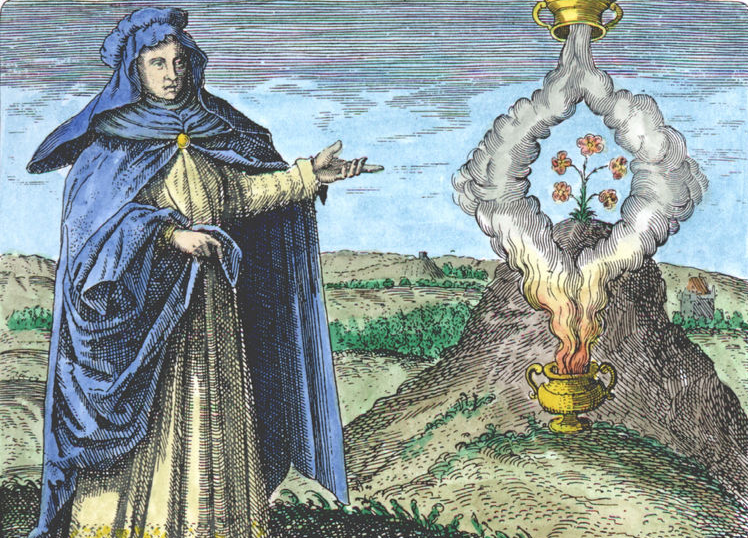
Maria Prophetissa points towards the seedling that has fallen on the top of the Cosmic Mountain. The summit of the mountain is the location of the Philosopher's Stone. From Michael Maier’s Symbola Aurae Mensac, 1617
Maria Prophetissa points towards the seedling that has fallen on the top of the Cosmic Mountain. The summit of the mountain is the location of the Philosopher's Stone. From Michael Maier’s Symbola Aurae Mensac, 1617