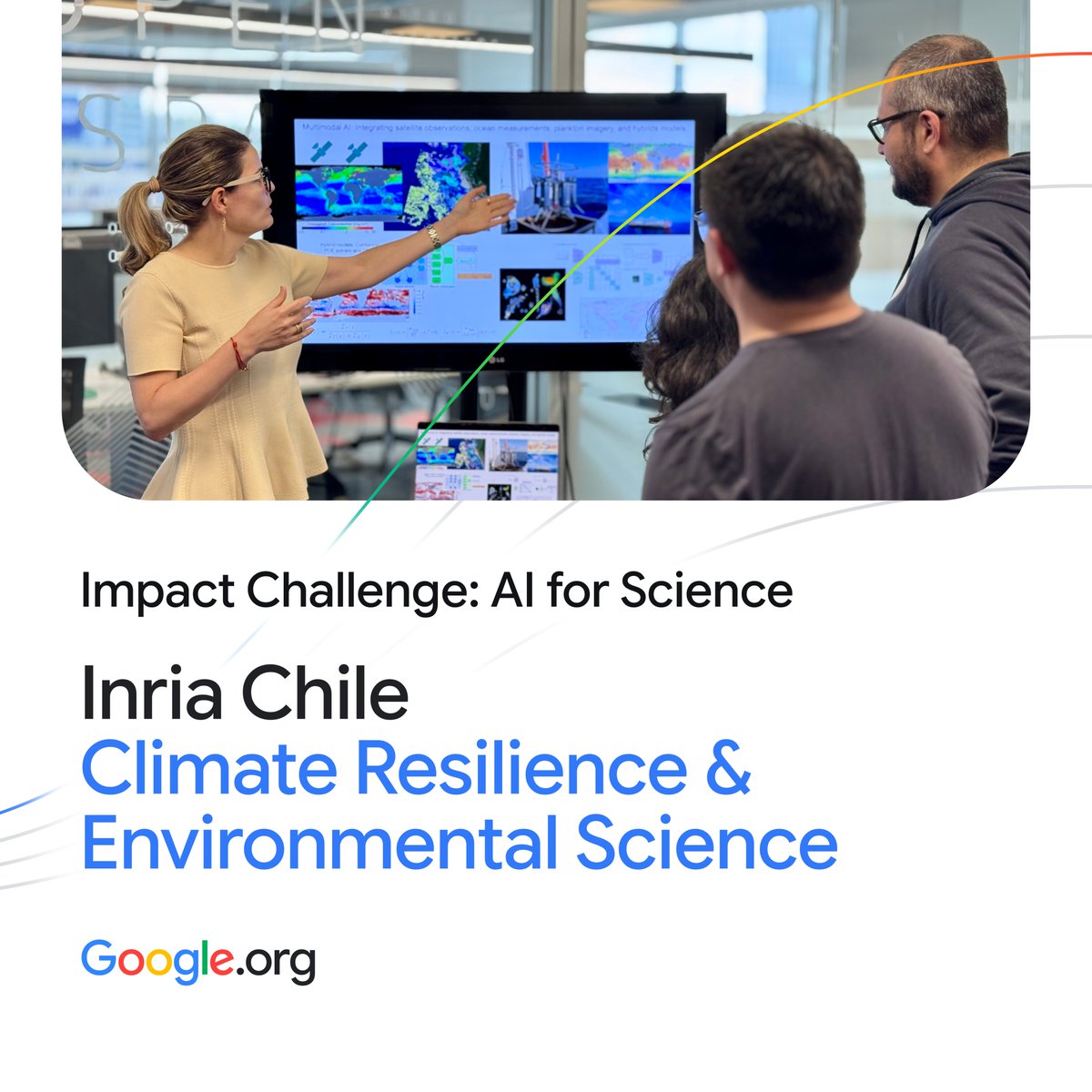
📣 #Anuncio | ¡Nos emociona compartir que @inria_chile ha sido seleccionada como una de las 17 organizaciones beneficiarias del mundo del Impact Challenge de https://t.co/SWkR9wIFJd: IA para la Ciencia, siendo la única institución latinoamericana ganadora! #AIforScience
Terence Tao says today's AIs pass the eye test -- but fail miserably on the smell test.
They generate proofs that look flawless. But the mistakes are subtle, and strangely inhuman.
“There's a metaphorical mathematical smell.. it's not clear how to get AI to duplicate that.”
Intelligence isn't what looks correct. It's what smells true.
Stephen Wolfram says there may be no way to readily identify and explain the mechanisms behind machine learning because, like neuroscience and biology, it may depend on "wild computation" and be the outcome of computationally-irreducible evolutionary adaptation
At Inria Chile, we are working on applying Deep Learning techniques in astronomy. In particular, we are developing anomaly detection algorithms to discover a special type of black hole called Changing-state active galactic nuclei.
If you are curious, yo…https://t.co/xykJ1iXRA6
📢 ‼️ ATTENTON! #IJCAI2022#OceanIA
We invite to all the AI/ML community to participate in the workshop "AI: Modeling Oceans and Climate Change" (AIMOCC 2022), organized by @inria_chile , that will take place within the IJCAI-ECAI 2022 in July in Vienna, Austria.
Today at the Space&AI workshop from @ECMLPKDD organized by @vision_claire @esa I presented some of the work we are doing in @inria_chile in astronomy. See our recent paper about anomaly detection for the identification of CSAGNs. https://t.co/0JkSq2yDfe