Registra tu trabajo para la segunda versión del
@LatEnvChemPSE
Los mejores posters de cada categoría serán premiados con 100 dólares!
Visita nuestra página:
https://t.co/P8vZmO86JJ
@dulcebollas Lamento muchísimo tu pérdida prima. No hay palabras de aliento que puedan hacer que te sientas mejor, el tiempo sanará, tu mamá vivirá por siempre en ustedes, siéntete orgullosa del legado que dejó. Los queremos mucho 🤗
24 de Junio del 2022 - Examen de selección de la Maestría en Ciencias en Ingeniería Química del @TecNM_MX @TecNMcampusAgs 🇲🇽
Becas @Conacyt_MX para estudiantes nacionales y extranjeros.
Informes:
Dr. @ABPetriciolet, [email protected]
@LYanethSM @LatEnvChemPSE Hi @LYanethSM, thank you for your question. The advantage of using bone char is due to its high content of hydroxyapatite which have calcium, hydroxyl and phosphate groups compared to other type of precursors. Those components may interact with fluoride enhancing its adsorption.
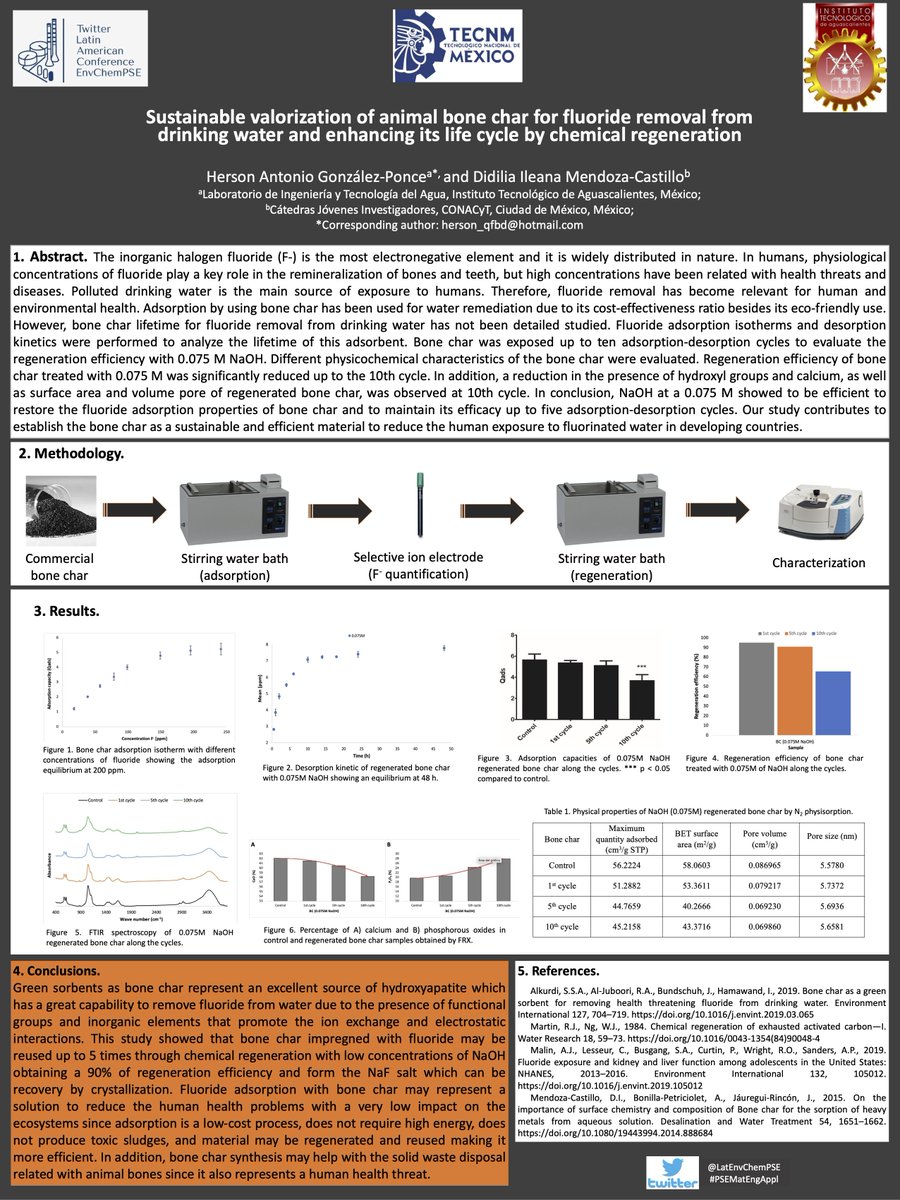
Hello everyone! I want to share with you all my research entitled: "Sustainable valorization of animal bone char for fluoride removal from drinking water and enhancing its life cycle by chemical regeneration" @LatEnvChemPSE#PSEMatEngAppl
@FatimaStreit@Liliana92984271@LatEnvChemPSE Hi @FatimaStreit, thank you for your comment. Indeed, you are right since chemical regeneration is the most efective in terms of cost-benefit compared with other methods, e.g. thermal or ultrasonication. Chemical regeneration is an efficient and low-energy process.
@Liliana92984271@LatEnvChemPSE Hi @@Liliana92984271, thank you for your question. We didn't try with another chemical reagent or compound to regenerate impregned bone char but as long as I know we can use a compound with a metal to form a fluoride salt.
@ValdesMirelle@LatEnvChemPSE Hi Evelyn, thanks for your question.
Yes, we have used Opuntia plants and fruit residues to produce char for fluoride removal as well. Bone char showed higher capability of fluoride adsorption.
Authors are invited to submit a poster for the Twitter Latin American Conference on Environmental and Chemical Process Systems Engineering.
The best posters will be awarded with $100 dollars!
#LatEnvChemPSE
Imposible imaginar un candidato más mentiroso que el morenista de Ags. Experto? Ya lo desmintieron. Empresario? Lo sancionó el gobierno de su propio partido. Gerente de una autofinanciera? La quebró y defraudó. Honorable? Falseó productos que vendió a Sedena. Decente? NXVIM
@DavidDanaci@IntAdsSoc Hi David, thank you for your question! We used buffered pillows to adjust the pH in the solutions at 7, and because of that we didn't experience interferences or variations in the measurements.
@IntAdsSoc Hi, I'm pleased to share with all your scientific community my research study entitled: "Enhancing bone char life cycle by chemical regeneration for fluoride removal from drinking water". #IASTwitterPoster https://t.co/eSswrEOpe0
@wilkins_ns@IntAdsSoc Hi Nicholas, thank you for your question. We performed our experiments under controlled laboratory conditions having the possibility to wash our material in each cycle to remove remanent NaOH. This is a first step and we aim to implemented in a process although seems complicated.
@IHarrieha@IntAdsSoc Hi Isabel, thank you for your coment!
We performed our experiments at 30°C (adsorption and desorption). Regarding [NaOH], we performed desorption kinetics with different [NaOH] and 0.075M was the lowest and more effective removing F‐, and keeping material integrity.
Hi! It's a pleasure for me to share my research work with you, the title is: Opuntia Albicarpa wastes as precursor of lanthanum functionalized adsorbents for the removal of geogenic pollutants" #IASTwitterPoster
Hi! I'm very happy to share my research work with you. The title is "ADSORPTION OF EMERGING DRUGS FROM AQUEOUS SOLUTIONS USING ADSORBENTS OBTAINED FROM OPUNTIA ROBUSTA PLANTS" #IASTwitterPoster
Hello everyone. #IASTwitterPoster this is my second work entitled "Comparative analysis of the synthesis route of lanthanum functionalized adsorbents for removal of arsenic from water ". @IntAdsSoc
Hi @IntAdsSoc, may I ask why my poster is still not visible at you homepage, there is something else I have to do to make it visible?
I've published my poster yesterday using #IASTwitterPoster
Thank you in advance for your support.
@daaliaa22@IntAdsSoc Hi Dalia, thank you for your coment.
We did't measure whether the material used released toxic elements or compounds in drinking water during the experiments, but we know that the main component of bone char is hydroxyapatite (Ca⁵HO¹³P³) which is a non toxic compound for humans