Looped LLMs are everywhere right now! But why are they interesting? Do they model language differently than regular LLMs?
Grown and looped transformers are better sequence models!
With @kaitlinmaile & @oswaldjoh (@Google, Paradigms of Intelligence Team) and @stefanAbauer. 🧵
⁉️⁉️ What if the harmful data we delete is exactly what makes AI safe?
💬 LLMs have quietly become the first place people turn when something is wrong: a symptom, a debt, a legal problem, a crisis. At this scale, AI safety is no longer an abstract research problem. It touches real lives, every day.
🚫 Yet most alignment today works by erasure: filter out unsafe data and train the model to refuse. The result is often a blanket "Sorry, I can't help with that."
⚠️ But refusing is not the same as being safe. A refusal leaves people with nothing to act on, and it can push them toward riskier, unmoderated sources exactly when they need guidance most.
💡 Here's the irony: unsafe data is abundant and packed with real domain knowledge, while safe, genuinely helpful answers are scarce and costly to curate. And we throw the abundant part away.
🤔 So we asked a counterintuitive question: can unsafe data actually make models safer?
🎉 Our answer is yes, and I'm thrilled to share that this work has been accepted at #NeurIPS2026!
📄 Dialectics of Alignment: Harnessing Unsafe Knowledge for Dynamic Safety Routing
RecAMPLIFY: Large-Scale Pretraining of Recursive Protein Language Models
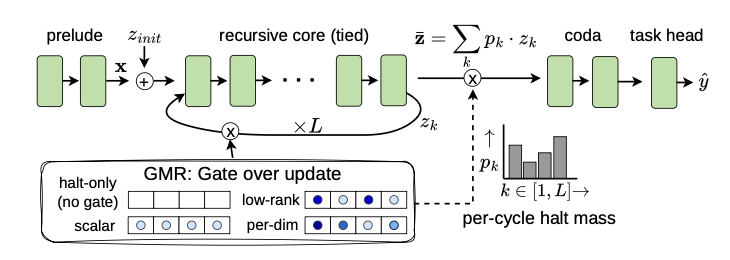
1 recAMPLIFY introduces test-time compute scaling for masked protein language models by making “effective depth” adjustable at inference: a weight-tied Transformer core iteratively refines residue-aligned hidden states over L recurrent cycles, without changing sequence length or breaking residue-to-state alignment.
2 Key result: with 155M unique parameters trained on the same 2T tokens as AMPLIFY-350M, recAMPLIFY uses 56% fewer parameters yet improves CASP contact recovery and 3 of 4 supervised probes; fold classification accuracy increases by 22.5% (56.8% to 69.6%), and localization accuracy rises (71.6% to 74.1%).
3 Architecture summary: a non-recurrent prelude maps embeddings to a latent state; a tied recurrent core refines the state over cycles while re-injecting the input each cycle (for stability); a non-recurrent coda maps the refined state to the MLM output space for masked-residue prediction.
4 The paper highlights a practical issue with recurrence: “more cycles” is not monotonic. Optimal depth varies across tasks and even across DMS assays, and fixed-depth models can degrade when unrolled beyond the depth seen during training (“overthinking” past the trained horizon).
5 To address input-dependent compute allocation without external verifiers (hard for MLM), the authors propose Gated Mixture Recurrence (GMR): the model decodes from a probability-weighted mixture of hidden states along the recurrence trajectory, while a learned residual gate controls how much of each cycle’s proposed update is accepted.
6 GMR unifies halting and gating: a learned “survival” signal both (a) determines mixture weights over cycles (PonderNet-style halting emerges as a special case when updates are ungated) and (b) gates residual updates. Gates can be scalar (one value per sequence), low-rank (shared survival trajectories projected to features), or per-dimension (one survival per hidden channel).
7 Efficiency/accuracy trade-off: layered on recAMPLIFY, GMR reduces expected layer depth by ~32–40% (up to 37% reported) relative to a 6-cycle baseline, while improving CASP contact recovery and most supervised probes; the trade-off is task-dependent, with small drops in zero-shot DMS ranking and KL calibration in some settings.
8 Mechanistic findings: residual gating (not halting alone) stabilizes recurrence beyond the trained depth by driving step sizes toward zero and producing empirical fixed-point convergence. Per-dimension gating best preserves a feedforward-like layerwise mixing profile under deep unrolling, while halt-only variants can keep drifting.
9 Biological interpretability: expected halt depth correlates with properties of sequences. After controlling for length and model confidence, deeper “pondering” tracks compositional diversity signals such as higher sequence entropy and higher hydrophobic fraction, and halt depth clusters more tightly among splice isoforms of the same gene than among matched random protein pairs.
💻Code: https://t.co/aBbrowZSzw
📜Paper: https://t.co/JvMs5nNoXi
#ProteinLanguageModels #ProteinML #Transformers #SelfSupervisedLearning #AdaptiveComputation #ComputationalBiology #Bioinformatics #MachineLearning
Mila’s application process is live. Plenty of profs to do research with, from protein science to robotics, reasonning, safety…and a great research ecosystem (reading groups, workshops and above all, free food).
Mila's annual supervision request process is now open to receive MSc and PhD applications for Fall 2027 admission! For more information, visit https://t.co/r01eLcXtZw
Mila's annual supervision request process is now open to receive MSc and PhD applications for Fall 2027 admission! For more information, visit https://t.co/r01eLcXtZw
Introducing RoboJEPA, the first scaling law for multiembodiment world models.
We scaled JEPA predictors up to 8B params, showed scaling laws extrapolate and correlated compute scaling with planning performance.
We release all checkpoints and the code.
https://t.co/nSRBjasDBk
🎉 Thrilled to share that 8 papers from our lab (and collaborations with lab members) have been accepted at #NeurIPS2026!
The work spans RL, world models, dynamical systems, LLM safety & interpretability, tabular foundation models, and forecasting. Huge congrats to everyone 🧵👇
People use LLMs all the time for help with medical problems, some doctors might also use them too to explain diagnoses to patients.
But diagnostic tests are inherently probabilistic. This work from @dicemasz explores if LLMs are suited or not for this usecase!
I will be attending @icmlconf and am looking to hire 2 postdocs: one in foundation models for biology (proteins/small molecules/genomics data/drug discovery) and another in RL (including continual RL, world models, and RL training for LLMs). Please do reach out to me if you are interested in these positions and attending ICML too!
@ChandarLab will be at #ICML 2026
in Seoul — South Korea 🇰🇷 !! Presenting our most recent state-of-the-art research on continual learning, reinforcement learning and AI agents! Drop by and check it out! 🔥
Checkout the recent work on diffusion world models from our lab! The work studies a simple but important design choice: should the world model think in pixels reconstruction space or in semantic feature space?
If you work in continual learning, adaptation, online learning, updatable ML, unlearning, model editing and any other form of non-stationary/non-iid learning settings, consider joining the @CoLLAs_Conf mailing list here: https://t.co/RkRNuAdt2A!
📣 Announcing the CoLLAs Seminars
A year-long exploration of one of the central challenges in AI: building systems that can learn continually, adapt in real time, and improve over their lifetime.
Join us on May 13th at 11 am ET as we kick off the series with Pulkit Agrawal speaking on “Rethinking Post training”.
ℹ️ Learn more: https://t.co/Xs7slVeIYK
✉️ Join our mailing list: https://t.co/m3WvA3EO2E
🔗 Zoom link for the talk: https://t.co/tqRtIEeSf6
Want to know the expressivity of Mamba 3?
Come by our ICLR poster!
Sat, Apr 25 • 3:15 PM – 5:45 PM
Pavilion 4 P4-#4409
The Expressive Limits of Diagonal SSMs for State-Tracking
Joint work with Behnoush Khavari, Siamak Ravanbakhsh, and @apsarathchandar.
We're thrilled to see the Workshop on Weight-Space Symmetries coming to #ICML2026! Huge shoutout to our postdoc @KateLobacheva for co-organizing it. We're excited for the ideas and discussions this workshop will bring to the community!
📢Excited to announce the Workshop on Weight-Space Symmetries @icmlconf! We welcome 4-page submissions analysing symmetries, their effects on training and model structure, and practical methods to utilize them.
Submission Deadline: April 24 (23:59 AoE)
#ICML2026