Families are already paying more for groceries, gas, and rent. The DSA’s answer is more government spending. That’s like fighting a fire with gasoline. Inflation is a spending problem, and socialism only makes it worse.
Yezhov – The Butcher.
His old boss once said he had never met a more ideal worker: "Give him a task and you don't need to check on him – he'll get it done. He has only one shortcoming: he doesn't know when to stop."
Nikolai Yezhov was a small man, barely five feet tall, a former factory worker with little schooling who rose through the Party as a diligent, obedient bureaucrat. He was exactly the man the system needed.
A small and vicious man – in power, he drank heavily and liked to go down to the prisons to watch interrogations – sometimes joining the beatings himself. When his wife had an affair with the novelist Mikhail Sholokhov, Yezhov had their hotel room bugged and listened to the recordings. He watched his own bedroom just as he watched over the whole country.
His philosophy fit in one sentence: better that ten innocent people suffer than one spy escape. English law had said the opposite for centuries: better that ten guilty men go free than one innocent suffer. That one reversal is the whole difference between a civilization and a terror.
In 1936, Stalin put him at the head of the NKVD. The old boss who had praised him was shot in the terror that followed.
The West calls it the Great Purge. Russians remember it as the Yezhovshchina – "the Yezhov times." But it was not a frenzy. It was a plan.
An order of July 1937 gave every region a quota: so many to be shot – the "first category" – and so many to be sent to the camps – the "second category." Local chiefs competed to fulfill the plan and asked Moscow to raise their limits. Moscow usually agreed.
Torture was authorized from the top. Then came the national operations – Germans, Latvians, Finns, and above all Poles. Order 00485, signed by Yezhov, hunted an organization that did not exist. The verdicts came in albums, a few lines per person. In Moscow, two signatures sealed them – Yezhov's and the prosecutor Vyshinsky's – hundreds of death sentences at a sitting.
The wives of the condemned went to the camps. Their children went to orphanages.
Propaganda posters showed him crushing a many-headed snake in a spiked glove. His name means "hedgehog," and "hedgehog gloves" is the Russian idiom for an iron grip.
In two years, around seven hundred thousand people were shot.
Then the machine needed a culprit. In 1938, Beria arrived as his deputy, and by November Yezhov was out. In April 1939 he was arrested, tortured with the methods he had perfected, and made to confess to being a spy. At his secret trial, he asked that Stalin be told he would die with his name on his lips. He was shot in February 1940.
Then he was erased – from the photographs, from the records, from the story. The terror kept his name, Yezhovshchina, so that it would not carry the Master's.
His adopted daughter was sent to an orphanage, like the children of his victims.
The machine is never satisfied. It always needs the next name on the list – and, when the time comes, the name of the man who made the lists.
Next: Beria.
Vyshinsky – The Prosecutor.
Baku, 1908. In a crowded prison cell, two young revolutionaries argue about politics. One is a Georgian who calls himself Koba – the world would later know him as Stalin. The other is the son of a Polish Catholic family: Andrey Vyshinsky – Andrzej Wyszyński.
Thirty years later, one would sign the death lists. The other would read the charges out in court.
Vyshinsky had a problem: he had picked the wrong side. He was a Menshevik, from a rival socialist faction. In 1917, as a district police chief in Moscow, he signed an order to arrest Lenin as a "German spy." He joined the Bolsheviks only in 1920, once the civil war was won. A man with a past like that had one way to survive: to be more zealous than anyone. The system knew it, and used such men. Those with something to hide make the most obedient servants.
The system he served didn't need courts. It needed theater. Here is how a Soviet trial worked.
First, the verdict. The leadership – often Stalin himself, pencil in hand – decided who would be convicted and what the sentence would be.
Then, a law to fit it. In 1934, a decree stripped "terrorism" cases of everything a court is for: ten days of investigation, the charges handed over a day before the trial, no defense, no appeal – and execution immediately after the sentence.
Then, the confession. Months of interrogation: sleepless nights, interrogators working in shifts so the prisoner never rested, beatings, threats against wives and children. A decree of 1935 made children from the age of twelve subject to all criminal punishments, including death – an argument no father could resist in the interrogation room. Some were promised their lives if they confessed. Others were told that confessing was their last service to the Party.
Then, the rehearsal. The testimony was learned like a role, and every confession named new accomplices, who were arrested, interrogated and made to confess in turn.
Then, the performance. Vyshinsky's principle: the confession of the accused is the queen of evidence. No documents, no proof – just defendants accusing themselves of plots that never existed.
From 1936 to 1938, in the Great Purge, Lenin's old comrades stood in the dock and confessed. Vyshinsky called them mad dogs and demanded that every one of them be shot. They were, within a day or two of the verdict.
And the audience believed it. Foreign diplomats and writers sat in the hall, and the American ambassador reported home that the accused were guilty.
The show trials were only the visible tip. For hundreds of thousands of others there was no theater at all: three-man tribunals, no defendant in the room, sentences passed in minutes.
The prosecutor even helped himself to the house and money of one of his defendants, who was then shot.
The machine devoured Yagoda, then Yezhov. It never came for Vyshinsky. A regime can always find a new executioner. A prosecutor who could make a lie sound like law was harder to replace.
After the war, he was the Soviet power behind the scenes at Nuremberg. At a dinner there, he raised his glass to the German defendants: "May their paths lead straight from the courthouse to the grave!" The verdict before the trial – his whole method, in one toast. And the Soviet side insisted on charging the Germans with Katyn, the Soviets' own massacre of Polish officers.
Then Foreign Minister, he ended his career at the United Nations, speaking of peace, and died in New York in 1954.
In 1953, the year the communists arrested the Primate of Poland, Cardinal Stefan Wyszyński, the other Wyszyński was speaking for the Soviet Union at the UN. Same name, two Polands: one served the lie, the other refused it.
The method outlived him. Decide the guilt first, then build the case. Today it is called lawfare, and the process is the punishment. Even the confession survived: the ritual public apology, demanded before any verdict. And, as in Moscow, it never saves you.
Next: Yezhov.
What Socialism Is.
Socialism is not a real model to be applied in the world – it is a contradictory rhetoric used to gain power over people, by manipulating those who are easiest to manipulate.
It is anti-life, because it contradicts reality. Its contradictions stay harmless only as long as it stays on paper. Try to implement it, and they come due.
It postulates equality – and produces the most unequal societies of all: the nomenklatura in its special shops, everyone else in the queue.
It says it frees the workers – and in 1980, ten million Polish workers had to rise up against the workers' state.
It postulates abundance – and gets rid of the people who produce it. Venezuela, sitting on the largest oil reserves in the world, watched its people lose an average of eleven kilos in a single year.
It says the state will wither away – and builds the biggest state in history.
It postulates peace – and needs an enemy for every failure.
"From each according to his ability, to each according to his needs." Needs, of course, especially of the immoral, are unlimited. Ability is punished.
Someone has to resolve these contradictions. In socialism, that someone is the police, by force. When the theory says one thing and reality another, it is never the theory that gets arrested.
That is why it is anti-life. Life works by getting reality right: every living thing survives because it reads the world correctly. Socialism switches off the instruments – prices that say what is scarce, profits and losses that say what works, free speech that says what is wrong. A society that can no longer see where it is going ends up where socialist societies always end up: first the queue, then the famine and the camp.
And yet it keeps coming back. Why? Because socialism is not an economic theory that failed. It is a technique of power that works. The economics always fails. The rhetoric never does – on those easiest to manipulate, and for those who rise by manipulating them.
Socialism has never delivered what it says. It has always delivered what it is for: power.
@boriquagato My reason for ending it is that I live on the very western edge of EST. The effect is too significant. Summer sundowns are later that 10 pm and winter sunrises are after 8:30 am.
Recently I was talking with a guy from the bourgeoisie. Good schools, good job, good manners.
I asked him: "Do you think there are too many people on Earth?"
He said yes. Without a second of hesitation.
I asked him why.
He gave me two reasons. First: there aren't enough resources. Second, and I'm quoting him word for word: "I'm afraid of the masses."
That second sentence chilled me. Because it admits what the first one disguises.
This guy didn't come up with that opinion on his own. Nobody is born a Malthusian. You become one. And this belief has a history, authors, institutions, and funders.
It starts with Thomas Malthus, an English clergyman who argued at the end of the 18th century that population would always grow faster than food, and that famine would take care of the surplus. There were 1 billion of us. Today there are more than 8 billion, and humanity has never eaten better in its entire history.
In 1968, Paul Ehrlich publishes The Population Bomb. He predicts that hundreds of millions of people will starve to death in the 1970s. It doesn't happen. Norman Borlaug and the Green Revolution feed the world. Ehrlich never apologizes, and gets invited on every show for the next fifty years.
In 1972, the Club of Rome, founded by an Italian industrialist and a Scottish scientist, commissions a report from MIT: The Limits to Growth. Computer models, collapse scenarios, resource depletion. The book becomes the bible of an entire generation. Degrowth is its direct descendant.
In 1980, economist Julian Simon makes a bet with Ehrlich: the price of five metals, chosen by Ehrlich himself, will fall within ten years. By 1990, all five had fallen. Simon wins. Why? Because a human being is not a mouth to feed. A human being is a brain that solves problems. The ultimate resource is us.
Fifty years later, the story hasn't changed. It just changed outfits. It's no longer "there won't be enough wheat," it's "your child has a carbon footprint." Studies get published explaining that not having children is the most ecological thing you can do. People discuss it at Davos, between two private jets.
Bill Gates said it himself on the TED stage in 2010. He presents an equation to bring CO2 emissions down to zero, and the first term of that equation is P. People. He then explains that with vaccines, healthcare, and reproductive health, we could lower population projections by 10 to 15%. Nobody is talking about killing anyone. It's more subtle, and in my view more disturbing: a large part of the elite sincerely sees human beings as a variable to be reduced in an equation.
And what happens when a technocratic elite actually takes this dogma all the way? You get China. In the late 1970s, Song Jian, a missile engineer for the regime, discovers the Club of Rome's work, runs his own projections, and convinces the Communist Party. The result: the one-child policy. Hundreds of millions of abortions and sterilizations, many of them forced. Today China sits around 1 child per woman and is set to lose a massive share of its population by the end of the century.
Meanwhile, look at the numbers. South Korea: 0.8 children per woman. Taiwan: 0.7. Spain: 1.1. Japan: 1.14. And France, long the champion of Europe, has dropped to 1.56. In 2025, for the first time since World War II, my country recorded more deaths than births.
Elon Musk has been saying it for years: population collapse is a far bigger danger to civilization than climate change. If people don't have more children, civilization will crumble. Japan will eventually cease to exist if nothing changes. And just yesterday: so many cultures are dying out. People call him alarmist. The curves prove him right.
Now do a simple exercise.
Take all 8 billion humans and pack them into a cube. It would be less than a kilometer on each side. All of humanity, in a volume smaller than a single neighborhood.
Even better: if all of humanity lived at the density of Paris, it would fit in an area smaller than France. The rest of the planet would be empty.
And the next time you fly, look out the window. Paris to San Francisco is hours over Greenland, the Canadian Arctic, deserts, forests, mountains. Emptiness. Thousands of miles without a single light. Cities cover roughly 1% of the Earth's land.
We are not too many. We are tiny.
And above all, we are far too few for what lies ahead.
If we want to leave this cradle, build cities on Mars, mine asteroids, build orbital habitats, and then head for the stars, we won't need 8 billion humans. We'll need a trillion. Just to get started. Every human is a genetic and cultural lottery ticket. The more humans there are, the more Newtons, Pasteurs, and Von Neumanns. The more engineers, builders, artists, and explorers. Genius is a law of large numbers.
So let me be clear.
Everything you think you know about overpopulation is dogma. A dogma born with an English clergyman, turned into equations by the Club of Rome, enforced with a truncheon by the Chinese Communist Party, and recycled today by the degrowth left and the salons of Davos.
It's not science. It's a worldview in which humans are a problem rather than a solution. And behind the resources argument, there is almost always what the guy I was talking to was honest enough to say out loud.
Fear of the masses.
The problem was never that there are too many of us. The problem is that soon there will be too few.
More lies from MasterLiarMaliq.
Sharia Law, which is the written embodiment of the Islamic legal rules as spelled out in the Koran, specifically authorizes and legalizes some combination of the following barbaric abuses of women:
• wife beating
• unilateral instant divorce declarations (by men only, of course)
• polygamy
• reduction of women’s rights to inherit
• spousal rape
• sexual slavery for female prisoners of war
• women’s testimony only counting half as much as men’s testimony in court
• honor killings of women, including those whose only “crime” was to have been raped, is not prohibited by Sharia law
• imprisoning women in their own homes, unable to leave unless accompanied by a man
• death for adultery, often by stoning (for both women and men, but rarely applied to men)
• infant marriage, and consummation at nine years of age
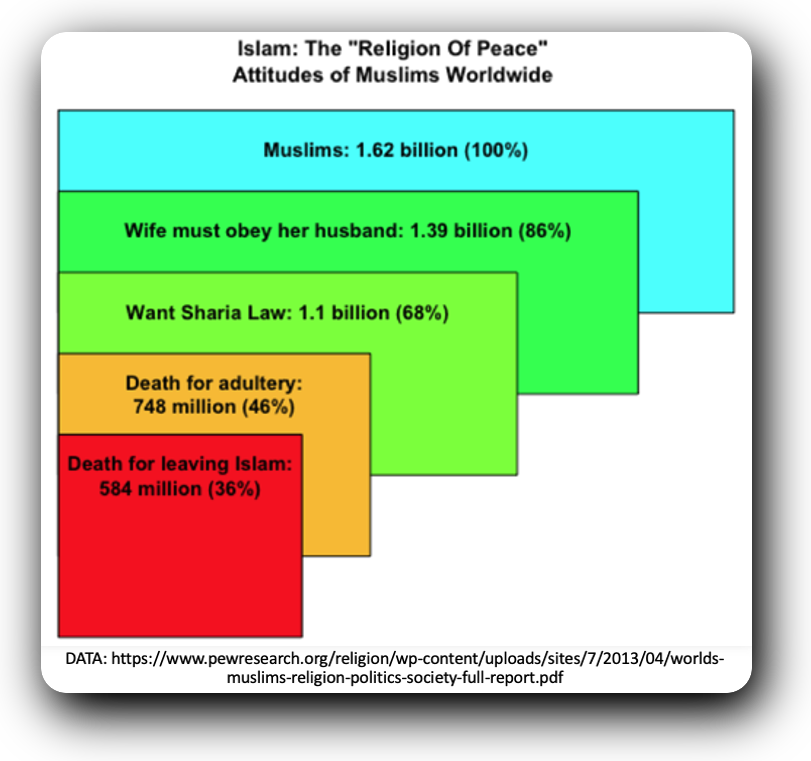
Not only that, but as the Pew Forum worldwide Muslim poll results below show, Sharia Law is the expressed preference of about 70% of Muslims worldwide. This means that the barbaric 7th-century laws authorizing inhumane abuses of women are NOT extremist Islamic views.
Those legalized Islamic abuses of women are the stated preference of a majority of Muslims worldwide.
In the Muslim world, those egregious violations of women’s basic rights are not unusual or fanatical views. They are not a “radical interpretation of the Koran”. They are not held by some mythical “extremist minority” of Muslims. I say again:
The various barbaric and ruthless repressions of women specified in the Koran and codified in Sharia Law are the clear preference of Muslims worldwide.
w.
Lula – The Gramsci of Latin America.
Latin America is a bit behind Europe, but it follows the same script. Lula is in fact their Gramsci, or their Dutschke.
In Europe, the turn came in 1968. The revolution had failed in the streets, so the generation of '68 took Gramsci's advice and Dutschke's slogan: don't storm the palace – march through the institutions.
Latin America had its own street revolution: Che's guerrillas. They failed too. Then the Berlin Wall fell, and the left lost both its model and its money.
So in 1990, Lula, the leader of the Workers' Party, who had just lost the presidential election, called the left of the whole continent to a hotel in São Paulo. He and Fidel Castro had agreed that his party would host the meeting. The São Paulo Forum was born: communist parties, socialist parties and guerrilla movements, all at one table.
This summer, Lula himself explained why he created it: he thought the left of Latin America could be educated through elections. The road to power was not the rifle but organizing people and winning votes. And that it would take 20-30 years.
That is the long march: not the war of maneuver but the war of position. Gramsci, translated into Portuguese.
And it worked. Within fifteen years, parties from the Forum governed Venezuela, Bolivia, Nicaragua, Uruguay, El Salvador – and Brazil itself. In Cuba, of course, the communists never left power since 1959.
Brazil even had the long march's schoolmaster. Paulo Freire, author of Pedagogy of the Oppressed, the book that turned teaching into raising revolutionary consciousness, ran São Paulo's schools for Lula's party from 1989.
And the march reached the courts. The Supreme Court annulled Lula's corruption convictions on procedural grounds, then sentenced his main rival, Jair Bolsonaro, to 27 years in prison.
In Europe, the long march was an idea. In Latin America, it has a founder, an address and a membership list. Dutschke gave Europe a slogan. Lula gave Latin America an organization.
But Latin America started the march twenty years after Europe – and it may be the first to walk out of it. Argentina, El Salvador, Bolivia and Chile already have. Brazil, for now, stays in line.
@BreitbartNews This is the line.
Americans will not stand for this.
This is the ultimate destruction of the Democratic party.
If they make Ilhan above the law... thats an end to Americans politics as we know it and the beginning of whatever comes after political debate
The article is hogwash. Mammals of all kinds produce either large gametes or small gametes. Those producing large gametes are called "female", small gametes "male".
Yes, there are genetic abnormalities, but those don't alter the statement above. Why not? Because they are alterations like "large gametes plus something" or "small gametes minus something". They don't alter the maleness or the femaleness.
Read. Colin's. Article.
w.
https://t.co/iCtYUu9T7k
@LewisWithrow5@ClarksonsFarm1 This fact coupled with a negative Joule-Thompson coefficient of expansion makes hydrogen tricky. Embrittlement increases leak pontiential and pressurized hydrogen leaks get hot and can ignite.
Electricity is NOT energy.
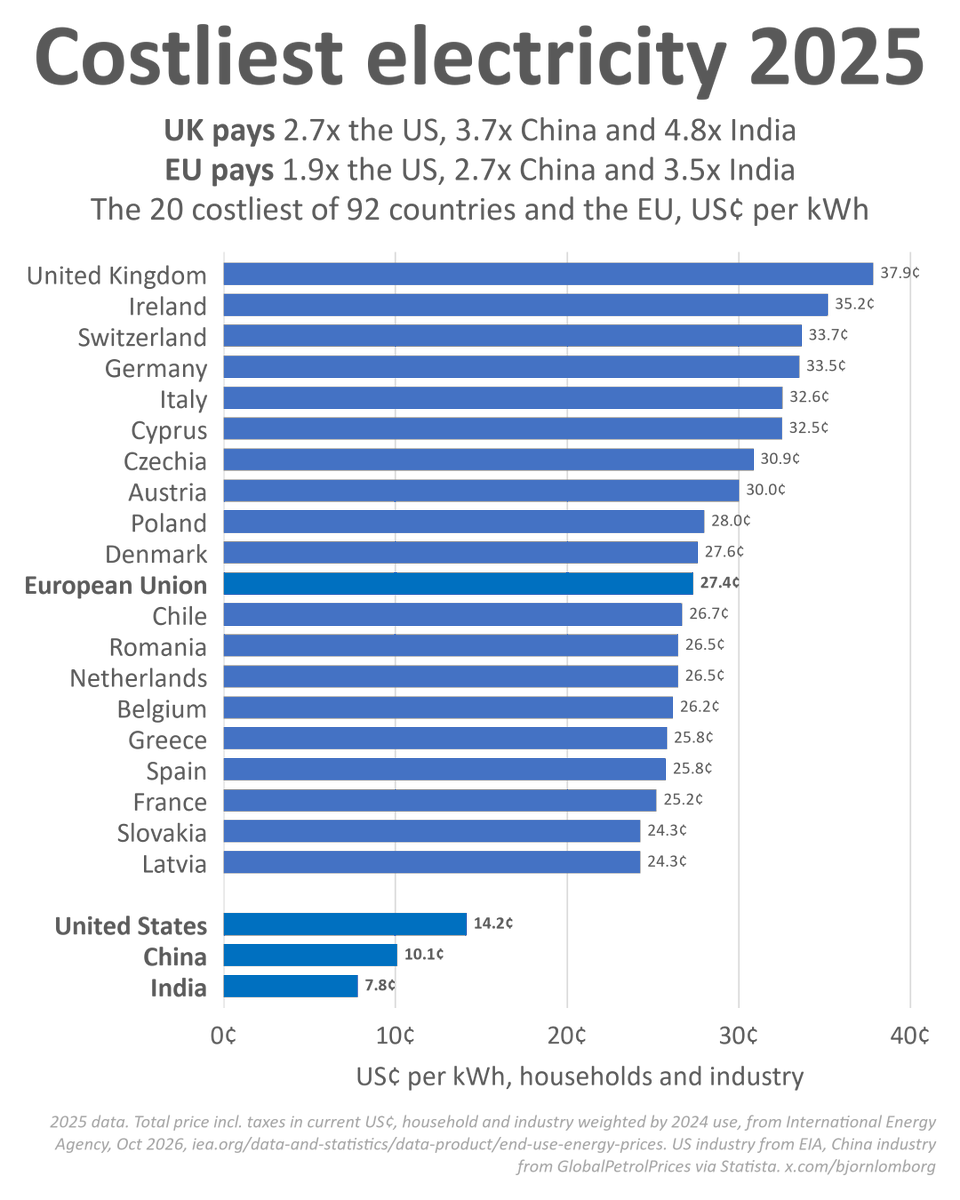
This chart tells only part of the story.
Electricity is roughly 20% of global final energy consumption. The rest includes industrial heat, steelmaking, cement production, transportation, and heating.
When you include ALL energy, not just electricity, fossil fuels still supply roughly 80% of the world's primary energy.
Wind and solar? Still only about 7–8%.
You can't power modern civilization with a cherry-picked electricity chart.
The world runs on ENERGY, not just electricity.
If you think Democrats really care about lowering gas prices remember that on the First Day of the Biden Admin they cancelled the Keystone XL pipeline and halted all new oil and gas leases.
Elon Musk becomes deeply moved, and deadly serious, when Bret Baier asks him why he called Sen. Mark Kelly a "Traitor" for pushing to send more US aid and weapons to Ukraine.
Watch every second of his response.
"We should have empathy for the thousands of people dying everyday in the trenches. For no movement in the lines. For the past two years thousands of people have died every week for nothing."
"I take great offense at those who put the appearance of goodness over the reality of it. Those who virtue signal and say we can't give into Russia, but have no solution to stopping thousands of kids dying every day."
"I have contempt for such people and I want to make that clear. Because they're virtue signaling and their lack of a solution means that kids don't have a father. It means parents lost a son. For what? Nothing."