@BrendanPedersen Quite a stark illustration of how seriously the crypto industry takes law enforcement/compliance to have hired so many fmr officers and enforcement officials. Good point. The industry has definitely matured
Prob a big reason so many law enforcement tools are baked into CLARITY
@zengjiajun_eth Lower issuance, monetary policy has only ever tightened, sustainable security budget, leading the industry in quantum resistance, and native yield without the need for trusted third parties
It is a strong case to be made imho
I know Bitcoiners will fucking hate me saying this, but if @saylor had several billions in $ETH staking, it would completely and entirely (forever) solve his dividend payout problem.
Literally. Wouldn’t even need to exchange much of Strategy’s corn for Ether, either - just rebalance from Bitcoin to Ether when needed, and stake additional ETH as the STRC dividend payout amount grows over time. No raises, no selling Bitcoin…just a constantly churning yield from a small part of your capital stack spitting out native yield that solves your problem for you.
Permanently.🤷♂️
@fundstrat and @joechalom seem to have figured this out.
Here is the root cause of the current Gnosis Pay incident. Several other projects are affected. We tried to inform everyone privately in advance, but if you haven’t heard yet and are using a Zodiac module — Delay or Roles — please urgently check whether you are affected 👇
Ethereum is preparing for a post-quantum future.
The transition away from BLS signatures starts with a dedicated Post-Quantum (PQ) Public Key Registry.
https://t.co/H1UUFfUZqk
Here is a deep dive into the design space, XMSS, and how Ethereum will secure its validators. 🧵👇
HIRING: a research associate to help us advocate for Ethereum & DeFi in Europe:
TLDR:
- Data reports on:
- - Decentralization & DeFi taxonomy
- - Tokenization & Stablecoins
- - European Ethereum ecosystem
- Ideally an enrolled student
- Part-time under @EuEthInstitute
👇
Today a crazy quantum story just got wilder.
On March 31, the Google Quantum AI team published a landmark result on Shor's algorithm for elliptic curve cryptography. Technically, the paper was a bombshell: a dramatic 10x improvement over the state-of-the-art. As a stunt and wakeup call to the blockchain space, those optimisations were illustrated on secp256k1, the elliptic curve underlying Bitcoin and Ethereum signatures.
But perhaps the most striking part of the paper was sociological, not technical. Instead of following standard academic process, the optimisations were kept secret, hidden behind a zero-knowledge (ZK) proof. Google's accompanying blog post mentions they "engaged with the U.S. government". The ZK proof demonstrates the existence of algorithmic improvements without leaking details. Academic censorship with ZK, a historic first!
As a co-author of the Google paper I witnessed some of the context surrounding this censorship. To be honest, multiple aspects of that context don't sit well with me. As much as I believe the general public ought to know more, I am limited in my ability to whistleblow. Though let me be clear about one thing: the Google team's professionalism has been absolutely exemplary, and they deserve nothing but praise.
Censorship has a way of backfiring. The Streisand effect, where an attempt to bury something only draws more attention to it, is exactly what's unfolding today. First, Google's key optimisation has been rediscovered by the French. And in a thrilling turn of events, a collaborative Shor-at-home challenge just launched. The initiative, available at ecdsa[.]fail, breached a new Shor world record in a matter of hours.
Let's start with the rediscovery. Just two months after Google's paper, French quantum expert André Schrottenloher cracks the main secret optimisation. His paper, titled "Optimized Point Addition Circuits for Elliptic Curve Discrete Logarithms", landed on the arXiv today. Big congrats to André, who beat several other nerdsnipped experts to it. In a blog post also published today, Craig Gidney, the world expert on Shor optimisations, revealed that he'd been sitting on this very optimisation for a whole year under censorship pressure.
Interestingly, André missed a handful of minor optimisations, both from Google's original publication and from improvements found since. It's plausible there's still plenty of juice left to squeeze out of Shor, and this is exactly what the ecdsa[.]fail challenge is about. The verifier program developed for the ZK proof does double duty, automatically filtering for valid submissions. Dozens of compounding small and micro improvements are rolling in. As of the time of writing there's an 8.4% improvement to Google's circuit, as measured by the product of logical qubit count and Toffoli gate count. Nice!
The nerdsnipping ran deeper than anyone expected. Over the last few weeks it became clear it extended well beyond André and other quantum experts. Behind the scenes, a small army of amateurs quietly got to work. Inspired by Karpathy-style autoresearch, they turned AI on Shor. Ironically, the verifier program for the ZK proof makes an ideal reward function for AIs. The barrier to entry for this modern style of research is refreshingly low, with several non-experts, even a teenager, finding nice optimisations. Get in touch if you'd like to join a Telegram group with fellow autoresearchers :)
Part 2: neutral atoms and qday
The story doesn't end with Google. On the same day Google went public, a stealthy startup called Oratomic published its own Shor paper in a coordinated release. It made a splash, ultimately becoming the most upvoted paper on scirate[.]com, a website ranking arXiv papers.
Oratomic's claim was wild. By building on Google's logical optimisations and applying custom physical optimisations for neutral atoms, they claimed just 10K physical qubits were sufficient to run Shor's algorithm on secp256k1. That number is mind-bogglingly low.
Knowing essentially nothing about neutral atoms when Oratomic's paper landed, I was intrigued and decided to learn more about the tech. I fell straight down the rabbit hole and spent a couple hundred hours on the topic. I got a little obsessed and watched every YouTube video I could find and spoke to a bunch of experts.
My conclusion? The tech is real, very real. Even Google recently decided to start a neutral atom lab, a notable pivot from their sole focus on superconducting qubits. If you care about qday, i.e. the day a quantum computer will break the first piece of cryptography in production, neutral atoms demand your attention. I shared some of my learnings on Shor and neutral atoms in a 30min talk at the ZKProof cryptography conference. You can find it on YouTube by searching "zkproof neutral atom".
Here's an interesting observation about this duo of breakthrough papers: neither Google nor Oratomic say a word about what their results mean for qday. No timelines. Zero. Nada. That is especially baffling given that the whole point of whitehat quantum cryptanalysis is to inform qday estimations and help the general public make good decisions.
So let me attempt to partially fill the silence, similarly to what Scott Aaronson did in his April 29 post. Given everything I know, including scary non-public information, I now put the odds of qday by 2032 at 50%. 10% by 2030.
Anecdotally, the US government has its own date: 2035. Originating at the NSA and later adopted by NIST, it's when branches of the US government will be disallowed from using quantum-vulnerable cryptography. In plain language: with hindsight, that date is a joke and should be discounted entirely. I don't see how NIST avoids being forced to pull it forward by years.
Part 3: post-quantum cryptography
There are good reasons to sound the alarm today, but please do not panic. Rushing carelessly towards immature post-quantum cryptography is a recipe for disaster. IMO a good target date for migration is 2029, roughly 3.5 years out. 2029 happens to be the date selected by Google, Cloudflare, and the Ethereum Foundation.
These days most of my time goes to safely migrating Ethereum towards post-quantum cryptography as part of the broader lean Ethereum effort. There's a lot to do. We need to rip out and replace BLS signatures at the consensus layer, KZG commitments at the data layer, and ECDSA signatures at the execution layer.
The plan to get there is compelling, and is based on hash-based cryptography. Within the Ethereum Foundation we've developed a Swiss army knife called leanVM (github[.]com/leanEthereum/leanVM) powered by the magic of hash-based SNARKs. Thanks to truly exceptional work by Emile, Thomas, and others, its performance is derisked. Regarding security, leanVM is a jewel, a minimal zkVM crafted for end-to-end formal verification and maximum security.
Want to help? There are two $1M initiatives. First, the Proximity Prize (proximityprize[.]org). Solve a long-standing mathematical conjecture in coding theory, improve hash-based SNARKs, and go home a millionaire. Second, the Poseidon Initiative (poseidon-initiative[.]info), offers $1M for breaking Poseidon, the SNARK-friendly hash function.
Ethereum is preparing for a post-quantum future.
The transition away from BLS signatures starts with a dedicated Post-Quantum (PQ) Public Key Registry.
https://t.co/H1UUFfUZqk
Here is a deep dive into the design space, XMSS, and how Ethereum will secure its validators. 🧵👇
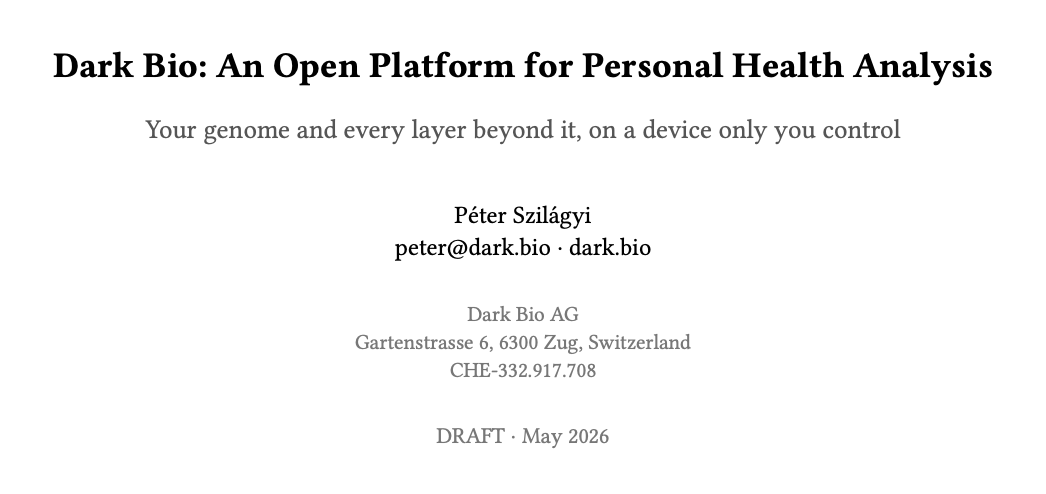
Dark Bio whitepaper is out!
We're building a system in which a person's health data, their genome most of all, no longer has to live with a custodian to be useful. A system, where data does not move, rather stays on a small device the owner holds.
Have had some people ask me how I could go from being a toxic Bitcoin maximalist for 8 years, and then update my thesis.
I am always revisiting things, and making sure that a thesis is still in tact. If something changes that equation materially, I can then go through a process of updating my initial thesis. This is just being an objective human who pays attention to reality.
In the case of Ethereum, I simply identified a structural trend: agentic systems, tokenized finance, programmable money, permissioned/conditional execution…agents are going to change the economy forever. So I asked:
What rails would this world realistically need?
Conviction is not stubbornness…it is a model with falsification criteria…
Bitcoin is incredible at one thing: credibly scarce, hard-money settlement. It is simple, durable, culturally ossified, and that is the point. But the exact thing that makes Bitcoin beautiful also makes it a bad candidate for the agentic economy unless something dramatically changes.
An agentic financial system needs rails that can express:
- programmable permissions
- conditional execution
- smart accounts
- delegated authority
- revocable approvals
- escrow
- tokenized assets
- collateral logic
- identity/attestation layers
- automated settlement
- composability between applications
- machine-readable state and incentives
Ethereum is the only major decentralized protocol seriously designed around that job.
Bitcoiners often wave toward “L2s,” “sidechains,” “RGB,” “BitVM,” “Drivechains,” “eventually fees,” etc. Some of that is interesting. Some of it may matter. But it is still largely around Bitcoin, not native to Bitcoin’s core operating model. The agentic economy is not going to wait around for brittle, awkward, partially trusted contraptions if there is already a battle-tested programmable settlement layer with stablecoins, DeFi, rollups, account abstraction, token standards, custody tooling, real institutional experimentation, and developer gravity.
And the security budget issue is not some made-up critique either. It is a real long-term question:
- Bitcoin block subsidies trend toward zero.
- Long-term miner security must increasingly come from fees.
- The future fee market is not guaranteed.
- If Bitcoin is mostly HODL collateral and not high-throughput settlement, then the fee-security model becomes an open question.
- The common answer is basically: “number go up enough and fees will appear.”
Maybe! But “maybe fees will appear because vibes” is not the same as a solved security model. That deserves scrutiny.
ETH’s thesis is now strong:
If the future of finance is increasingly machine-mediated, tokenized, automated, and permissioned, then the winning base layer needs to be programmable, composable, and credibly neutral. Ethereum is much closer to that target than Bitcoin.
That is not cope or me randomly changing my opinion. That is a real thesis from real data, from the real world.
ETH is better money than Bitcoin. 🤷♂️
@sgodofsk Not sure your Vegan straw-man is best counter. I’m an omnivore that grills steak/chicken and cooks pork most days of the week and I’d be fine with curbing this even if it costs quite a bit more per pound. Not like I nor a single person would go hungry/malnourished as a result
I’m receiving a lot of outreach from disgruntled Polymarket users who feel cheated and are looking for alternatives.
Many are looking to migrate to @Trueo_, they like the idea of our resolution system, but cite liquidity as the primary barrier.
Later this month we will be releasing a product we’ve been working on since last year - User Created Markets.
After this release we’ll have two primary areas of focus:
1) Upgrading our oracle to an immutable, long term model
2) Focusing on improving our liquidity
We already have a token so there are no cheap promises of an airdrop. Our solution to liquidity will be something more sustainable than incentives.
I’ve teased about it in the past. It’s a concept we call “Smart Vaults.”
A vault that bootstraps select markets using a real-time AI managed adapter.
The concept is very experimental, so it won’t be open to public depositors, but it will allow us to improve liquidity conditions significantly across most markets.
Some really cool stuff is coming soon, starting with UCM and an app-wide UX overhaul later this month.
Stay tuned!