When the Vietnam War ended in 1975, the countryside was scattered with the remains of military equipment left behind by years of intense air operations. Among the most common items were external fuel tanks, also known as drop tanks, which had been attached beneath U.S. fighter aircraft such as the F-4 Phantom and F-105 Thunderchief. These large aluminum tanks were designed to carry extra fuel during long missions and were normally discarded once empty to lighten the aircraft. Thousands of them ended up lying across fields and rural areas throughout Vietnam.
For local farmers and craftsmen, the unusual shape of these tanks quickly suggested a practical use. The smooth aluminum shells were lightweight, strong, and already shaped somewhat like a boat hull. With a few modifications such as cutting an opening along the top, adding simple wooden seats, and fitting small paddles, the tanks could easily be turned into narrow river boats or canoes. In many river communities where transportation depended heavily on waterways, these improvised boats became surprisingly useful.
Over time, the converted drop tank boats became a familiar sight along Vietnamese rivers and canals. What had once been part of military aircraft flying combat missions was transformed into everyday transportation for fishing, farming, and travel between villages. The story became a striking example of how communities repurposed the remnants of war into something practical, turning discarded pieces of aviation technology into simple boats that helped support daily life.
#archaeohistories
Dear researchers on AI-empathy,
We (@AnatPerry, @minzlicht, and @_desmond_ong) are writing a short review of current research on AI and empathy.
We know your published work but are also looking for preprints or submitted papers that we may have missed.
Share in comments!
🚨New WP🚨
Can AI do "deep canvassing"—the time-intensive, empathic persuasive dialogues that durably reduce prejudice when done by humans?
Spoiler: Yes! We find durable reduction in prejudice toward undocumented immigrants
LLMs make deep canvassing possible at scale
It is easy to glance at the news and be captivated by whatever fresh travesty is happening in the world today. But the reality is that most of people’s moral lives play out in quieter, seemingly more mundane moments, such as those involving friends and family, at the grocery store, or at the office.
Over the past four years, I have been involved in a large-scale project seeking to better understand these “everyday moral dilemmas.” I’m thrilled to say that the results of this project were published yesterday in the journal PNAS: Nexus.
https://t.co/b3MuRAHrqc
To explore this topic, my collaborators and I used an unconventional data source: the "Am I the Asshole?" forum on Reddit, a thread in which people post about everyday moral conundrums and elicit feedback from their peers. We extracted 369,000 posts and 11 million “comments,” or reactions to these posts, from the site, then used state-of-the-art language processing tools to analyze the data. To assess generalizability of this data we then conducted a followup study involving a US-representative sample.
Many of our findings surprised me. Here are some highlights:
-𝗧𝗵𝗲𝗿𝗲 𝗮𝗿𝗲 𝟮𝟵 𝗱𝗶𝗳𝗳𝗲𝗿𝗲𝗻𝘁 𝗸𝗶𝗻𝗱𝘀 𝗼𝗳 𝗲𝘃𝗲𝗿𝘆𝗱𝗮𝘆 𝗺𝗼𝗿𝗮𝗹 𝗱𝗶𝗹𝗲𝗺𝗺𝗮𝘀. These range from “broken promises” to “privacy violations.”
-𝗧𝗵𝗲 𝗺𝗼𝘀𝘁 𝗳𝗿𝗲𝗾𝘂𝗲𝗻𝘁𝗹𝘆 𝗲𝗻𝗰𝗼𝘂𝗻𝘁𝗲𝗿𝗲𝗱 𝗺𝗼𝗿𝗮𝗹 𝗾𝘂𝗲𝘀𝘁𝗶𝗼𝗻 𝗶𝘀: “𝗪𝗵𝗮𝘁 𝗱𝗼 𝗜 𝗼𝘄𝗲 𝘁𝗵𝗶𝘀 𝗽𝗲𝗿𝘀𝗼𝗻?” 𝘙𝘦𝘭𝘢𝘵𝘪𝘰𝘯𝘢𝘭 𝘰𝘣𝘭𝘪𝘨𝘢𝘵𝘪𝘰𝘯𝘴—that is, questions about what we owe (and don’t owe) to friends and family—are the most commonly experienced type of moral dilemma.
-𝗛𝗼𝗻𝗲𝘀𝘁𝘆 𝗶𝘀 𝗸𝗶𝗻𝗴. The most negatively evaluated behaviors concerned acts of 𝘥𝘪𝘴𝘩𝘰𝘯𝘦𝘴𝘵𝘺.
-𝗣𝗲𝗼𝗽𝗹𝗲 𝗵𝗮𝘁𝗲 𝗵𝘆𝗽𝗼𝗰𝗿𝗶𝘁𝗲𝘀. Being 𝘫𝘶𝘥𝘨𝘮𝘦𝘯𝘵𝘢𝘭 is among the things most likely to get you labeled “the asshole”
-𝗠𝗼𝗿𝗮𝗹𝗶𝘁𝘆 𝗶𝘀 𝗳𝗹𝗲𝘅𝗶𝗯𝗹𝗲. People, for example, think it’s worse to lie to a 𝘤𝘰𝘸𝘰𝘳𝘬𝘦𝘳 than your 𝘣𝘰𝘴𝘴, and it’s worse to break a promise to your 𝘥𝘢𝘶𝘨𝘩𝘵𝘦𝘳 than your 𝘴𝘰𝘯.
In followup analysis, we have found that there is virtually no difference in the kinds of moral dilemmas experienced across the political divide. This suggests that when you zoom out from the hot-button issues that divide us, we all grapple with similar questions: questions such as how to navigate interpersonal disagreement, build community, and contribute to society (and, of course, whether we should be honest with our partner about their new haircut).
The bottom line is our moral lives are far richer, more varied, and more similar to each other than you might think.
Big thanks to my co-authors Sudeep Bhatia, Geoff Goodwin, Andrew Reece, PhD, and Kurt Gray.
Are #smartphones and #socialmedia harming a generation?
This is a hotly debated and often polarizing debate. So we surveyed over 120 experts on the topic to see where there was genuine consensus (or not), like experts have previous done for climate change.
92–97% of experts agreed with the following statements:
1) Adolescent mental health has declined in several Western countries over the past 20 years.
2) Heavy smartphone and social media use can cause sleep problems.
3) Smartphone and social media use correlate with attention problems and behavioural addiction.
4) Among girls, social media use may be associated with body dissatisfaction, perfectionism, exposure to mental disorders, and risk of sexual harassment and predation.
5) Evidence on social deprivation and relational aggression is limited.
6) The evidence for policies like age restrictions and school bans is still preliminary.
These results can help guide future research (e.g., on policies) and informed policy on adolescent technology use.
This was led by @ValerioCapraro@laura_k_globig@steverathje2 and @ZachMRausch and numerous other authors!
[NEW REPORT] A new @MoreinCommon_US report finds that while 70% of Americans feel a responsibility to connect with people who have different backgrounds and beliefs, a lack of opportunity stands in their way. https://t.co/11UchDISwM (1/3)
Two common findings from sleep research are that 1) short sleep durations predict worse health outcomes, and 2) people from some cultures sleep much less than those from others. Do people from cultures with short sleep durations have worse health outcomes? 🧵
A brilliant lab manager in my dept will likely have her only PhD offer rescinded due to funding reductions. Her visa ends in June - this has turned her world upside down. If you know of any post-bacc psychology jobs that would sponsor an international applicant please share. 🙏
🚨Excited to announce the return of the Moral Psychology pre-conference at #SPSP2025! A crowd-pleaser for over 20 years!
We have an incredible lineup of speakers! And we're accepting posters; deadline to submit is Oct 17 https://t.co/MqzlCO28KD. PS there's a best poster award!
I’m hiring a lab manager to start July 2025! Submit CV and cover letter as soon as possible as review will begin immediately. Link to the job ad is here: https://t.co/0xbIjQRh1O
Please share with any undergrads or mentees who might be interested!
Across 102 polled issues, Congressional action matches the public majority 55% of the time. Failures are concentrated in inactions due to the Senate filibuster or divided party control
https://t.co/DnTJ0FopqW
Introducing OCTAVE, a next-generation speech-language model.
OCTAVE has new emergent capabilities, like on-the-fly voice and personality creation and much more 👇
We’d love to see it reach tech and policy spaces, so please feel free to share the link! We also would like to connect with organizations and explore potential research partnerships--reach out if interested!
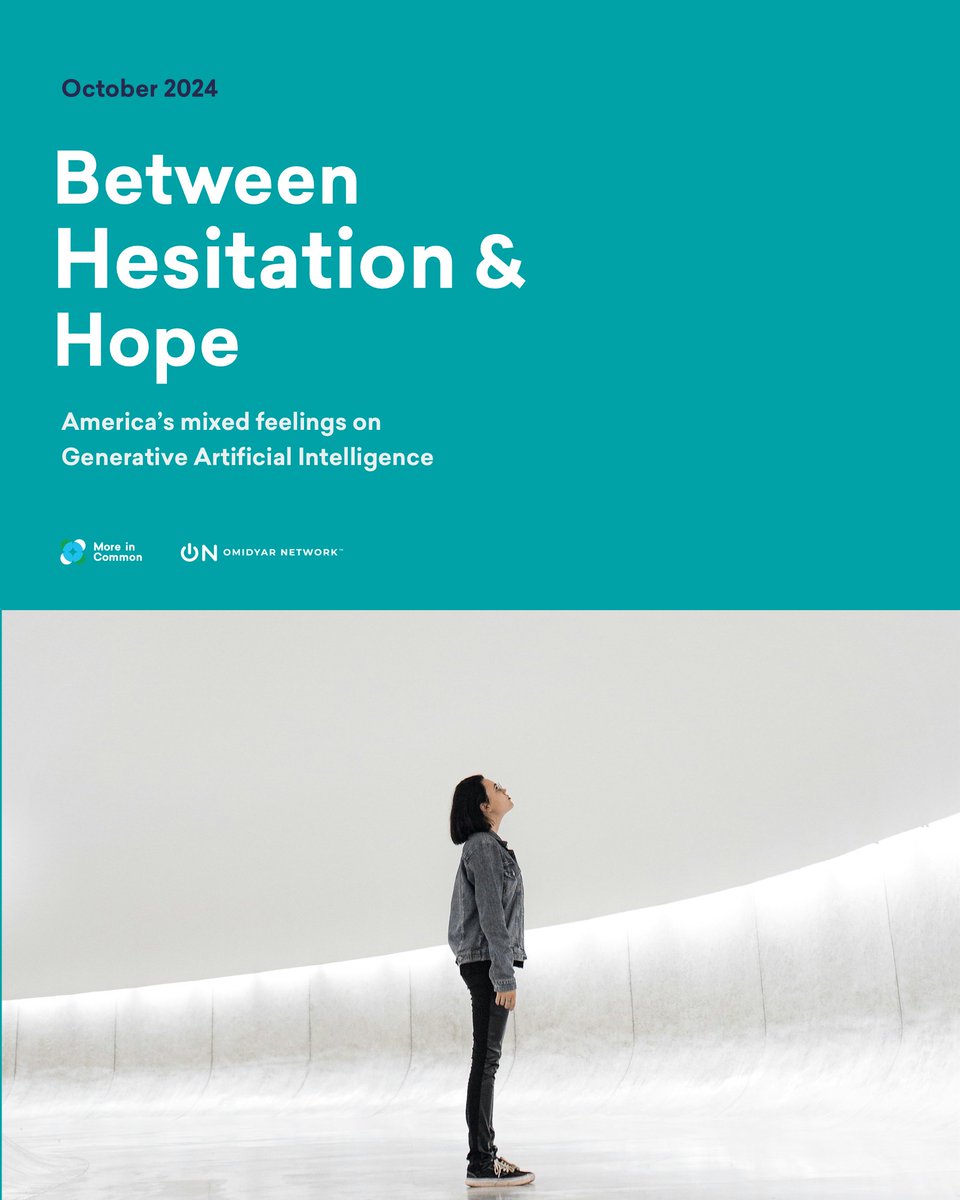
Excited to share a ✨new report ✨ I helped lead as a research fellow at More in Common on Americans' attitudes towards generative AI! You can check it out here: https://t.co/dQyvX3qbYA
On the research presentation side, we experiment with using Flourish for interactive dataviz (embedded in Canva). It's a really cool way to show subgroup findings!








![MoreInCommon_US's tweet photo. [NEW REPORT] A new @MoreinCommon_US report finds that while 70% of Americans feel a responsibility to connect with people who have different backgrounds and beliefs, a lack of opportunity stands in their way. https://t.co/11UchDISwM (1/3) https://t.co/BZPwQlbpaI](https://pbs.twimg.com/media/GmU0lFNWcAAgyQ9.jpg)