We are launching AI Convert, a free migrator for Heym 🎉
Paste an existing workflow export or describe what you want to build. AI Convert generates a Heym workflow you can preview on a canvas, inspect node by node, copy, download, and import.
Try it: https://t.co/ZWNGD8tHD6
#AI #Automation #WorkflowAutomation #DeveloperTools #Heym
Most workflow builders start with an empty canvas.
Heym can start with intent.
Describe the workflow you need, and the AI Assistant generates the nodes, edges, and structure on the canvas.
Prompt first.
Canvas second.
https://t.co/R3MWQcC62X
https://t.co/H2OHJ4tpV0
Heym includes a built-in MCP server. 🧩
Your workflows can become tools for Claude, Cursor, and other MCP-compatible clients.
Build visually in Heym.
Expose as MCP tools.
Run from your AI toolchain. ⚡
You can watch it here:
https://t.co/Wa44h29SEF
I think about it as a distinction between commercial use and commercial resale.
We do not restrict companies from using Heym commercially. If you/your org self-host Heym to run your own automations, support operations, internal tools, or customer-facing workflows, that is fine. No usage caps, no “you need enterprise for production” layer.
The restriction is about reselling Heym itself. The license is there to stop someone from taking the product, hosting it as a competing paid cloud service, rebranding it, or selling something whose value mainly comes from Heym without permission.
So the goal is simple: keep Heym source-available, self-hostable, and usable in real businesses, while preventing straight commercial resale of the platform. More detail is in the GitHub license.
https://t.co/krAKub5T8b
your automation platform added an "AI agent node" last quarter.
heym shipped with:
multi-agent orchestration ✓
built-in RAG ✓
MCP support ✓
HITL checkpoints ✓
LLM tracing ✓
self-hosted ✓
because it was built around AI, not bolted on.
https://t.co/TReDbOTJr7
https://t.co/HeCoJ6TCy3
Want to publish a workflow template for the community? You can now submit it directly from the Templates page. Open the dialog, paste your workflow DSL, and send it for review. No pull request needed.
https://t.co/s5OOyWawrc
#WorkflowAutomation#WorkflowTemplates#DSL #DeveloperTools #NoCode #OpenSource
https://t.co/UG3AqibzwY
Heym Portal turns AI workflows into chat interfaces.
Users can run workflows without seeing the canvas, nodes, credentials, or internal setup.
You can watch the tutorial now 👇▶️
https://t.co/e9iFRv3TPe
Guys, stop saying "build this" or "review this code" and hoping one model / single call gets it right.
There are better development loops. Let different models weigh different sides of the same problem, and have them talk to each other in their agentic way of talking.
Yes, it burns more tokens +1. But believe me, it is worth as models are biased and chase quick wins. Its always better when you support agents with follow-up questions and feed evidence/more data.
@heymrun Traces help you understand what happened inside an AI workflow.
In this demo:
two agents run in parallel
node details are inspected
timing shows latency per node
Traces reveal full LLM request/response
pricing shows model cost
Demo: https://t.co/nCy7UMyoIa
You can now talk to your AI workflows in Heym.
New in Chat:
🔊 Read any message out loud
🎙️ Hands-free voice mode (you talk, it talks back)
Integration with ElevenLabs. Automatic language detection, works in any language, dark mode and mobile ready.
https://t.co/TReDbOTJr7
#AI #VoiceAI #ElevenLabs #Automation #heym
@compileandpush We do not collect telemetry reports or analytics data, not today, not tomorrow. Open source should be free of charge.
#noenterprisegatekeeping
n8n is great for automation.
LangChain is great for agent code.
Langfuse is great for observability.
Qdrant is great for vector search.
Heym tries to bring these production AI workflow needs into one visual, self-hosted platform.
https://t.co/R3MWQcC62X
Qdrant is pretty flexible on schema changes. The metadata side is schemaless: each point can carry arbitrary JSON payload, so adding fields like source, tenant_id, version, or category is just an upsert or payload update, not a migration. If you later need fast filtering on a new field, you create a payload index for that field and type.
In Heym we use Qdrant this way for RAG: documents are stored as chunks with text plus metadata payload, then the RAG node can search and filter against that metadata. These templates show the pattern: RAG Document Ingest and RAG Q&A Agent.
https://t.co/yw0SblZnAP
https://t.co/A8vQVYpQxE
Improved the /chats experience with collapsible tool-call cards, a context usage badge, automatic context compression, and persisted tool-call history across reloads.
Cleaner debugging, better visibility into agent actions, and more resilient long-running chats.
#AI#Agents #DeveloperTools #UX #OpenSource
https://t.co/HeCoJ6TCy3
New in Heym Traces: full LLM cost observability, built in.
Tokens by model, USD spend, latency, error rate, all filterable by time range (1h, 24h, 7d, 30d, all). Per-model pricing syncs from Helicone for 1,100+ models, with per-user overrides and custom model support.
#LLMOps #AI #Heym #OpenSource
https://t.co/HeCoJ6TCy3
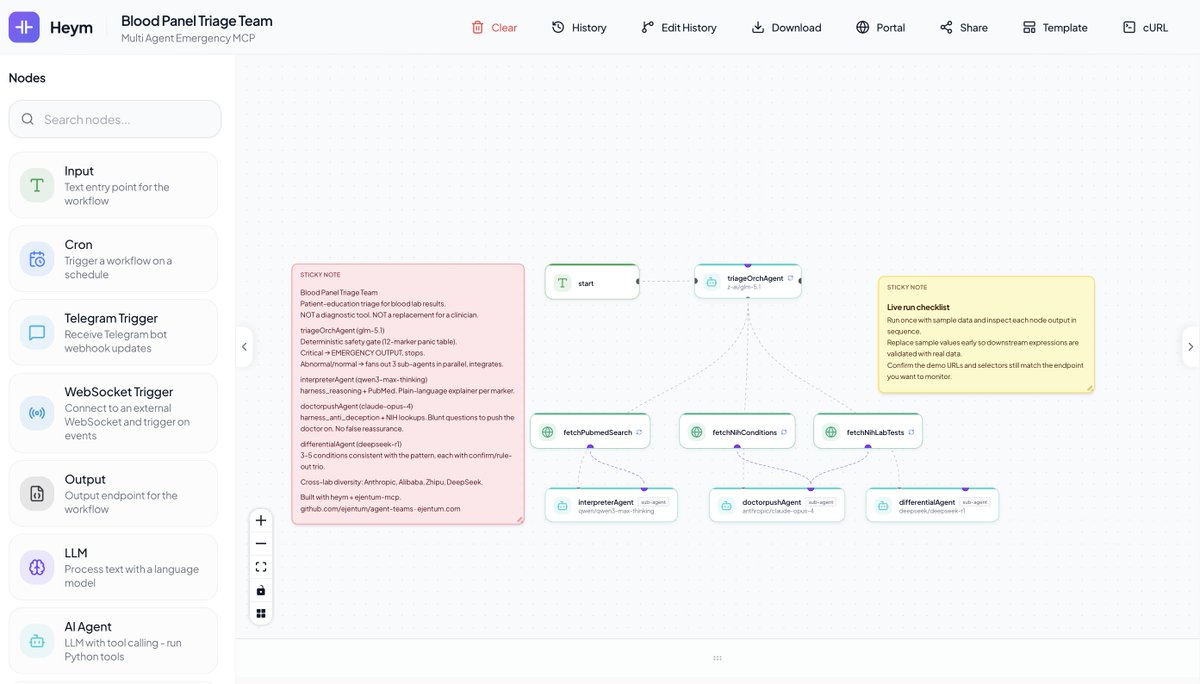
@TheEcomNomad @ejentum Exactly. The safety-critical branch should be boring and inspectable: pure Python checks panic values first. Critical stops before any sub-agent. Non-critical panels fan out to role-locked agents over the same structured JSON. 🙏🤞