The happiest people in the world are the ones who:
• love what they're doing
• accept things that they can't change
• find pleasure in doing things
• continue to grow and evolve
• practice humility
• expect less
• enjoy and appreciate little things in life
Quantum superpositions allow for simultaneous possibilities, while general relativity suggests that space and time are malleable. Paired together, these radical features imply that causality is indefinite. https://t.co/ycMD3Fc6Ar
In the year 1961, the well-known meteorologist Edward Lorenz was engrossed in running a computational model for weather forecasting. Intent on restarting an interrupted simulation, he decided to utilize initial conditions from a prior printout, only to discover the ensuing simulation significantly deviating from the previous run.
The startling divergence was rooted in the subtle discrepancy of the printout values, rounded to a mere three decimal places, lacking the accuracy incorporated in the original calculations. Lorenz had anticipated that any deviations resulting from this loss in precision would be minor, however, they spiraled out of control. The errors escalated rapidly, doubling approximately every four days of simulated weather, and within the span of two simulated months, the weather scenario bore no resemblance to the initial conditions.
In this unexpected turn of events, Lorenz stumbled upon a phenomenon that would later be famously known as the butterfly effect.
This pivotal incident in the realm of chaos theory underscores the sensitivity of complex systems to minute changes in initial conditions. Its profound implications have rippled across diverse fields, from meteorology to finance to ecology, and beyond. The butterfly effect, originally identified in the world of weather simulations, serves as a profound reminder of the inherent unpredictability and complex interplay within natural systems.
This moment, forever ingrained in the annals of scientific exploration, marks a fundamental shift in understanding the dynamics of complex systems, echoing the consequences of minor alterations over time. It underscores the profound influence that seemingly insignificant changes can have, resulting in entirely different outcomes, forever altering our comprehension of the intricate interdependencies of the natural world.
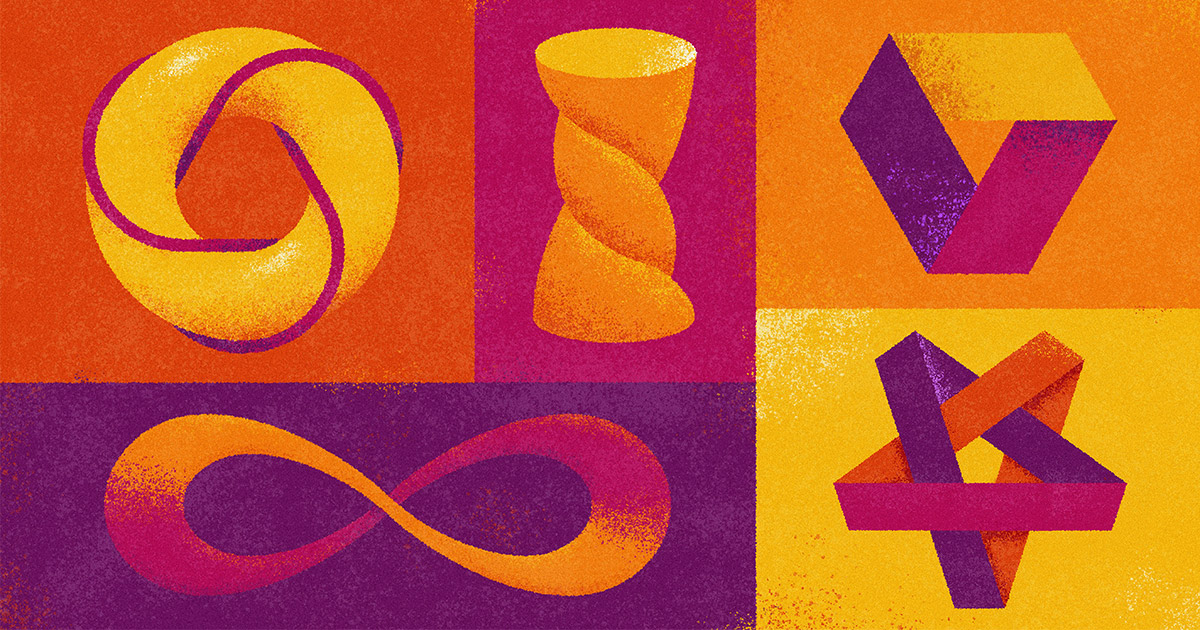
In recent years, there have been at least five mathematical results that identify the “optimal” version of shapes, including the Möbius strip (with one twist), the three-twist Möbius strip and the simple knot. @KSHartnett explains how these shapes work, with graphics by Merrill Sherman: https://t.co/iVriMC4EF8
“Einstein took the question ‘What if the speed of light is just the same to everyone?’ seriously. And spacetime grew out of that thought experiment.” https://t.co/WCWWOVGqc2
The Coriolis effect is due to a fictitious force that acts on objects in motion within a rotating frame of reference. On the Earth, this effect shows as a deflection of the trajectories of objects not connected to the ground.
#MathType#math#mathematics#mathfacts
Lagrange points are positions in space where the gravitational forces of two large masses, such as the Sun and the Earth, balance each other out. This means that a small object, such as a satellite, can orbit at these points with minimal fuel consumption. There are five Lagrange points, labeled L1 to L5, for any pair of orbiting bodies. L1, L2, and L3 are on the line connecting the centers of the two large masses, while L4 and L5 form the vertices of two equilateral triangles with the centers of the two large masses.
The Swiss mathematician Leonhard Euler identified the three collinear Lagrange points (L1, L2, L3) around 1750. This discovery preceded by about a decade the finding of the remaining two points by the Italian-born Joseph-Louis Lagrange.
🧀 The molecule propionate is one component of the aroma of Swiss cheese. It also contributes to body odor. Last year, scientists witnessed a human smell receptor latch onto this compound, a first for human olfaction research. https://t.co/mRGX1YKkRR
How to STUDY Mathematics:
• Practice, Practice & More Practice.
• Review Errors.
• Master the Key Concepts.
• Understand your Doubts.
• Create a Distraction Free Study Environment.
• Create a Mathematical Dictionary.
• Apply Math to Real World Problems.
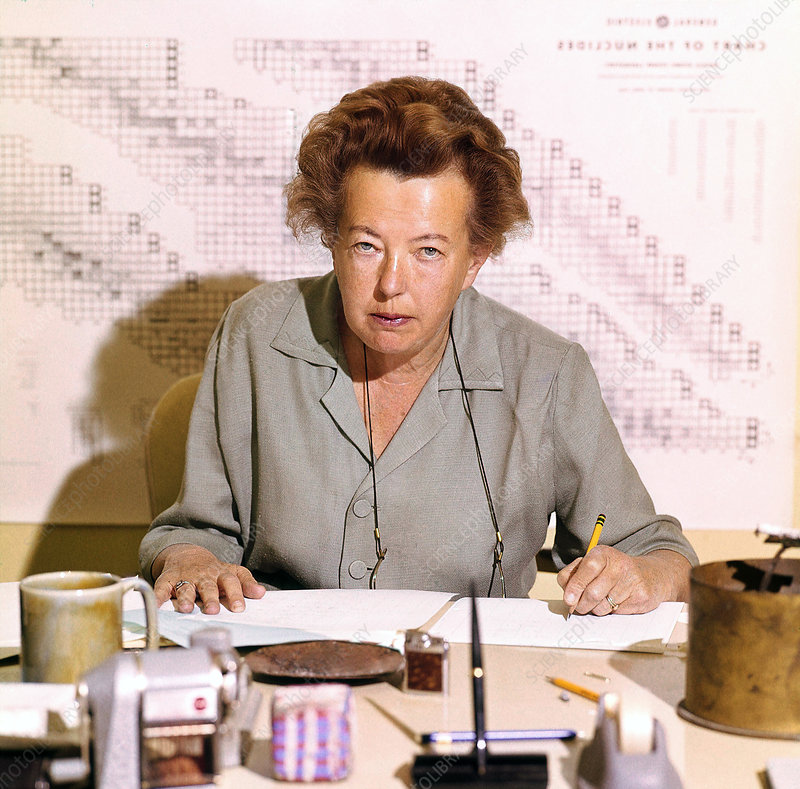
While Marie Curie is well-known for her Nobel Prizes, few are aware of Maria Goeppert Mayer, the second female physicist to win the Nobel Prize in Physics in 1963 for her work on the nuclear shell model of atomic nuclei. Her achievement remained relatively overshadowed in the history of physics.
📷JACK FIELDS/SCIENCE PHOTO LIBRARY