Biotechnology runs on less than 1% of life on Earth—not because the rest isn't useful, but because we can't touch it, yet.
@CultivariumFRX is now open for business as a Frontier Research Contractor to unlock the rest.
Learn more: https://t.co/0u5nOXlOuz and reach out [email protected]
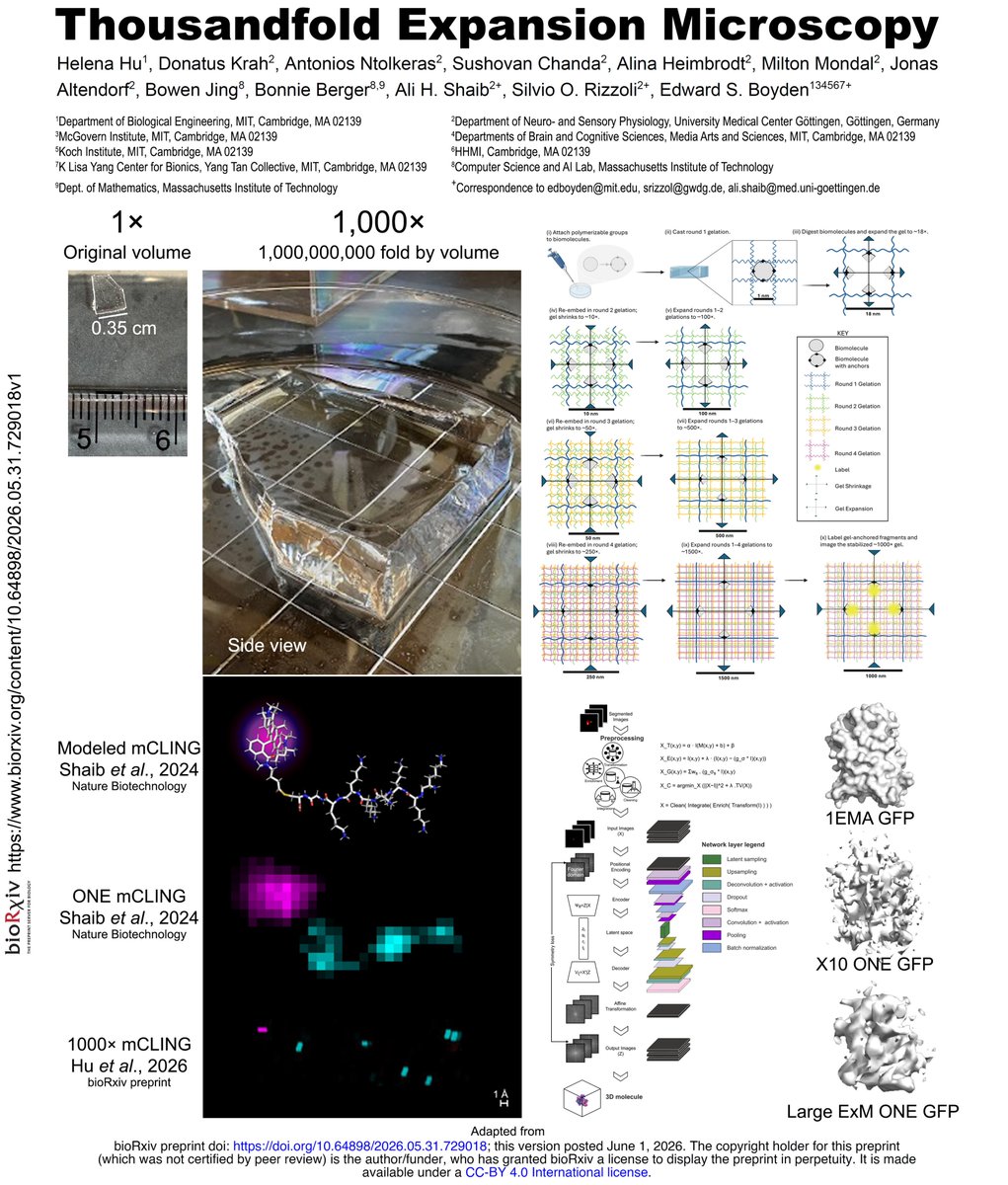
Hello world, meet 1,000× Expansion Microscopy.
1,000,000,000× expansion by volume! A gel that starts at a few centimeters will then expand to the volume of an Olympic swimming pool. https://t.co/E43kxx4O5M
In our new bioRxiv preprint, work carried out between MIT and UMG, led by Helena Hu in collaboration with scientists from the labs of @eboyden3 Ed Boyden, Silvio Rizzoli, and myself, we present Thousandfold Expansion Microscopy.
By enlarging biological specimens across multiple rounds of expansion, molecular-scale features, as small as the distances between adjacent amino acids, can be visualized with conventional optical microscopes.
Democratizing super-resolution microscopy.
Today, we are launching our research blog!
We’ll use it for technical notes from our work building tools for enzyme and biomolecular design.
Our first post is about The Unreasonable Redundancy of Nature's Protein Folds.
TLDR: Please don't fold more sequences (1/n)
Documenting the headwinds I now see for AI.
It won't seem like it, but I love AI and am long-term positive. But when "math doesn't math" I take note.
1. The core thesis for foundation model lab investment has been high upfront investment made worthwhile by significant long-term profits.
2. These are capital intensive businesses and the compute commitments are very high relative to revenue and require strong growth over long time periods. The "leverage" (commitments versus revenue) is extremely high.
3. The fundamentals are not as positive as they previously were:
• Input costs are higher (commodities, chips, power)
• Interest rates are higher
• Competition is more intense
• Scaling Laws are now problematic: exponential costs/power cannot continue
4. Forecasting compute spend is challenging and high risk due to (a) revenue uncertainty and (b) algorithm uncertainty
5. Revenue growth appears to be slowing. The technology is valuable, but ROI is proving to be more expensive and take longer than anticipated.
6. The future is likely "different models for different use cases" with the lower end of the market being highly competitive.
7. Core use cases such as agentic software engineering are likely to need approaches beyond next-token prediction. They are Σ₂ᴾ complexity problems requiring multi-objective optimization and likely a combination of Transformers and other methods.
8. Current forecasts in memory makers are built largely on quadratic attention. That will not persist: we are already seeing work from DeepSeek, Minimax and Nvidia that can cut RAM needs by 80% or more.
9. This means semiconductor valuations are substantially overinflated and will go through the traditional glut versus shortage cycle.
10. For foundation model providers: lower costs with competitive differentiation is good. However, lower costs with a lack of differentiation would mean lower revenues. This makes it harder to (a) service commitments and (b) pay back investors.
11. Leverage is substantially higher than in previous cycles, evidenced by leveraged ETFs, call option activity and margin loans. Korea is particularly susceptible.
12. 0DTE options create a profile that has stronger parallels to portfolio insurance and 1987 than any other point I can remember.
13. The combination of exponential increases in call activity coupled with the ties of semiconductors to structured products means there is a non-trivial systemic risk to the financial system.
14. Implied earnings growth rates are inconsistent with other periods in history.
15. Macroeconomically we cannot and should not fund exponential cost increases. History has shown us repeatedly that there are better ways (see Quick Sort and Simplex).
16. Significant supply is hitting the market via IPOs.
––
Taken together: costs and competition are increasing while revenue growth is likely slowing. Valuations are fragile and prone to technology disruptions that are already here. Systemic financial market risk is extremely high.
One of the most amazing things I’ve ever seen: a standing ovation for the full Daraxonrasib results
I feel inspired and energised, to put it mildly — we have a targeted therapy for pancreatic cancer now, and nothing is undruggable anymore
BREAKING: We can confirm that it was an EXPLODING METEOR that produced a sonic boom over eastern Massachusetts and much of Southern New England at 2:07 p.m. Eastern time.
It was cloudy, so there weren't reliable reports. The American Meteor Society has logged several reports of the boom.
United States Geological Survey data confirms it was NOT an earthquake.
The GOES East weather satellite has a geostationary lightning mapper that can detect infrared light emissions. At 2:07 p.m., it plotted a line of simultaneous lightning strikes in a 50 mile-long line. That would be highly unusual for lightning. While there was lightning south of Martha's Vineyard and Nantucket, this was NOT the correct region of the overall storm for lightning, nonetheless a 50 mile-long stretch of it, to occur.
As such, we are comfortable calling this an EXPLODING METEOR. The satellites detected the infrared light emissions.
A few fragments likely fell to earth, but we're reviewing additional eyewitness data and radar data to determine the exact trajectory. (If it was moving southbound as it exploded, then a spattering of fragments probably fell on the Cape.)
Life sciences expertise is not required, the position can be remote, and pays $75,000-$120,000.
@statnews is a great place to work. Please feel free to email me with any questions!
“Yet engineers stamp work that they haven’t personally produced. Engineering is the field where tools have most fully displaced what was once the engineer’s hands-on work or calculation.”
I have seen many despairing takes on the recent Nature sequence on automated science. I don’t think there is cause for this. Cheer up,
1. automation will create some new scholarship on the science of science in the near term
2. more means of elucidating physical truth will only increase agency not narrow it
3. more means of generating and leveraging discoveries will only increase demand for experts in science and engineers.
4. many/most fundamental scientific questions are not addressable with today’s experiments, let alone those that can be automated.
The frontier of knowledge will always remain human because we are the only players with stakes. Someone even wrote an extended argument to this effect and you should check it out:
https://t.co/Z31BO7uIRq
You know, the only thing I ever feared at Oxford Nanopore, wasn’t failure, wasn’t risk, wasn’t running out of money, wasn’t personal criticism, wasn’t the technical challenges……. It was customer/ investor indifference.
Being a founder is so freaking hard man.. chewing glass every day. If you fail, no one cares. If you succeed, you are given way more problems. Sometimes I really wonder how many founders wake up in the morning and ask themselves "is it really worth it".
Starting a company is so glorified - but building, scaling and maintaining one is a different story. This is why it's so important to do this for the right reasons - solve problems you are deeply passionate about and one you'll do even if the world is against you. At least there will be light at the end of the tunnel that's constantly drawing you in on those days when you are questioning your motivation.
I have never had the courage to personally start a company for this reason. Just wanted to say to the ones going through this - I see you, I salute you and I admire you 🫡