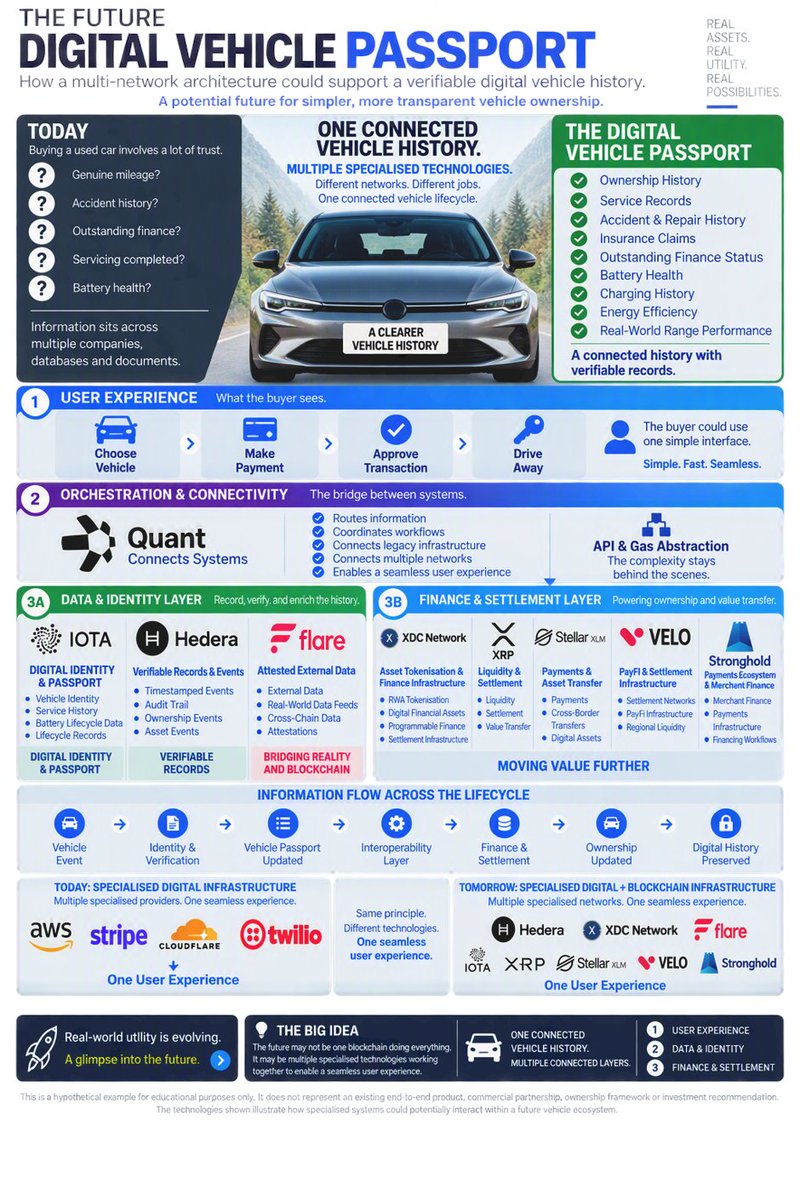
Imagine buying a used electric vehicle with a digital history covering ownership, servicing, accident repairs, insurance claims, mileage, battery health, charging and real-world range performance.
The most interesting part of tokenisation may not be the token. It could be the connected, verifiable history built around the vehicle, helping a buyer understand its past and allowing relevant records to remain accessible when it changes hands.
The buyer would not need to understand the technology. They could choose the vehicle, pay and drive away.
Behind the scenes, digital identity, trusted records, finance, external data, interoperability and settlement could work together to create a connected history of the vehicle.
That is where the idea that one blockchain needs to do everything starts to break down.
Today’s internet relies on different providers for cloud services, payments, security and communications. They work together to give us one usable experience.
A future digital vehicle passport could work in much the same way, with specialised technologies performing different roles:
🪪 Digital identity and product passport → IOTA
📊 Verifiable records and events → Hedera
🏦 Asset tokenisation and finance infrastructure → XDC Network
🌐 External data for on-chain applications → Flare
🔗 Connections between networks and systems → Quant
💸 Payments, liquidity and settlement → XRPL/XRP, Stellar/XLM, VELO
🏪 Merchant payments and finance → Stronghold/SHX
These technologies could connect with existing vehicle, insurance and financial systems, helping people access and verify relevant information when they need it.
The bigger opportunity is a connected, verifiable history around a real-world asset — from manufacture and first ownership through servicing, finance, insurance, charging and eventual resale.
One vehicle. One connected history. Multiple specialised technologies. 🚗⚡
Real-world utility is evolving. A glimpse into the future. 🌍
Hypothetical example for educational purposes. It illustrates how technologies with relevant capabilities could potentially interact. It does not represent an existing end-to-end product, partnership or confirmed implementation.
Most people assume Trump’s priority is helping Republicans win the Midterms.
I’m not convinced.
At 80, with his term ending in January 2029, he may be thinking less about the next election and more about what he leaves behind.
What if pressure on the existing financial system opens the door to replacing parts of it?
A crisis reaching beyond banks into government debt, energy markets and international payments could make reforms that once seemed politically impossible suddenly acceptable.
Under this theory, 2027 becomes a potential turning point. By 2030, he would be outside the White House, without presidential authority to shape what comes next.
Winning the Midterms would still matter. But what if his bigger ambition is to embed new financial infrastructure before he leaves office? To be remembered as the president who “flipped the switch”.
New payment rails. New settlement mechanisms. Systems that become so deeply woven into everyday finance that the next administration would struggle to unwind them without causing disruption.
There are limits, of course. Losing the House or Senate would make parts of his agenda harder to deliver. Congress controls legislation and funding, and regulators cannot simply do whatever they want. Even so, some change can move forward through existing powers, institutional adoption and private-sector investment.
The contrarian question is whether he would accept political losses along the way if the result were a transformation that outlasted his presidency.
Crazy theory?
Maybe.
But history often looks obvious only in hindsight.
#Trump #Midterms #Blockchain #DigitalAssets #GlobalPayments #Iran #Russia #Ukraine #Geopolitics #Trump #Midterms #Blockchain #DigitalAssets #GlobalPayments
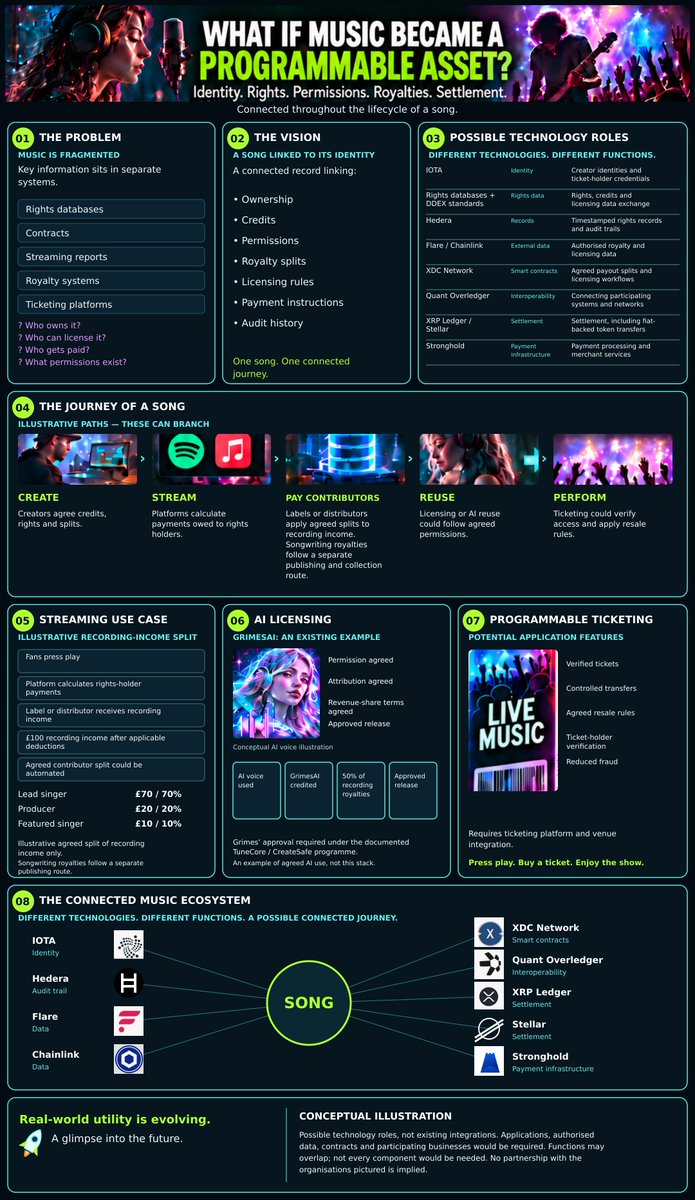
What if a song could stay connected to its creators, rights and payment instructions wherever it went? 🎵
Every stream, sample, licence or remix raises familiar questions: Who created it? Who owns what? What is permitted? Who gets paid?
Imagine an independent lead singer making a recording with a producer and a featured singer. For this example, they agree to share recording income 70% / 20% / 10%.
🎧 Then someone presses play.
Today, streaming platforms calculate payments owed to rights holders. Recording income normally goes through a label or distributor, which pays contributors under their contracts. Now imagine the distributor’s confirmed royalty report could be connected to the contributors’ agreed payment instructions.
Once £100 of recording income was available after applicable deductions, a smart contract—for example, on XDC—could apply their agreed split: £70 to the lead singer, £20 to the producer and £10 to the featured singer.
Different technologies could support different steps:
• Flare or Chainlink could bring authorised external information, such as a confirmed royalty report, into the smart-contract process through a suitable integration.
• Quant Overledger and APIs could help connect the distributor’s systems, the smart-contract application and payment services, passing information and instructions between them.
• XRP Ledger or Stellar could provide settlement networks for transferring the funds, with connected payment providers handling currency conversion and bank payouts. Contributors would not need to receive XRP or XLM.
Some distributors already automate splits. The wider opportunity is to connect rights information, agreed payment instructions and settlement across participating systems, making payments easier to trace and potentially reducing administrative friction.
The technology would distribute confirmed income. It would not decide what a stream is worth.
This example covers recording income only. Songwriting royalties are not included and follow a separate publishing and collection route.
🤖 The song could then take on a new life.
A filmmaker might seek a licence, another musician might request permission to sample the recording, or a creator might explore an authorised AI voice collaboration.
Audio recognition could flag possible reuse. Connected rights information could help identify whom to contact and what terms apply. A match would still need review; it would not itself grant permission.
GrimesAI offers a real example of one part of this idea. Other creators can use an authorised AI version of Grimes’ voice in their own original music. Under the documented GrimesAI/TuneCore programme, releases require Grimes’ approval, credit GrimesAI and allocate 50% of recording royalties to Grimes.
That illustrates permission, attribution and agreed revenue sharing—not the complete blockchain system shown here.
🎟️ Finally, the artist announces a concert.
A ticketing platform could verify tickets and manage authorised transfers. For named tickets, a digital identity credential could help confirm that the person presenting one is its authorised holder.
Depending on the organiser’s policy and applicable law, rules on the authorised resale platform could cap prices to protect fans from excessive mark-ups, or allocate an agreed share of any resale premium to the artist.
For the fan, the experience remains simple: press play, buy a ticket and enjoy the show.
The infographic explores where different technologies could support this journey—from identity and rights information to audit trails, external data, smart contracts, interoperability and payments.
Different technologies. Different functions.
One connected journey for music and the people who made it. 🚀🎵
Real-world utility is evolving. A glimpse into the future.
These are possible roles in a conceptual system. Specific integrations, authorised data, contracts and business agreements would be required. Functions overlap, not every component would necessarily be needed, and no partnership is implied.
What if buying a house eventually became one connected digital transaction?
Today, buying a home involves property and land registries, searches, solicitors, banks, mortgage lenders, identity checks, payments, insurers and energy providers. Most of these systems are already digital. The bigger opportunity could be connecting them.
Imagine a future where different technologies performed different jobs:
🪪IOTA → identity & verifiable credentials
🔗 QNT / Overledger → interoperability between different systems and networks
🏠 XDC → potential infrastructure for tokenised real-world assets
📊 HBAR / IOTA → data integrity and trusted digital records
💷 XRPL / Stellar → digital payments & settlement
🔄 SHX → potential utility within a payments ecosystem
🤖 Smart contracts → automated rules and transactions
None of these would need to do everything – they could potentially work together.
☀️ Imagine your home generates solar energy. Your smart meter verifies the energy generated and exported. An energy provider pays you for that generation. With the right APIs and financial integrations, you could imagine a future where that income could be automatically directed towards your mortgage.
Not because the blockchain replaces the bank.
Because the systems can talk to each other.
Imagine a live digital dashboard showing:
🏠 Original purchase price
💷 Mortgage balance
📉 Interest paid
📆 Repayment progress
📈 Current equity
☀️ Energy generated
⚡ Energy consumed
And your home having its own digital passport - one secure, transferable record containing:
• Ownership history
• Property searches & documents
• Planning information
• Maintenance & repairs
• EPC and energy information
• Improvements & upgrades
• Warranties & certificates
So when the property changes hands, the next owner doesn't have to start from scratch. They inherit the digital history of the home.
The important point isn't that one blockchain does all of this.
It's different technologies performing different functions — connected together to create one digital experience.
The technology is already evolving.
The question is what happens when it all starts working together.
A glimpse into what the future could look like
@iota @quant_network @XDCFoundation@hedera@Ripple@StellarOrg@StrongholdPay
#Tokenization #RWA #DigitalIdentity #Blockchain #Fintech #PropTech
Trump's Republicans could be playing a much more strategic game than is immediately obvious. Tomorrow's Senate vote on the CLARITY Act isn't about rushing a bill into law overnight—it could be a calculated setup designed to build market momentum while setting up a post-election window for full passage
The Step-by-Step Legislative Sequence:
• First Senate Cloture (60-vote supermajority): Clears the filibuster on the motion to proceed to begin formal consideration.
• Senate Debate & Amendments (Simple majority / 51 votes): Formal debate on the floor and votes on proposed text modifications.
• Second Senate Cloture (60-vote supermajority): Ends all floor debate and locks in the final bill text.
• Final Senate Passage (Simple majority / 51 votes, or 50 plus VP tiebreaker): Passes the completed Senate version.
• House Approval (Simple majority / 218 votes): House votes to approve the exact Senate-passed text.
• Presidential Signature: Signed into law.
1. The Market Signal and Pre-Election PR (Sept 15)
• The Hurdle: Reaching 60 votes on the first cloture motion.
• Market Impact: Clearing 60 votes would act as a major proof-of-concept, injecting immediate optimism into the market by proving the bill has genuine bipartisan support.
2. The Strategic Pause
• With the October campaign recess approaching and government funding taking priority, pausing full floor debate protects vulnerable incumbents from taking controversial votes on tricky amendments right before election day. If the first cloture vote passes and the positive market signal is sent, leadership can freeze full floor debate.
• The Macro Narrative: if they were able to pair this “win” with broader stability or peace messaging heading into November, a surging market would create a highly favourable economic backdrop for leadership right before voters go to the polls.
3. Post-Midterm Shift: Reduced Friction
• After the Nov 3 midterms, campaign optics disappear, removing the political incentive to use the bill as a partisan talking point.
• Opposition friction drops significantly once candidates are no longer actively campaigning.
4. The Execution Window (Nov 4 – Jan 2)
• Even if control of the House flips on Nov 3, current majorities retain full legislative authority until January 3, 2027.
• Leadership could use this historical “Lame Duck” two-month period—when outgoing members face zero political risk—to run the second cloture vote (60 votes), clear final Senate passage (51 votes), secure House approval (218 votes), and send CLARITY to the President's desk.
The most bullish scenario tomorrow isn't instant enactment. It is securing a 60-vote win that drives positive market sentiment ahead of the midterms, while reserving the “Lame-Duck” window to quietly push CLARITY through the remaining procedural hurdles before the new Congress takes power on Jan 3.
Where does the Fed go from here?
Today's CPI report looks more concerning at first glance than it does underneath.
Headline inflation rose 0.4% in August, keeping annual inflation at 3.4%. Core CPI was firmer than expected at 0.3% month-on-month, but annual core inflation actually eased to 2.4%.
That distinction matters. Core CPI already excludes food and energy, so we cannot simply say inflation would look fine if oil were removed. But it does suggest that while the oil shock is clearly lifting headline inflation, we do not yet have strong evidence that it is becoming a broad, self-sustaining inflation cycle.
PPI tells a similar story, with energy driving much of the increase in goods prices while final-demand services rose only 0.1%.
So the key question for the Fed is whether this is a temporary energy shock or the beginning of broader inflationary pressure.
With the Fed meeting on 15–16 September, a 25bp hike is now heavily priced in. The more important question is what happens afterwards.
If Brent remains above $100, yields push through 5% and inflation starts spreading more broadly, the Fed will have little room to ease and liquidity will remain under pressure.
If geopolitical tensions ease and oil falls, the inflation shock could prove temporary. In that scenario, particularly if the labour market continues to weaken and core inflation moderates, markets could quickly return to pricing eventual rate cuts and easier financial conditions.
And with the US midterm elections on 3 November, a meaningful fall in oil and borrowing costs would also provide a much more supportive economic backdrop heading into the election. That does not mean the Fed will cut for political reasons — it means that if inflation concerns genuinely start to fade, the economic conditions would give policymakers more room to ease in the future improving market sentiment
Next week's double central bank test
The Fed is followed immediately by the Bank of Japan on 17–18 September, where a 25bp hike to 1.25% is widely expected.
That creates an unusual combination of potential tightening from both sides. Higher US yields and higher Japanese yields, alongside a stronger yen, could put further pressure on carry trades and global liquidity. This makes the next few weeks particularly important.
Three things matter next:
Brent: $100
US 10-year: 5%
USD/JPY: How the yen reacts if the BoJ hikes
If oil and yields continue higher while the yen strengthens, financial conditions tighten further.
If oil falls, yields follow and core inflation continues to moderate, the market can start looking beyond the current inflation shock and back towards easier policy — creating a potentially much more positive backdrop for risk assets and crypto heading into November.
That is the key question: are we entering another inflation cycle, or is this a temporary energy shock arriving late in an already slowing economy?
That answer will ultimately determine whether the next major move is towards tighter financial conditions — or a renewed liquidity trade.
The market may be focusing on the wrong thing.
A lot of attention is on the CLARITY Act and the Senate vote on 15 September, but the politics behind it may be just as important as the legislation itself.
The House and Senate work very differently. Every House seat is up for election every two years, making it much more sensitive to changes in public opinion. The Senate is different. Senators serve six-year terms and only around a third of the chamber is up for election at any one time. Current polling and political models suggest Republicans could lose control of the House at the midterms while still retaining the Senate. If that's the case, holding as many Senate seats as possible becomes critically important because the Senate controls confirmations for judges, regulators and key government appointments for years to come.
This is where the CLARITY Act vote becomes interesting.
To advance most legislation, the Senate needs 60 votes to end debate through a process known as cloture. The CLARITY Act may struggle to reach that threshold, but forcing a vote still has political value. It puts senators on record. Republicans can then use those recorded votes in campaign adverts across battleground states, portraying opponents as voting against financial innovation, digital asset regulation and economic competitiveness.
In other words, the vote may be serving two purposes: trying to pass legislation while also helping defend and potentially expand the Republican Senate majority heading into the midterms.
However, there is an important constitutional catch.
If the CLARITY Act does not become law before the current Congress ends on 3 January 2027, it expires. Even if Republicans gain additional Senate seats in November, those newly elected senators do not receive voting power until the very moment the new Congress is sworn in on 3 January. By that point, any bill not passed by the previous Congress, including the current version of the CLARITY Act, is effectively dead and would need to start the entire legislative process again from scratch.
At first glance that sounds negative for crypto.
But for investors, the bigger question is whether institutional adoption actually depends on the CLARITY Act.
The answer is probably no.
Wall Street does not need perfect legislation to build. What it needs is enough regulatory certainty to operate. If the SEC and CFTC provide clear guidance, asset classifications and safe harbour protections, banks and asset managers can still move forward with custody, tokenisation, settlement networks and institutional products.
Once that infrastructure is built and billions, eventually trillions, begin flowing through those systems, it becomes increasingly difficult to reverse. Adoption becomes driven by economics and market demand rather than by a single piece of legislation.
The CLARITY Act would certainly be the cleanest and most durable outcome. But even if it expires, the long-term trend of institutional digital asset adoption, tokenisation and blockchain-based financial infrastructure appears very much alive.
The headline is politics. The real story is infrastructure, regulatory clarity and capital flows.
#Crypto #XRP #XDC #Bitcoin #Tokenisation #DigitalAssets #CLARITYAct #Blockchain #Finance #Investing
Still think crypto lacks real-world utility?
Next time you order a coffee in your local café, consider the journey it took to get there. ☕🌍
From a farm in Kenya to a café in New York, supply chain tracking, trade finance, tokenisation and cross-border payments could be enhanced by blockchain networks providing complementary functions across the supply chain.
Real-world utility is evolving. This is a glimpse into what the future could look like. 🌐
#Crypto #Blockchain #Web3 #SupplyChain #TradeFinance #CrossBorderPayments #Tokenisation #EnterpriseBlockchain #RWA
$IOTA $HBAR xdce-crowd-sale:native ripple:native algorand:native $SHX $XLM
September is beginning with a growing divergence between the short-term macro environment and the longer-term direction of financial markets. Oil prices are rising, bond yields are pushing higher and geopolitical risks are intensifying, creating a more challenging backdrop for liquidity and risk assets. At the same time, the infrastructure supporting digital finance continues to strengthen through regulatory progress, institutional adoption, stablecoins and tokenisation. Markets are increasingly being pulled between a traditional financial system facing renewed inflation and liquidity concerns, and a digital financial system moving steadily towards mainstream adoption.
The most important macro development remains Japan. Bank of Japan Governor Kazuo Ueda has confirmed that a September rate hike is being debated, while Japanese ten-year government bond yields have reached over 3%, their highest level since the mid-1990s. The yen has also strengthened following the latest comments from policymakers. Rising Japanese yields gradually reduce the attractiveness of the global carry trade, potentially tightening an important source of global liquidity just as investors continue to anticipate eventual Federal Reserve easing.
Oil is adding another layer of pressure. Brent crude has climbed towards $95 per barrel following renewed escalation in the US-Iran conflict, with markets once again focused on the risk of disruption around the Strait of Hormuz. The key issue is not simply today's military activity, but the possibility that a prolonged conflict could disrupt future energy supplies and push oil towards or above $100. Higher energy prices feed directly into inflation expectations, putting upward pressure on bond yields and making it harder for central banks to ease policy aggressively. Diplomatic efforts remain active, however, particularly through Pakistan's attempts to maintain dialogue between Washington and Tehran. For markets, this creates an important potential off-ramp. A reduction in geopolitical tensions could quickly remove some of the premium currently embedded in oil prices. Until then, the combination of higher energy prices and rising yields remains a significant macro headwind.
Bond markets continue to reflect these concerns. The US ten-year Treasury yield is approaching 4.8%, UK ten-year gilt yields remain above 5.2%, and Japanese yields are at multi-decade highs. Yet equities remain relatively resilient, with the VIX around 16.6, while the MOVE Index has risen towards 78, showing considerably greater stress within fixed income. Importantly, high-yield credit spreads remain contained around 2.63%, suggesting that markets are currently dealing with inflation, interest-rate and liquidity concerns rather than signalling a broader financial crisis.
Against this backdrop, crypto continues to show notable resilience. Bitcoin remains around $77,500, Ethereum around $2,400, and total cryptocurrency market capitalisation remains close to $2.57 trillion. Bitcoin dominance is still above 60%, showing that capital remains concentrated in the largest digital assets rather than rotating aggressively into the wider altcoin market. Stablecoin dominance remains well below the considerably higher levels seen earlier in the summer, although it has ticked higher during the recent consolidation. This suggests that while the broader crypto liquidity structure remains healthier than earlier in the summer, investors have become slightly more defensive during the recent pullback.
Part of that resilience is coming from the rapidly improving regulatory and institutional backdrop. The CLARITY Act has now become one of the most important dates on the market calendar. The legislation aims to establish clearer distinctions between digital asset securities and commodities while defining the respective responsibilities of the SEC and CFTC. The next major milestone comes on 15 September at 2:15pm ET, when the Senate is scheduled to consider cloture. The vote requires 60 votes to advance debate and is not final passage, but it represents the most important procedural hurdle facing the legislation and could become a significant catalyst for the sector. With Republicans holding 53 seats, at least seven Democratic or independent votes would likely be required if all Republicans support the motion, underlining why the market still views the outcome as uncertain.
The stablecoin debate is also becoming considerably more important. A consortium of 21 major financial institutions, including Bank of America, Citi, Goldman Sachs, Deutsche Bank, UBS, Wells Fargo, Fidelity, Santander and BBVA, is preparing a joint stablecoin venture, with a dollar-backed stablecoin targeted for 2027. What makes this particularly notable is that the initiative began as a ten-institution exploratory project in 2025 and has now expanded significantly, highlighting the shift from experimentation towards implementation. If delivered, this would represent a major change in the narrative. Stablecoins would no longer be viewed simply as a crypto-sector innovation, but as an increasingly important part of mainstream banking, payments and settlement infrastructure.
As stablecoins expand, their reserves also create growing demand for cash and short-term US government debt, further integrating them into the existing financial system rather than operating outside it. This creates an interesting contrast with Japan. While rising Japanese yields could eventually reduce demand for overseas assets, stablecoin issuers are becoming increasingly important buyers of Treasury bills and cash-equivalent instruments. Over time, digital finance may become an increasingly important component of US financial plumbing.
The wider infrastructure story is developing at the same time. On 17 September, the SEC is due to host a roundtable involving major financial institutions to discuss 24-hour market operations, resilience and investor protection. The SEC is also considering changes that could allow greater use of electronic systems and blockchain-based recordkeeping. Combined with tokenisation initiatives at the London Stock Exchange and growing institutional investment in digital-asset infrastructure, these developments point towards a financial system increasingly capable of operating around the clock and using digital infrastructure for issuance, trading and settlement.
As reported yesterday Ripple and SettleMint have also partnered to provide banks and financial institutions with the tools needed to create, store and manage digital assets such as stablecoins, tokenised funds and digital securities. This further strengthens the broader institutional infrastructure story surrounding Ripple and highlights how traditional finance continues to build the foundations for tokenised markets
The US retirement market is also moving in the same direction, with the White House completing its review of a Department of Labour proposal that could make it easier for retirement plans to offer exposure to digital assets and other alternative investments. This does not imply an immediate wave of retirement capital flowing into Bitcoin, but it removes another potential barrier to institutional adoption.
Today's economic data releases reinforced the idea that the US economy is slowing, but not collapsing. ADP reported that private-sector employment increased by just 38,000 jobs in August, below expectations of around 48,000 and the weakest reading since January, suggesting labour-market conditions continue to cool. However, Factory Orders rose 0.9%, beating expectations and indicating that manufacturing demand remains more resilient than many investors anticipated. Meanwhile, EIA data showed a roughly 4.5 million barrel draw in US crude inventories, significantly exceeding expectations and reinforcing the bullish oil narrative at a time when markets are already focused on Middle East tensions and potential supply disruptions. Taken together, the data supports a familiar theme: growth is slowing but remains resilient, while inflation risks linked to energy continue to complicate the outlook for policymakers. Attention now turns to the Federal Reserve's Beige Book which is a summary of real-world feedback from businesses across the US, giving the Federal Reserve an on-the-ground view of economic activity, hiring, wages and inflation ahead of its next policy meeting. This is due later today and should provide further insight into how businesses are experiencing the current balance between slowing growth and persistent inflation pressures.
In summary, the next few days are particularly important. Following today's Beige Book, attention will shift to Friday's official US employment report. ADP has historically been an imperfect guide to payrolls, but after today's softer reading the labour market data becomes even more significant. If payroll growth disappoints while oil remains elevated, the Federal Reserve could find itself facing an increasingly uncomfortable combination of slowing employment and renewed inflation pressure. Beyond the immediate macro data, investors will also be focused on the 15 September CLARITY Act cloture vote, the 17 September SEC roundtable on 24-hour markets, and the September FOMC meeting itself.
The central tension therefore remains clear. The short-term environment is becoming materially less friendly as oil rises, yields climb, geopolitical uncertainty increases and Japan moves towards tighter monetary policy. Yet Bitcoin remains resilient, credit markets remain relatively calm, regulatory clarity is improving, institutional participation is expanding and the infrastructure supporting tokenised finance continues to develop.
The short-term story remains about inflation, yields and liquidity. The long-term story is increasingly about the digitisation of money, payments, settlement and financial markets themselves. That divergence is becoming one of the defining investment themes of the second half of 2026.
As the second half of 2026 unfolds, markets appear to be approaching one of the most important inflection points of the current cycle. At first glance, the data appears reassuring. The S&P 500 remains close to record highs, volatility has eased significantly from recent peaks, credit spreads remain exceptionally tight, the US dollar has weakened below the psychologically important 100 level on the DXY, and economic activity continues to display resilience. Bitcoin has absorbed multiple macroeconomic shocks and remains firmly above $64,000 despite ongoing regulatory uncertainty and cautious sentiment across digital assets.
Beneath that relatively calm surface, however, several structural shifts are taking place simultaneously which could shape the remainder of 2026 and potentially the early years of the next cycle.
The first and arguably most important is Japan. For more than a decade, global markets benefited from an environment in which capital could be borrowed extremely cheaply in yen and deployed into higher-yielding assets around the world. That environment is now changing. The Bank of Japan has already raised rates to 1.0%, the highest level seen in decades, and markets continue to speculate about whether further tightening lies ahead.
Earlier in the summer, many feared this would trigger a disorderly carry-trade unwind and widespread deleveraging across global markets. Thus far, that has not happened. Equity markets remain firm, volatility remains contained, credit markets remain healthy and Bitcoin continues to hold key support levels. The implication is that markets may be absorbing Japan's existing tightening cycle far better than initially feared.
At the same time, attention is increasingly turning towards the Federal Reserve. While Japanese tightening is often viewed solely as a threat to liquidity, there is another side to the equation. If tighter financial conditions in Japan contribute to a gradual slowing of global liquidity while inflation continues to moderate, the Federal Reserve may gain greater flexibility heading into year-end. This forms the basis of the so-called "Double Header" thesis. Under this framework, Japan removes liquidity at the margin through tighter monetary policy while the United States later offsets part of that pressure through easing financial conditions. This does not require direct coordination between central banks. Rather, it reflects two institutions responding independently to their own domestic objectives, with the effects eventually overlapping. Should that sequence develop during the final quarter of the year, liquidity conditions could begin improving just as several other uncertainties begin to fade.
Which brings the focus to the second major variable: the CLARITY Act. The Senate's decision to delay consideration until September has undoubtedly frustrated digital asset investors. However, there remains a significant distinction between delay and defeat. Senate leadership has indicated that the legislation remains a priority and is expected to return to the agenda after the August recess. Negotiations continue, and the broader trajectory towards a federal digital asset framework appears stronger today than at any point in recent years. The significance of CLARITY extends far beyond cryptocurrency prices. Regulatory certainty remains one of the final barriers preventing many institutional participants from deploying capital more aggressively across digital asset infrastructure. The opportunity is not that banks suddenly discover blockchain technology. Those conversations have been taking place for years. The opportunity is that legal clarity finally allows institutions to move from testing and experimentation towards implementation, investment and broader adoption.
That distinction helps explain one of the most notable features of today's market. Bitcoin remains relatively resilient, yet much of the wider digital asset sector remains heavily discounted. Bitcoin dominance continues to rise while infrastructure and utility-focused networks such as XRP, XLM, HBAR, XDC and others continue to lag. Investors are still favouring certainty over opportunity. Should regulatory clarity emerge, that dynamic could change remarkably quickly.
The third major variable is geopolitics. Although headlines continue to focus on Middle Eastern tensions, sanctions, energy security and wider geopolitical fragmentation, markets increasingly appear to be pricing ongoing tension rather than outright escalation. This creates an underappreciated possibility. What happens if conditions improve rather than deteriorate? A meaningful geopolitical de-escalation could reduce oil prices, ease inflationary pressures, improve supply chain confidence, lower risk premiums and provide central banks with greater policy flexibility. Such an outcome would not simply be positive in isolation. It would amplify the effects of both regulatory clarity and monetary easing, creating a substantially more supportive backdrop for risk assets.
This leads to what may become the defining investment framework for the remainder of 2026: The Triple Alignment Thesis.
The most bullish outcome is not a Federal Reserve pivot on its own. It is not the passage of the CLARITY Act on its own. It is not geopolitical de-escalation on its own.
It is the convergence of all three.
Imagine a scenario in which the Bank of Japan adopts a measured stance in September, allowing markets to absorb previous tightening without triggering a disorderly unwind. At the same time, Congress resumes work on the CLARITY Act and meaningful progress is achieved towards a comprehensive regulatory framework for digital assets. Through October and November, geopolitical tensions gradually cool, energy markets stabilise and inflationary pressures continue moderating. By year-end, the Federal Reserve gains sufficient room to signal a more supportive policy environment. Investors would suddenly be confronted with a markedly different landscape: improving liquidity, declining uncertainty and the emergence of the first genuinely comprehensive framework for digital assets in the world's largest capital market. That combination could prove significantly more powerful than any individual catalyst viewed in isolation.
Of course, timing remains the great uncertainty. Even if the Triple Alignment ultimately unfolds, markets rarely move in a straight line. Regulatory progress may take longer than expected, the Bank of Japan could tighten further before conditions improve, and the Federal Reserve may require clearer evidence of slowing economic activity before adjusting policy. The broad thesis may ultimately prove correct whilst the timing proves considerably more frustrating than many market participants anticipate.
Alternative outcomes remain possible. The CLARITY Act could face further delays. Japan could tighten more aggressively than anticipated which in the shorter term would suck liquidity from the markets. Geopolitical tensions could re-escalate. Yet what stands out most today is that markets appear far more focused on those risks than on the possibility of a positive convergence.
Crypto sentiment remains subdued. Institutional positioning remains cautious. Substantial pools of capital remain defensively allocated. The continued strength in gold suggests many investors are still paying a premium for protection against uncertainty rather than positioning for expansion. Ironically, that may be the strongest argument for optimism. The most powerful bull markets rarely emerge from periods of widespread confidence. They tend to emerge when investors remain under-positioned whilst underlying conditions quietly improve. Regulatory clarity appears closer than at any point in recent years. Monetary conditions are gradually moving towards a potentially more supportive phase. Geopolitical risks, whilst far from resolved, increasingly appear manageable rather than existential.
Taken together, these developments suggest that the greater risk may not be excessive optimism, but insufficient imagination regarding how quickly sentiment could change if these trends align. The second half of 2026 increasingly appears to be a race between three timelines: Japan's tightening cycle, Washington's regulatory agenda and the Federal Reserve's response to evolving liquidity conditions. Should those timelines converge in a constructive manner, the period ahead may ultimately be remembered not as the end of a cycle, but as the moment the foundations of the next one were quietly being laid.
A Final Caveat: Liquidity Is Not the Same as Solvency
Whilst the Triple Alignment thesis presents a compelling framework for late 2026 and potentially early 2027, it is important not to confuse improved liquidity with the permanent resolution of underlying structural challenges.
Even in the most constructive scenario, where regulatory clarity arrives, geopolitical tensions ease and central banks begin supporting financial conditions, many of the issues that have accumulated over the past decade do not simply disappear. Public debt levels remain historically elevated across much of the developed world, fiscal deficits remain substantial, productivity growth remains uneven, and governments continue to rely heavily on debt issuance to finance spending commitments.
A renewed easing cycle could provide markets with exactly what they need in the short to medium term. Lower rates, improving liquidity and increased confidence could support equities, digital assets and broader risk assets for an extended period. History demonstrates that financial markets often respond positively when central banks begin injecting liquidity back into the system. However, a deeper question remains.
If future economic growth becomes increasingly dependent on lower interest rates, rising debt and continued policy support, then each cycle risks becoming more reliant on intervention than the one before it. Liquidity can alleviate financial stress, stabilise markets and postpone the consequences of excessive leverage, but it cannot permanently eliminate debt. In many cases, it simply transfers the burden into the future.
This does not necessarily mean a recession is imminent. Indeed, one of the more plausible outcomes is that any meaningful downturn is delayed if policymakers successfully engineer a softer landing. Nevertheless, investors should remain open to the possibility that the next easing cycle buys time rather than permanently resolving the structural imbalances that have gradually accumulated across the global economy. The implication is straightforward: even if a powerful liquidity-driven bull market emerges during late 2026 or early 2027, complacency would be misplaced. The same forces capable of driving a significant expansion in financial assets may also be laying the foundations for the next set of economic challenges further down the road.
In that sense, the Triple Alignment should perhaps be viewed less as the end of the story and more as the beginning of a new chapter. Ultimately, the market appears caught between two competing futures. One points towards greater liquidity, improving clarity and renewed risk appetite. The other points towards a world in which policymakers continue to buy time whilst deeper structural challenges continue to build beneath the surface.
Markets often turn long before the headlines do. Today, Japan, Washington and the Federal Reserve appear to be moving along separate paths. The key question for investors is whether those paths begin to converge. If they do, the second half of 2026 may ultimately be remembered not as the end of this cycle, but as the beginning of the next one.
A notable shift has taken place over the past 48 hours. Markets are no longer trading as though they are preparing for the next crisis. Instead, investors are increasingly behaving as though several of the biggest risks that dominated late July are beginning to stabilise. That change can be seen almost everywhere. Equities have surged to fresh highs, Treasury yields have eased, oil prices have fallen sharply, volatility has retreated and credit spreads have tightened. Importantly, these moves are occurring simultaneously, suggesting investors are becoming more comfortable with the broader macro backdrop rather than simply reacting to one isolated event.
Today's economic data largely reinforces that view. Private-sector hiring slowed sharply in July, with ADP reporting just 44,000 jobs added, down from 95,000 in June and well below expectations. The labour market is clearly cooling and businesses appear to be becoming more selective about hiring. However, the broader economy continues to expand. The latest ISM Services PMI came in at 54.1, slightly below the 54.5 consensus forecast but comfortably above the critical 50 threshold that separates expansion from contraction. Business activity and new orders both strengthened during the month, indicating that economic growth is slowing rather than rolling over. The takeaway is straightforward: employment growth is slowing, but economic activity remains resilient. That combination helps explain why risk assets continue to perform well despite softer labour market data.
The immediate focus remains on three interconnected themes: Japan, the Strait of Hormuz and US crypto regulation. Together they have become the key drivers of market sentiment as investors look ahead to the final months of 2026.
One of the clearest developments today is the continued improvement in financial conditions. The S&P 500 has rallied to 7,737, while the Nasdaq has recovered to 29,770, both comfortably above the levels seen during last week's volatility. More importantly, the rally is broadening. The Russell 2000 has climbed above 3,040, suggesting investors are becoming more willing to own smaller and more domestically focused companies rather than concentrating exclusively in mega-cap technology stocks.
At the same time, several measures of market stress continue moving in the right direction:
VIX: 16.01
MOVE Index: 77.56 (down from 80.48 yesterday)
High Yield Spread: 2.78% (down from 2.84%)
US 10-Year Treasury Yield: 4.61% (down from 4.70%)
Taken together, these indicators point to a gradual reduction in market anxiety.
Oil Loses Its Risk Premium
Perhaps the most dramatic move this week has come in energy markets. Less than two weeks ago, Brent crude traded above $98 per barrel as traders worried about a prolonged disruption around the Strait of Hormuz. Today Brent sits around $80, with markets rapidly unwinding the geopolitical premium that built up during July. The catalyst continues to be signs of progress surrounding efforts to normalise traffic through Hormuz. While there is still no final agreement, recent comments from both Marco Rubio and Scott Bessent have reinforced hopes that a diplomatic framework may be emerging. The significance extends beyond oil itself. Lower energy prices reduce inflation pressures, ease concerns about consumers and potentially give bond markets room to stabilise. The fact that Treasury yields have fallen alongside oil is one of the most constructive developments of the week.
Japan Moves from Crisis to Monitoring
Japan remains critically important, but the focus has shifted. Yesterday's debate centred on whether the intervention would work. Today's discussion is increasingly about whether markets have accepted it. So far, the answer appears to be yes.
USD/JPY: 157.68
Japanese 10-Year Yield: 2.82%
US 10-Year Yield: 4.61%
The yen remains significantly stronger than it was just a week ago, while Japanese government bond markets have remained orderly. That combination suggests policymakers have, at least for now, succeeded in stabilising conditions without triggering the wave of forced deleveraging and global market disruption that many investors feared. The longer-term questions, however, remain unresolved. Japanese yields are still trading at levels not seen for decades, and investors continue to watch closely for signs that higher domestic returns could encourage Japanese capital to be repatriated from overseas markets. While the immediate sense of crisis has faded, attention is now shifting from whether the intervention worked to how sustainable it will prove to be. Japan remains one of the most important structural stories in global markets, and investors will continue to assess how long policymakers can maintain stability in the yen without facing renewed pressure from underlying market forces.
The CLARITY Act Becomes the Crypto Market's Main Focus
While macro conditions are improving, the next major catalyst for digital assets increasingly appears political rather than monetary. Attention remains fixed on the CLARITY Act as the Senate approaches recess. With only a limited number of legislative days remaining, investors are looking for any indication that Senate leadership intends to move towards a procedural vote this week/weekend. The challenge is that time is quickly running out. Republicans still require bipartisan support, ethics provisions remain contentious and the procedural pathway before recess is becoming increasingly narrow.
Traditional Finance Continues Building
Away from Washington, as reported yesterday institutional adoption continues progressing regardless of regulatory timelines. Mastercard's acquisition of BVNK remains one of the clearest examples of where the industry is heading. The deal reflects a growing belief among major financial institutions that future payment systems will increasingly connect traditional banking infrastructure with tokenised assets and digital settlement technology. The message from large institutions remains remarkably consistent: Regulation is important, but the infrastructure is being built anyway.
Crypto Market
Crypto continues to stabilise.
Bitcoin: $64,014
Ethereum: $1,868
Total Crypto Market Cap: $2.17T
Fear & Greed: 27
BTC Dominance: 59.24%
The improvement in sentiment is modest rather than explosive. Bitcoin continues attracting the majority of institutional inflows, while broader altcoin performance remains subdued. OTHERS/BTC continues trending lower and Bitcoin dominance has pushed higher once again. The data continues to suggest that investors are gaining confidence in crypto as an asset class, but remain highly selective about where they deploy capital.
Precious Metals Send an Interesting Signal
One of today's more overlooked developments is the continued strength in precious metals.
Gold: 4,169
Silver: 61.67
Platinum: 1,768
The rally across gold, silver and platinum simultaneously is unusual. Gold typically benefits from lower yields and monetary uncertainty, while platinum and silver tend to respond more positively to improving industrial expectations.
Together, they suggest investors are hedging against uncertainty whilst simultaneously becoming more constructive on growth.
In Summary
Today's market action looks fundamentally different from last week's. Oil is falling. Bond yields are easing. Credit spreads are tightening. Volatility is declining. Equities are making fresh highs. The rally is broadening beyond technology and into smaller companies. At the same time, today's economic data paints a relatively balanced picture. The labour market is cooling, but the services sector continues to expand and broader economic activity remains resilient even if slightly below expectations. The data supports a narrative of moderating growth rather than imminent recession. That does not mean the underlying structural issues have disappeared. Japan, Treasury market stability, government debt issuance and regulatory uncertainty all remain important themes. But the mood has clearly shifted from stress management towards measured optimism.
For now, investors appear increasingly willing to believe that policymakers have bought themselves time. The key question is whether that time is ultimately used to address the underlying structural pressures or simply postpone them.
Geopolitical whiplash is peaking.
Hours after the US hits 90 targets in Iran, Trump announces that Iranian leadership just called him wanting a deal "so badly."
One minute it's World War 3, the next it's an imminent peace deal.
This headline chaos is exactly why everyone watching oil is missing the forest for the trees.
Algorithms are getting chopped up, volatility is spiking, and capital is on defence.
The headline is oil. The reality is a liquidity system under immense pressure.
Keep an eye on Japan.
Everyone is watching oil.
The real story is liquidity.
The market thinks the question is whether $80+ Brent delays Fed rate cuts.
The bigger story is Japan.
Higher oil colliding with an already fragile, historically weak yen creates a painful inflation shock for an economy that imports much of its energy. The BOJ faces increasingly difficult choices.
Higher oil + weak yen → higher inflation → pressure on the BOJ → higher Japanese yields → carry trade unwind → capital repatriation → tighter global liquidity.
That's a completely different macro regime.
Oil may be the catalyst.
Liquidity may be the destination.