This week on #SimplyBlood 🩸 we're featuring the Cabezas-Wallscheid Lab out of ETH Zürich - Swiss Federal Institute of Technology. Learn more about their science, lab traditions, and tips for running a successful lab ➡️ https://t.co/HfAjEiYwlB
A historic success for the German Cancer Research Center (DKFZ): Four DKFZ researchers are receiving one of the prestigious @ERC_Research Synergy Grants this year - more than ever before at a single institution in a single funding round. #ERCSyG 🥳👏
https://t.co/Hn1ryygrZK
Für seine herausragende Forschung zum alternden Immunsystem und zur Immunabwehr von Blutkrebs erhält Mirco Friedrich (DKFZ, @hi_stem_lab & @uniklinik_hd) den Preis der Peter und Traudl Engelhorn Stiftung. Herzlichen Glückwunsch! @mircoscopy
https://t.co/AE0YoqrC2i
Mirco Friedrich (DKFZ, @hi_stem_lab and @uniklinik_hd) receives the Peter and Traudl Engelhorn Foundation Award for his outstanding research on the aging immune system and the immune response to blood cancer. Congratulations! @mircoscopy
https://t.co/1HVXyEH335
Can we keep a cancer cell from changing its identity?
Our @Nature studies show that glioblastoma cells switch along predictable paths, and that the least plastic state is actively maintained by safeguard repressors led by MYT1L.
https://t.co/fCi78aiJ9h
https://t.co/FzqUq8ykbY
Forschende vom DKFZ, @embl, HITBR und @sangerinstitute haben in @Nature beschrieben, wie Glioblastomzellen zwischen verschiedenen Zuständen wechseln, einer der Gründe für die hohe Aggressivität von Glioblastomen.
https://t.co/BHNzxCeFC3
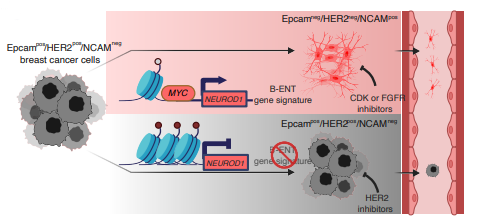
Now online in @CD_AACR: Neuroendocrine Differentiation Mediates Escape from HER2-Targeted Therapy in Breast Cancer - by Roberto Würth, @tasneem_cheytan, Paul Schwerd-Kleine, Ewgenija Gutjahr, Andreas Trumpp, and colleagues @hi_stem_lab@DKFZ
One of the reasons for the high aggressiveness of glioblastomas is their remarkable adaptability. Scientists from DKFZ, @embl, HITBR and @sangerinstitute now describe in @Nature how glioblastoma cells switch between different states.
https://t.co/aeTXorIf3K
1/8 🧵 How do HER2+ breast cancers escape targeted therapies?
A groundbreaking paper in @CancerDiscovery led by Roberto Würth, Andreas Trumpp, and colleagues at @hi_stem_lab reveals a new route of treatment resistance: Neuroendocrine Differentiation (NED) 🧬👇
7/8 💡 Key Takeaways:
1️⃣ NED is a major driver of resistance to HER2 targeted therapy in breast cancer.
2️⃣ EpCAM-based CTC detection misses NED escapees — NCAM+markers are needed.
3️⃣ FGFR1 inhibition offers a potential strategy to target drug-resistant neuroendocrine-like cells
1/8 🧵 Rethinking Hematopoietic Stem Cell Isolation: Is CD150 missing a vital piece of the puzzle?
A ground-breaking new study in @CellStemCell from @DawnSLin, Andreas Trumpp, and colleagues at @hi_stem_lab reveals a previously unrecognized, deeply dormant HSC population!🩸👇
Researchers at DKFZ & @hi_stem_lab have discovered a group of particularly long-lived blood stem cells in mice. These cells remain in a dormant state for an exceptionally long time while retaining their ability to generate new blood cells. @CellStemCell
https://t.co/HjbzuZhrUq
Bei einem Besuch im Labor von René Jackstadt informierte sich der Minister über Forschung zur Metastasierung und Entwicklung von Therapieresistenzen bei Darmkrebs.
Anschließend besichtigte Minister Linnemann die Präventionsambulanz des Nationalen Krebspräventionszentrums.
Check out Georg Nagel – the 2026 medicine prize laureate – wearing a blue helmet and a big smile, cycling into the University of Würzburg to a warm welcome full of balloons and applause from students.
Check out his first reaction interview here: https://t.co/w9Iu6Kodq2
1/8 🧵 How do HER2+ breast cancers escape targeted therapies?
A groundbreaking paper in @CancerDiscovery led by Roberto Würth, Andreas Trumpp, and colleagues at @hi_stem_lab reveals a new route of treatment resistance: Neuroendocrine Differentiation (NED) 🧬👇
7/8 💡 Key Takeaways:
1️⃣ NED is a major driver of resistance to HER2 targeted therapy in breast cancer.
2️⃣ EpCAM-based CTC detection misses NED escapees — NCAM+markers are needed.
3️⃣ FGFR1 inhibition offers a potential strategy to target drug-resistant neuroendocrine-like cells