My first cover story in this month's issue of @Cancer_Cell! 🍾
"On the cover: Friedrich et al. (711–725) reveal the mode of action of bispecific antibodies in patients with multiple myeloma."
Check it out:
https://t.co/kA5G16XLYN
https://t.co/MNgCa8SaVA
Congratulations to HI-STEM Group Leader Mirco Friedrich for being selected to the Forbes "30 under 30 Europe" List in the category of Science & Healthcare.
https://t.co/DH8nx9Vwpr
Mirco Julian Friedrich vom DKFZ, @hi_stem_lab und @uniklinik_hd wurde in die renommierte @Forbes-Liste "30 Under 30 Europe" in der Kategorie #Science & #Healthcare aufgenommen. Herzlichen Glückwunsch! 👏🥳
➡️ https://t.co/Cx1oQgGAXO
📣 We are excited to announce the 10th Heidelberg Myeloma Workshop
Join us on April 25–26, 2025, as international & local experts share the latest advancements in multiple myeloma research.
#mmsm
✅ CME-certified
🔗 Speaker line-up & registration 👇🏼
https://t.co/bQGWekLOgn
Nucleases, core components of CRISPR-based genome-editing therapies, can stimulate unwanted immune responses. Scientists have now engineered two CRISPR nucleases to mask them from the immune system, paving the way for safer, more efficient gene therapies. https://t.co/c3zbEqFC5J
1/ Thrilled to share an advancement in gene therapy from my PhD in @NatureComms! We've developed a new approach to reduce immune responses while maintaining efficiency—paving the way for safer, more effective therapies. Big thanks to @zhangf & @mircoscopy! https://t.co/eXZkpgiMXq
One step more towards non-immunogenic genome editing 🚀
Using AI-informed epitope mapping, we engineered effective #CRISPR nucleases with reduced immunogenicity. This paves the way for safer, repeatable genome therapies in humans.
https://t.co/zobsvrnZhf
Chapter 2 of branched RNA: chemically modified branched cap for multi-capped mRNA and capped circular RNA (QRNA)--the cellular translation machinery is surprisingly tolerant of unnatural structures! Beyond enhanced performance, the mechanism is intriguing: https://t.co/iGynbJb8b8
Honored to receive this Young Investigator Award for novel immunotherapy approaches against brain tumors. Thanks so much to my graduate institutes @DKFZ and @uniklinik_hd for their support! 🎉 #brain#cancer#glioma#immunotherapy
Neue Therapieansätze gegen #Hirntumor|en: Gips-Schüle-Nachwuchspreis 2024 für Mirco Friedrich (#DKFZ und @uniklinik_hd). Herzlichen Glückwunsch! 👏
➡️ https://t.co/ST2F1MJhta
Congrats to clients @mircoscopy, @MiKilian90, Kevin Lu, & @platten_michael for “The Immunoglobulin Superfamily Ligand B7H6 Subjects T Cell Responses To NK Cell Surveillance” in @SciImmunology. Our work didn’t win the cover, but we loved it & wanted to share! #scienceillustration
Apply as a research group leader! Lead an independent research group in computational biology, focusing on AI-biology interfaces. Enjoy core support and outstanding infrastructure. Explore EMBL's Molecules to Ecosystems vision, and more!
https://t.co/08YxNqtRMX
Science #Immunology’s May issue is out!
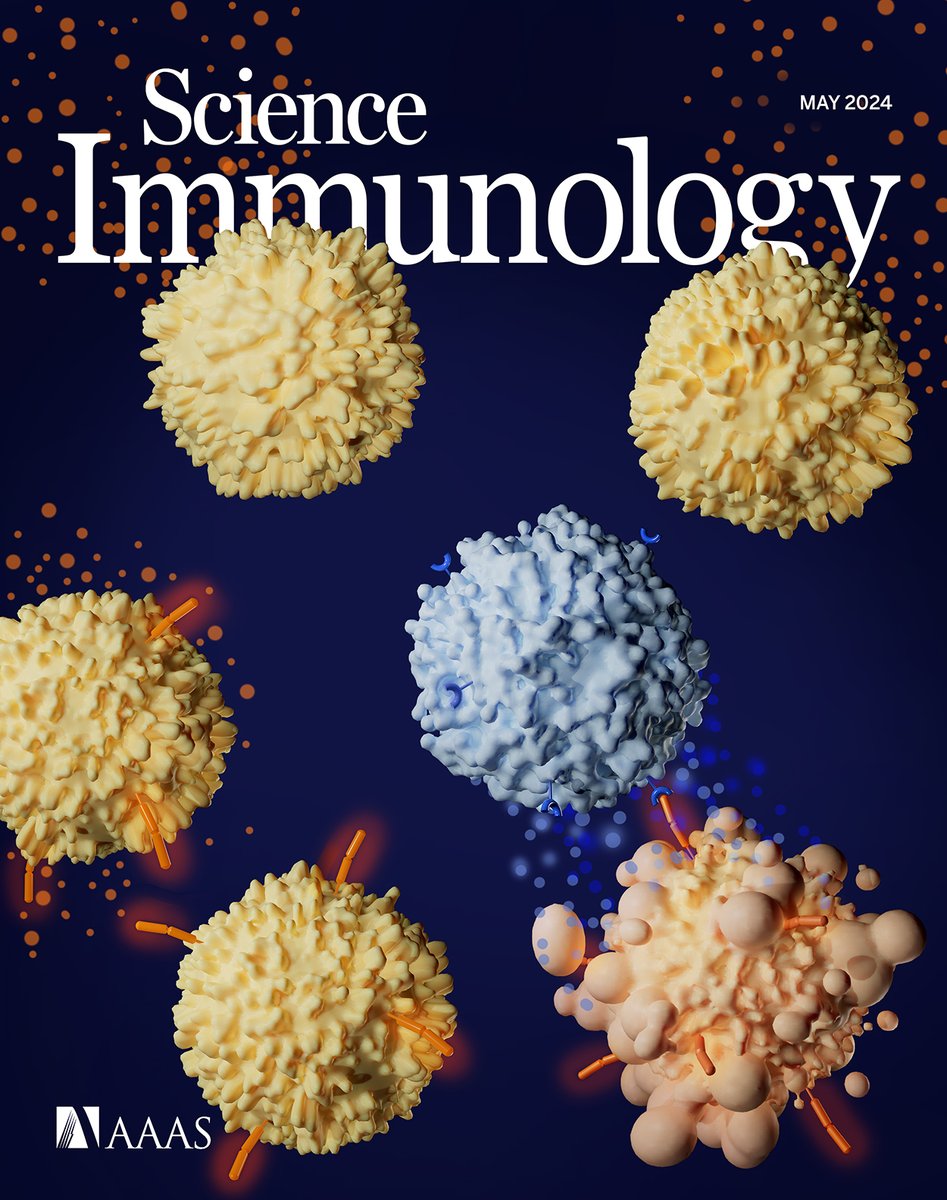
This month’s cover depicts an NK cell (light blue) decorated with NKp30 (blue surface receptor) killing an antitumoral T cell (yellow) that expresses B7H6 (orange surface ligand). https://t.co/8NvA7atkmX
B7H6 protein flags activated T cells for clearance by NK cells, and its genetic deletion enhances T cell proliferation and persistence @SciImmunology @platten_michael
https://t.co/8J9j4t0nlH
🙏 8/8 Grateful for the hard work of our team and collaborators! @MiKilian90 Kevin Lu @platten_michael
Check out our full paper for more!
https://t.co/kACTBOzomC
#ScienceTwitter
🧪 6/8 Further, our data show that B7H6+ T cells are prevalent not just in tumors but in various diseases. Their presence positively correlated with clinical responses to immune checkpoint therapy, hinting at their dual role in immune surveillance.
🎯 7/8 The B7H6-NKp30 axis represents a novel, NK cell-dependent "immune checkpoint." Therapeutically targeting this interaction could enhance T cell survival and persistence, offering new avenues for improving cancer immunotherapies.
📊 5/8 Clinically, we observed that a high ratio of NK to T cells in tumor tissues correlates with poorer responses to immune checkpoint inhibitors. This suggests that B7H6+ T cells are key players in modulating immune therapy outcomes.
Excited to share our latest publication in @SciImmunology! We've uncovered an NK cell-mediated immune checkpoint (B7H6 : NKp30) that limits CAR T cell persistence, revealing new insights into immune regulation. #Immunology@broadinstitute@DKFZ
https://t.co/kACTBOzomC
🔎 4/8 We also explored this mechanism in humanized mouse models of leukemia. Here, NK cells limited the effectiveness of CAR T-cell therapies against tumors, driven primarily through the B7H6 pathway. Blocking this could enhance CAR T cell function!
🛡️ 3/8 Unlike typical checkpoint molecules that regulate T cells internally, B7H6 interacts with NKp30 on NK cells. This interaction is crucial as it leads to the cytolysis of these activated T cells by NK cells, a critical but often overlooked immune regulation pathway.