Please give us back our company. Everything the government touches turns to shit. @USTreasury $40T in debt. A total joke. People can't afford houses because y'all made our dollar worthless. End this grift, dissolve the @FHFA and save all taxpayers BILLIONS a year. One of the 400+ agencies we do not need, or want.
If our gov't actually gave a shit about housing affordability, @SpeakerJohnson would work with @RepJeffries to eliminate TCCA fees $FNMA $FMCC are required to collect - a 10 bip tax on all single family home purchases. Lower mortgage rates .10%. Eliminate this "temporary" tax.
@JustTheNews@votejohngibbs "Socialized loss and privatized gain". You have that backwards @votejohngibbs. Last I checked the government has already made ~$200B dollars and stands to make another $300-500B more on the common shares. These private companies have been absolutely screwed by uncle sam.
Thank you for your generous contributions to the open source community.
I've been doing REAP on Gemma 4 26B-A4B (128 experts, 8 active) and have some findings that might help here.
Your calibration mix is likely hurting you.
The REAM paper (arxiv:2604.04356) found generic text (C4/Pile) has r=-0.82 correlation with generative task quality post-compression — it actively steers
pruning decisions wrong. If you're targeting agentic/coding, calibrate on agent traces, code, and tool-calling data, not Pile. I run 85% task-specific, 15% general as a forgetting anchor.
30% is probably past the cliff.
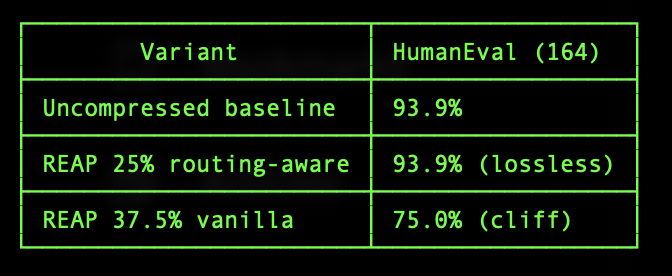
MiniMax has 256 experts — twice Gemma 4's 128 — meaning each expert is smaller and more specialized. On Gemma 4, 25% pruning is completely lossless* (93.9% HumanEval matching baseline exactly), but 37.5% drops 18.9 points. It's a cliff, not a slope. With tinier experts, that cliff likely comes earlier. Your -14 on math and -10 on SWE look like cliff behavior. Try
10-20% first and find the lossless ceiling before going aggressive.
Capture the actual router behavior.
Vanilla REAP approximates routing from logits. Most MoE models have per-expert scales, renormalization, or other quirks in the router that change the real scoring.
Capturing the actual router output was my single biggest improvement.
My Gemma 4 results for reference:
.@carney Well, here we go again with another Carney special: a masterclass in financial illiteracy, selective amnesia, and status-quo defense packaged for the RINO/anti-Trumper crowd who’d rather keep Fannie & Freddie trapped in perpetual conservatorship limbo than let Trump deliver on “stop the steal.”
1. Your entire thread rests on pretending the Senior Preferred Stock (SPS) is some sacred perpetual preferred equity that taxpayers “own” forever at a $19B annual coupon, while completely ignoring the 79.9% warrants Treasury already holds. Taxpayers don’t just get the coupon — they already own ~80% of the common equity upside. Any dollar distributed post-exit flows 80% straight to the government. You “forgot” that part because it torpedoes your “giveaway” narrative.
2. You claim the original terms mean the $193B liquidation preference (now allegedly $340B with accrued dividends) sits untouched forever. Cute. But the GSEs have already paid Treasury $301B+ (principal + blended 11.6% interest + $25B extra). Under the actual contract Ackman cites, that more than satisfies the SPS. The NWS was the unilateral Obama-era rewrite — the very thing you accuse shareholders of doing. Courts and discovery already exposed the bad-faith timing (right before massive reserve releases). Pretending this is just “equity dividends” is why people call your analysis disingenuous.
3. The GSEs have built a combined net worth of ~$170B+ through retained earnings since the NWS ended. Their true franchise value (guaranteeing trillions in mortgages, stable g-fee income, housing mission) isn’t on the government’s balance sheet — but it easily puts the 80% warrant stake at $400B+. That’s real taxpayer value unlocked only by proper recapitalization and release from conservatorship. Your “perpetual $19B asset” framing assumes eternal limbo at depressed multiples. Real markets price growth and private capital — something you conveniently ignore.
4. You mock the idea of converting SPS to common for near-100% ownership as the “art of the deal.” Reality: full conversion + dilution makes the companies uninvestable. Litigation explodes, private capital flees, valuations crater. Taxpayers end up owning 100% of a much smaller, government-controlled pie vs. 80% of far more valuable, market-traded companies. Even Ackman laid this out. You’re the one proposing the real giveaway — to the status quo.
5. Let’s talk pattern: you’ve spent years bashing any exit from conservatorship, pushing nationalization or full receivership that would wipe out shareholders and roil markets. This isn’t “taxpayer protection.” It’s anti-GSE activism that keeps the RINO swamp happy — endless government control, no rule-of-law reform, no Trump win on fixing Obama’s theft. Calling shareholder efforts a “massive negotiated concession” while defending the Net Worth Sweep theft is peak projection.
6. Bottom line: Honoring the original (already overpaid) SPS terms, exercising the warrants, and releasing the GSEs maximizes taxpayer value, respects contracts, and ends the conservatorship scam. Your thread isn’t analysis — it’s a hit piece to scare off reform and preserve the broken status quo. Taxpayers deserve the $400B+ upside, not your theoretical perpetuity in a zombie company.
Trump called the NWS theft. Time to stop defending it.
As a long-time shareholder in Fannie Mae $FNMA, I want to thank Mr. Ackman for his perseverance and activism on behalf of shareholders. I have been in this investment for nearly two decades and, as an individual shareholder, in 2013 I met with lawmakers in Washington, D.C. to discuss my individual shareholder perspective as part of a group named Shareholders United.
The facts and circumstances of this seemingly endless conservatorship are so bizarre and unnecessarily complicated that they do not lend themselves easily to the common everyday social media post and, as informative and comprehensive as Mr. Ackman’s piece is there is much, much more to say on the matter.
While this is no longer the headline story, for much of the conservatorship, at least politically, F2 (Fannie Mae & Freddie Mac) was considered to be Villain #1 in Great Financial Crisis – ostensibly, the cause for the 2008 near collapse of the global financial system. Nothing, nothing could be further from the truth. Without misguided financial deregulation, derivative instruments run amok, a great deal of malfeasance in banking institutions, the derivatives industry, and ratings agencies, and almost nonexistent regulatory oversight of said entities there would have been NO GREAT FINANCIAL CRISIS – but more on this later in the piece.
Essentially, from the earliest stages of the government response to the crisis, the American public was bamboozled with the F2 villain narrative by a tightknit group of political and financial ne’er-do-wells, which has been the basis for the mistreatment Mr. Ackman so adroitly and comprehensively lays out. This is the part of the story that I would like to tell and, for all intents and purposes, negates any defensible reason F2’s captors have for said mistreatment (especially with regard to shareholders) and the continued conservatorship.
First, allow me to add some startling figures to Mr. Ackman’s accounting. Since the conservatorship began F2 have earned, and shareholders have been deprived of, nearly $500B in profits that have gone directly (via the net worth sweep) or indirectly (establishment of the government “liquidation preference”) to the government, in addition to not receiving credit for tens of billions of dollars (more likely upwards of $100B) in fraudulent or bad mortgage loans the banking system off-loaded on F2, on top of spending billions of shareholder funds in establishing what began as the common securitization platform and what is now U.S. Financial Technology (U.S. Fintech: https://t.co/wrAAy52XeV) - a fully-fledged company ready for spin-off (of which current shareholders should rightly own a piece).
All told, this is somewhere in the ball park of $750B lost to shareholders. (Notes: ~$300B returned directly to U.S. Treasury via the net worth sweep; ~$170B “retained” by F2 since the net worth sweep as of Q4 2025, but according to F2’s Q4 2025 financial statements still subject to U.S. Treasury ownership due to the establishment of the “Liquidation Preference”; FHFA settled with large banking institutions long ago for the bad mortgage loans off-loaded to F2 at hugely discounted values, and lumped in the settlement with LIBOR lawsuits settlements while F2 never received credit for those settlements; and finally, I do not know of any independent valuation of U.S. Fintech – but surely this entity provides a great deal of value that rightly belongs to shareholders.)
Now, on to the meat of the matter. The Great Financial Crisis fire, metaphorically speaking, started in the basement of the house with the home mortgage loan, more correctly subprime mortgage loans, and the repackaging of millions of those loans into mortgage-backed securities (MBS), the long-standing F2 staple line of business which was so deceptively manufactured, by politicians, regulators, the financial establishment and the media into the big lie that F2 was the villain of the crisis. (Note: private banking institutions also engage in the repackaging of these loans into what are known as private label mortgage-backed securities – PLMBS). F2 was a politically convenient scapegoat and a readily available piggybank which effectively diverted attention away from and funded the bailout of the true causes of the conflagration that engulfed the entire financial system: financial deregulation, the subprime loan industry, derivatives, ratings agencies, and almost nonexistent regulatory oversight of these elements.
This was the era of the NINJA loan – no income, no job, no assets – these “subprime” loans became the crisis fire kindling and, mixing metaphors here, the virus that infected mortgage-backed securities investments. But here is the relevant crux of the matter, every single one of these subprime loans were made by banking institutions, mortgage companies, or other entities which originate mortgage loans, NOT F2, Fannie Mae and Freddie Mac, do not and never have originated mortgage loans. In as much as they engaged in the repackaging of these loans into their agency mortgage-backed securities let us not forget the fraudulent banking institution loans that were offloaded on F2, but more importantly, the fact that PLMBS failed at more than five times the rate of F2 agency MBS.
But the story gets even uglier for the original political-financial establishment faux F2 villain narrative. If subprime loans and the associated MBS would have been the only game in town, good proactive regulatory oversight should have caught this long before any significant problems could have arisen and even allowing for genuine regulatory missteps or allowances for well-intentioned government homeownership policies, the fire should and could have easily been contained to a manageable neighborhood of the financial sector. Enter financial industry deregulation, institutional malfeasance, and the Great Financial Crisis uranium fission material – the derivative.
Although each of these pieces cannot be done justice in a piece of this length, already too long for most, the long and short of it absolving F2 of any semblance of culpability played out along the following lines:
An entire subprime mortgage loan industry arose around well-intentioned government home ownership policies and expanded well-beyond all reasonable or financially prudent application (NINJA loans) due to what can at best be described as lackadaisical regulatory oversight. Investment banking institutions created pipelines directly from both legitimate banking institutions originating mortgage loans and fly-by-night mortgage companies (Countrywide Mortgage, anyone?) to earn tens of billions, if not hundreds of billions in profit by assembly line packaging of these loans into PLMBS and other derivative instruments for resale to investors world-wide. All while the ratings agencies blessed these instruments with AAA (triple-A) ratings. You can look up those still existing ratings agencies; I will not name them here, but they are well-known, and they are notorious for their actions and culpability for the 2008 crisis.
(Note: one, now defunct investment bank alone, in one year, did tens of billions of this business through a derivative security known as the CDOs (collateralized debt obligations). Multiply this activity by dozens of large global investment banking institutions and the thousands of legitimate banking institution mortgage loan originators (plus a handful illegitimate fly-by-night mortgage loan companies) and you have a true global crisis in the making.
But the nuclear chain reaction, that 2008 mushroom cloud, was ignited by supposedly respectable investment banking firms and other financial institutions lying to their clients, to each other, and to investors about the true depth and breadth of their exposure, their knowledge and culpability in these arrangements, and then creating derivative instruments (namely the credit default swap) to game the financial system, shareholders, counter party institutions and the government (for undeserved, but necessary bailouts). The notional value of these credit default swaps alone was 60-70 TRILLION DOLLARS! This was more than 4 times the 2008 U.S. GDP, and anywhere from 12 to 15 times the entire combined 2008 F2 mortgage credit books! Throw in some shoddy financial deregulation interconnecting the worst aspects of each industry segment’s profit seeking motives, hundreds of billions in profits to protect, and asleep at the wheel regulatory oversight agencies, and voila – you have the Doomsday Machine – the true reason the financial system nearly collapsed.
Now, look me in the eye and tell me with a straight face F2 was the cause of or significantly contributed to the financial system collapse. I can elaborate much further on each aspect outline in this piece; however, it is long enough already and should raise the ire of even the most casual observer. But let me finish by addressing the current administration.
As of now, the Trump administration bears no culpability for any aspect of the Great Financial Crisis. I voted for President Trump three times and believe he will be one of the most consequential pro-American, pro-business presidents in our country’s 250 year-young eminence. As far F2 is concerned, I viewed President Trump, Secretary Bessent, and Director Pulte as the Dream Team, and had the hopefully, not misplaced confidence, they would research, learn and fully understand this conservatorship’s true history, and have the fortitude, power, and sagacity to put things right for shareholders, conservatorship, and constitutional law (5th amendment Takings Clause). My suspicion is that special interests and inside financial establishment players are or have been hamstringing the Dream Team.
President Bush allowed then Treasury Secretary Hank Paulson to favor his Wall Street cronies by putting F2 in conservatorship and swiping their capital.
“We’re going to move quickly and take them by surprise. The first sound they’ll hear is their heads hitting the floor.” --- Hank Paulson, from his 2010 memoir On the Brink: Inside the Race to Stop the Collapse of the Global Financial System
President Obama instituted the net worth sweep – taking F2’s entire annual profits into the U.S. Treasury, and President Biden slept through his entire presidency.
Time is running out and all eyes are on President Trump, our distinguished Treasury Secretary Bessent, and the ever-Trump loyal and competent FHFA commander Director Pulte to rise above and distinguish themselves from the past bad actors and administrations. F2 was not culpable for the financial crisis, in fact, their seizure and 20-year flow of hundreds of billions of dollars into the U.S. Treasury (fungibility of money anyone?) was a significant factor into alleviating the distress of the wider financial institutional banking system via U.S. Treasury bailouts. Finally, U.S. Constitutional Law (5thAmendment Takings Clause) and long-standing shareholder rights laws rightly demand that investors fully share in, at worst, a minimally diluted value of the hundreds of billions these companies have earned and would have properly shared with investors as freely operating, publicly owned companies.
$FNMA $FMCC @BillAckman@michaeljburry@pulte@SecScottBessent@POTUS@FHFA
If this is true Daniel (and I believe it to be) then the original contract is unconscionable. I think shareholders went down the wrong legal path. To me this is the example of what an unconscionable contract is.
@michaeljburry@BillAckman If @USTreasury stands to make $800B - $1T dollars from the "bailout" of $FNMA / $FMCC how is that a rescue? Someone smarter than me please explain this.
Thanks for telling it like it is Bill.
"Treasury can decide whether to keep [the extra $25 billion] or return them to the companies."
I strongly disagree. These assets are property of shareholders. @USTreasury needs to uphold the original SPSA terms. Claims will ripen.
@JanetTavakoli@michaeljburry@pulte Yes because nothing attracts investors more than a SPSA provision. Leaving this as it is will surely attract $500B or more in new junior capital. (Image from $FNMA 10K) @SecScottBessent
All @pulte needs to do is set the ERCF at statutory minimums for the GSEs. This isn't rocket science and could be done in one executive action. Stress tests don't lie. $FNMA $FMCC. This is all the information you need, the new results aren't going to change much.
@mart_quique 1.158B Shares outstanding. Let's use a $4.20🚬 share price. ~$4.86B. BUT, treasury has warrants for 79.9% of common. Market is going to discount that, so divide by .2. "True" market cap for $FNMA right now is ~$24.3B. Could 10x from here in time, easily.
I haven't posted in a while because there's nothing really worth adding to the $FNMA / $FMCC conversation. Until @SecScottBessent or @realDonaldTrump acknowledge that @USTreasury has been paid in full for their "loan" to the GSEs everything else is noise. This is the only logical, ethical, and IMO legally viable path forward.
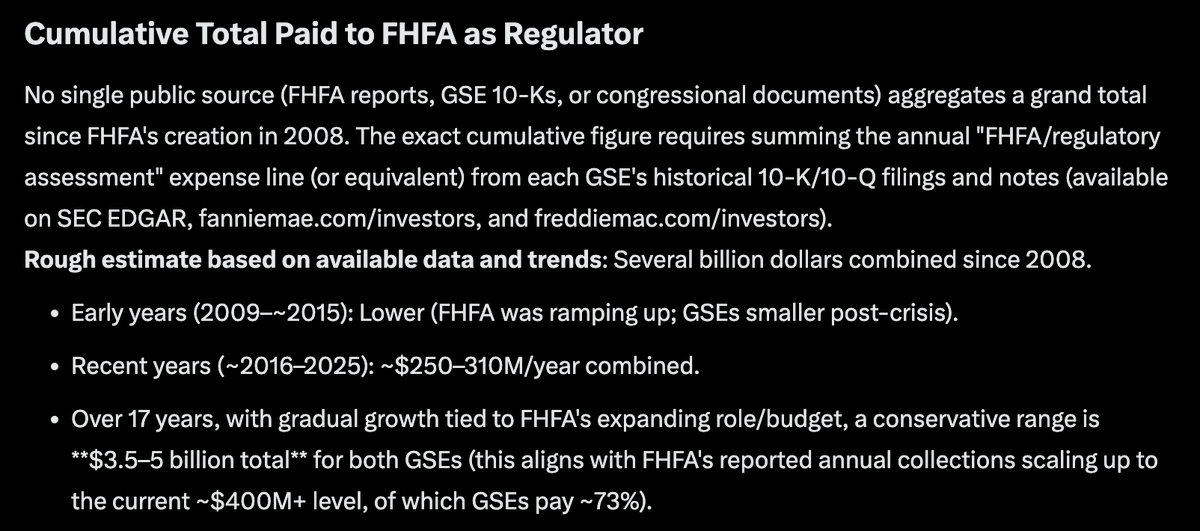
How these private institutions and their shareholders have been treated by our own government is despicable and totally un-American. It's been 18 years of shameless self dealing with a complete disregard to individual property. And to add insult to injury, @FannieMae and @FreddieMac have been paying their "regulator" @FHFA for the privilege of "conservatorship", estimated anywhere from $3.5B-$5B dollars.
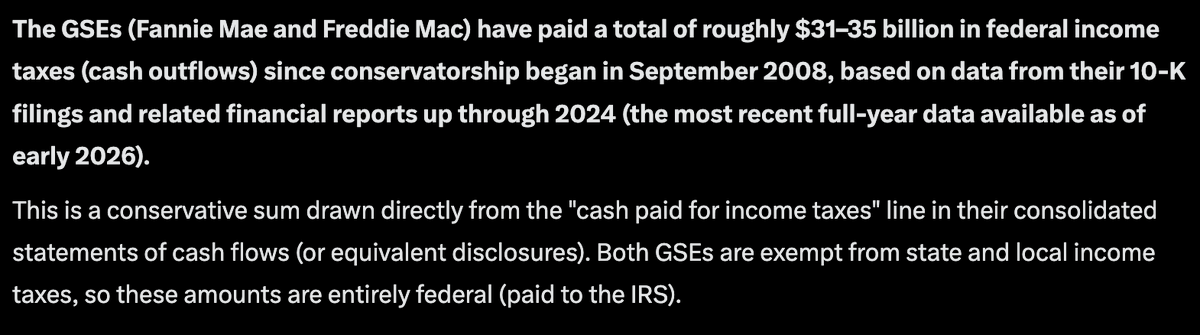
These struggling companies apparently did well enough in conservatorship to pay ~$35B in Federal income taxes over the years.
Watch out for Uncle Sam... He's the guy who always forgets his wallet when you go out to lunch, and never has his own pack of cigarettes.
I'm thankful for @BillAckman and @michaeljburry for exposing our story to a wider audience, and hopefully fighting for smaller retail shareholders. I know the lamestream media wants to demonize you guys, which is typical. When the elites can't start real wars they start class wars, and there's nothing easier than blaming "rich" people for all our problems.
Now I understand some "folks" in the @GOP want to introduce legislation to "release the GSE's from conservatorship". The CRT lobby is strong in this one... they need to get their gravy train of "risk transfers" codified, because when you actually run the numbers, it makes almost no fiscal sense for the GSEs, but its a money printer for an industry that probably shouldn't even exist.
https://t.co/GJ52mWhaa3
I hope y'all are hanging in there, don't let Michael Burry buy all your shares in this range.
@grok @FKDJASFKLJSALFD @bennyjohnson This is a false narrative. The real story is fraud in private label MBS. Check out @Ny1david if you want the truth.