Great disquiet over the quality of drinking water in city estates. Western parts of Nairobi especially Kilimani & Lavington are major culprits this time.
🏢 Nairobi Regeneration Program is always a scam.
One part Nairobi becomes and looks good. But on the other hand beneath the surface lies unfinished jobs, unattended streets that ultimately fill up with litter and garbage.
Next: a new contractor is given contract to redo.
Repeat.
This plot here is in Gitanga Close (Nairobi) belongs to AMECEA Sisters. Stagnant water took over after the rains. It now smells & the Chinese have turned it into a frog pond, where they fish frogs. It is a health hazard to the other communities. @NemaKenya, please help asap.
I met a schoolmate this week who is now a relief worker in northern Kenya.
He told me something fascinating; something that haunts me since then.
"Do you know how we measure severity of hunger in pastoral nomadic communities?
We count number of mothers who have died. The more mothers dying of hunger the greater the famine.
Among the pastoralists, the womenfolk are trained from infancy to repress hunger; while men are allowed to 'act on their hunger' by raiding a neighbours' cattle.
There is a piece of cloth women are given before marriage for tying their stomachs to gird themselves against hunger.
Girls and women are the last ones to eat - they only eat after the menfolk have finished eating.
Paradoxically, it is women who are least vulnerable to hunger by death. They are accustomed to extreme hunger and have devised various mechanisms for coping."
Wow !
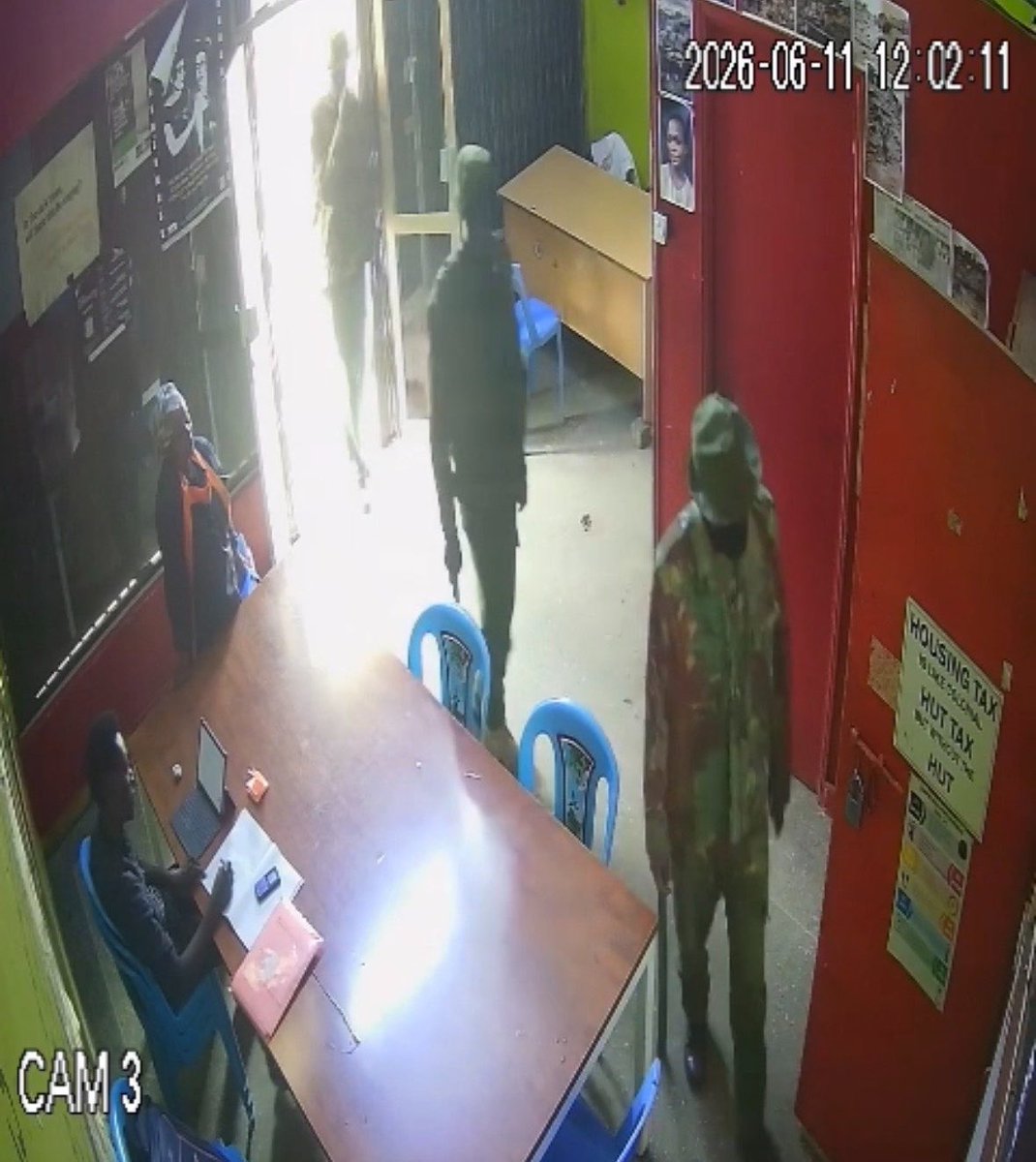
BREAKING 🇰🇪 Police raide offices of @ProgIntl member Mathare Social Justice Centre ahead of the launch of From Mau Mau to Ruto Must Go, a book documenting Kenya's recent anti-government protests.
🔗 Find out more: https://t.co/tOAX9Yrslh
Whenever I pull up one of these old pieces of mine covering the (hi)story of Nairobi, I remind myself that I am now an elder in this place. Seven decades of living through the social and political contours of this city. Five of actively studying these evolutions.
I've done 4 deep-dive threads on Nairobi's transit infra,covering NIUPLAN,NAMSIP to Njeru's MSc critique &how Expressway disrupted the master plan.Critiques,corrections/extra perspectives you guys might have are welcome! @AnganaKeith@chriskost@EricKigada@xysist@kinjeketile
🧵There's a detailed, government-approved, World Bank-funded plan that redesigns every major road, creates dedicated cycle lanes, builds BRT, proposes LRT,& puts pedestrians first across all of Eastlands.
It's called NaMSIP. Here's a breakdown of the ultimate Nairobi transit plan
On 18 May 2026, Kenyan police shot dead 20 people for protesting against the fuel price hike. Here are their names:
#RutoStopKillingUs#HakiSasa#JusticeNow
1. Macmillan Mukuru Mwangi, 17 years old, killed in Thika, Kiambu County.
2. Kelvin Muriri Mutie, 18 years old, killed in Githurai, Kiambu County
3. Allan Odhiambo, 19 years old, killed in Busia, Busia County
4. Prudence Imali, 20 years old, killed in Marurui, Nairobi County.
5. Shadrack Onyango, 20 years old, killed in Busia, Busia County.
6. Githinji Wambui, 21 years old, killed in Thika, Kiambu County
7. Joseph Mwangi Kariuki, 26 years old, killed in Nyeri, Nyeri County.
8. Joseph Kiarie, 28 years old, killed in Kasarani, Nairobi County.
9. Tifas Wanjala, 29 years old, killed in Kiambu, Kiambu County.
10. John Kangethe, 30 years old, killed in Thika, Kiambu County.
11. Frederick Odhiambo, 30 years old, killed in Busia, Busia County.
12. Martin Rigii, 32 years old, killed in Kiambu, Kiambu County.
13. George Njuguna Kamau, 32 years old, killed in Dagoretti South, Nairobi County.
14. James Osambo Okhelo, 40, Busia, Busia County.
15. John Paul, Age Unknown, killed in Nairobi, Nairobi County
16. Harrison Karanja Njeri Age Uknown, Killed in Naivasha, Nakuru County
17. David Chege Wanyoike, Age Unknown- Killed in Naivasha, Nakuru County
18. Derrick Peter Machanja, Age Unknown, Kakamega, Kakamega
19. Unknown male killed in Naivasha, Nakuru County.
20. Unknown male Nakuru, Nakuru County
Nokia could have invented the iPhone. Three years before Apple did, a Nokia engineer walked into a meeting in Finland with a working prototype: a touchscreen phone with full internet access. Management killed it. The device looked too expensive and too risky to sell. The same year, Nokia also rejected a proposal for an online app store. Apple would launch the same idea four years later.
In 2007, Nokia controlled 40% of the world's mobile phone market and was worth more than $150 billion. By 2013, it had sold its phone business to Microsoft for $7.2 billion. The company that defined the cell phone became irrelevant in less time than it takes most kids to finish high school.
In 2016, two professors from INSEAD and Aalto University spent years interviewing 76 Nokia executives, engineers, and consultants for a research paper. Their conclusion: nobody at the company could have an uncomfortable conversation.
Senior leaders were described as "extremely temperamental." One consultant remembered then-CEO Jorma Ollila shouting at people "at the top of his lungs" in front of fifteen other vice presidents. Middle managers learned the rules fast. Bad news got you fired, so they stopped delivering it.
The engineers knew Nokia's operating system could not compete with what Apple was building for the iPhone. One design team submitted 500 separate proposals to fix it between 2001 and 2009. Not a single one got approved. When a middle manager once suggested that a colleague push back against a top executive, the colleague refused. He "didn't have the courage; he had a family and small children."
The top managers were also afraid, just of different things. They worried about looking weak to investors. So they publicly defended the old operating system while privately knowing it was dying. The middle managers heard the demand for optimism and supplied it. For four years, the people who knew the company was sinking could not get that message to the people who could do something about it.
Researchers call this shoot-the-messenger culture. It shows up in cockpit recordings before plane crashes, in hospital records before preventable deaths, and in the investigations of the 2008 financial crisis. The cost of avoiding a difficult conversation is always paid later, with interest.
Nokia's case is unusual because the math is so clean: the silence cost roughly $143 billion in market value and an entire company. The discomfort would have cost a few bad meetings.
🧵Nairobi has a comprehensive roadmap for its future: the NIUPLAN from 2014,prepared by JICA & officially approved by the Nairobi City County. Containing some of the most rigorous transport data analysis in the country. Let’s break it down (Transport Infrastructure).
Somali referee Omar Artan, who was denied entry into the USA ahead of the World Cup, has now been appointed by UEFA to officiate PSG vs. Aston Villa in the Super Cup final.