we’re over paying for ETH security. is EIP8363 the solution? or another revised issuance curve?
here is @jdetychey convincing us we definitely need to do something
Is Ethereum Printing Too Much ETH? With @jdetychey
Ethereum pays validators with newly issued ETH but how much is actually needed to keep the network secure?
In today’s episode, we’re joined by @jdetychey to explore whether Ethereum could reduce issuance without compromising security.
We unpack the debate around EIP-8363, why it was withdrawn from consideration for Hegotá, and what changing staking rewards could mean for ETH holders, solo stakers, and DeFi.
We discuss:
- How Ethereum’s issuance and fee burns work
- The case for changing staking rewards
- EIP-8363 and the pushback it received
- Ethereum’s transition toward post-quantum security
- Whether staking competes with productive DeFi activity
- Could lower yields push capital into other chains?
- How excessive staking could make network capture harder to contest
- What dilution and taxes mean for solo stakers
- And much more—enjoy!
—
Timestamps:
(00:00) Introduction
(02:50) How Ethereum creates new ETH
(06:52) ETH issuance versus fee burns
(10:04) EIP-8363’s proposed rewards curve
(11:36) Why EIP-8363 was withdrawn
(12:06) Ethereum’s post-quantum transition
(23:19) Staking through market cycles
(34:43) Is staking competing with DeFi?
(35:47) Could lower yields drive exits?
(41:30) Security, centralization, and network capture
(47:51) Solo staking, taxes, and dilution
(58:11) Ethereum’s long-term trade-offs
—
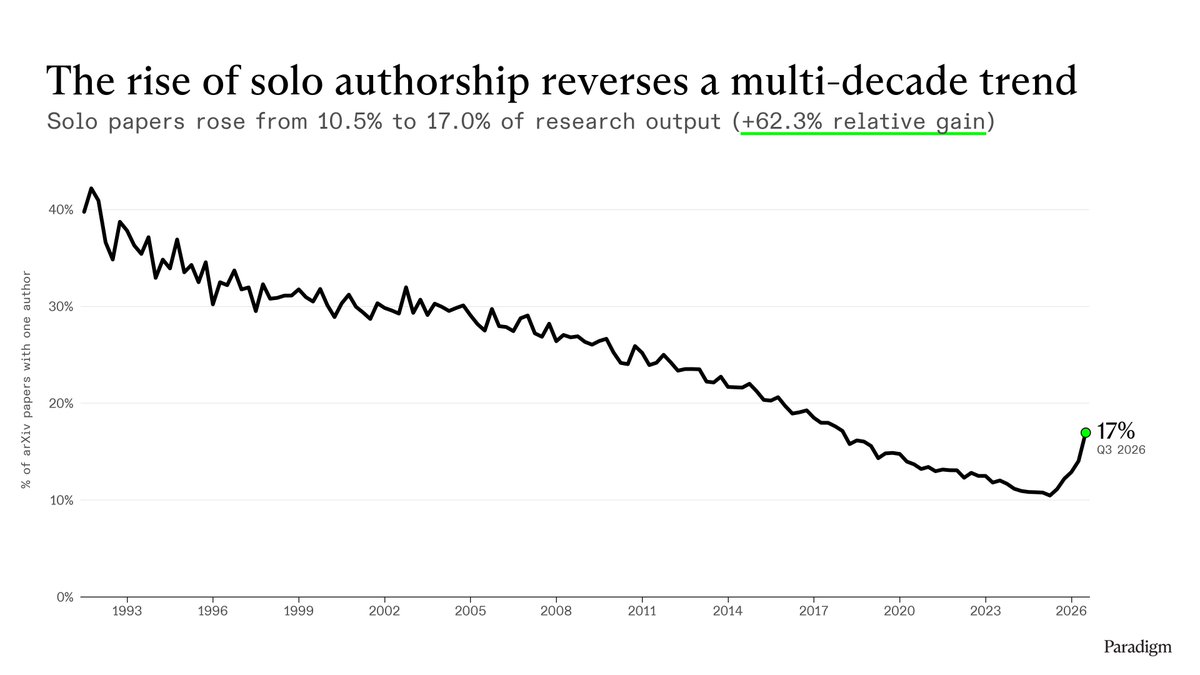
new data report on the recent superexponential publication boom
we measure the boom across 5 million papers + 2.5 million researchers + 7000 institutions + 15 data sources
here are the top 7 chart takeaways
🚨NEW EP: Tempo's Big Bet: Better Payments beyond Stablecoin Transfers🚨
Today we're joined by @malleshpai Forward Deployed Researcher and Recovering Economist at @Tempo to dive into what it takes to build a blockchain specifically for payments.
We discuss:
*What is Tempo?
*Why payments need dedicated infrastructure
*Micropayments and agentic payments
*Stablecoins beyond simple transfers
*Enterprise payment use cases
*Supporting multiple stablecoins
*Predictable fees and payment rails
*Tempo’s transaction architecture
*Onchain payment data
*Stablecoin supply and activity
*Measuring payment networks
*Tempo’s design tradeoffs
*And much more—enjoy!
—
Timestamps:
(00:00) Introduction
(02:11) What is Tempo?
(06:07) Micropayments and new use cases
(15:02) Agentic payments
(16:50) Enterprise payment infrastructure
(29:53) Supporting multiple stablecoins
(32:17) Predictable transaction fees
(36:45) Diving into Tempo data
(47:57) Stablecoin activity
(50:18) Real-world payment patterns
(53:32) Beyond TVL metrics
(56:33) Tempo’s design tradeoffs
🚨NEW EPISODE: Who actually bets on prediction markets🚨
Today we're joined by @DaiZeshi, full node researcher at Surf AI, to dive deep into prediction markets and the data behind @Polymarket and @Kalshi.
We discuss:
Polymarket vs Kalshi
Crypto markets driving volume
Polymarket US growth
Prediction market turnover
Sports and crypto fee engines
Polymarket user growth and churn
Which markets onboard users?
Geopolitics and user retention
Cross-category user behaviour
Bots vs retail traders
Who actually makes money?
Prediction markets’ future
And much more—enjoy!
—
Timestamps:
(00:00) Introduction
(00:44) James Dye and Surf AI
(03:19) Prediction market data
(06:07) Polymarket vs Kalshi
(10:23) Polymarket US growth
(12:20) Turnover and fee engines
(19:33) User growth and churn
(23:32) What onboards new users?
(27:39) Retention by market
(30:05) Cross-category user behaviour
(33:10) Bots vs retail traders
(43:20) Who actually makes money?
(46:10) Prediction markets’ future
this week ethereum blob usage hit an all-time high: 3 day moving avg of 5.9 blobs/block & 6.7 daily avg!!
but the ambition to keep scaling requires funding to client teams, which is increasingly scarce
this is solvable - a $300b mcap chain should not have these problems
Introducing @EthenaPay: the internet money neobank.
→Card spend cashback at 5.0%
→Best-in-class 6.0% dollar savings rate
→Borderless, free, instant global money transfers
→Free global onramps in USD, GBP, EUR and local FX
→Multi-currency high-rewards savings accounts in local FX
→Unified fiat IBAN integration with self-custodial stablecoin accounts
→Buy Now Pay Never where your savings rewards covers daily expenses
Not coming soon™️. Live now to download on iOS.
here's an HHI (Herfindahl-Hirschman Index) measure of concentration/diversity in blob posters + active vs. effective submitters
it will be interesting to track this moving forward! query can probably be improved, send feedback
https://t.co/4JgpJMwW34
🚨NEW EP: Robinhood Just Changed Crypto Forever? Inside Their New Blockchain🚨
Today we're joined by Tom Wan, Head of Data at Entropy Advisors, and Ali, Data at Entropy Advisors to break down one of crypto's biggest infrastructure launches of the year: Robinhood Chain.
We dive into why Robinhood chose @arbitrum as its blockchain infrastructure, how the partnership actually works behind the scenes, and what this means for the future of tokenized real-world assets. We also explore early onchain data, blob usage, revenue sharing, Ethereum economics, and whether @RobinhoodApp could become the everything-app for finance.
We discuss:
- Why Robinhood launched its own blockchain
- Robinhood's partnership with Arbitrum explained
- Blockchain infrastructure vs distribution
- Tokenized RWAs and Robinhood's vision
- Early Robinhood Chain adoption metrics
- Memecoins vs real-world assets
- Robinhood app UX and chain abstraction
- Blob usage and Ethereum settlement
- Robinhood Chain revenue sharing
- Ethereum vs Arbitrum economics
- The future of tokenized finance
- What's next for Robinhood Chain
- And much more—enjoy!
—
Timestamps:
(00:00) Introduction
(01:10) Why Robinhood built a chain
(09:20) Blockchain as infrastructure
(21:26) Memes vs RWAs
(23:39) Robinhood user experience
(31:25) Chain abstraction explained
(44:14) Robinhood blob dominance
(45:19) Revenue sharing model
(47:16) Arbitrum economics
(48:18) Future of Robinhood Chain
(51:03) What's coming next
(53:09) Outro
🚨NEW EP: Why Solana Data Doesn't Agree (And Why That Matters)🚨
Today we're joined by @waldruupi from the @SolanaFndn to discuss Solana Data, an initiative tackling one of crypto's biggest hidden problems: why different data providers report completely different numbers.
We discuss:
- What is Solana Data?
- Why crypto data providers disagree
- Institutional adoption & data quality
- Benchmarking Dune, Artemis, Allium & others
- DEX volume methodology differences
- Stablecoin supply challenges
- Wash trading & filtering assumptions
- Open source data benchmarking
- Building standards for crypto analytics
- The future of onchain data auditing
- Why transparency matters for institutions
- And much more—enjoy!
—
Timestamps:
(00:00) Introduction
(00:55) What is Solana Data?
(02:20) Why institutions need data
(04:23) Launching Solana Data
(06:24) Data provider disagreements
(11:15) Biggest data headaches
(12:08) Stablecoin supply issues
(14:14) DEX volume comparison
(22:19) Why metrics differ
(27:19) Cross-chain data standards
(32:50) Open source methodology
(36:00) Community contributions
(38:02) Most trusted metrics
(41:50) Final thoughts
(43:25) Outro
How does a data indexer operate on a network designed to keep data private?
@NovesBen of @Noves_Fi, joined @Indexed_Pod to walk through Canton's architecture, how privacy works at the network level, and what activity on Canton actually looks like.
@christian_zro@novesben@Noves_fi we could even get more data going forward since in some cases it would be beneficial to all involved, for example to prove that issuers aren't silently printing more than what's known
🚨NEW EPISODE: Inside Canton: The Private Blockchain Powering Institutions🚨
Today we're joined by @novesben, co-founder and CEO of @noves_fi, to explore the Canton Network.
We discuss:
- What is the Canton Network?
- How privacy works on Canton
- Why blockchain data breaks on private networks
- How Noves indexes Canton data
- Validators, synchronizers & network architecture
- Network performance, TPS & scalability
- Institutional adoption & real-world assets
- Privacy vs transparency trade-offs
- What activity is happening on Canton today?
- The future of institutional blockchain infrastructure
- Live walkthrough of Canton analytics dashboards
- And much more—enjoy!
—
Timestamps:
(00:00) Introduction
(04:28) How Canton works
(10:04) Collecting private data
(12:29) Validators explained
(17:37) Network performance
(18:04) Peer-to-peer architecture
(25:57) What Noves can see
(27:27) Privacy vs transparency
(28:18) Institutional adoption
(35:27) Activity on Canton
(38:24) Canton dashboard demo
(43:57) Blockchain meets TradFi
(44:44) What's next for Noves
(46:04) Outro
🚨NEW EPISODE: Why Ethereum PropAMMs Aren’t Actually AMMs🚨
Today we're joined by @katiabanina, CEO of @bebop_dex, to unpack one of the most misunderstood emerging trading primitives in DeFi: PropAMMs.
We discuss:
- What Bebop does and its evolution
- Why PropAMMs aren’t actually AMMs
- RFQs vs streaming quotes
- The concept of Request for Stream (RFS)
- How PropAMMs work on Ethereum
- Market maker incentives and quote signing
- Toxic flow and execution quality
- Block builders and sidecar quote streams
- Ethereum vs Solana PropAMM designs
- Oracle updates and onchain execution
- RFQ vs PropAMM tradeoffs
- Adoption across aggregators
- The future of onchain market structure
- And much more—enjoy!
—
Timestamps:
(00:00) Introduction
(01:35) What is Bebop?
(02:25) Bebop’s evolution
(07:41) Why PropAMMs aren’t AMMs
(10:20) RFQs vs streaming quotes
(12:35) Request for Stream explained
(26:39) Ethereum vs Solana designs
(32:05) Signed quotes and incentives
(39:11) Block builders and sidecars
(47:06) RFQ vs PropAMM execution
(55:03) Oracle-traded markets
(56:24) Adoption and market share
(1:02:15) Future of onchain trading
(1:03:16) Outro
🚨NEW EPISODE🚨
Do AI Trading Agents Actually Work?
Today we're diving into AI trading agents, the rise of DeFAI, and whether autonomous trading bots are actually generating alpha.
We discuss:
- AI trading agents and the DeFAI hype cycle
- @elizaOS, @virtuals_io, and agentic trading products
- Onchain tracking vs qualitative research
- Whether agents actually made money
- Early wins, later losses, and extractive markets
- Alpha Arena and AI model trading competitions
- Why sample size matters for agent experiments
- Agent reliability, harnesses, and model variability
- AI workflows, Dune MCP, and product building
- Ethereum bearishness, EVM success, and ETH value capture
- Stablecoins and prediction markets
And much more—enjoy!
—
Timestamps:
(00:00) Introduction
(00:46) AI trading agents
(01:26) DeFAI product promises
(04:55) Eliza and Virtuals
(05:08) Research methodology
(12:58) Biggest wallet gains
(14:48) Profitability fades
(16:19) Alpha Arena experiment
(19:18) Sample size problem
(25:57) Learning from competitions
(31:51) Dune MCP workflows
(42:04) Ethereum bearishness
(53:41) Outro
For the first time, all ZK circuits used by Lighter perp DEX L2 were regenerated from sources by L2BEAT!
Now you don’t have to trust the Lighter team to perform a permissionless emergency exit.
👇Learn more in the thread👇