📊 Summary of Oil Industry Movements - Week 35 | https://t.co/ZNGpg6vc0s
Record Refinery Margins Endure as Dark Transit Flows Reshape the Oil Trade
Brazil Leads the Global Refinery Response to Record Diesel Cracks.
⚡ Record high Diesel cracks are triggering a decisive global refinery response. Brazil's Diesel output hit a 21-month high as refiners aggressively shift yield away from Gasoline, aiming to reduce the country's growing Diesel import bill amid the global supply crunch.
Surging TD3 Rates Confirm Dark Transit Flows Are Larger Than Reported.
⚡ TD3 VLCC freight rates continue surging, corroborating that dark transit voyages through Hormuz are increasing beyond what shiptracking data captures. Producers and shippers are accepting heightened tanker attack risks to sustain crude flows out of the region.
2026 Refinery Margins Surpass 2022 Peaks in Both Level and Duration.
⚡ Refinery margins remain at record highs, having already exceeded 2022 levels with significantly greater staying power. Higher dark transit crude volumes continue to weigh on flat price, channeling further tailwinds into product margins at crude's direct expense.
US Refiners Run at Record Utilization but Risks Are Building.
⚡ US refinery runs are up 0.5MMBD y/y at record utilization rates, with PADD 2 and PADD 3 driving the bulk of growth. However, running at peak capacity leaves the system increasingly exposed to unexpected outages, seasonal turnarounds and the approaching hurricane season.
https://t.co/5xqrUSAarN
#oil #oott #oilandgas #saas
📊 Summary of Oil Industry Movements - Week 34 | https://t.co/ZNGpg6vJQ0
Geopolitical Escalations Reignite the Brent Curve as Asia's Refining Divergence Deepens
VLCC Freight Surges Back to Record Highs on Hormuz Risk.
⚡ VLCC freight rates have returned to record highs as Hormuz risk premiums surge and shipping activity slows. Widespread re-routing is lengthening tonne miles across key trade lanes while dark vessel transits shuttling Hormuz crude keep global vessel utilization stubbornly elevated.
China's Product Exports Tick Up But Remain Far Below Potential.
⚡ Chinese Diesel exports jumped to 195KBD, the highest since September 2025, while Gasoline exports hit a 4-month high. However, with refinery runs still hovering at YTD lows, absolute export volumes remain deeply subdued relative to the record high crack environment.
India Maxes Out Refinery Throughput While China Stays Sidelined.
⚡ Indian refiners have swiftly rebounded from Hormuz crisis lows, with profitability near record highs and throughput maximized. China's continued refinery suppression remains a glaring mystery, with no clear economic rationale given the historically strong margin environment. (Source: PPAC and NBS)
Indian Diesel Exports Jump but Still Trail Record Highs.
⚡ India's Diesel exports surged sharply month-on-month in July as refiners moved aggressively to capture record cracks and fill the void left by Russian supply losses. Despite the strong jump, export volumes remain 100-200KBD short of all-time record highs. (Source: PPAC)
Brent Backwardation Hits a Rarely Sustained 13% of Flat Price.
⚡ Brent Dec/Dec surged on fresh geopolitical escalations, pushing backwardation as a percentage of flat price to 13%, a level rarely sustained at previous peaks. The market now faces a clear reckoning: either flat price is priced too low or backwardation is set to correct sharply.
https://t.co/48rA4RfvYt
#oil #oott #oilandgas #saas
What can kill / calm these Diesel market? #OOTT
Diesel markets are on fire, surpassing every 2022 record. Diesel cracks at $80+, Diesel flat price at $150+. This cannot continue forever. Some ways this market can self correct, a thread 👇
📊 HiLo AI in action
Managed money net long 240,748 lots, +76,026 WoW. Biggest 1-week net add since May.
⚡ Conviction long build, not a short squeeze: 68% fresh longs (+51,818) vs 32% short covering. Gross longs back toward H1 highs, which also means less short-side dry powder from here.
#oil #oott #oilandgas
📊 Summary of Oil Industry Movements - Week 33 | https://t.co/ZNGpg6vJQ0
The Real Crisis Is Refining: Diesel Supply Continues to Lag a Thirsty World
China's Crude Import Rebound Raises Hopes for Product Market Relief.
⚡ Chinese crude imports rebounded in July to 8.4MMBD but remain below the 5-year seasonal range and still down 2.7MMBD y/y. Markets are now watching closely for a follow-through rebound in refinery runs and product exports to cool global Diesel and Gasoline tightness.
Fading US/Iran Deal Hopes Expose a Dangerously Underpriced Hormuz Risk.
⚡ Market hopes for a quick US/Iran resolution are fading, with latest headlines pointing to a potential 1-2 year timeline for Hormuz normalization. If confirmed, deferred Cal27 and Cal28 crude prices are expected to remain firmly supported above $80.
IEA's Demand Forecast Looks Increasingly Vulnerable to Upward Revision.
⚡ The IEA projects 2026 oil demand to contract by 1.6MMBD y/y, yet has revised its demand estimates upward over each of the last four consecutive years. Another upward revision appears highly probable once full 2026 actual demand numbers are reported.
US Net Crude Imports Surge to a One-Year High.
⚡ US net crude imports spiked to their highest level in over a year as exports fell to 3MMBD while imports surged past 7MMBD. Rising LATAM import volumes could keep net imports structurally elevated even as crude exports mean revert to their 4MMBD average. (Source: EIA)
Gasoil Continues to Outperform as the Global Refining Shortage Takes Center Stage.
⚡ The Gasoil crack continues to widen its advantage over Brent M1 as crude flat price trades rangebound amid uncertainty over dark vessel transit volumes. The market is slowly recognizing that the true structural shortage is global refining capacity, not crude supply itself.
https://t.co/MthKwf6FHs
#oil #oott #oilandgas #saas
📊 Summary of Oil Industry Movements - Week 31 | https://t.co/ZNGpg6vJQ0
Diesel Markets Hit Uncharted Territory as Physical Tightness Defies Flat Price Weakness
Diesel Cracks Poised to Exceed Brent Flat Price for the First Time in History.
⚡ Diesel cracks are on the verge of surpassing absolute Brent flat price, an unprecedented market event. While Brent whipsaws on Trump and geopolitical headlines, diesel cracks continue trading structurally higher, reflecting a deepening physical supply crisis.
Latin American Crude Production Delivers a Record-Breaking 2026.
⚡ Latin American producers are collectively posting consistent y/y gains above 1MMBD. Brazil hit an all-time record of 4.4MMBD, Mexico reversed years of underperformance, and Guyana, though off recent highs, has new fields coming online later this year. (Source: ANP, Pemex, Guyana Oil Ministry)
Brent Structure Signals Physical Tightness Despite Sub-$80 Flat Price.
⚡ The current Brent curve is materially stronger than the last time flat price traded below $80. Headline-driven selling has dragged flat price lower, but persistent prompt backwardation confirms underlying physical tightness that the paper market is choosing to ignore.
US Diesel Exports Hit Record Highs, But Global Supply Remains Critically Tight.
⚡ US refiners responded to record diesel cracks by surging exports to all-time highs, with Europe absorbing the largest y/y volume increase. However, the Russian export ban and China's refinery stagnation continue to keep global diesel supplies critically tight. (Source: EIA Weekly)
India Posts First Positive Demand Growth Since the Hormuz Conflict Began.
⚡ Indian oil demand recorded its first y/y gain since the onset of the Hormuz conflict, rebounding strongly from YTD lows. Gasoline and Diesel are leading the recovery with nearly 10% y/y growth, more than offsetting continued weakness in LPG and Naphtha.
https://t.co/EB9p8eETeR
#oil #oott #oilandgas #saas
📊 Summary of Oil Industry Movements - Week 30 | https://t.co/ZNGpg6vJQ0
A Full Crude and Products Market Crisis Comes Into Sharp Focus
Gasoil Structure Hits Record Highs as Russian Supply Disruptions Persist.
⚡ Gasoil Dec/Dec structure reached new YTD highs despite flat price sitting $100-$200/MT below its peaks. Unlike crude, Gasoil structure continues to outperform as ongoing drone attacks on Russian refinery infrastructure keep supply severely constrained.
China's June Crude Imports Sink to a Multi-Year Low.
⚡ Chinese crude imports in June hit a multi-year low with Middle East volumes taking the hardest hit. Unlike India, China has failed to offset lower regional imports elsewhere, with only Brazil and Indonesia showing any y/y import gains.
Diesel Cracks Decouple From Brent as Supply Crisis Deepens.
⚡ Diesel cracks continue hitting record highs, severing their historical relationship with flat price Brent. A meaningful resolution requires two catalysts: a rebound in Chinese refinery runs and a recovery of Russian refinery infrastructure damaged by drone attacks.
India Rebounds Strongly While China Remains a Stubborn Mystery.
⚡ Indian refinery runs sharply recovered in June to prior year levels, driven by record refiner profitability. China's refinery system continues to stagnate inexplicably, defying the strong margin environment that has driven recoveries across every other major Asian economy. (Source: NBS China and PPAC)
Markets Wake Up to a Combined Crude and Products Crisis.
⚡ Gasoil backwardation surged to record highs while crude structure rapidly catches up, widening then narrowing the gap between the two. A sharp market rally signals traders are finally pricing in not just a products supply crisis, but a full crude market crisis as well.
https://t.co/3Eb1wThd2n
#oil #oott #oilandgas #saas
Our web platform has undergone a significant transformation driven by AI. The landscape of analytics is evolving quickly in this AI-driven era. We will be sharing regular videos showcasing the various use cases on how our AI chat adds value.
https://t.co/Vq74yzLkql
📊 Summary of Oil Industry Movements - Week 29 | https://t.co/ZNGpg6vJQ0
China Remains the Critical Outlier as Asian Oil Markets Gradually Normalize
Futures Market Conviction Collapses Amid Headline-Driven Trading.
⚡ Aggregate open interest in ICE Brent and ICE Gasoil has dropped 25% from YTD highs. Despite lower margin requirements from falling prices, headline-driven trading and lack of market direction continues to drain futures market participation. (Source: ICE and CME)
China's Crude Imports Hit a Fresh 10-Year Low.
⚡ Chinese crude imports reached a new 10-year low, though the pace of decline appears to be slowing near a floor. The 5MMBD drop from pre-Hormuz levels continues balancing the crude market while depressed refinery runs tighten the products market. (Source: China Customs)
China's Refinery Runs Plunge to Covid-Era Lows.
⚡ Chinese refinery runs hit Covid-era lows, with the widening gap between imports and runs signaling accelerating SPR drawdowns. A rebound appears inevitable as refinery margins surge and product export curbs are removed, freeing refiners to run harder.
South Korea Rebounds While China Stays Stubbornly Offline.
⚡ South Korean crude imports rebounded sharply from April lows as easing Hormuz pressures and alternative supply routes unlock crude for Asian refiners. China remains the critical outlier, yet to show the import rebound seen across other major Asian economies.
ARA Gasoline Stocks Hit Multi-Year Seasonal Lows.
⚡ Gasoline stocks in ARA have fallen to their lowest seasonal levels in many years, with cracks exploding higher once again. Continued inventory depletion across key trading hubs sustains powerful bullish tailwinds in the refined products market.
https://t.co/lkJ9eDDFC8
#oil #oott #oilandgas #saas
📊 Summary of Oil Industry Movements - Week 27 | https://t.co/ZNGpg6vJQ0
Crude Prices Crumble While Refinery Margins Hit Historic Highs
Speculative Energy Length Continues Its Relentless Collapse.
⚡ Combined energy spec length has fallen 10 of the last 13 weeks, with Brent taking the hardest hit. Net spec length has been nearly halved from 729K contracts in mid-March to just 326K recently.
Japanese Demand Weakness Signals Broader Asian Consumption Stress.
⚡ Japan's total oil demand fell 5% year-on-year, driven primarily by naphtha weakness in the petrochemical sector. Road fuel demand remains a rare bright spot, continuing to hold up against the broader demand deterioration.
US Oil Production Blows Past Forecasts Eight Months Early.
⚡ April's 13.9MMBD production print came in nearly 300KBD above EIA's Short Term Energy Outlook forecast, a level previously expected only by December. Weekly and monthly production forecasts will now need significant upward revision.
Crude Sells Off But Product Cracks Surge to Record Highs.
⚡ Despite relentless crude price weakness, refinery benchmarks have surged back to conflict highs. On a percentage of crude flat price basis, 3-2-1 cracks are now at all-time record highs, rewarding refiners handsomely.
Asian Refinery Runs Remain Deeply Depressed Post-Conflict.
⚡ Combined refinery runs across China, Japan, Korea and India are down 4MMBD from pre-conflict levels, with y/y declines near 2MMBD. China and South Korea account for the bulk of the deterioration. (Source: NBS China, PAJ, KNOC, PPAC)
https://t.co/3QxKLIFR4x
#oil #oott #oilandgas #saas
📊 Summary of Oil Industry Movements - Week 26 | https://t.co/ZNGpg6vJQ0
Global Oil Markets Navigate Inventory Crises and Shifting Refinery Dynamics
Record Brent Short Positioning Sets Up a Dangerous Squeeze.
⚡ Speculative Brent shorts approach record highs as the oil glut narrative returns. Extreme short concentration poses serious spike risk if Hormuz reopening stumbles, catching the market heavily offside.
China's Crude Import Collapse Deepens While India Snaps Back.
⚡ Indian crude imports recovered swiftly after the March-April drop, constrained by limited strategic reserves. China's decline is far sharper and more prolonged, with the critical question being when Chinese imports will meaningfully rebound.
US Total Crude Inventories Hit a 41-Year Low.
⚡ Combined Commercial and SPR stocks suffered another massive 15MM barrel weekly draw, pushing inventories to a 41-year low. With no end date on SPR releases, fresh record lows appear inevitable in coming weeks.
Iranian Sanctions Relief Opens the Door for Middle East Buying.
⚡ Chinese crude imports cratered year-on-year with Persian Gulf flows hit hardest. Temporary Iranian sanctions relief is expected to revive Middle East buying, potentially offering a floor to the prolonged regional demand slump.
Latin American Refinery Runs Diverge Sharply.
⚡ Brazilian refineries continue running hard post-Hormuz, driven by strong margins and product security needs. Mexico's runs fell below 1000KBD for the first time in seven months, signaling mounting operational pressure at Pemex.
#oil #oott #oilandgas #saas
https://t.co/5TWOK3mE5e
📊 Summary of Oil Industry Movements - Week 25 | https://t.co/ZNGpg6vJQ0
The commodity complex is aggressively shedding geopolitical weight, transferring focus back to a heavily depleted physical ecosystem. Here is the 5-point summary of this week’s oil industry movements:
Speculators Flee the Entire Commodity Complex
⚡ Financial players are executing a broad, synchronized retreat. For the third consecutive week, net speculative length across the wider commodity complex has fallen, completely erasing the entire speculative surge seen since the conflict began and returning positioning to mid-February levels. This week's wash-out was characterized by massive liquidations in Brent crude futures alongside a heavy unwind across the agricultural basket, notably in corn and soybeans.
A Massive 4.8 MMBD Drawdown of China's Strategic Stockpiles
⚡ While preliminary data had hinted at severe tightness, May 2026 figures confirm a dramatic operational squeeze. Chinese refinery throughput hit a 3-year low just as crude imports cratered to an 8-year low. This created a historic deficit: the gap between what Chinese refiners processed and what the country imported widened to a staggering 4,850 KBD (4.85 MMBD), proving that Beijing has been aggressively draining its domestic Strategic Petroleum Reserve (SPR) to keep its industrial complex running.
The Threat of a 90-Million-Barrel "Hormuz Supply Wave"
⚡ As ceasefire and Memorandum of Understanding (MOU) headlines saturate the market, front-month spreads are facing a unique structural threat. There are currently an estimated 90 million barrels of stranded crude sitting on floating tankers near the blocked Strait of Hormuz. If a diplomatic resolution is finalized, this massive volume risks hitting the prompt market almost immediately—creating a front-loaded supply wave that could heavily depress the Brent prompt "flys" (front spread minus the M2/M3 spread) and drag the rest of the prompt curve down with it.
Refinery Cracks Hold Firm Against the Crude Meltdown
⚡ While flat crude prices are under intense pressure and mean-reverting toward pre-conflict levels, the product market refuses to buckle. Key refined product cracks have decoupled from the crude selloff; though down from their absolute YTD peaks, cracks remain historically healthy and continue to guarantee robust margins for global refiners. This lower flat crude price environment is expected to act as a demand stabilizer, keeping global consumption for road and aviation fuels highly resilient.
A Pivot to the Brutal Reality of Destocked Hubs
⚡ With speculative froth and geopolitical "headline risk" rapidly clearing out of the paper market, the oil industry is preparing to refocus entirely on hard physical fundamentals. Commercial and strategic inventories across every major global trading hub are currently sitting at or near record lows. Market analysts note that the moment supply logistics actually begin to normalize, the immediate top priority for nations and trading houses will be a massive, competitive scramble to refill these empty storage tanks.
https://t.co/opTxiKZBfK
#oil #oott #oilandgas #saas
📊 Summary of Oil Industry Movements - Week 24 | https://t.co/ZNGpg6vJQ0
China's Imports Collapse to an 8-Year Low
⚡ Reflecting the severe loss of seaborne Middle Eastern barrels, preliminary May data reveals that Chinese crude imports plunged to an eight-year low of just 7.79 MMBD—a level not seen since May 2017. Leaning on its massive domestic stockpiles and deep refinery run cuts to avoid bidding up hyper-expensive spot barrels, China’s 3-month import average has officially dropped below 10 MMBD. This massive retreat from the market is the primary anchor preventing a massive blowout in front-month global flat prices.
LPG Shortages Force Severe Indian Demand Rationing
⚡ Combined Indian and regional naphtha demand hit multi-year lows as the reality of structural supply deprivation sinks in. India’s aggressive, government-backed demand conservation programs have been highly effective, particularly in rationing the country's starved LPG markets due to the absolute lack of flows from the Arabian Gulf. The primary debate now occupying the market is whether this forced demand destruction will become permanent or simply spring back once Hormuz eventually normalizes.
EIA Normalization Forecast Shifts from a "V" to a "U" Shape
⚡ The EIA’s latest June Short-Term Energy Outlook (STEO) has significantly grimmed its timeline for global oil recovery. Moving away from previous expectations of a quick rebound, the EIA has flattened its OPEC+ production restart curve from a sharp V-shape to a prolonged U-shape. Aggressive downward revisions have slashed projected July-to-November OPEC output by a massive -3.0 MMBD, pushing any semblance of supply normalization out to Q1 2027 and ensuring cumulative conflict-driven losses will eclipse 1.5 billion barrels.
US Inventories Bleed out at an Accelerated Clip
⚡ The operational pressure valve on the Western hemisphere is reaching a critical threshold. The EIA reported that US combined oil and product stocks fell by another -13 million barrels, with massive weekly draws becoming the structural norm as the Strategic Petroleum Reserve is systematically depleted. Commercial crude inventories are now sitting just 17 MMBBLs above their historical 2022 lows, while refined product cushions have been whittled down to within 55 MMBBLs of their absolute floor.
US Production Limits Tested Amid Global Shortage
⚡ The accelerating depletion of US inventories comes despite the domestic supply machine running at absolute maximum throttle. Compared to the 2022 energy crisis, the US is currently churning out 2.0 MMBD more crude oil while domestic refineries are processing 0.6 MMBD more feedstock. The fact that US inventories continue to collapse at an accelerating rate despite this massive incremental domestic supply highlights the insatiable, desperate global pull for US barrels.
With the EIA officially pushing out the timeline for a Hormuz resolution into 2027, would you like to take a closer look at how this U-shaped outlook is impacting the back-end pricing of the 2027/2028 Brent spreads?
https://t.co/5Q9wqL0t3B
#oil #oott #oilandgas #saas
📊 Summary of Oil Industry Movements - Week 23 | https://t.co/ZNGpg6vJQ0
Short Sellers Return in Force
⚡ Sustained headlines regarding a potential Middle East ceasefire and optimism over a smooth US-Iran diplomatic resolution have invited financial players back to the short side of the market. According to CFTC and ICE data, managed shorts in both Brent and WTI have returned to levels last seen pre-conflict in February, unwinding a major portion of the geopolitical risk premium in front-month flat prices.
Brazil Defies Global Trends to Target Product Self-Sufficiency
⚡ While the rest of the world grapples with output cuts and falling refinery runs, Brazil’s oil sector is operating at maximum capacity. However, Brazil's crude exports dropped to an 11-month low, falling below 2 MMBD. Instead of exporting its raw pre-salt crude, Brazil is diverting these record barrels into its own domestic refineries—running them at record highs—to boost refined product output and structurally reduce its heavy reliance on expensive foreign fuel imports.
Asian Naphtha Slumps as High Prices Trigger Petchem Destruction
⚡ The Asian naphtha flat price is struggling to hold above $1,000/MT, retracing heavily toward pre-conflict benchmarks. Echoing the severe market dynamics of 2022, the hyper-inflated flat-price environment witnessed over the last few months has triggered a rapid defensive reaction from the petrochemical sector, causing extensive demand destruction as steam crackers across Asia idled operations or sharply cut run rates due to unsustainable input costs.
US Refiners Solve the Jet Crisis at Gasoline's Expense
⚡ Robust US refinery runs are churning out record-high distillate and jet fuel output, with the latter climbing past 2 MMBD as refiners strategically alter their yields to alleviate the global aviation fuel crunch. However, this intensive structural swing toward middle distillates is coming at a steep cost to light ends: refinery configurations are maximizing jet fuel at the direct expense of gasoline production, setting up a tight supply balance for road fuels as summer driving demand peaks.
Crashing Naphtha Cracks Flash Macro Warning Signs
⚡ The naphtha crack has plunged by $16/bbl from its YTD highs in just two months, continuing its downward spiral despite a global reduction in overall refinery runs. Historically treated as a primary "canary in the coal mine" for broader macroeconomic health, the severe and rapid collapse of the naphtha crack indicates that the market has fundamentally underestimated the sheer scale of demand destruction echoing through the global manufacturing and petrochemical supply chains.
https://t.co/k8N7nJHm6A
#oil #oott #oilandgas #saas
📊 Summary of Oil Industry Movements - Week 22 | https://t.co/ZNGpg6vJQ0
Ceasefire Headlines and the "Dec Spreads" Convergence
⚡ The market is intensely testing the validity of the latest ceasefire rumors through its curve structure. If a genuine diplomatic breakthrough occurs, the steep risk premium embedded in the forward curve will collapse. Analysts note that true headline progress should cause the Dec-26/Dec-27 and Dec-27/Dec-28 spreads to converge rapidly, as the market pivots from short-term conflict panic to long-term inventory replacement.
China’s Refining Drop Drags Down Regional Yields
⚡ Driven by the April operational slump, China’s domestic diesel and gasoline production plummeted close to a 4-year low. In contrast, naphtha output bucked the trend, holding steady due to rising petrochemical yields. Looking ahead, market veterans expect a replay of 2022: if international margins remain highly lucrative, Chinese refiners will actively tweak their configurations to ramp up diesel yields now that the temporary export restrictions have been lifted.
Divergence in the Asian Refining Engine (China vs. India)
⚡ Combined Indian and Chinese refinery runs for April showed a massive retrenchment from their pre-conflict highs, down -0.94 MMBD year-on-year and a steep -2.4 MMBD from their YTD peaks. However, a sharp divergence has emerged between the two giants:
China: Accounted for the vast majority of the processing decline due to severe seaborne feedstock constraints.
India: Surprisingly resilient, keeping its refinery runs robust despite high crude prices and the record-low Rupee.
The True Drama in US Product Draws
⚡ While headline inventory numbers look tight, stripping out "other oil" (like liquid petchems and propane) reveals a much more critical situation for consumers. Key transport fuels—distillates and gasoline—have plunged to multi-year seasonal lows. Because "other oil" has sharply increased as a percentage of total US stockpiles, the remaining cushion for actual commercial road fuels is drastically thinner than the aggregate data implies.
Dec-26 Brent Gains on Positive Roll Yield
⚡ Even with front-month flat prices pinned in a volatile, headline-driven trading range, Dec-26 Brent continues to hover near its post-conflict highs. The steep backwardation in the curve creates a powerful positive roll yield, allowing deferred contracts to mechanically "roll up" higher each month as global inventories continue to rapidly bleed out. Despite this strength, the contract still sits roughly $20 below the equivalent December contract peaks seen during the 2022 crisis, leaving structural room to run if a ceasefire fails to materialize.
#oil #oott #oilandgas #saas
📊 Summary of Oil Industry Movements - Week 21 | https://t.co/ZNGpg6vJQ0
Chinese Refining Activity Plummets to 2022 Lows
⚡ Despite having a vast domestic stockpile built up over recent years, China is hitting operational walls. April refinery runs plummeted to their lowest levels since August 2022. The prolonged closure of the Strait of Hormuz since March has severely pinched the country's crude procurement, proving that even a massive inventory surplus cannot fully insulate refiners from an aggressive, ongoing seaborne supply shock.
China’s Export "Freeze" Cripples Regional Fuel Supply
⚡ A short-lived product export ban in April caused Chinese gasoline exports to hit an all-time record low (near zero), while diesel exports dried up to just 230 KT. Although Beijing lifted the ban in May to let refiners chase lucrative international margins, the relief will be highly constrained; with underlying refinery runs slashed by 1.5 MMBD due to the Hormuz blockade, China simply will not have the structural surplus to ramp exports back to normal levels anytime soon.
The US SPR is Bleeding at a Historic "Libya-Sized" Pace
⚡ The US Strategic Petroleum Reserve is being drained at an unprecedented velocity to keep the global market afloat. The latest week saw a massive 9.9 million barrel draw (~1.4 MMBD)—a rate of supply injection equivalent to tossing another entire OPEC nation like Libya into the mix. This aggressive reliance has left the SPR just 27 MMBBLs shy of its 2023 lows, putting the US on track to breach multi-year lows by early June.
Largest Combined US Crude Draw on Record
⚡ The emergency emergency-valve strategy is hitting its limit. The EIA reported the largest total weekly crude drawdown (SPR + Commercial) on record, wiping out nearly 18 million barrels of domestic inventory in a single week. This leaves total commercial stocks at a 2-year low, teetering just 50 MMBBLs away from the historic absolute floor seen in 2023 right as the high-demand summer driving season kicks off.
Product Export Mirroring of 2022
⚡ The parallel between current product flows and the 2022 energy crisis has tightened. While China’s product exports touched multi-year lows in April due to government restrictions, the massive international price premium for diesel and gasoline has forced a policy reversal for May. However, unlike 2H 2022—when Chinese refiners safely capitalized on massive export quotas—the current lack of raw feedstock means the global market cannot rely on China to bail it out of the current product crunch.
https://t.co/Qot5Lf9wN7
#oil #oott #oilandgas #saas
📊 Summary of Oil Industry Movements - Week 20 | https://t.co/ZNGpg6vJQ0
The widening Brent-WTI spread is clearly just one symptom of a much larger, structural rebalancing taking place as the market digests the full scale of the Hormuz crisis. Here is the 5-point summary of these latest developments:
China’s Import Collapse Cools Global Differentials
⚡ Preliminary Chinese crude imports for April plunged by a staggering -2.46 MMBD month-on-month, hit hard by ongoing supply outages. With May numbers expected to remain depressed, the market is watching to see if imports break below the 2022 lows. Paradoxically, this massive drop in Chinese buying has acted as a pressure valve for the physical market, causing global crude differentials to collapse nearly back to pre-conflict levels.
Record Low Rupee and High Prices Squeeze Indian Demand
⚡ India’s April demand numbers revealed a sharp overall decline. While domestic road fuels (gasoline and diesel) held up reasonably well, a severe shortage of LPG supplies from the Arabian Gulf dragged down the headline figures. Pinched by high global oil prices and a record-low Rupee, Indian demand remains heavily suppressed, though it still holds a 0.5–0.6 MMBD buffer above its 2022 lows.
EIA STEO: A 2-Billion-Barrel Supply Deficit
⚡ The EIA’s May Short-Term Energy Outlook (STEO) lays bare the staggering scale of the conflict's impact. Comparing the current data to pre-conflict (February) forecasts:
The Peak: May is projected to be the peak month for supply outages, with Middle East shut-ins hitting nearly 10.8 MMBD.
The Long Road: The EIA warns the market will not return to "normal" until Q1 2027.
The Cumulative Hit: The total volume of oil lost to the market during this extended disruption is expected to exceed 2 billion barrels.
US Product Exports Smash Past 2022 Peaks
⚡ The US Gulf Coast continues to operate as the world's primary energy lifeline. Combined US exports of crude, distillate, and gasoline have soared to fresh record highs, running nearly 2 MMBD higher than the peak seen during the 2022 energy crisis.
Dec-26 Brent Rides the "Positive Roll Yield"
⚡ While front-month (M1) Brent futures remain stuck in a volatile, headline-driven trading range, deferred contracts like Dec-26 Brent are holding near post-conflict highs. This resilience is driven by rapid global inventory depletion, allowing the back-end of the curve to steadily "roll up" higher via a strong positive roll yield. Notably, the Dec Brent contract still sits $20 below the historic heights reached by the equivalent December contract during the 2022 price spikes, leaving room for further upside if inventories continue to bleed.
https://t.co/uqS10PrxIx
#oil #oott #oilandgas #saas
SPR is now being released on average by 1m b/d with the SPR dropping 23.5m barrels in the last 5 weeks. This has had the desired calming effect on WTI flat price ( down approx. 10 dollars per barrel as per Friday close) and WTI Summer timespreads. The WTI-Brent has been more volatile but with Jul WTI-Brent @ -10 with the year starting at -4 level, it is clear that Europe has been a major beneficiary of US incremental volumes.
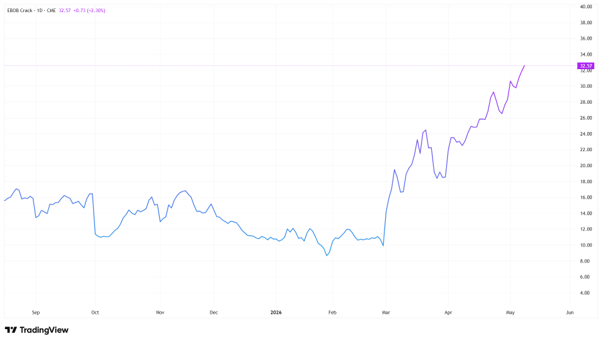
One interesting move has been the European Summer gasoline crack graphed on a rolling basis below. Since the beginning of the Summer this has almost doubled. Trump confirmed the IEA plan in mid March and the uptrend has been quite prominent with the weakening of crude relative to products. European SPR response has been largely crude and distillates, so gasoline crack has had a relatively clean path to higher levels as compared to the distillate crack.
Now 120 days after the first March releases the 171m barrel SPR release factor will abate; the last deliveries should be end of July as part of the second tranche of tenders issued by the DOE. One to follow closely to see if the EBOB gasoline crack will lose momentum pending the end of the program and as we enter into the end of the Summer driving season.
Subscribe to our daily report and platform now offering the latest intra-day data and analysis for tradeable insights like this. #OOTT
📊 Summary of Oil Industry Movements - Week 17 | https://t.co/NcHqTrWInC
The Migration to Options: Trading the "Binary" Risk
⚡ A notable divergence has emerged between ICE Brent futures and options. High volatility and surging margin requirements are pushing liquidity out of the futures market, as participants find the "Hormuz on/off" scenario too binary for standard positions. Investors are increasingly using options to hedge against "all-or-nothing" geopolitical outcomes, allowing them to manage risk without the punishing capital hits of the futures exchange.
China’s New Crude Slate: Bypassing the Middle East
⚡ Chinese customs data confirms a strategic pivot in refining. China is aggressively cutting reliance on the Middle East (excluding Iran) and backfilling the gap with barrels from Indonesia (frequently a hub for Iranian "dark" flows), Brazil, and Russia. This diversification is no longer just about price; it is a survival tactic to keep refinery runs resilient as the Hormuz crisis threatens traditional supply lines.
Dec26 Crude: The Anchor in the Storm
⚡ While the front-month Brent (M1) swings wildly on every ceasefire headline, the December 2026 contract has remained remarkably steady, trading within a narrow $6 range through April. This stability suggests that while the "prompt" market is in chaos, long-term participants are still viewing the current conflict as a transitory shock rather than a permanent re-rating of oil prices three years out.
US Exports Hit Record 12.9 MMBD
⚡ The US is effectively acting as the world's life support for refined products. Combined crude and product exports hit an all-time high of 12.9 MMBD, driven by global desperation for US-refined barrels. Crude exports alone reached 4.8 MMBD, and with the current SPR (Strategic Petroleum Reserve) releases gathering pace to combat the Persian Gulf blockade, this figure is expected to climb higher in May.
Historic Pressure on Deferred Backwardation
⚡ The Brent Dec/Dec spread has reached a conflict high, signaling extreme long-term tightness. Even though the front-month price is $15 off its peak, the sustained inventory drawdown is forcing the entire curve into a more aggressive "backwardated" shape.
The Transatlantic Gap: Brent Dec/Dec is now commanding a significant premium over WTI Dec/Dec, reflecting the fact that the US supply chain remains resilient while the rest of the world (particularly Europe and Asia) faces a much more precarious balance.
#oil #oott #oilandgas #saas