Personal update: I've joined Anthropic. I think the next few years at the frontier of LLMs will be especially formative. I am very excited to join the team here and get back to R&D. I remain deeply passionate about education and plan to resume my work on it in time.
"Every software company in the world, needs to have an @openclaw strategy" - Jensen at @NVIDIAAI GTC
Framing OpenClaw as one of the most important open source releases ever, they have announced NemoClaw - a reference platform for enterprise grade secure Openclaw, with OpenShell, Network boundaries, security baked in.
In the next version of Claude Code..
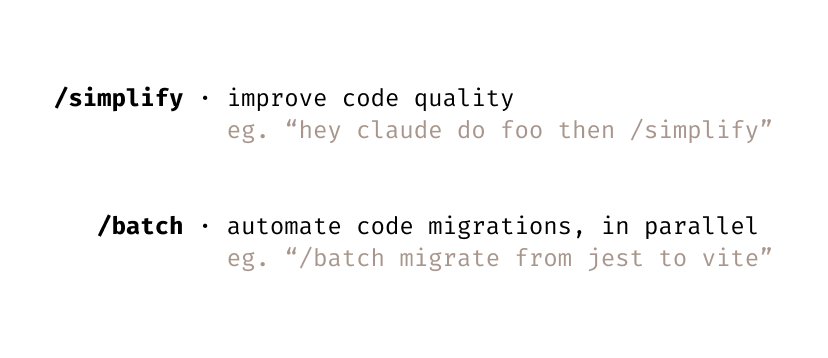
We're introducing two new Skills: /simplify and /batch. I have been using both daily, and am excited to share them with everyone.
Combined, these kills automate much of the work it used to take to (1) shepherd a pull request to production and (2) perform straightforward, parallelizable code migrations.
I've never felt this much behind as a programmer. The profession is being dramatically refactored as the bits contributed by the programmer are increasingly sparse and between. I have a sense that I could be 10X more powerful if I just properly string together what has become available over the last ~year and a failure to claim the boost feels decidedly like skill issue. There's a new programmable layer of abstraction to master (in addition to the usual layers below) involving agents, subagents, their prompts, contexts, memory, modes, permissions, tools, plugins, skills, hooks, MCP, LSP, slash commands, workflows, IDE integrations, and a need to build an all-encompassing mental model for strengths and pitfalls of fundamentally stochastic, fallible, unintelligible and changing entities suddenly intermingled with what used to be good old fashioned engineering. Clearly some powerful alien tool was handed around except it comes with no manual and everyone has to figure out how to hold it and operate it, while the resulting magnitude 9 earthquake is rocking the profession. Roll up your sleeves to not fall behind.
The hardest part of building AI agents isn't teaching them to remember.
It's teaching them to forget.
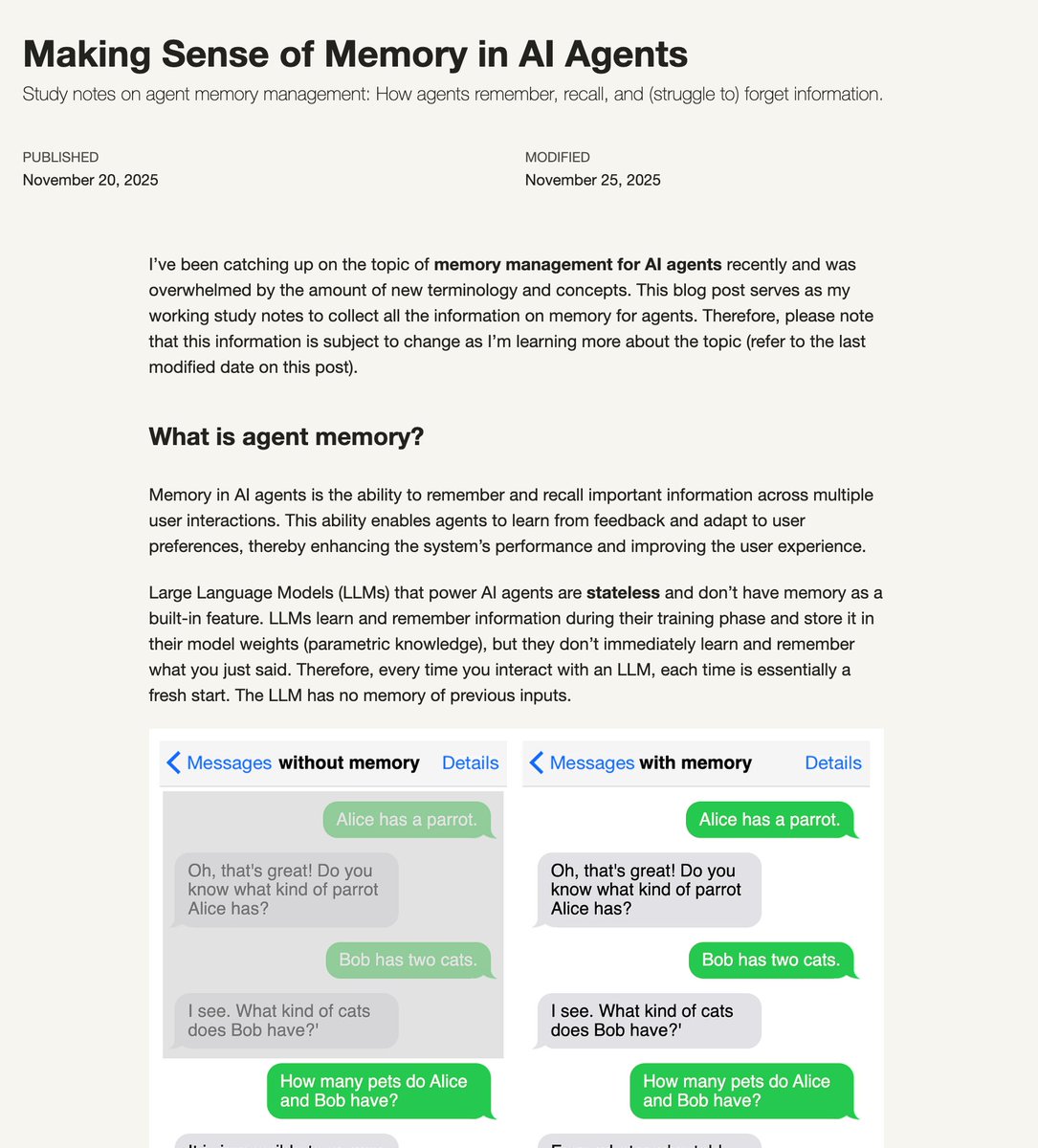
My colleague and amazingly talented writer @helloiamleonie just published what might be the most comprehensive breakdown of agent memory I've seen - and trust me, we all needed this.
Here's the core challenge: 𝗟𝗟𝗠𝘀 𝗮𝗿𝗲 𝘀𝘁𝗮𝘁𝗲𝗹𝗲𝘀𝘀. Every conversation is a fresh start. They don't remember what you said five minutes ago, let alone what you said last week. So how do we make agents that actually remember?
𝗧𝘄𝗼 𝗳𝘂𝗻𝗱𝗮𝗺𝗲𝗻𝘁𝗮𝗹 𝗺𝗲𝗺𝗼𝗿𝘆 𝘁𝘆𝗽𝗲𝘀:
• 𝗦𝗵𝗼𝗿𝘁-𝘁𝗲𝗿𝗺 𝗺𝗲𝗺𝗼𝗿𝘆: Information in the LLM's context window (the current conversation)
• 𝗟𝗼𝗻𝗴-𝘁𝗲𝗿𝗺 𝗺𝗲𝗺𝗼𝗿𝘆: Information stored externally (past conversations, user preferences, learned facts)
But here's where it gets interesting - and confusing. Different frameworks categorize memory differently, for example:
𝗖𝗼𝗔𝗟𝗔'𝘀 𝗮𝗽𝗽𝗿𝗼𝗮𝗰𝗵 (inspired by human cognition):
• Working memory (current conversation)
• Semantic memory (facts about the user)
• Episodic memory (past experiences and actions)
• Procedural memory (instructions and behaviors)
𝗟𝗲𝘁𝘁𝗮'𝘀 𝗮𝗽𝗽𝗿𝗼𝗮𝗰𝗵 (architecture-focused):
• Message Buffer (recent messages)
• Core Memory (actively managed in-context blocks)
• Recall Memory (raw conversation history)
• Archival Memory (explicitly stored knowledge)
𝗧𝗵𝗲 𝗵𝗮𝗿𝗱𝗲𝘀𝘁 𝗽𝗮𝗿𝘁? 𝗙𝗼𝗿𝗴𝗲𝘁𝘁𝗶𝗻𝗴.
Managing what goes into memory is super complex. Managing what gets 𝘥𝘦𝘭𝘦𝘵𝘦𝘥 is even harder. How do you automate deciding what's obsolete? When is old information genuinely outdated versus still contextually relevant? This is where most implementations struggle.
Leonie covers everything from the different memory types (working, semantic, episodic, procedural) to practical implementation strategies and the growing ecosystem of memory frameworks like mem0, Letta, and zep.
This is one of those posts you'll want to bookmark and return to as you build your agent systems.
Leonie’s blog post: https://t.co/1uGI6l6fW2
We're now rolling out interactive images to the @GeminiApp for more visual and dynamic learning. It’s designed to help you visually explore complex academic concepts, turning studying from passive viewing into active exploration. Learn more → https://t.co/GLVkfBIuGd
Releasing a new "Agentic Reviewer" for research papers. I started coding this as a weekend project, and @jyx_su made it much better.
I was inspired by a student who had a paper rejected 6 times over 3 years. Their feedback loop -- waiting ~6 months for feedback each time -- was painfully slow. We wanted to see if an agentic workflow can help researchers iterate faster.
When we trained the system on ICLR 2025 reviews and measured Spearman correlation (higher is better) on the test set:
- Correlation between two human reviewers: 0.41
- Correlation between AI and a human reviewer: 0.42
This suggests agentic reviewing is approaching human-level performance.
The agent grounds its feedback by searching arXiv, so it works best in fields like AI where research is freely published there. It’s an experimental tool, but I hope it helps you with your research.
Check it out here: https://t.co/n7ctnDilJJ
Super interesting post from @karpathy. I wanted to dive deeper, so I created a @NotebookLM notebook based on this tweet, and then did a Deep Research run in-app to gather related sources. Then generated one of our new slide decks to explore further. Instant knowledge base.
Sharing an interesting recent conversation on AI's impact on the economy.
AI has been compared to various historical precedents: electricity, industrial revolution, etc., I think the strongest analogy is that of AI as a new computing paradigm (Software 2.0) because both are fundamentally about the automation of digital information processing.
If you were to forecast the impact of computing on the job market in ~1980s, the most predictive feature of a task/job you'd look at is to what extent the algorithm of it is fixed, i.e. are you just mechanically transforming information according to rote, easy to specify rules (e.g. typing, bookkeeping, human calculators, etc.)? Back then, this was the class of programs that the computing capability of that era allowed us to write (by hand, manually).
With AI now, we are able to write new programs that we could never hope to write by hand before. We do it by specifying objectives (e.g. classification accuracy, reward functions), and we search the program space via gradient descent to find neural networks that work well against that objective. This is my Software 2.0 blog post from a while ago. In this new programming paradigm then, the new most predictive feature to look at is verifiability. If a task/job is verifiable, then it is optimizable directly or via reinforcement learning, and a neural net can be trained to work extremely well. It's about to what extent an AI can "practice" something. The environment has to be resettable (you can start a new attempt), efficient (a lot attempts can be made), and rewardable (there is some automated process to reward any specific attempt that was made).
The more a task/job is verifiable, the more amenable it is to automation in the new programming paradigm. If it is not verifiable, it has to fall out from neural net magic of generalization fingers crossed, or via weaker means like imitation. This is what's driving the "jagged" frontier of progress in LLMs. Tasks that are verifiable progress rapidly, including possibly beyond the ability of top experts (e.g. math, code, amount of time spent watching videos, anything that looks like puzzles with correct answers), while many others lag by comparison (creative, strategic, tasks that combine real-world knowledge, state, context and common sense).
Software 1.0 easily automates what you can specify.
Software 2.0 easily automates what you can verify.
I took delivery of a beautiful new shiny HW4 Tesla Model X today, so I immediately took it out for an FSD test drive, a bit like I used to do almost daily for 5 years. Basically... I'm amazed - it drives really, really well, smooth, confident, noticeably better than what I'm used to on HW3 (my previous car) and eons ahead of the version I remember driving up highway 280 on my first day at Tesla ~9 years ago, where I had to intervene every time the road mildly curved or sloped. (note this is v13, my car hasn't been offered the latest v14 yet)
On the highway, I felt like a passenger in some super high tech Maglev train pod - the car is locked in the center of the lane while I'm looking out from Model X's higher vantage point and its panoramic front window, listening to the (incredible) sound system, or chatting with Grok. On city streets, the car casually handled a number of tricky scenarios that I remember losing sleep over just a few years ago. It negotiated incoming cars in tight lanes, it gracefully went around construction and temporarily in-lane stationary cars, it correctly timed tricky left turns with incoming traffic from both sides, it gracefully gave way to the car that went out of order in the 4-way stop sign, it found a way to squeeze into a bumper to bumper traffic to make its turn, it overtook the bus that was loading passengers but still stopped for the stop sign that was blocked by the bus, and at the end of the route it circled around a parking lot, found a spot and... parked. Basically a flawless drive.
For context, I'm used to going out for a brief test drive around the neighborhood to return with 20 clips of things that could be improved. It's new for me to do just that and exactly like I used to, but come back with nothing. Perfect drive, no notes. I expect there's still more work for the team in the long march of 9s, but it's just so cool to see that we're beyond finding issues on any individual ~1 hour drive around the neighborhood, you actually have to go to the fleet and mine them. Back then, I processed the incredible promise of vehicle autonomy at scale (in the fully scaleable, vision only, end-to-end Tesla way) only intellectually, but now it is possible to feel it intuitively too if you just go out for a drive. Wait, of course surround video stream at 60Hz processed by a fully dedicated "driving brain" neural net will work, and it will be so much better and safer than a human driver. Did anyone else think otherwise?
I also watched @aelluswamy 's new ICCV25 talk last week (https://t.co/RdaM23kvez) that hints at some of the recent under the hood technical components driving this progress. Sensor streams (videos, maps, kinematics, audio, ...) over long contexts (e.g. ~30 seconds) go into a big neural net, steering/acceleration comes out, optionally with visualization auxiliary data. This is the dream of the complete Software 1.0 -> Software 2.0 re-write that scales fully with data streaming from millions of cars in the fleet and the compute capacity of your chip, not some engineer's clever new DoubleParkedCarHandler C++ abstraction with undefined test-time characteristics of memory and runtime. There's a lot more hints in the video on where things are going with the emerging "robotics+AI at scale stack". World reconstructors, world simulators "dreaming" dynamics, RL, all of these components general, foundational, neural net based, how the car is really just one kind of robot... are people getting this yet?
Huge congrats to the team - you're building magic objects of the future, you rock! And I love my car <3.
Claude + n8n + Gamma = AI Investor Deck System that generated $127K last quarter...
(And it's being used by founders raising Series A rounds)
This system generates investor-grade pitch decks in 12 minutes with $15K+ worth of market research built-in...
→ No more 3 weeks trapped building PowerPoint decks manually
→ No more $3K-$5K agency fees for generic templates
→ No more designer dependencies killing your fundraising speed
→ No more recycled decks that VCs have seen 50 times already
Just company brief → autonomous intelligence pipeline that builds Fortune 500-grade investor decks.
Here's how it works:
→ Company Form Trigger (collects 5 strategic inputs, activates workflow)
→ Market Research Agent (TAM/SAM/SOM analysis + competitive intelligence)
→ GTM Strategy Builder (actionable growth roadmap with ICP definition)
→ Gamma Deck Generation (renders investor-grade presentation automatically)
→ Auto-Export System (Drive delivery + investor email generation)
→ Tracking Database (logs every output for iteration management)
Built with investor psychology standards.
Runs 24/7 without supervision.
12-minute deck generation. $0.87 cost per deck.
Want the complete system?
Like + comment "GAMMA" + repost, and I'll DM it to you.
(must be following)
Your story, told your way.
With Veo 3.1 on HeyGen, you can now create multi-scene videos where your identity stays perfectly consistent from appearance to voice. Every transition is seamless.
Retweet this for the full guide to Veo 3.1 on HeyGen.
The @karpathy interview
0:00:00 – AGI is still a decade away
0:30:33 – LLM cognitive deficits
0:40:53 – RL is terrible
0:50:26 – How do humans learn?
1:07:13 – AGI will blend into 2% GDP growth
1:18:24 – ASI
1:33:38 – Evolution of intelligence & culture
1:43:43 - Why self driving took so long
1:57:08 - Future of education
Look up Dwarkesh Podcast on YouTube, Apple Podcasts, Spotify, etc. Enjoy!
Finally had a chance to listen through this pod with Sutton, which was interesting and amusing.
As background, Sutton's "The Bitter Lesson" has become a bit of biblical text in frontier LLM circles. Researchers routinely talk about and ask whether this or that approach or idea is sufficiently "bitter lesson pilled" (meaning arranged so that it benefits from added computation for free) as a proxy for whether it's going to work or worth even pursuing. The underlying assumption being that LLMs are of course highly "bitter lesson pilled" indeed, just look at LLM scaling laws where if you put compute on the x-axis, number go up and to the right. So it's amusing to see that Sutton, the author of the post, is not so sure that LLMs are "bitter lesson pilled" at all. They are trained on giant datasets of fundamentally human data, which is both 1) human generated and 2) finite. What do you do when you run out? How do you prevent a human bias? So there you have it, bitter lesson pilled LLM researchers taken down by the author of the bitter lesson - rough!
In some sense, Dwarkesh (who represents the LLM researchers viewpoint in the pod) and Sutton are slightly speaking past each other because Sutton has a very different architecture in mind and LLMs break a lot of its principles. He calls himself a "classicist" and evokes the original concept of Alan Turing of building a "child machine" - a system capable of learning through experience by dynamically interacting with the world. There's no giant pretraining stage of imitating internet webpages. There's also no supervised finetuning, which he points out is absent in the animal kingdom (it's a subtle point but Sutton is right in the strong sense: animals may of course observe demonstrations, but their actions are not directly forced/"teleoperated" by other animals). Another important note he makes is that even if you just treat pretraining as an initialization of a prior before you finetune with reinforcement learning, Sutton sees the approach as tainted with human bias and fundamentally off course, a bit like when AlphaZero (which has never seen human games of Go) beats AlphaGo (which initializes from them). In Sutton's world view, all there is is an interaction with a world via reinforcement learning, where the reward functions are partially environment specific, but also intrinsically motivated, e.g. "fun", "curiosity", and related to the quality of the prediction in your world model. And the agent is always learning at test time by default, it's not trained once and then deployed thereafter. Overall, Sutton is a lot more interested in what we have common with the animal kingdom instead of what differentiates us. "If we understood a squirrel, we'd be almost done".
As for my take...
First, I should say that I think Sutton was a great guest for the pod and I like that the AI field maintains entropy of thought and that not everyone is exploiting the next local iteration LLMs. AI has gone through too many discrete transitions of the dominant approach to lose that. And I also think that his criticism of LLMs as not bitter lesson pilled is not inadequate. Frontier LLMs are now highly complex artifacts with a lot of humanness involved at all the stages - the foundation (the pretraining data) is all human text, the finetuning data is human and curated, the reinforcement learning environment mixture is tuned by human engineers. We do not in fact have an actual, single, clean, actually bitter lesson pilled, "turn the crank" algorithm that you could unleash upon the world and see it learn automatically from experience alone.
Does such an algorithm even exist? Finding it would of course be a huge AI breakthrough. Two "example proofs" are commonly offered to argue that such a thing is possible. The first example is the success of AlphaZero learning to play Go completely from scratch with no human supervision whatsoever. But the game of Go is clearly such a simple, closed, environment that it's difficult to see the analogous formulation in the messiness of reality. I love Go, but algorithmically and categorically, it is essentially a harder version of tic tac toe. The second example is that of animals, like squirrels. And here, personally, I am also quite hesitant whether it's appropriate because animals arise by a very different computational process and via different constraints than what we have practically available to us in the industry. Animal brains are nowhere near the blank slate they appear to be at birth. First, a lot of what is commonly attributed to "learning" is imo a lot more "maturation". And second, even that which clearly is "learning" and not maturation is a lot more "finetuning" on top of something clearly powerful and preexisting. Example. A baby zebra is born and within a few dozen minutes it can run around the savannah and follow its mother. This is a highly complex sensory-motor task and there is no way in my mind that this is achieved from scratch, tabula rasa. The brains of animals and the billions of parameters within have a powerful initialization encoded in the ATCGs of their DNA, trained via the "outer loop" optimization in the course of evolution. If the baby zebra spasmed its muscles around at random as a reinforcement learning policy would have you do at initialization, it wouldn't get very far at all. Similarly, our AIs now also have neural networks with billions of parameters. These parameters need their own rich, high information density supervision signal. We are not going to re-run evolution. But we do have mountains of internet documents. Yes it is basically supervised learning that is ~absent in the animal kingdom. But it is a way to practically gather enough soft constraints over billions of parameters, to try to get to a point where you're not starting from scratch. TLDR: Pretraining is our crappy evolution. It is one candidate solution to the cold start problem, to be followed later by finetuning on tasks that look more correct, e.g. within the reinforcement learning framework, as state of the art frontier LLM labs now do pervasively.
I still think it is worth to be inspired by animals. I think there are multiple powerful ideas that LLM agents are algorithmically missing that can still be adapted from animal intelligence. And I still think the bitter lesson is correct, but I see it more as something platonic to pursue, not necessarily to reach, in our real world and practically speaking. And I say both of these with double digit percent uncertainty and cheer the work of those who disagree, especially those a lot more ambitious bitter lesson wise.
So that brings us to where we are. Stated plainly, today's frontier LLM research is not about building animals. It is about summoning ghosts. You can think of ghosts as a fundamentally different kind of point in the space of possible intelligences. They are muddled by humanity. Thoroughly engineered by it. They are these imperfect replicas, a kind of statistical distillation of humanity's documents with some sprinkle on top. They are not platonically bitter lesson pilled, but they are perhaps "practically" bitter lesson pilled, at least compared to a lot of what came before. It seems possibly to me that over time, we can further finetune our ghosts more and more in the direction of animals; That it's not so much a fundamental incompatibility but a matter of initialization in the intelligence space. But it's also quite possible that they diverge even further and end up permanently different, un-animal-like, but still incredibly helpful and properly world-altering. It's possible that ghosts:animals :: planes:birds.
Anyway, in summary, overall and actionably, I think this pod is solid "real talk" from Sutton to the frontier LLM researchers, who might be gear shifted a little too much in the exploit mode. Probably we are still not sufficiently bitter lesson pilled and there is a very good chance of more powerful ideas and paradigms, other than exhaustive benchbuilding and benchmaxxing. And animals might be a good source of inspiration. Intrinsic motivation, fun, curiosity, empowerment, multi-agent self-play, culture. Use your imagination.
Excited to release new repo: nanochat!
(it's among the most unhinged I've written).
Unlike my earlier similar repo nanoGPT which only covered pretraining, nanochat is a minimal, from scratch, full-stack training/inference pipeline of a simple ChatGPT clone in a single, dependency-minimal codebase. You boot up a cloud GPU box, run a single script and in as little as 4 hours later you can talk to your own LLM in a ChatGPT-like web UI.
It weighs ~8,000 lines of imo quite clean code to:
- Train the tokenizer using a new Rust implementation
- Pretrain a Transformer LLM on FineWeb, evaluate CORE score across a number of metrics
- Midtrain on user-assistant conversations from SmolTalk, multiple choice questions, tool use.
- SFT, evaluate the chat model on world knowledge multiple choice (ARC-E/C, MMLU), math (GSM8K), code (HumanEval)
- RL the model optionally on GSM8K with "GRPO"
- Efficient inference the model in an Engine with KV cache, simple prefill/decode, tool use (Python interpreter in a lightweight sandbox), talk to it over CLI or ChatGPT-like WebUI.
- Write a single markdown report card, summarizing and gamifying the whole thing.
Even for as low as ~$100 in cost (~4 hours on an 8XH100 node), you can train a little ChatGPT clone that you can kind of talk to, and which can write stories/poems, answer simple questions. About ~12 hours surpasses GPT-2 CORE metric. As you further scale up towards ~$1000 (~41.6 hours of training), it quickly becomes a lot more coherent and can solve simple math/code problems and take multiple choice tests. E.g. a depth 30 model trained for 24 hours (this is about equal to FLOPs of GPT-3 Small 125M and 1/1000th of GPT-3) gets into 40s on MMLU and 70s on ARC-Easy, 20s on GSM8K, etc.
My goal is to get the full "strong baseline" stack into one cohesive, minimal, readable, hackable, maximally forkable repo. nanochat will be the capstone project of LLM101n (which is still being developed). I think it also has potential to grow into a research harness, or a benchmark, similar to nanoGPT before it. It is by no means finished, tuned or optimized (actually I think there's likely quite a bit of low-hanging fruit), but I think it's at a place where the overall skeleton is ok enough that it can go up on GitHub where all the parts of it can be improved.
Link to repo and a detailed walkthrough of the nanochat speedrun is in the reply.
Announcing my new course: Agentic AI!
Building AI agents is one of the most in-demand skills in the job market. This course, available now at https://t.co/zGHUh1loPO, teaches you how.
You'll learn to implement four key agentic design patterns:
- Reflection, in which an agent examines its own output and figures out how to improve it
- Tool use, in which an LLM-driven application decides which functions to call to carry out web search, access calendars, send email, write code, etc.
- Planning, where you'll use an LLM to decide how to break down a task into sub-tasks for execution, and
- Multi-agent collaboration, in which you build multiple specialized agents — much like how a company might hire multiple employees — to perform a complex task
You'll also learn to take a complex application and systematically decompose it into a sequence of tasks to implement using these design patterns.
But here's what I think is the most important part of this course: Having worked with many teams on AI agents, I've found that the single biggest predictor of whether someone executes well is their ability to drive a disciplined process for evals and error analysis. In this course, you'll learn how to do this, so you can efficiently home in on which components to improve in a complex agentic workflow. Instead of guessing what to work on, you'll let evals data guide you. This will put you significantly ahead of the game compared to the vast majority of teams building agents.
Together, we'll build a deep research agent that searches, synthesizes, and reports, using all of these agentic design patterns and best practices.
This self-paced course is taught in a vendor neutral way, using raw Python - without hiding details in a framework. You'll see how each step works, and learn the core concepts that you can then implement using any popular agentic AI framework, or using no framework. The only prerequisite is familiarity with Python, though knowing a bit about LLMs helps.
Come join me, and let's build some agentic AI systems!
Sign up to get started: https://t.co/FX35dloqw4