Recently @a16zcrypto published article about "The missing infrastructure for AI agents: 5 ways blockchains can help" where great contributor were there including @cc_crowley, @ccatalini, @ahall_research, @liz_harkavy, @nlevine19, and @psneville.
And Guess What : we had build this, now looking to make it live soon -
@MOI_Tech - The Participant Layer of Internet, which can solve this and beyond while catering enterprises, web2 apps and web3 dapps.
Authority lives independently at the participant level. so you don’t embed it into every agent, you keep it separate, and you propagate it only when you deliberately choose to. This creates clean, controllable, and revocable control without baking permissions into every AI instance.
Our Moat: Participant-Level State Management
We own the participant layer.
- The source of truth for “who can do what” sits with the participant, not the agent.
- When the participant’s state is set to “participant,” every downstream decision (even by agents) must resolve against that single source.
- Agents themselves remain completely stateless, they carry no persistent authority.
Why This Matters (The Permission Problem Solved) If every agent simply “holds an API key,” you have a nightmare:
- How do you give or revoke permission dynamically?
- How do you enforce it across thousands of interactions without constant re-authorization?
Our model flips it:
- Agents need authority, they don’t own it.
-Authority lives at the interaction level, issued fresh from the participant’s state on every call.
- Revocation is instant and global: change the participant state once → agents lose access immediately. No chasing down API keys.
Result: True Distributed Authority
- Participant = Stateful (owns the rules)
- Agent = Stateless (executes only what it’s handed)
- Authority = Dynamically granted per interaction This gives real safety and trust to AI agents.
Target Use Cases
- Safe Pool of AI agents (secure, auditable multi-agent environments)
- AI Governance frameworks (enterprise-grade control and compliance)
- Enterprise Data Consent & KYC (solve the consent-entity problem cleanly, participants explicitly grant/revoke consent at source, KYC-compliant by design)
Hope @moltbook can become participant centric after been acquired by @Meta
Which will be possible when i can trust the agents. Which can easily happen via @MOI_Tech
Bring it on @finkd
🚨Google Suspended OpenClaw.
MiniMax said hold my bear.
MaxClaw just dropped.
Here's what MaxClaw actually is-
OpenClaw * MiniMax Agent * M2.5 Fully unlocked.
But want to have participant have some leverage here...
So i want
OpenClaw * MiniMax Agent * M2.5 * @MOI_Tech
Runs 24/7 across every app you already use:
-> Telegram
-> Whatsapp
-> Slack
-> Discord
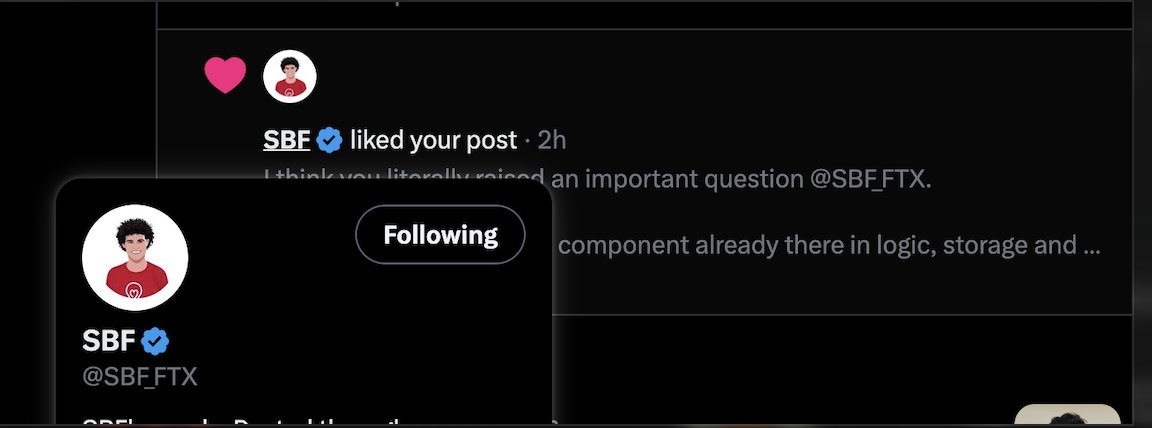
I think you literally raised an important question @SBF_FTX.
We see what, where, how component already there in logic, storage and execution form.
But we don’t have who compute in tech stack for AI agents which can bring participant centric approach, have your identity, ownership will be with user themself, and agency who can work at this level.
This is structural fix to computer science itself which is done by Contexual compute and gives us who component.
On contextual compute as foundation @MOI_Tech is build which gives who component to AI Agent while making AI safe as well.
This also gives principal of record, scoped authority, interaction-level accountability, live revocation, unified assets at Participant level.
Welcome to participant layer @MOI_Tech
Some big waves @JasonSoraVC and @soraventures are making in Bitcoin Treasury space....
- Sora Ventures Launched Asia’s First Bitcoin Treasury Fund, Plans to Buy $1 Billion in BTC Within 6 Months
Link to blog - https://t.co/1RwdF43Vjy
- @JasonSoraVC become new CEO of @DV8Thailand - https://t.co/T718Wxij07
- @jason is co CEO of @asia_strategy and already listed on NASDAQ: SORA
No other VC other than Sora Ventures is bullish this much on Bitcoin. More ventures are going to follow soon...
Real yield. Real choices 🪃
@pimabtc breaks down how users can pick vault strategies based on risk appetite - from delta-neutral to full-on directional.