Claude Code now supports session sharing!
You can share your full conversation with team members, or anyone with the link
Available on web, desktop, and the mobile app
On building more powerful self-evolving agents.
LLM agents struggle to learn from experience after deployment. Fine-tuning is expensive and causes catastrophic forgetting. RAG retrieves based on semantic similarity alone, often pulling noise instead of what actually works.
Similarity and utility are not the same thing.
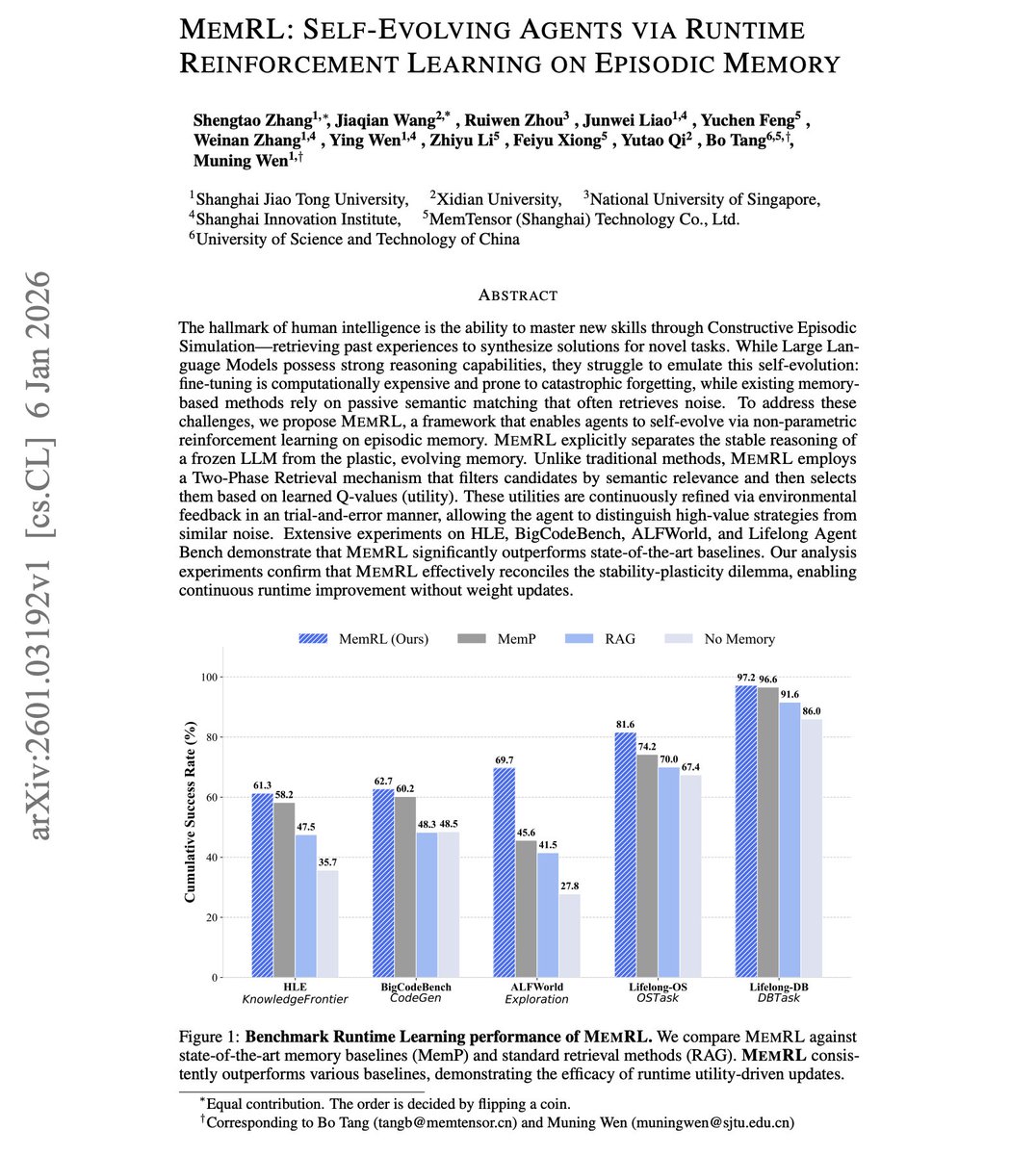
This new research introduces MemRL, a framework that enables agents to self-evolve through non-parametric reinforcement learning on episodic memory, keeping the LLM completely frozen.
The core idea is to treat memory retrieval as a decision-making problem, not a matching problem. Each memory stores an Intent-Experience-Utility triplet. The utility is a learned Q-value representing expected returns, continuously refined through environmental feedback.
MemRL implements Two-Phase Retrieval. First, filter candidates by semantic similarity to ensure relevance. Then, rank by learned Q-values to select what actually works. This distinguishes high-value strategies from semantically similar noise.
When the agent succeeds or fails, it updates the Q-values of retrieved memories using Bellman-style backups. No gradient updates to model weights. The frozen LLM provides stable reasoning while the memory evolves plastically.
Results across four benchmarks: On HLE (knowledge frontier tasks), MemRL significantly outperforms both RAG and existing memory systems like MemP. The pattern holds on BigCodeBench for code generation, ALFWorld for exploration tasks, and Lifelong Agent Bench for OS and database operations.
Analysis confirms a strong correlation between learned utility scores and actual task success, validating that Q-values capture genuine functional value rather than superficial similarity.
Why does it matter? Decoupling stable reasoning from plastic memory enables continuous runtime improvement without the catastrophic forgetting or computational costs of fine-tuning.
Paper: https://t.co/HvLUnXW2Jd
Learn to build effective AI agents in our academy: https://t.co/zQXQt0PMbG
Autonomous Memory Management in LLM Agents
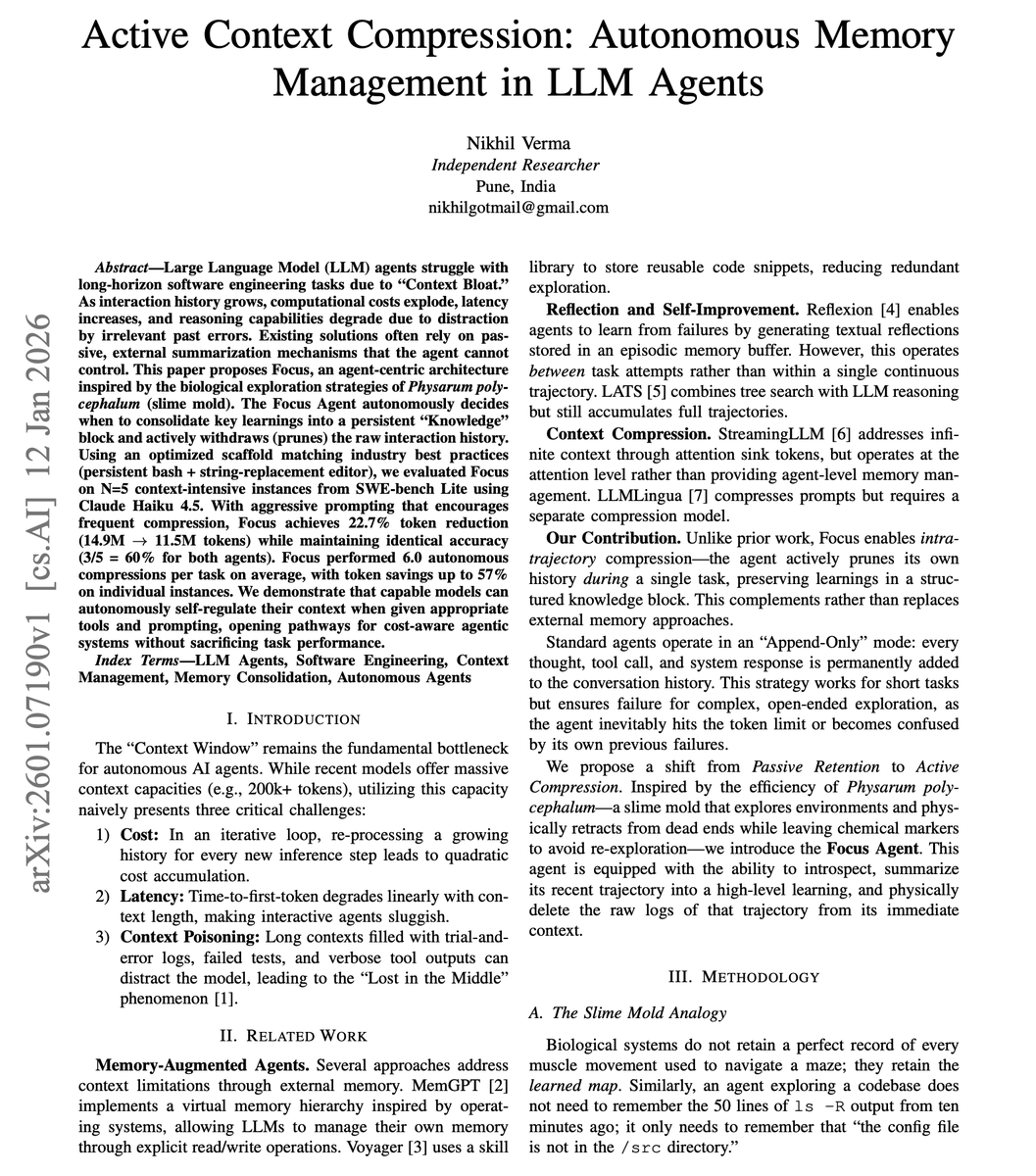
LLM agents struggle with long-horizon tasks due to context bloat.
As interaction history grows, computational costs explode, latency increases, and reasoning degrades from distraction by irrelevant past errors.
The standard approach is append-only: every thought, tool call, and response permanently accumulates. This works for short tasks but guarantees failure for complex exploration.
This research introduces Focus, an agent-centric architecture inspired by slime mold (Physarum polycephalum). The biological insight: organisms do not retain perfect records of every movement through a maze. They retain the learned map.
Focus gives agents two new primitives: start_focus and complete_focus. The agent autonomously decides when to consolidate learnings into a persistent Knowledge block and actively prunes the raw interaction history. No external timers or heuristics forcing compression.
It declares what you are investigating, explores using standard tools, and then consolidates by summarizing what was attempted, what was learned, and the outcome. The system appends this to a persistent Knowledge block and deletes everything between the checkpoint and the current step.
This converts monotonically increasing context into a sawtooth pattern: growth during exploration, collapse during consolidation.
Evaluation on SWE-bench Lite with Claude Haiku 4.5 shows Focus achieves 22.7% token reduction (14.9M to 11.5M tokens) while maintaining identical accuracy (60% for both baseline and Focus). Individual instances showed savings up to 57%.
Aggressive prompting matters. Passive prompting yielded only 6% savings. Explicit instructions to compress every 10-15 tool calls, with system reminders, increased compressions from 2.0 to 6.0 per task.
Capable models can autonomously self-regulate their context when given appropriate tools and prompting, opening pathways for cost-aware agentic systems without sacrificing task performance.
Paper: https://t.co/bVkeQlrvGJ
Learn to build effective AI agents in our academy: https://t.co/zQXQt0PMbG
I’m starting to get into a habit of reading everything (blogs, articles, book chapters,…) with LLMs. Usually pass 1 is manual, then pass 2 “explain/summarize”, pass 3 Q&A. I usually end up with a better/deeper understanding than if I moved on. Growing to among top use cases.
On the flip side, if you’re a writer trying to explain/communicate something, we may increasingly see less of a mindset of “I’m writing this for another human” and more “I’m writing this for an LLM”. Because once an LLM “gets it”, it can then target, personalize and serve the idea to its user.