Using AI to solve the Traveling Salesman Problem at warehouse scale. 📦
AlphaEvolve helped FM Logistic improve its routing algorithm by 10.4%, resulting in a reduction of total warehouse travel by over 15,000 km per year. 🚚
A great example of how @GoogleDeepMind and @googlecloud are using AlphaEvolve to help companies become more efficient.
Read more at: https://t.co/19KvSOoTpk
You switched world models. You rewrote everything.
Every architecture, its own repo, its own config, its own training loop.
No shared foundation. Until now.
Great video on how 7-Eleven in Japan vs US is basically a different company.
https://t.co/Gp9a72ir0D
Fresh food delivered 3x/day. Data-driven restocking system at the store level. Dense clustering, or so-called "area dominance strategy" that cuts logistics costs. This efficiency and success eventually led 7-Eleven Japan to buy the American parent co.
But the takeaway here isn't "Japan konbini is superior" (although I have to admit I personally think so)
It's that things like culture and urban structure, factors you can't really change, determine how easily a business model can be copied.
And this cuts both ways. Japan's konbini model is hard to replicate in the US. But Japanese companies also struggle to copy successful US digital products, because the best ones are simple enough that anyone from any background instantly understands what it does. That kind of universal simplicity comes from building for diverse markets, which Japan's relatively homogeneous market hasn't historically pushed for.
Anyways, the gap between convenience store in Japan and the states is a masterclass in how ops and supply chain can transform the same format into something completely different.
my go-to Chrome extension FIO (Figure it Out) disappeared at some point and I'd been mildly inconvenienced ever since. just rebuilt it with Claude Code in no time
Prediction: In the AI age, taste will become even more important. When anyone can make anything, the big differentiator is what you choose to make.
https://t.co/3GQUlfH58t
funny to come across this as I just learned it firsthand. been using gpt 5.1 nano for my little vibe-coded app to get tiny tasks done quick, assuming it’s the fastest model (as a clueless non-technical). finally tried 4.1 on the playground and realized it gives me a 10x speed up!
We grew from zero to $100M ARR and 70M users in <2.5 years, profitably
it cost us millions in experiments to learn what worked
1100-word post on every growth hack that got us here
I'll cover:
1. How to launch a feature in one day
2. How to find top 0.01% talent and keep them
3. What to focus on (and what not to)
4. Influencer marketing
5. You can't wish culture into existence
0. The thing that matters the most
1. How to launch a feature in one day
Our feedback loop:
10am: we come up with a new idea, or triggered by user insight.
12pm: designers code a prototype using Cursor.
4pm: we find new users to record themselves testing the feature (Voice Panel, UserTesting).
6pm: we watch the recording.
8pm: we know if the feature can be launched, if it needs refining, rebuilding, or if we should just drop it.
This is a way for you to actually watch and hear from your customers as they struggle through your product. You can hear in their voice where they're confused.
Sometimes you think you came up with a cool prototype. But as soon as users test it, they get stuck or have no idea how to use it. It's very helpful to have them explain how they're trying to use this feature.
When you see them confused, double click there. If they light up, you know you've hit gold.
That's how we often ship a feature per week. And not any feature; a feature with good odds of being well received.
In a month, we might improve our product in ways that would otherwise take a year.
Speed compounds.
2. How to find and keep talent
Finding Talent
- The best hires came from our network and cold inbound.
Someone once sent me a great message on LinkedIn, out of nowhere. We got on a call. 3 weeks later, he was hired full-time on-site.
- When someone joins, ask them “Who’s the best engineer you’ve ever worked with,” and reach out right away.
- Only open a role after you’ve felt the pain of doing it yourself so that you know what 'Great' looks like. (I ran marketing solo for nearly a year before hiring).
- Look for depth. In interviews, ask, “What’s a new skill you’ve learned recently? Can you teach it to me?” Keep asking 'why' and see how far they go. The best candidates go deep.
Keeping Talent
- A players want playing time. Hiring others takes time in the field away from them. Careful.
- Retention takes care of itself when you keep the bar high for hiring.
- We'll do regular tender offers so employees' vested shares actually get them liquidity from time to time.
- Give them ownership. Our hires are more 'full stack'. Designers can code in Cursor, engineers talk to users, marketers have design literacy. This way, they can own more of what they do and compensation can be proportional to the value they create.
3. What to focus on (and what not to)
In March 2023, we rebuilt Gamma to focus on one thing: users must feel the magic in the first 30 seconds.
We reworked everything in the process and became AI native.
In the 2.5 years before this, Gamma went from 0 to 60k users.
In the 2.5 years after this, Gamma went from 60k to 70M users.
What changed? What we focused on.
As we scaled, the temptation was to go wider - add more things. But we went deeper - make the current thing easier, faster, more delightful.
Every new feature, hire or campaign had to be tied directly to user value.
Gamma 3.0 does exactly what Gamma 2.0 did, just 10x better.
The most common error of a smart engineer is to work on something that should not exist - Elon Musk
4. Influencer Marketing
This is a strong amplifier for word of mouth. Anytime we scaled up an influencer program, we saw a disproportional increase in people that came through word of mouth. And when we invested less, we saw a deceleration.
What you need to know:
- 10% of your content will generate 90% of reach. When something works, figure out why and replicate it 100 times.
- Give it 6+ months, select multiple creators, and be willing to spend $10-$20k/mo. It'll not work until it does. When it does, it'll explode.
How to get it right:
- List creator personas with relevant audiences. Use freelancers/agencies for outreach.
- Pay base + viral bonus. What you reward will happen more often.
- On TikTok, use new accounts. Same chance of virality as old ones but without previous audience, so you can test.
- Test all platforms (TikTok, IG, X, LinkedIn), track specific creators/hooks that work. Triple down on those.
- Add "How did you hear about us" to onboarding. Measure leads, not views.
- Document 20-30 winning formats, then hire top creators to train others on these.
- Never write scripts, creators know their audience better than you do.
The formula:
Go broad -> See what works -> Scale it.
Virality isn't luck. It's discovering the hooks/formats that resonate with your audience and exploiting them.
5. Culture
People got this concept backwards. They think, 'I'll write down some principles and tell everyone they need to follow them.'
But you can't wish culture into existence. It's not what you hope it was. It's what you do.
Culture is a habit. A moving average of the past 60 days. It's not steady. Behavior molds it.
One day I looked around, identified the traits I admired in our teammates and wrote them down. Then I realized, 'That's our culture'.
Now we had to nurture it. We have an internal Slack channel where people give praise to teammates for a specific thing they did.
I note these things and try to reinforce them.
Don't just let anyone into your ecosystem. They always change it in some way. Hire up.
0. Have a word of mouth worthy product
Are users bragging about having found your product? Are they sending it over to friends and people they work with? Do they feel relieved when they open your app?
Until then, stick in a room with your team and get it right. Nothing of what I said above will save you if you don't get to this stage.
It doesn't matter if it takes 6-12 months. Digital products can go from $0 to $1bn in a few years if you solve a worthy problem.
If you try to speedrun through this step, you'll always be behind. 10 years will have passed and you'll be stuck at the same place.
Closing up, these are the main things that helped us grow Gamma.
Hope you find our playbook useful.
Excited to announce we're featured in @sfstandard. This is the first time our Japanese startup community has gotten the media spotlight.
The title calls me "Godfather," a bit embarrassing :), but it's a great read that includes many others.
https://t.co/eVnnS2h7it
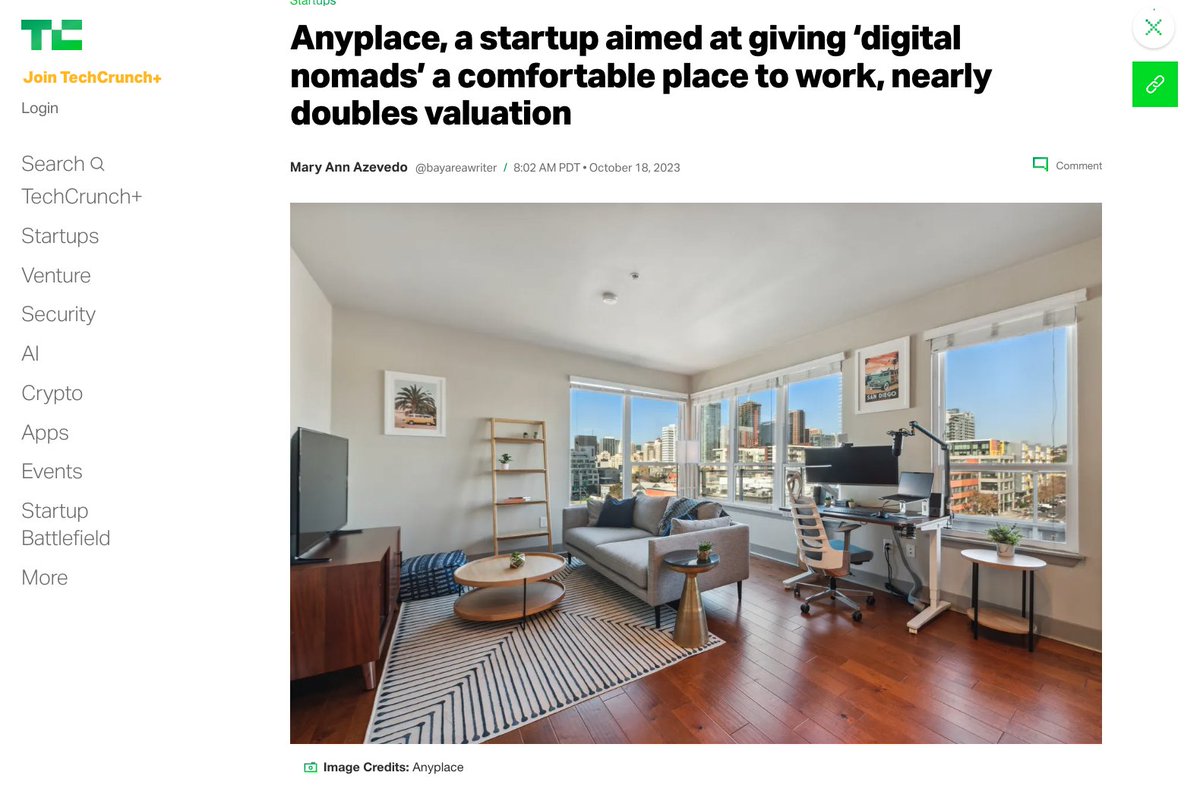
I’m thrilled to announce @anyplacecom has secured $10.27M in Series B Funding! 🎉
This round was led by @Jason and the @LAUNCH Fund, alongside @CapitalX_ , @GaingelsVC, Riverside Ventures, Potluck Ventures (@ErikJLim), and the rest of our amazing supporters. And a warm welcome to @msavino, the president at the LAUNCH Fund, who has now joined our board!
We’re on a mission to create work-friendly accommodations across the globe that give people the confidence to embrace travel with work. The funding milestone brings us closer to achieving this, as it allows us to continue expanding inventory in our current markets while also opening new locations.
A huge thank you to @TechCrunch and @bayareawriter for covering the news – our whole team appreciates it 🙏