Hey, this is a great opportunity. Mohammad and I are working together on this so post-docs will have a chance to work between my lab at Harvard and his lab at Umass Am. @mmuthukrishna@slingerland20@StevenHeine4
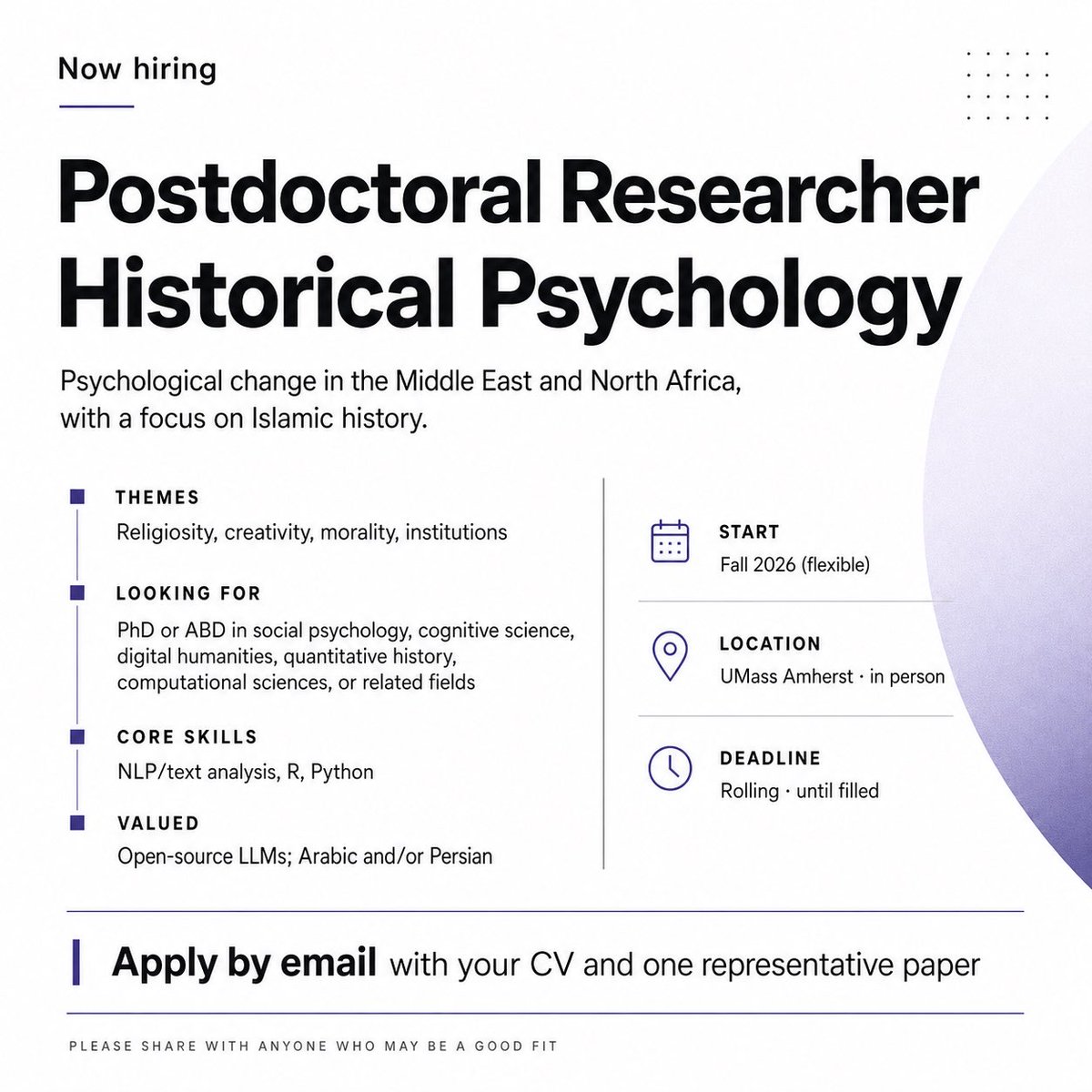
I'm hiring a postdoc in historical psychology!
This project will focus on psychological change in the Middle East and North Africa, with a particular interest in Islamic history. Topical themes include religiosity, creativity, morality, and institutions.
Info in the pic.
NEW PREPRINT!
Led by my brilliant Ph.D. student, Meriel Burnett.
In this new work, titled "Roman Personality," we ask: Would ancient Romans have recognized anything like the Big Five personality dimensions?
THREAD 1/n
I'm hiring a postdoc in historical psychology!
This project will focus on psychological change in the Middle East and North Africa, with a particular interest in Islamic history. Topical themes include religiosity, creativity, morality, and institutions.
Info in the pic.
Psychology has a familiar origin story. 1879, Leipzig, Wundt opens the first laboratory. What it leaves out is that he was running two psychologies in parallel. Alongside the experimental program, he wrote Völkerpsychologie, a "psychology of peoples" studying mind through language, myth, and shared custom. The experimental side became the discipline. The other ten volumes were largely forgotten.
The problem is not that experimental psychology failed. The problem is what it left out. For most of the twentieth century, the field built its evidence on a narrow slice of humanity @JoHenrich et al. (2010) called WEIRD: Western, Educated, Industrialized, Rich, Democratic. From that one sample, psychology produced a description of "the mind" that stood in for the species.
Historical psychology is the second half of Wundt's program coming back. Word-embedding models track how words like honor or woman shifted across decades. Classifiers read whole archives at scales no single researcher could match. @JF_Schulz et al. (2019) showed that the parts of Europe most reorganized by the Catholic Church's bans on close-kin marriage are now the most individualistic and trusting of strangers. The "modern" mind looks less like a universal baseline than the long-term outcome of reshaped kinship.
Historical psychology is not just another subfield. It is where psychology can rejoin the social sciences it left behind a century ago. Doing it well needs three things at once: data anchored in time and place, theories that hold across centuries not a single decade, and real collaboration with historians, economists, and computational linguists. @MohammadAtari90 et al. (2025) call this the chronospatial turn. The tools are already in use.
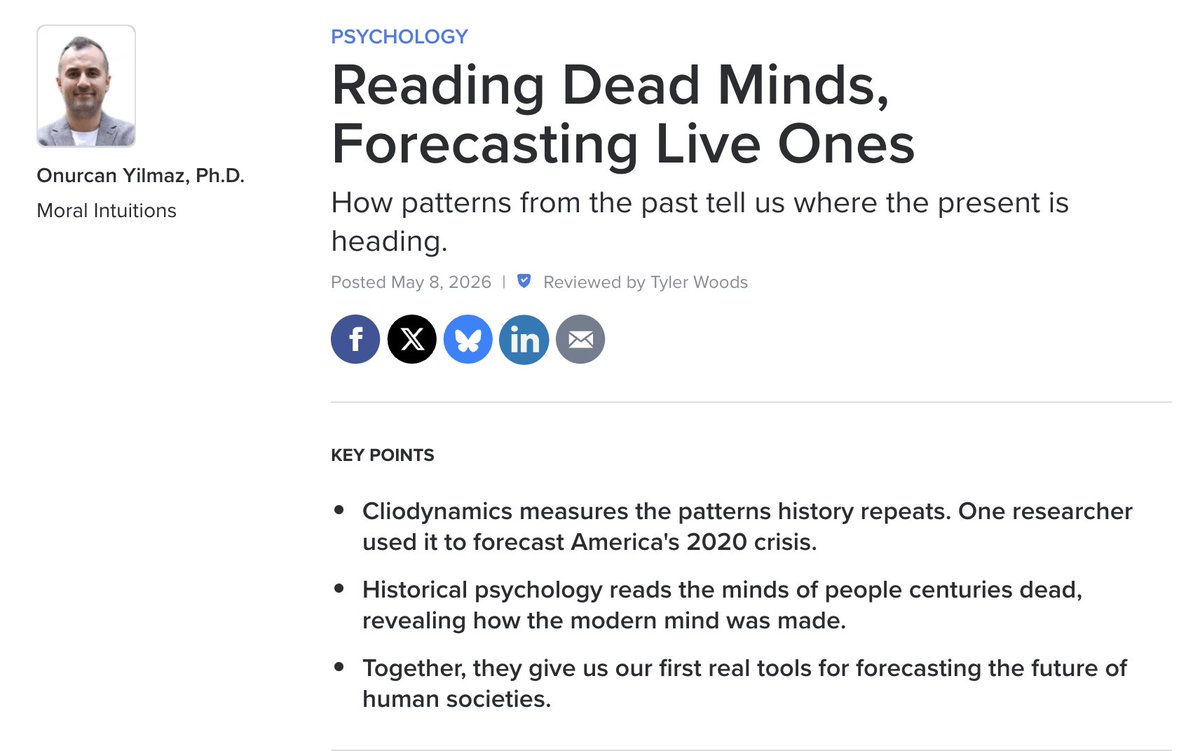
Why this matters beyond the academy. Cliodynamics (@Peter_Turchin's quantitative reading of historical patterns) anticipated the 2020 U.S. crisis a decade in advance and describes the structural pressure inside a society. Historical psychology describes how that pressure changes the way people think: why uncertainty pushes them toward simpler narratives, why misinformation and authoritarian rhetoric spread faster at some moments, not because people are irrational but because the conditions amplify shortcuts the mind already takes under stress. Understanding why is a precondition for designing interventions that work.
Wundt's separation gave psychology both rigor and provincialism. The chronospatial turn quietly closes that gap.
Full piece on @PsychToday 👇
https://t.co/HBlodrJJpB
New pieces in your inbox (free): https://t.co/PLGwVHVIqR
Here's more cool stuff you can do with Moral Foundations Theory: quantify the degree to which LLMs are wrong in their estimations of morality in various cultures.
This is important to know as AIs operate in our morally varied world.
From Alia Zawail, Alexandra Figueroa, Jesse Graham, & Mohammad Atari
https://t.co/Heb6Gb54UJ
Happening this Thursday:
Historical Psychology preconference at #SPSP2026
We look forward to seeing you!
Welcome note by @MohammadAtari90 at 8:00am.
Data blitz:
Chayce Baldwin
Nava Caluori
Nick Kay
Rui Pan
Allon Vishkin
Plamen Akaliyski
Meriel Burnett
Featured Talks:
🚨🚨🚨 New paper alert!
"Public Speakers With Nonnative Accents Garner Less Engagement" -- now out in Psych Science!
This is my first graduate student's first first-author paper (and it was her first-year project).
Short THREAD on the results:
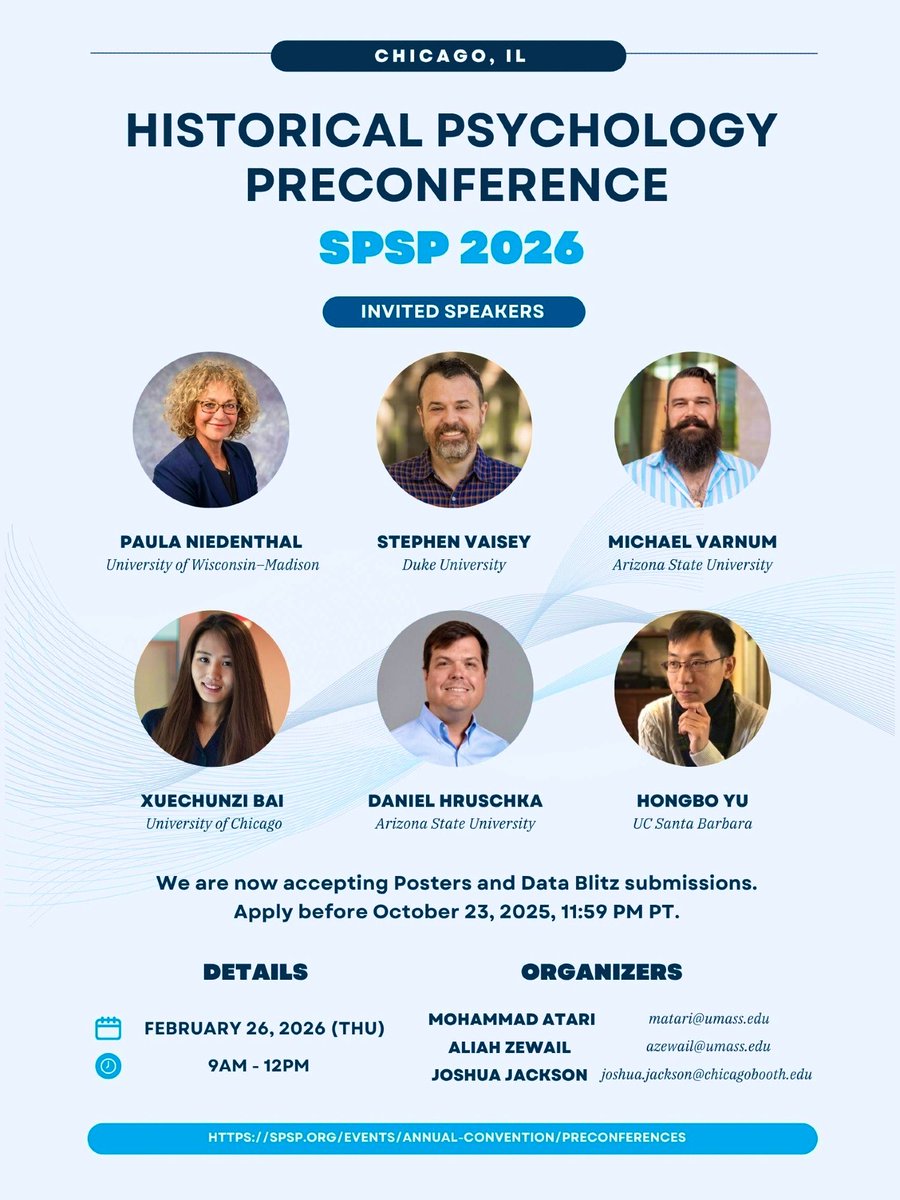
🚨Historical Psych Pre-conference at #SPSP2026
Submit your poster or data blitz abstract by Oct. 23,link below. We especially encourage early-career researchers to submit.
Any research on psychological change, cultural evolution,or historical context of social psych is welcome!
🚨Historical Psych Pre-conference at #SPSP2026
Submit your poster or data blitz abstract by Oct. 23,link below. We especially encourage early-career researchers to submit.
Any research on psychological change, cultural evolution,or historical context of social psych is welcome!
🚨 New Chapter Preprint: Is Empathic AI Possible?
W/ @firat_sekr & Aliah Zewail
Many AI researchers treat empathy as something to engineer into machines. But empathy is shaped by culture and context. We must first accept that there is no single "human" empathy.
@cam_lab_umass
Congrats to HBES Rising Star Mohammad Atari, for his work on the intersection of culture, evolution, and morality, particularly how social structures and immediate contextual cues impact people’s moral judgment and acceptance of social norms: https://t.co/Tdw4ezyMpu