“Loop engineering” is a hot buzzphrase after mentions of it by Boris Cherny (Claude Code’s creator) and Peter Steinberger (OpenClaw's creator) went viral on social media. Loops are now a key part of how we get AI agents to iterate at length to build software. In this letter, I’d like to share my 3 key loops, shown in the image below, for building 0-to-1 products. These loops guide not just how I build software, but also how I decide what software to build.
Agentic coding loop: Given a product specification and optionally a set of evals (that is, a dataset against which to measure performance), we can have an AI agent write code, test its work, and keep iterating until the code is bug-free and meets its specification. This idea of closing the loop took off around the end of last year, and it has been a game changer in enabling coding agents to work longer productively without human intervention. For example, over the weekend, I was building an app for my daughter to practice typing, and my coding agent could easily work for around an hour, using a web browser to check what it had built multiple times before getting back to me, without needing my intervention.
The engineering loop executes quickly. Every few minutes, the coding agent might build and test a new version of the software. I hear frequently from developers who are finding new ways to engineer more effective engineering loops. This is an active area of invention!
Developer feedback loop: In this loop, a developer examines the current product and steers the coding agent to improve it. Last year, a lot of developers (including me) were acting as the QA (quality assurance) function for our coding agents, manually finding bugs and then asking the agent to fix them. But with coding agents much more able to test their own code, the amount of time we need to spend on this function has decreased significantly. This allows us to make higher-level product decisions, such as what key features to offer, where the UI needs improvement, and so on.
The developer-feedback loop operates over time intervals between tens of minutes and hours — that's how frequently a developer might review a product and give feedback. In the case of the typing app, I changed my mind a few times about the visual design, what cat costumes she can unlock as she learns (she loves cats), and the user flow for a grown-up to log in and steer the child's learning experience.
When a developer has a clear vision for what to build, it is still a lot of work to translate that vision into a specification for a coding agent to implement. Further, after the developer has seen an implementation, they might update (or perhaps clarify) the spec to steer it toward what they want. If you find that the system repeatedly runs into certain problems, building a set of evals for the agent becomes useful.
AI-native teams are increasingly using AI to help shape product direction, for example, automating the gathering and analysis of usage data, summarizing written and verbal customer feedback, or carrying out competitive analysis. However, for pretty much all the products I’m involved in, I see humans as having a significant context advantage over current AI systems — we know a lot more than the AI system about the users and the context the product has to operate in — and thus humans play a critical role. Many people describe this human contribution as “taste,” but I prefer to think of it as humans having a context advantage, since that gives us a clearer path to helping AI systems get better. This also speaks to why this step can’t be automated: So long as the human knows something the AI does not, human-in-the-loop is needed to to inject that knowledge into the system.
External feedback loop: This includes a wide range of tactics like asking a few friends for feedback, launching to alpha testers, or putting the code into production with A/B testing. These tactics are usually slow, rarely taking less than hours and sometimes taking days or even weeks. This data informs the developer vision, which in turn continues to drive the detailed product spec, which in turn drives the coding agent.
With coding agents speeding up software development, more engineers are starting to play a partial product management role. For many engineers who are growing into this role, the hardest part is shaping the product vision and striking a balance between building (bridging the gap between vision and spec) and getting user feedback to evolve the vision. It is important to do both!
I will write more about how to do this in future posts, but for now, I find it encouraging that engineers are playing an expanded role (just as product managers and designers now do more engineering).
[Original text: The Batch]
Instead of watching an hour of Netflix, watch this 2 hour hour Stanford lecture will teach you more about how LLMs like ChatGPT and Claude are built than most people working at top AI companies learn in their entire careers.
oh yeah i should have linked autoresearch probably
https://t.co/YCvOwwjOzF
(you don't "use it" directly, it's just a recipe/idea - give it to your agent and apply to what you care about.)
and the tweet about it that went mini-viral over the weekend with more context
https://t.co/q5eWsvx5p2
I'm Boris and I created Claude Code. I wanted to quickly share a few tips for using Claude Code, sourced directly from the Claude Code team. The way the team uses Claude is different than how I use it. Remember: there is no one right way to use Claude Code -- everyones' setup is different. You should experiment to see what works for you!
Whether you like it or not, the future of AI will not be canned genies controlled by a "safety panel". The future of AI is democratization. Every internet rando will run not just o1, but o8, o9 on their toaster laptop. It's the tide of history that we should surf on, not swim against. Might as well start preparing now.
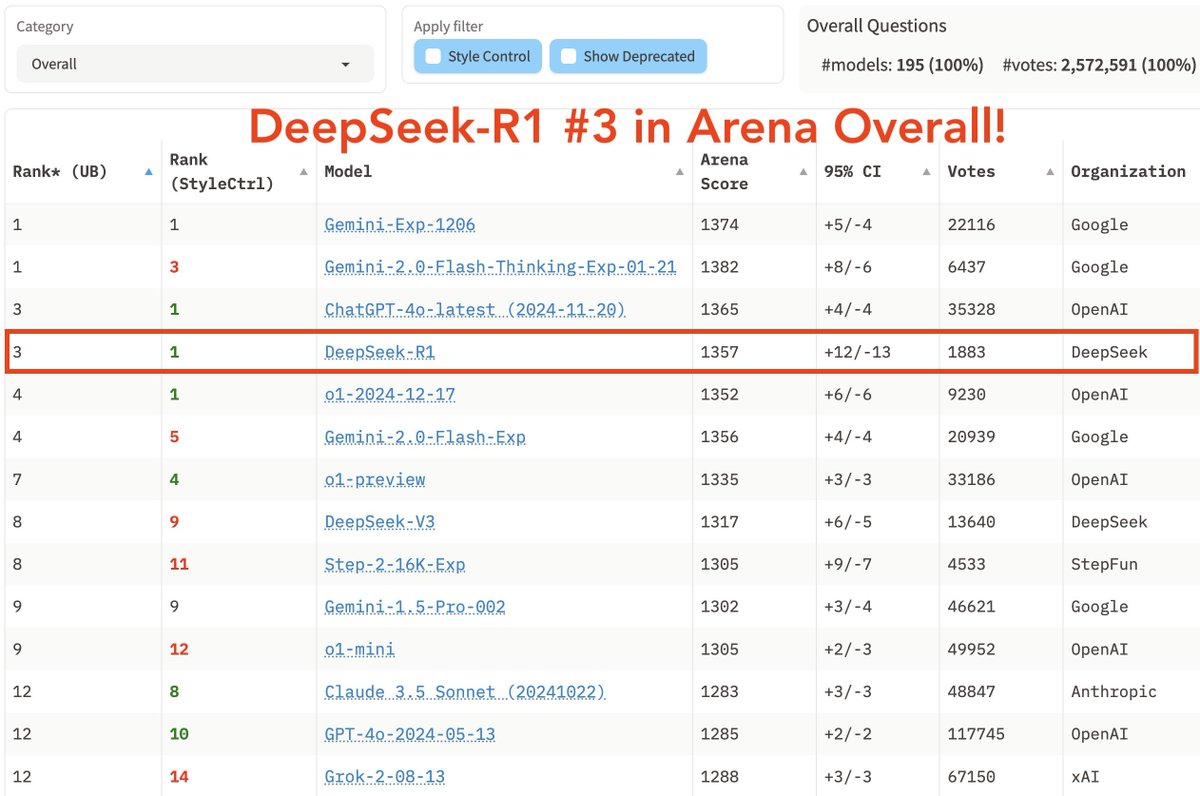
DeepSeek just topped Chatbot Arena, my go-to vibe checker in the wild, and two other independent benchmarks that couldn't be hacked in advance (Artificial-Analysis, HLE).
Last year, there were serious discussions about limiting OSS models by some compute threshold. Turns out it was nothing but our Silicon Valley hubris. It's a humbling wake-up call to us all that open science has no boundary. We need to embrace it, one way or another.
Many tech folks are panicking about how much DeepSeek is able to show with so little compute budget. I see it differently - with a huge smile on my face. Why are we not happy to see *improvements* in the scaling law? DeepSeek is unequivocal proof that one can produce unit intelligence gain at 10x less cost, which means we shall get 10x more powerful AI with the compute we have today and are building tomorrow. Simple math! The AI timeline just got compressed.
Here's my 2025 New Year resolution for the community:
No more AGI/ASI urban myth spreading.
No more fearmongering.
Put our heads down and grind on code.
Open source, as much as you can.
Acceleration is the only way forward.
Took a while to figure out how to run Docker on Apple Silicon macOS. Here's what worked for me: https://t.co/NhUg337inr Colima and Lima indeed simplify the process a lot 💕
We remain committed to our partnership with OpenAI and have confidence in our product roadmap, our ability to continue to innovate with everything we announced at Microsoft Ignite, and in continuing to support our customers and partners. We look forward to getting to know Emmett Shear and OAI's new leadership team and working with them. And we’re extremely excited to share the news that Sam Altman and Greg Brockman, together with colleagues, will be joining Microsoft to lead a new advanced AI research team. We look forward to moving quickly to provide them with the resources needed for their success.
Instant dubbing + lip sync with @HeyGen_Official
80% of the worlds population does not speak English.
Having the ability to not only voice clone and dub your content into more languages but also do lip sync is a game changer!
Below I (AI) speak 8 languages...
🧵 A thread
#LK99 아카이브에 공개한 논문의 진위 여부를 검증한다는 건 정말 터무니 없는 소리.
1. 아카이브에 공개한 논문은 누구나 자유롭게 재현성 실험하고 자기가 그 논문에 근거 하여 발전된 연구를 할 수도 있음, 즉, 아카이브에 올라온 순간 ‘불특정 다수 동료들이 검토’를 하는 ‘피어 리뷰’임. 외려 2-4 정도 리뷰어에 의해 ‘피어 리뷰’받고 리비전하고 해서 게재 승인됐다 해서 끝이 아님, 레가시 방식 논문 투고, 피어 리뷰 후 게재 승인되는 거랑 달리, 아카이브에 공개된 건 ‘불특정 다수의 동료’에게 피어 리뷰 받는 거임.
2. 전세계적으로 여기저기서 ‘피어 리뷰’ 중인데 유독 우리나라에서만 ‘피어 리뷰’ 후 게재 승인 받은 게 아니라 회의적이란 소리 나오더니 ‘검증’ 위원회 구성 운운하며 마치 연구 비위 때려 잡듯 나댐, 세상이 미친 거 같음, 그리고 검증할테니 샘플 혹은 시편 내놓으라 함. 이건 뭐 범죄자 취급임.
이런 황당한 상황에서 우리나라의 검증 드립은 무시하고 세계 각국에서 진행 중인 ‘복수 개의 피어 리뷰‘ 결과를 즐거운 마음으로 지켜 보면 됨.








![AndrewYNg's tweet photo. “Loop engineering” is a hot buzzphrase after mentions of it by Boris Cherny (Claude Code’s creator) and Peter Steinberger (OpenClaw's creator) went viral on social media. Loops are now a key part of how we get AI agents to iterate at length to build software. In this letter, I’d like to share my 3 key loops, shown in the image below, for building 0-to-1 products. These loops guide not just how I build software, but also how I decide what software to build.
Agentic coding loop: Given a product specification and optionally a set of evals (that is, a dataset against which to measure performance), we can have an AI agent write code, test its work, and keep iterating until the code is bug-free and meets its specification. This idea of closing the loop took off around the end of last year, and it has been a game changer in enabling coding agents to work longer productively without human intervention. For example, over the weekend, I was building an app for my daughter to practice typing, and my coding agent could easily work for around an hour, using a web browser to check what it had built multiple times before getting back to me, without needing my intervention.
The engineering loop executes quickly. Every few minutes, the coding agent might build and test a new version of the software. I hear frequently from developers who are finding new ways to engineer more effective engineering loops. This is an active area of invention!
Developer feedback loop: In this loop, a developer examines the current product and steers the coding agent to improve it. Last year, a lot of developers (including me) were acting as the QA (quality assurance) function for our coding agents, manually finding bugs and then asking the agent to fix them. But with coding agents much more able to test their own code, the amount of time we need to spend on this function has decreased significantly. This allows us to make higher-level product decisions, such as what key features to offer, where the UI needs improvement, and so on.
The developer-feedback loop operates over time intervals between tens of minutes and hours — that's how frequently a developer might review a product and give feedback. In the case of the typing app, I changed my mind a few times about the visual design, what cat costumes she can unlock as she learns (she loves cats), and the user flow for a grown-up to log in and steer the child's learning experience.
When a developer has a clear vision for what to build, it is still a lot of work to translate that vision into a specification for a coding agent to implement. Further, after the developer has seen an implementation, they might update (or perhaps clarify) the spec to steer it toward what they want. If you find that the system repeatedly runs into certain problems, building a set of evals for the agent becomes useful.
AI-native teams are increasingly using AI to help shape product direction, for example, automating the gathering and analysis of usage data, summarizing written and verbal customer feedback, or carrying out competitive analysis. However, for pretty much all the products I’m involved in, I see humans as having a significant context advantage over current AI systems — we know a lot more than the AI system about the users and the context the product has to operate in — and thus humans play a critical role. Many people describe this human contribution as “taste,” but I prefer to think of it as humans having a context advantage, since that gives us a clearer path to helping AI systems get better. This also speaks to why this step can’t be automated: So long as the human knows something the AI does not, human-in-the-loop is needed to to inject that knowledge into the system.
External feedback loop: This includes a wide range of tactics like asking a few friends for feedback, launching to alpha testers, or putting the code into production with A/B testing. These tactics are usually slow, rarely taking less than hours and sometimes taking days or even weeks. This data informs the developer vision, which in turn continues to drive the detailed product spec, which in turn drives the coding agent.
With coding agents speeding up software development, more engineers are starting to play a partial product management role. For many engineers who are growing into this role, the hardest part is shaping the product vision and striking a balance between building (bridging the gap between vision and spec) and getting user feedback to evolve the vision. It is important to do both!
I will write more about how to do this in future posts, but for now, I find it encouraging that engineers are playing an expanded role (just as product managers and designers now do more engineering).
[Original text: The Batch]](https://pbs.twimg.com/media/HMEtxp3bsAARJdi.jpg)


