CAMO is a leading research center on how AI transforms organizations, management & work. Based in Hong Kong, we bridge East & West in the global AI shift.
🚀 𝗔𝗜 𝗶𝗻 𝗔𝗰𝘁𝗶𝗼𝗻: 𝗔𝗜 𝗜𝗻𝗱𝘂𝘀𝘁𝗿𝘆 𝗦𝗲𝗺𝗶𝗻𝗮𝗿 𝟮𝟬𝟮𝟲 — From Practice to Value
How can enterprises move beyond AI pilots and turn implementation into real, scalable business value?
Jointly initiated by our AI Implementation Lab, @Official_CRSHK 华兴资本, InnoX Shenzhen, and Cheung Kong Graduate School of Business, this seminar brings together business leaders, AI solution providers, investors, and industry practitioners to explore how AI can be integrated into core operations, scaled across organisations, and translated into sustainable business value.
The seminar will be conducted primarily in Mandarin.
📅 Date: 16 September 2026
📍 Venue: HKU Business School Shenzhen Campus, Futian District, Shenzhen
🎫 Attendance: By invitation, with a limited number of places available through public registration.
Interested in joining the conversation?
Scan the QR code to register your interest by sharing your industry background and areas of focus. Public registrations will be reviewed by the organising committee, and selected applicants will receive confirmation.
#AIinAction #AIIndustryForum #EnterpriseAI #AIImplementation #BusinessTransformation
As AI adoption accelerates across industries, enterprises are increasingly moving from asking whether AI can work to determining how it can be implemented effectively.
The seminar will focus on some of the most pressing questions facing business leaders and decision-makers today:
🤖 How can enterprises develop and deploy AI Agents in real business environments?
🔄 How can AI reshape organisational workflows and operating models?
💡 How can technology, products, and business needs be effectively aligned?
🏢 What organisational challenges and strategic opportunities emerge as AI becomes part of everyday operations?
📈 How can enterprises move from experimentation to scalable, sustainable business value?
The seminar is primarily designed for 𝗰𝗼𝗺𝗽𝗮𝗻𝘆 𝗰𝗵𝗮𝗶𝗿𝘀, 𝗖𝗘𝗢𝘀, 𝗮𝗻𝗱 𝘀𝗲𝗻𝗶𝗼𝗿 𝗱𝗲𝗰𝗶𝘀𝗶𝗼𝗻-𝗺𝗮𝗸𝗲𝗿𝘀 from enterprises with genuine AI implementation needs and clearly defined use cases.
Many of the organisations currently in discussion about participation are listed companies and industry leaders in Mainland China.
By connecting enterprises undergoing digital transformation with AI technology companies, solution providers, investors, and experienced industry practitioners, the seminar aims to facilitate practical exchanges around real business needs, real-world implementation, and measurable outcomes.
🚀 𝗔𝗜 𝗶𝗻 𝗔𝗰𝘁𝗶𝗼𝗻: 𝗔𝗜 𝗜𝗻𝗱𝘂𝘀𝘁𝗿𝘆 𝗦𝗲𝗺𝗶𝗻𝗮𝗿 𝟮𝟬𝟮𝟲 — From Practice to Value
How can enterprises move beyond AI pilots and turn implementation into real, scalable business value?
Jointly initiated by our AI Implementation Lab, @Official_CRSHK 华兴资本, InnoX Shenzhen, and Cheung Kong Graduate School of Business, this seminar brings together business leaders, AI solution providers, investors, and industry practitioners to explore how AI can be integrated into core operations, scaled across organisations, and translated into sustainable business value.
The seminar will be conducted primarily in Mandarin.
📅 Date: 16 September 2026
📍 Venue: HKU Business School Shenzhen Campus, Futian District, Shenzhen
🎫 Attendance: By invitation, with a limited number of places available through public registration.
Interested in joining the conversation?
Scan the QR code to register your interest by sharing your industry background and areas of focus. Public registrations will be reviewed by the organising committee, and selected applicants will receive confirmation.
#AIinAction #AIIndustryForum #EnterpriseAI #AIImplementation #BusinessTransformation
This is an important point: (applied) economic theory can play a valuable role in anticipating the potential consequences of AI by combining models of trade-offs we already know matter with emerging facts about AI.
We have created a micro-site for Messy Jobs, at https://t.co/6kQuA00d8Y, were you can find Part I of the book in open access, and an experimental feature, that we will be enriching with data, helping you determine how "Messy" your job is.
Enjoy!
https://t.co/hpcabDIKrk
Highly recommended!
"Messy Jobs: The Work That AI Cannot Reach" by Luis Garicano, Jin Li, and Yanhui Wu.
"Economists Luis Garicano, Jin Li, and Yanhui Wu offer a new framework for thinking about AI and work. They show why some roles will disappear, why others will be reshaped, and why many of the most valuable forms of human work will endure. Along the way, they explain how AI changes careers, firms, and the wider economy. AI will automate many tasks, the authors say, but jobs are more than tasks. Jobs are bundles of judgment, coordination, accountability, tacit knowledge, and human relationships. When tasks are tightly bundled within a job, AI will be less able to eliminate it."
https://t.co/2z3V00M8bW
Behind all the ideas on AI and the future of work is something deeply personal: a hope to build a more friendly future for the next generation.
Happy Father’s Day 💙 And excited to celebrate this milestone today. 📚
Read more: https://t.co/p2thdYUsTe
Today, we celebrate two things 🎉
The launch of the book “Messy Jobs: The Work That AI Cannot Reach” and Father’s Day 🥂
The book begins with a line that means a lot to the authors and us:
⏰ 5 days to go!
Co-hosted with @hkuicube, our June 21 "Messy Jobs: The Work That AI Cannot Reach" Book Launch & Networking Reception is around the corner !
📅 21 June 2026 | 4:00 – 6:00 PM HKT
📍 HKU iCube, Two Exchange Square, Central
🎟️ Invitation only — interested? Drop us a DM.
Where does AI stop and where do YOU become irreplaceable? For more details : https://t.co/gxCvU3Qrbp
#MessyJobs #HKU #CAMO #BookLaunch #FutureOfWork #AI
Delighted to tell you that Messy Jobs is coming out on June 21st. The kindle preorder link is available!
Here are advance reviews/blurbs for you to ponder by @raffasadun@davidautor@patrickc@alexolegimas@bengtmit and Evan Guo.
"Messy Jobs is a brilliant application of price theory. AI changes what is scarce in the economy and therefore what is valuable. When intelligence becomes cheap, judgment, coordination, trust, and responsibility become more valuable. The authors use this simple, powerful logic to illuminate how AI will reshape work and organizations." Bengt Holmström, Paul A. Samuelson Professor of Economics at MIT and recipient of the 2016 Nobel Memorial Prize in Economic Sciences
"In Messy Jobs, Garicano, Li, and Wu bring the discipline of organizational economics to a question too often left to speculation: How will AI actually reshape work? They move past the usual debates about what AI can or cannot do and ask the harder questions. What shapes the incentives to adopt it? How does adoption reshape the incentives to learn? What new configuration of skills will emerge as AI advances? A rigorous, original, and engaging account of how AI will reshape organizations and labor markets, and what it will take to thrive in them." - Raffaella Sadun, Charles Edward Wilson Professor of Business Administration, Harvard Business School
"This is the first book in the AI era that recognizes that most of what organizations struggle with does not involve computational problems. People in messy jobs must hold coalitions together, adjudicate between competing interests, and make change stick. These are political, diplomatic, and interpersonal challenges. As a result, these types of messy jobs will persist well into our AI future. Garicano, Li, and Wu, are neither techno-utopian nor techno-dystopian. They take seriously what machines can do, what humans will do, and how jobs will be rebundled. The economics analysis is lucid and penetrating, and the book pinpoints where human agency will remain paramount. The book is hopeful and practical for anyone charting a career in the coming decade." - David Autor, Daniel (1972) and Gail Rubinfeld Professor, Google Technology and Society Visiting Fellow, Margaret MacVicar Faculty Fellow, MIT Department of Economics
"This is simply a must-read book if you are interested in the future of work in the age of AI. For decades, Luis Garicano has been a leading voice in how organizations morph and change with new technology and innovation. Together with Jin Li and Yanhui Wu, they have written the definitive text on how AI will affect the labor market. The book is an impressive feat of combining academic rigor with clear explanations and concrete examples. I would recommend this book to anyone interested in learning about what comes next. "- Alex Imas, director of AGI Economics, Google DeepMind, and the Roger L. and Rachel M. Goetz Professor of Behavioral Science, Economics, and Applied AI, and Vasilou Faculty Scholar at the University of Chicago Booth School of Business
"There is a lot of woolly thinking on the topic of AI and jobs. This excellent book contains by far the most thoughtful and economically literate account that has yet been written." - Patrick Collison, CEO, Stripe
"AI is not going to lead to mass unemployment, and this is the best book to explain why not. It also illuminates how labor markets are likely to evolve. It is short, to the point, eminently readable, and of extreme relevance. ""- Tyler Cowen, professor of economics at George Mason University
"This book isn't just some economist's armchair theorizing; it's a practical guide. I hope you get as much out of it as I did. "-- Evan Guo, CEO of Zhaopin Group, the largest career development platform in China
https://t.co/L7UM3bHHYO
Looking good! Messy jobs is the Number 1 release in the US in Careers and Job Hunting! Read it for the career advice and absorb the economics for free, or, even better, read it for the economics and walk out with a job ;-).
https://t.co/QEuw0Yvzlv
This is an invitation-only event. If you're interested in attending, drop a comment below or email us at [email protected] and we'll reach out to you directly. ✨
🚨 NEW EVENT
"𝗠𝗲𝘀𝘀𝘆 𝗝𝗼𝗯𝘀: 𝗧𝗵𝗲 𝗪𝗼𝗿𝗸 𝗧𝗵𝗮𝘁 𝗔𝗜 𝗖𝗮𝗻𝗻𝗼𝘁 𝗥𝗲𝗮𝗰𝗵", co-authored by scholars from the LSE and our Centre, is set to publish soon. We're co-hosting a 𝗕𝗼𝗼𝗸 𝗟𝗮𝘂𝗻𝗰𝗵 & 𝗡𝗲𝘁𝘄𝗼𝗿𝗸𝗶𝗻𝗴 𝗥𝗲𝗰𝗲𝗽𝘁𝗶𝗼𝗻 with @hkuicube on Jun 21.
#CAMO Quote💬
Firms are intentionally stripping away judgment and responsibility to settle for "good enough" standardized output. The real threat isn't #AI taking your job. 𝗜𝘁'𝘀 𝗔𝗜 𝗺𝗮𝗸𝗶𝗻𝗴 𝘆𝗼𝘂𝗿 𝗷𝗼𝗯 𝘄𝗼𝗿𝘀𝗲.
Read full paper : https://t.co/x4eynswyso
We have a new @camo_hku paper out (with Jin Li and @chang_sun_econ): "Toward a Bad Job Economy: AI Adoption, Agency Costs, and Job Design." We show that AI may not just replace jobs; it may make the jobs that remain worse.
Memorable presentation today by @Afinetheorem at @camo_hku. Not only because of super interesting paper (human verification of AI output important but costly, thus subject to econ tradeoffs & for determining "optimal" AI), but also because of innovative & interactive format ;)
Famously (there is a beautiful Works in Progress piece on this) in 2016, Geoffrey Hinton told an audience in Toronto that medical schools should stop training radiologists, since AI would soon outperform them at reading scans. Ten years later, there are more radiologists than ever, and they earn more than they did then.
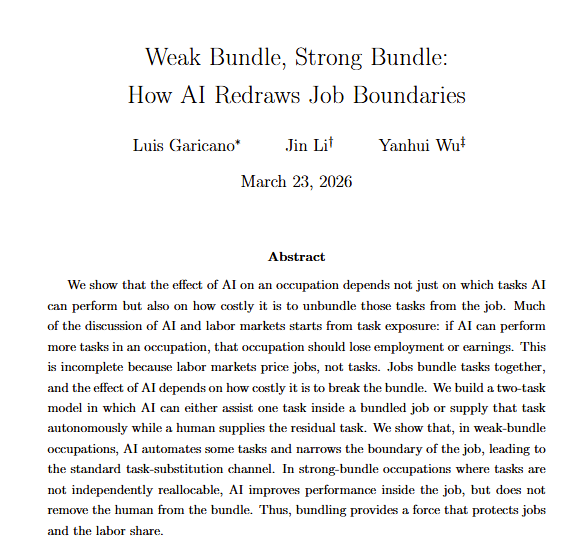
Hinton was right about the task, but he was wrong (so far!) on the future of the radiology profession. Times have never been better for them. The gap between those two claims, the difference between tasks and jobs, is the subject of a paper I have written with Jin Li and Yanhui Wu, and that we release today: "Weak Bundle, Strong Bundle: How AI Redraws Job Boundaries." (Very relatedly we are also finishing the first draft of our book "Messy Jobs" on AI and Jobs!! You will be the first to hear).
We start from the observation that the growing literature on AI and labor markets measures the AI shock by task exposure: people count how many tasks AI can perform in a given occupation AI can perform, and infer that more exposure means more displacement. Eloundou et al. published a paper in Science in 2024 that started this literature, and many follow the same logic. The inference they make is that the more exposed tasks, the worse the outcomes.
This is incomplete, because labor markets price jobs, not tasks. A radiologist does not just sell image classification, but does many other jobs: triages cases, communicates with other physicians, trains residents, makes the difficult decisions, and signs a diagnosis. The market buys a bundled service. The question AI poses is not whether it can do one task inside the bundle. The question is whether that task can be pulled out.
Thread (1/3)
https://t.co/wEYMfjGbeX
🦞 Calling all #OpenClaw builders, tinkerers, & #AI makers!
Meet others pushing their lobsters beyond prototypes — sharing the workflows, wins, and hard lessons of building real AI-driven value 🦾
🗓 Mar 28, 2–5PM | HKU iCube
💡 Free reg: https://t.co/71mxIB4gyE
#HKUCAMO