Tiffany has been on crystal meth for nine years. For the last four months she's been selling it too. Her whole family showed up to save her on camera. Before the day was over, the police had been called. Three days later she was arrested with meth on her.
She sits in front of the camera with a red bandana in her hair. Then the family takes turns: her mother, her grandmother, two brothers, her stepfather. In between, the old photos: Tiffany as a smiling baby, Tiffany at family birthdays, years before any of this.
Her parents divorced when she was 11. Two years before the cameras showed up, her boyfriend broke up with her. By then meth had been part of her life for years, and by the time A&E filmed her she wasn't just using it. She was dealing it.
The intervention was set up near the courthouse. Her family waited for her down the street and sat her down with all of them in one room. It didn't stay in that room. It ended outside, on the street, with her relatives around her and the police on their way.
The episode ends with one line on a black screen. Three days after the intervention, Tiffany was arrested for possession of crystal meth and moved back in with her grandparents.
Her family got one day with her. The police got her three days later.
Can a family's love actually pull someone out of nine years of meth, or does it only work once the person hits bottom on their own?
He slapped her so hard her ears rang. Then he beat her head against the floor until her face was covered in blood, choked her unconscious twice and held her head in a toilet so she couldn’t breathe
He wasn’t a stranger. He was a porn star she called a friend
Jessie Rogers was a young porn star on the rise. She had been to his place before. Several times. Never on camera, just hanging out
That night started like the others
She walked in. He looked angry
“You’re late.”
Then the first slap. She hit the floor
Everything after that happened fast. She remembers being in a daze while he slammed her head down again and again. Her face started bleeding. He kept going
She asked him to slow down. She asked him to stop
“You’re fine, babe.”
He choked her until she blacked out. When she came to, he did it again
Then he pushed her head into his toilet. Every time she tried to come up for air, he pushed her back down
“I thought I was going to die, honestly.”
The warning signs had been there for a while. Before that night, a syphilis outbreak hit the industry. The man who spread it was no beginner. He had been working for more than eight years, and he kept shooting with other performers
She and her roommate had talked about quitting. More than once. They stayed
Until 4 a.m. that night, when she was driving home alone and asking herself one question:
“Why am I hanging out with these type of people?”
She quit. Her roommate quit too
Years later she tells the story on camera, fit and done with that world. Halfway through she has to stop. “It’s hard for me to talk about it in detail.”
Then she says the strangest part
She’s thankful for that night. Because it woke her up
A man nearly killed her, and that’s what it took to get her out
So was he one monster, or just the one who finally showed her what that industry really is?
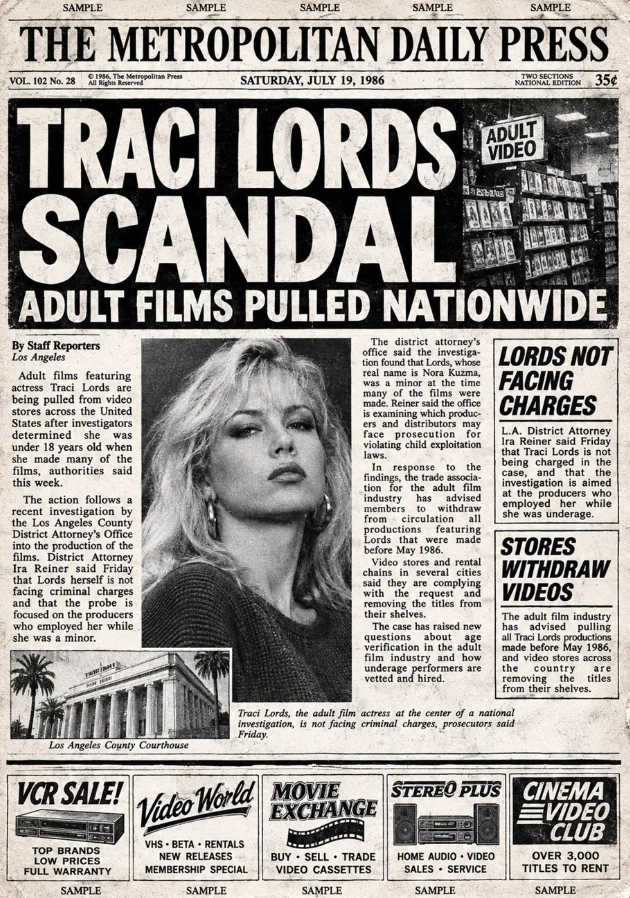
Traci Lords was one of the most famous names in the adult industry by 1986. Then investigators found out she had been a minor for almost all of it. She was 15 when she started, with a fake ID. Overnight nearly every film she made became illegal. Stores pulled them nationwide.
Her real name was Nora Kuzma. She was born in Steubenville, Ohio, in 1968. After her parents split up, her mother moved the kids to Los Angeles. As a young teen she got hold of a fake birth certificate and a California driver's license that said she was 20.
With that ID she walked into an agency in the San Fernando Valley. Nobody checked further. Within two years she was on magazine covers and in dozens of films. Her name sold videotapes all over America, and the money went to the producers and distributors.
In May 1986, just after her 18th birthday, the truth came out. The Los Angeles County District Attorney's office found that she had been under 18 when almost all of her work was made. Overnight, every one of those tapes was legally child exploitation material. The industry's own trade association told members to pull everything made before May 1986.
Video stores and rental chains across the country emptied their shelves. District Attorney Ira Reiner said Traci herself would not be charged, because the law saw her as the victim. The investigation went after the agents, producers and distributors who had hired her. In the end, almost none of them went to prison. Courts ruled they could argue they had been fooled by her ID.
She walked away from the industry and spent years trying to be taken seriously. John Waters cast her in Cry-Baby in 1990. She got roles on Melrose Place and other shows and released music. In her 2003 memoir she wrote about the abuse in her childhood and said she had been a lost kid nobody protected.
Half the internet says she lied about her age and fooled an entire industry. The other half says a 15-year-old should never have been able to. Almost nobody talks about the fact that the age-verification records every studio in America still has to keep exist because of her.
She broke the law to get in. The law said she was the only one who couldn't be guilty.
Was Traci Lords a teenage con artist who fooled everyone, or a 15-year-old girl that a whole industry chose not to look at too closely?
Kristin used to help people buy homes in one of the richest counties in America. Then a judge took her child away. Now she's 44, sleeping on the streets of Irvine, smoking the second she wakes up and taking a cut from shoplifters just to survive.
Her old life was in Orange County, one of the richest parts of California. She says the old days were boring, a good kind of boring, the kind you only miss once it's gone. She worked in mortgages and made good money doing it. Drugs weren't part of the picture. She calls her addiction a newer thing.
What broke it was court. She lost custody of her child, and she says she didn't know how to deal with the pain, so she found something to numb it. She can't even remember exactly who first put the drugs in front of her. Now she lives outside in the same county where she used to arrange home loans.
The money now comes from the street economy. She works between boosters, the people who steal from stores, and fences, the people who buy what they take, and she keeps a percentage. Her day starts at around 5:45 in the morning, and the first thing she does, she says, is smoke.
She talks about what she has seen out there without much emotion. The man she was with was shot in the leg. People around her overdose constantly. She says people on the street won't go to the police for help, and most are too afraid to even ask. She still says she wants out, and that one day she wants to help the people living the way she does now.
At the end she tries to tell anyone listening to appreciate their family and the smallest things they have. She doesn't manage to finish the sentence.
She lost her child in a courtroom. She lost everything else on the street.
Is Kristin's story about drugs, or about how close anyone is to losing everything after one bad day in court?
Sarah's modeling photos look like magazine covers. Her arrest photo doesn't. It started with leftover Vicodin from dental surgery, taken to curb her appetite. By the time A&E found her, she was spending up to $300 a day on drugs and people online were telling her to die.
A&E's Intervention filmed her when the modeling career was already over. The episode opens with the photo shoots: posed, polished, the kind of pictures a family frames and puts on the wall. Then it cuts to her booking photo. Her family sits in front of the camera one by one and tries to explain how one turned into the other.
The pills came first. After dental surgery there was Vicodin left in the cabinet, and Sarah found out it killed her appetite. She kept taking it. Then she met Mikey. Homesick, she talked him into moving to Bend, Oregon, so she could be close to her family again, and together they started buying prescription opiates in large amounts. The episode also puts on screen messages people sent her: people calling her a low life, telling her they hoped she'd go to hell, telling her they hoped she'd die.
When she was 21, Mikey went to rehab. Sarah refused to go with him and kept using. When he finished the program, he moved back to Los Angeles without her.
The intervention worked, at first. The update at the end of the episode says that for 59 days Sarah was in recovery and doing well. On day 60 she walked out of the treatment center and relapsed. The center took her back, and she left again. She was sent to a state facility and left that one after a few days. On June 28, 2022, she asked to go back to Kemah Palms in Texas. They agreed, on the condition that her family helped pay. She started detox that day.
She made it 59 days. The episode ends with her starting over again.
Do you think Sarah can still come back from this, or did the people telling her she was a lost cause already decide how her story ends?
May 7, 2024. Stormy Daniels took the stand in the same Manhattan courtroom as Donald Trump and described, in detail, the night she says they slept together in 2006. Trump was heard cursing under his breath. By lunch his lawyers were asking for a mistrial.
The front page above covers the day of her testimony in Trump's hush money trial. Prosecutors were trying to prove that the $130,000 his lawyer Michael Cohen paid Daniels before the 2016 election was hidden in Trump's business records. Daniels was their witness for why the money was paid in the first place. Trump has always denied the encounter happened.
On direct examination, prosecutor Susan Hoffinger walked her through the 2006 meeting, and her answers tested the limits the judge had set before trial. Judge Juan Merchan stepped in more than once and told the prosecution to move along, warning that some of the details were unnecessary. At one point he objected to her testimony himself.
After the lunch break, Trump's attorney Todd Blanche moved for a mistrial. He told the judge her account was very different from the one she gave in 2016 and called it extraordinarily prejudicial. "How can you unring the bell?" he asked. Merchan said the defense had a point, and denied the motion anyway.
In the afternoon she was asked about the money itself and about a threat she says she received in 2011. Then defense lawyer Susan Necheles began her cross-examination, going line by line through what Daniels had and hadn't included in her 2018 book and suggesting she was making the story up. It ran into the next court day.
Three weeks later, on May 30, 2024, a jury convicted Trump on all 34 counts of falsifying business records. He was sentenced in January 2025 to an unconditional discharge, meaning no jail, no fine and no probation, and was already president-elect.
She spent two days on the stand. The verdict came down to the paperwork.
Do you believe Stormy Daniels, or do you think the defense was right that her story kept changing?
Traci Lords was raped at 11 and ran away from home. At 15, with a fake ID, she became one of the most famous porn stars in America. When the truth about her age came out, almost every film she had made turned illegal overnight. She was never charged. She was the minor
She was born Nora Kuzma in Steubenville, Ohio. Her father drank, her parents split, and her mother took the girls to Los Angeles. In the interview she says the rape at 11 was the single most traumatic thing that ever happened to her, and that she carried the shame for years without telling anyone, not even her mother. She stopped speaking to her mother, ran away and, in her words, went through the whole thing
At 15 she got a driver’s license in another woman’s name and walked into an adult modeling agency in the Valley. Nobody looked twice. Within months she was in Penthouse, and studios started building films around her
She says she was very, very high for about three years, most of the time. Plenty of kids have sex and try drugs in high school, she says. The scandal was that a camera was rolling and she was 15 years old
In 1986, shortly after her 18th birthday, it all came out. Video stores across the country pulled her tapes off the shelves. Prosecutors went after the agent and the producers who had hired her. The only legal film left was the one she made after she turned 18
She got sober, took acting lessons and landed a lead in John Waters’ Cry-Baby next to Johnny Depp. In this interview she is promoting her first album, the one where she sang about the rape for the first time. She says her past cost her roles, and whatever she has built, she built in spite of it
At the end the interviewer asks if women in porn are victims or have only themselves to blame. She says no normal, healthy woman wakes up one morning and decides to become a porn star. Out of all the women she met in that industry, she says, every single one of them had baggage
She was 15 on camera, and 40 years later most people still know her as a porn star first
Was Traci Lords a rebellious teenager who lied her way in, or a 15-year-old rape survivor that a whole industry chose not to ask questions about?
Amanda is 24 and went to college at Cal State Northridge. Now she works the blade in Los Angeles, smokes crack and asks an interviewer if she should try heroin. Then she explains who decides when she has to quit: the sun and the government.
She was born in LA and grew up without her mother. Relatives took her in, and she says life with them was good. Now she's back living with her dad in a single room, him on the floor and her on the bed, and she tells the camera she thinks he's been spitting in her food. Her brother has autism. She enrolled at CSUN after high school.
Then the job search. She tried working at PetSmart and says she kept making mistakes and couldn't keep up. For about a year she has been working as a prostitute on the stretch of street in LA everyone calls the blade. Asked if she likes it, she shrugs: "It's all right."
She lists what she has tried: crystal, weed, crack. When heroin comes up, she says she feels like she needs to try it. The interviewer tells her she doesn't.
Then comes the last minute. She says she's been given an ultimatum to get off crack. When he asks who gave it to her, she answers calmly: the sun. And the government. They're watching what she does, she says. Then she laughs and says she's joking. Then she says it again.
She went from a college campus to a street corner, and the only ones she thinks are keeping an eye on her are the sun and the government.
Is this a woman who chose this life, or one who needed help a long time ago and never got it?
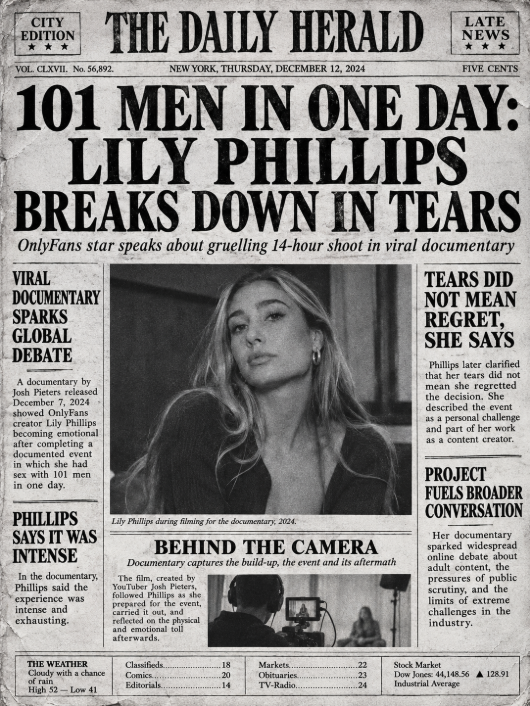
Lily Phillips was 23 when she spent 14 hours in a London Airbnb with 101 men, one after another, while a YouTuber filmed everything. When he asked her afterwards if it was more intense than she expected, she started crying. Then she announced her next goal: 1,000.
The front page above is from December 2024, the week Josh Pieters put his 47-minute documentary on YouTube and the internet found out what that day actually looked like. Phillips, from Derbyshire, had announced the stunt in October and asked for volunteers online. She ran it like a business, with a team of nine people on her payroll handling sign-ups, scheduling and filming.
On October 19 the shoot ran for about 14 hours. Her staff were overwhelmed, she skipped lunch, and afterwards she struggled to remember details of the day. When Pieters sat her down, she told him it wasn't for "the weak girls" and that she wasn't sure she'd recommend it. He asked if it had been more intense than she thought. She said "definitely" and broke down.
That clip is what went viral. Millions watched a young woman who had spent months insisting this was empowering suddenly admit she sometimes feels robotic. Half the comments called it a cry for help. The other half called it marketing.
Phillips pushed back on both. She told interviewers the tears were exhaustion, a bad day at work, not regret, and that her parents know exactly what she does. A few weeks later she said she was planning to do 1,000 men in a day and that the team had learned from the mistakes they made the first time.
She cried on camera once. It's the only part anyone remembers.
Was it a breakdown, or the best piece of marketing she ever made?
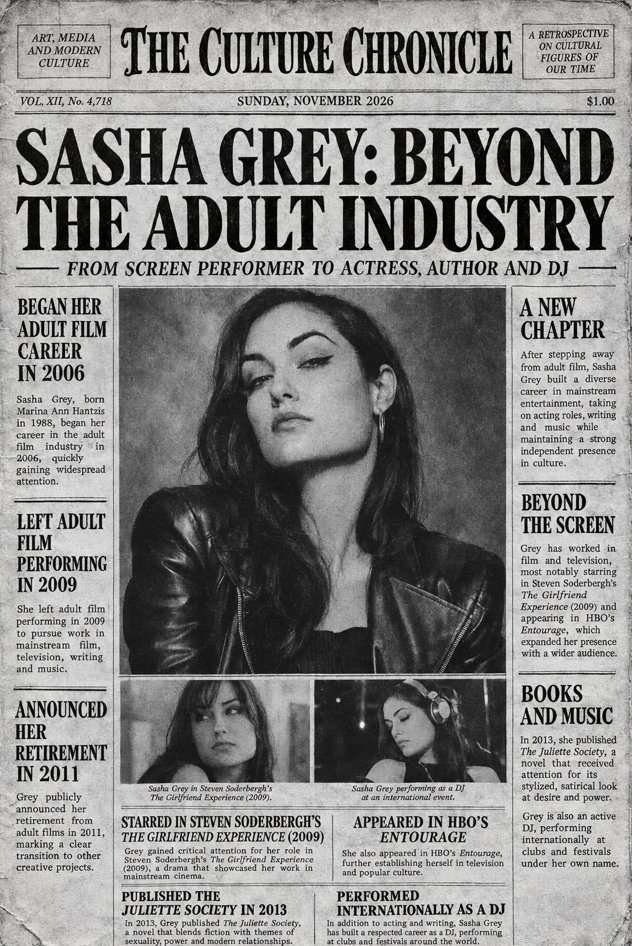
Sasha Grey entered porn weeks after turning 18 and became its biggest name almost overnight. Three years later Steven Soderbergh cast her as the lead in a Hollywood film. When she was invited to read to children at an elementary school, parents pulled their kids out of class.
The front page above covers how she got in and how she got out. Marina Ann Hantzis was born in 1988 in Sacramento. In 2006 she moved to Los Angeles with one plan, and she made no secret of it. She said in interviews that nobody pushed her into it. She wanted to be the most talked-about performer in the business, and within two years she was winning its top awards.
In 2009 she stopped. Soderbergh gave her the lead in The Girlfriend Experience, a small drama about a high-end escort in New York, and critics who had never heard her name started reviewing her acting. A year later she was on HBO playing herself in Entourage.
Not everyone moved on with her. In March 2010 she was invited to read to first-graders at a school in Compton as part of a national literacy day. When parents found out who she was, some kept their children home and the story went national.
In 2011 she officially announced she was done with adult film. She published a novel, The Juliette Society, in 2013, and built a second career as a DJ playing clubs and festivals around the world. These days she also streams video games online.
She left the industry more than fifteen years ago. Every interview still starts with it.
Can anyone really walk away from porn, or does the internet decide who you are forever?
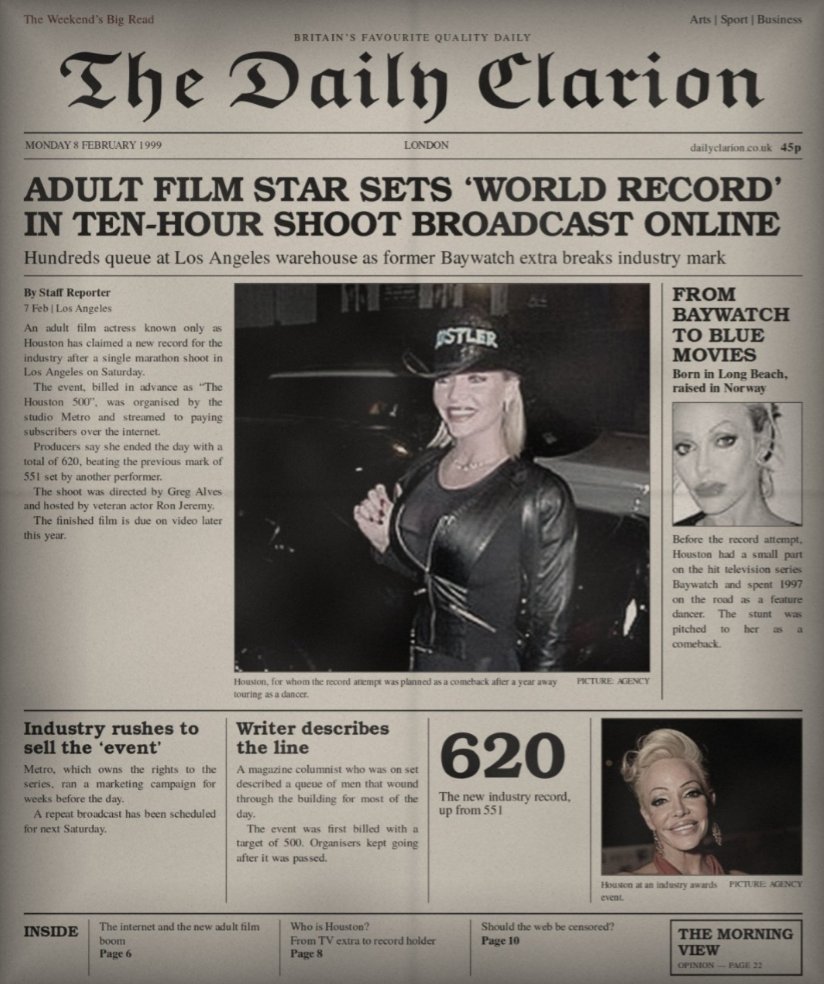
In 1999 a former Baywatch extra called Houston set a record in the adult industry that made headlines worldwide. Months later she told Howard Stern she was having cosmetic surgery. Then the piece the surgeon removed went up for online auction. It reportedly sold for $50,000.
February 6, 1999. The front page above covers the day a warehouse shoot in Los Angeles turned an almost forgotten actress into a household punchline. Houston, born in Long Beach and raised in Norway, had a small part on Baywatch and had spent 1997 touring strip clubs as a feature dancer. Her career was fading. Someone in the business pitched her a stunt as a comeback.
The studio Metro took the idea and sold it like a boxing match. The event was billed as "The Houston 500", streamed to paying subscribers, hosted by Ron Jeremy and directed by Greg Alves. The industry record at the time was 551. By the end of the day the count was 620, the name of the film changed to match, and it went on to win the award for the top selling release of the year.
The record lasted eight months. In October 1999 another performer pushed it past 700.
Houston didn't stop. On Howard Stern's show she explained she was having surgery to look better on camera. The tissue that was removed was later listed on an online auction site, and reports put the final price at around $50,000. She was inducted into the AVN Hall of Fame in 2004.
Decades later, now speaking under her real name, Kim Halsey, she has told a very different version of 1999. In recent interviews she said she was pressured into sex with a producer just to get the role, and she has warned the young women chasing the same kind of viral stunt today to think about what it costs.
For one weekend she was the most talked-about woman in the industry. She has spent the rest of her life explaining it.
Was Houston a businesswoman who knew exactly what she was selling, or a woman the industry used up and sold off piece by piece?
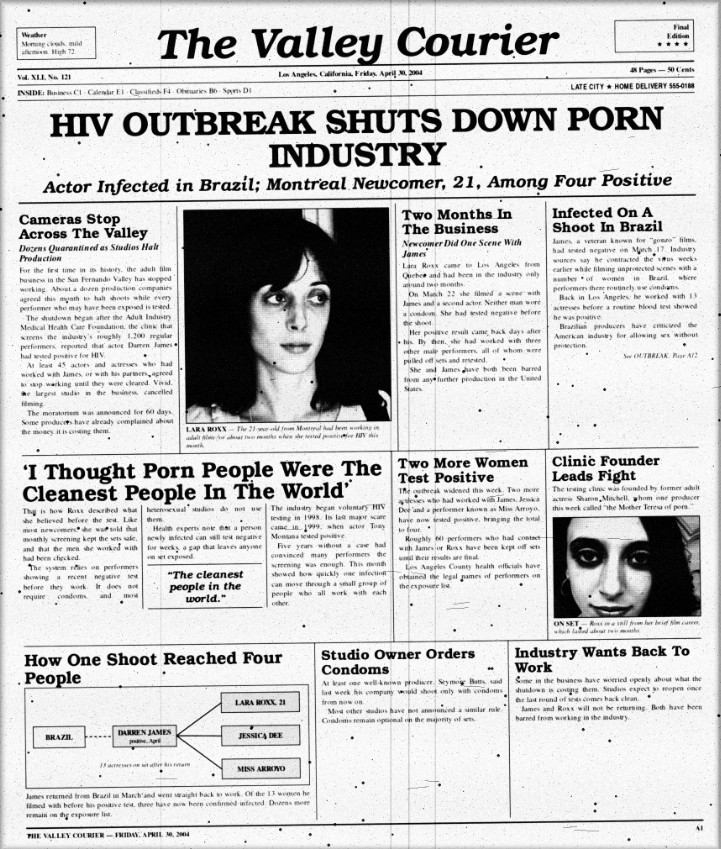
Lara Roxx was 21 and two months into porn when she shot one scene with an actor back from a shoot in Brazil. No condoms. He had HIV. Weeks later she tested positive, and so did two more women. The entire porn industry stopped filming. It reopened. She was banned for good.
April 2004. The front page above covers the week the San Fernando Valley shut down. Darren James, a veteran actor, had tested negative on March 17, flown to Brazil, shot unprotected scenes there and come back to work in Los Angeles. Over the next few weeks he filmed with 13 actresses. Then the industry's own clinic, which screens about 1,200 regular performers, called him back with a positive result.
Lara Roxx was one of those 13. She came from the Montreal area and had been in the business about two months. On March 22 she did a scene with James and a second actor, and her test came back positive a few days after his. By then she had already worked with three other men. Every one of them was pulled off set.
About a dozen studios agreed to halt production. Vivid, the biggest name in the industry, cancelled its shoots. Around 60 performers who had been near James or Roxx were kept off sets until their results came back. Los Angeles County health officials collected their legal names. By the end of April, two more actresses who had worked with James, Jessica Dee and a performer known as Miss Arroyo, had tested positive too.
"I thought porn people were the cleanest people in the world," Roxx said that month.
That was the deal on most sets. Everyone gets tested every month, so condoms are optional. The catch is that a fresh infection can still test negative for weeks, and James had passed his test in March.
The moratorium was announced for 60 days. It was lifted after 30. James and Roxx were barred from the industry for good. A Canadian filmmaker followed her for the next five years for a documentary called Inside Lara Roxx.
The studios were back to filming within a month. She was 21.
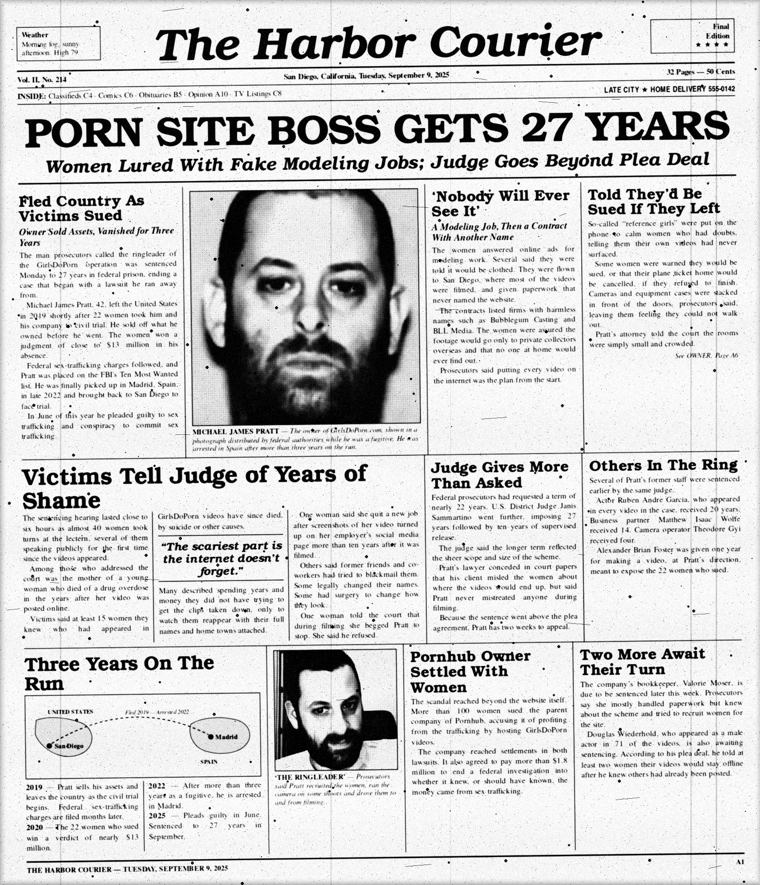
She begged him to stop filming. He didn't. He flew her in for a "modeling job," stacked camera cases against the door, swore nobody would see it. He posted it anyway. Victims say at least 15 women from his videos are now dead. Then he fled and made the FBI's Most Wanted list.
The front page above covers his sentencing. Michael James Pratt, 42, ran GirlsDoPorn out of San Diego. Women answered online ads for modeling work, some were told it would be clothed, and once they landed they were handed contracts from companies called Bubblegum Casting or BLL Media. GirlsDoPorn wasn't mentioned anywhere. They were promised the footage would only go to private collectors overseas.
Prosecutors said putting every video online was the plan from day one. Women who got nervous were put on the phone with "reference girls" who said their own videos had never surfaced. Women who wanted out were told they'd be sued or their flight home would be cancelled.
The hearing on September 8, 2025 ran almost six hours and nearly 40 victims spoke. One of them was the mother of a young woman who died of an overdose in the years after her video was posted. Others described clips that kept coming back with their full names on them, old friends and co-workers who tried to blackmail them, and a new job one woman quit after screenshots showed up on her employer's page more than ten years after the shoot. Some changed their names, and some had surgery so nobody would recognize them.
"The scariest part is the internet doesn't forget," one woman told the court.
Pratt didn't stay for the civil trial. In 2019, after 22 of the women took him to trial, he sold everything he owned and left the country, and they won close to $13 million without him in the room. He spent more than three years as a federal fugitive before police picked him up in Madrid in late 2022. In June 2025 he pleaded guilty to sex trafficking.
His lawyer admitted Pratt lied about where the videos would end up, but argued he never hurt anyone on set and the blocked doors were just small, crowded rooms. Prosecutors asked for nearly 22 years. Judge Janis Sammartino gave him 27, citing "the sheer scope and magnitude of this offense."
Many of the women told the court they have spent years trying to get their videos taken down, and most said they've had little or no success.
78 TOKENS PASSED EVERY CHECK ON THE DESK. THE 7TH BOT KILLED ALL 78. 59 WERE DEAD WITHIN 24 HOURS
the seventh seat can't talk. no paragraphs, no argument, nothing you can lean on.
six agents find pairs, check contracts, confirm smart money, stage orders, manage exits and run the thread. the seventh answers four closed questions and returns a probability for each.
// JUDGE, same four questions, every lead
organic: yes / no
late: yes / no
exit_risk: 1-5
action: buy / watch / pass
here's the gate:
▸ action = buy at 0.70 or higher
▸ organic = yes at 0.65 or higher
▸ late = no
▸ exit_risk 3 or lower
all four true or nothing gets bought. one false and the lead goes into the log with the answer that killed it.
confidence never changes position size. a 0.92 buy gets the same money as a 0.71 buy.
a model that writes can talk you into things. at 2am four confident paragraphs read the same on the token that goes to zero as on the one that doesn't.
every sunday it gets graded. group the buys into probability buckets, count how many closed green. if the 0.90 bucket doesn't beat the 0.70 bucket, raise the gate.
if it doesn't answer, the lead is a pass.
one honest warning: the $500 to $11,101 in five days is the author's bank and his thresholds. 43 trades, 69% win rate, memecoins. he says it himself, copy the shape and not the numbers. paper the gate first.
the seat that researches never signs. the seat that signs never gets an opinion.
YOU ARE PAYING SENIOR RATES TO RENAME FILES
the setup everyone is reposting is OpenAI Dots plus Claude Code as one dev team. the part actually worth stealing is smaller than that: which model gets the task first.
Sonnet 5.5 reads at $2 per million and writes at $10. Opus 5.5 is double on both.
~/project-x $ claude -p "Fix issue #381. Run the tests. Open a pull request." --model claude-sonnet-5-5
here's the split:
▸ Sonnet takes the first pass on everything, 2 tries maximum
▸ Opus gets it only when Sonnet is stuck, 1 try, and it plans instead of typing
▸ tests decide, not the model. 318 of 318 or the task is not done
▸ you approve the pull request, and nothing merges itself
on 1,000 tasks that is roughly $480 instead of $800 for the same work, because the expensive brain only wakes up for the 20% that earns it.
the part that makes this safe: the Dot never merges. it opens the issue, reads the result and writes you a summary. the branch, the commits and the test output all live in GitHub, so neither model has to remember anything.
by 08:00 there is a PR waiting with no database changes and your approval missing, not a commit you have to undo.
the benchmarks are closer than that price gap suggests. Sonnet beats Opus on Terminal-Bench 4.0, 70.6 to 66.4. Opus pulls ahead on the long messy ones, FrontierCode 54.4 to 46.2. that spread is the entire reason a router exists.
one honest warning: there is no connect button. OpenAI and Anthropic ship nothing that joins these two. you build the GitHub bridge yourself, and if your tests are weak you have only automated a bad merge faster.
8 hours of nothing becomes 9 tasks routed, fixed and green before you open the laptop.
save it, this is the cheapest senior engineer you will ever avoid hiring.
THIS IS THE CHEAPEST SECOND BRAIN YOU WILL EVER BUILD
no Obsidian, no Notion, no database. a handful of .md files on your disk and one index the agent reads before you type anything.
the index is CLAUDE.md in the root. Claude Code loads it into the system prompt at session start, so the map is already in its head.
~/brain $ mkdir notes people projects && touch CLAUDE.md
here's the split:
▸ notes/ holds one file per topic, named for the topic
▸ people/ holds one card per person, who they are and what you owe them
▸ projects/ holds status, where you stopped, the next step
▸ MEMORY.md, LEARNINGS.md and decisions.md sit in the root as the core, the lessons and the audit log
the rule that makes it work: one file, one topic. tax-policy.md, not notes.md. ivan-petrov.md, not note-12.md. lowercase and hyphens, always.
the part that makes it fast: nothing gets installed. these are text files. any editor, any agent, any machine, and they outlive whatever app you would have picked instead.
you ask "what did we decide on taxes?" and it goes map, then notes/tax-policy.md, then an answer with the file cited. ask about something you never wrote down and it tells you it is not in there.
that second one is the whole point. a clean structure is what lets it say "missing" instead of inventing a number.
you can pin a file with @MEMORY.md inside the map and it stays in focus every session. two files at most, or you are back to dumping everything into the prompt.
one honest warning: the map is the product, the folders are just storage. a sloppy CLAUDE.md gets you an agent that guesses, and it guesses confidently.
five minutes of folders tonight, filled as you go. no migration weekend.
save it, this is the cheapest memory your agent will ever have.
a rebuilt function matched the original byte for byte and was still wrong
the comparison tool lined up the instructions and never looked at the number they pointed to. the original checked player power against 128.0. the rebuild checked against 0.0. every byte matched, the meaning did not
the audit after it went through 1,548 floating-point references and found twelve more wrong ones, in five functions that had already been accepted
that is the part the install guides skip. the model reads, explains and rewrites. the check decides whether any of it is true, and the people doing this seriously have a name for the check. they call it the oracle.
doesn't matter if you're rebuilding a feature, porting a codebase or just letting an agent grade itself, the oracle is the whole job
the three kinds, and how to break them on purpose:
> byte oracle - compile your version, compare machine code. DX-Ball's audio balance helper: 3,205 test cases pass and all 63 compiled bytes reproduced. that is proven, not "looks right"
> behaviour oracle - same inputs into both, compare outputs. why Windows Calculator answers 220 to 200 + 10%, cross-checked against Microsoft's own published source with the exact version written down
> runtime oracle - build the whole thing and use it. the Chrome dino speed rule starts at 6, adds 0.001 per update, caps at 13, and they ran it: 10.0 after 4,000 updates, 13.0 after 10,000
> plant 3 failures before you trust a green run. one wrong constant, one swapped branch, one off-by-one. if any of them passes, the oracle is broken and every green result before it is suspect
> room A reads with REA and writes SPEC.md - behaviour, inputs, outputs, edge cases, unknowns. no code, no addresses, no names from the decompile
> room B is a fresh session in a separate folder that gets SPEC.md and nothing else. it never sees the analysis, which is the entire point of a clean room
> hold the builder to a measurable end: every case in the spec passes, all 3 planted failures rejected, nothing outside the folder touched, stop after 25 turns
the Adobe story everyone repeated is the proof. nobody decompiled anything. ArtCraft shipped twelve apps written from scratch in Rust, and FilmCraft's contributor rules forbid reading, disassembling or copying anything inside an Adobe bundle at all. you observe the behaviour by using the app. the people who rebuilt Adobe's workflow banned themselves from reading Adobe.
study the original, ship your own. an output is not a right, and reading a program gives you no claim on its code, its data or its name.
the board in my clip is a visual concept for software you own or may examine. the full guide, the two-room prompts and the planted-failure pack are below.