He slapped her so hard her ears rang. Then he beat her head against the floor until her face was covered in blood, choked her unconscious twice and held her head in a toilet so she couldn’t breathe
He wasn’t a stranger. He was a porn star she called a friend
Jessie Rogers was a young porn star on the rise. She had been to his place before. Several times. Never on camera, just hanging out
That night started like the others
She walked in. He looked angry
“You’re late.”
Then the first slap. She hit the floor
Everything after that happened fast. She remembers being in a daze while he slammed her head down again and again. Her face started bleeding. He kept going
She asked him to slow down. She asked him to stop
“You’re fine, babe.”
He choked her until she blacked out. When she came to, he did it again
Then he pushed her head into his toilet. Every time she tried to come up for air, he pushed her back down
“I thought I was going to die, honestly.”
The warning signs had been there for a while. Before that night, a syphilis outbreak hit the industry. The man who spread it was no beginner. He had been working for more than eight years, and he kept shooting with other performers
She and her roommate had talked about quitting. More than once. They stayed
Until 4 a.m. that night, when she was driving home alone and asking herself one question:
“Why am I hanging out with these type of people?”
She quit. Her roommate quit too
Years later she tells the story on camera, fit and done with that world. Halfway through she has to stop. “It’s hard for me to talk about it in detail.”
Then she says the strangest part
She’s thankful for that night. Because it woke her up
A man nearly killed her, and that’s what it took to get her out
So was he one monster, or just the one who finally showed her what that industry really is?
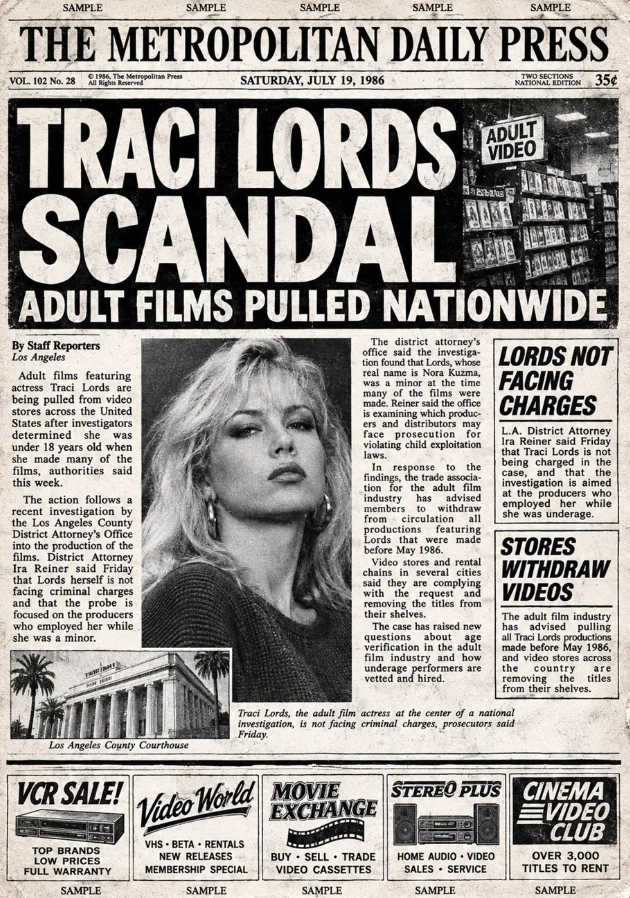
Traci Lords was one of the most famous names in the adult industry by 1986. Then investigators found out she had been a minor for almost all of it. She was 15 when she started, with a fake ID. Overnight nearly every film she made became illegal. Stores pulled them nationwide.
Her real name was Nora Kuzma. She was born in Steubenville, Ohio, in 1968. After her parents split up, her mother moved the kids to Los Angeles. As a young teen she got hold of a fake birth certificate and a California driver's license that said she was 20.
With that ID she walked into an agency in the San Fernando Valley. Nobody checked further. Within two years she was on magazine covers and in dozens of films. Her name sold videotapes all over America, and the money went to the producers and distributors.
In May 1986, just after her 18th birthday, the truth came out. The Los Angeles County District Attorney's office found that she had been under 18 when almost all of her work was made. Overnight, every one of those tapes was legally child exploitation material. The industry's own trade association told members to pull everything made before May 1986.
Video stores and rental chains across the country emptied their shelves. District Attorney Ira Reiner said Traci herself would not be charged, because the law saw her as the victim. The investigation went after the agents, producers and distributors who had hired her. In the end, almost none of them went to prison. Courts ruled they could argue they had been fooled by her ID.
She walked away from the industry and spent years trying to be taken seriously. John Waters cast her in Cry-Baby in 1990. She got roles on Melrose Place and other shows and released music. In her 2003 memoir she wrote about the abuse in her childhood and said she had been a lost kid nobody protected.
Half the internet says she lied about her age and fooled an entire industry. The other half says a 15-year-old should never have been able to. Almost nobody talks about the fact that the age-verification records every studio in America still has to keep exist because of her.
She broke the law to get in. The law said she was the only one who couldn't be guilty.
Was Traci Lords a teenage con artist who fooled everyone, or a 15-year-old girl that a whole industry chose not to look at too closely?
Kristin used to help people buy homes in one of the richest counties in America. Then a judge took her child away. Now she's 44, sleeping on the streets of Irvine, smoking the second she wakes up and taking a cut from shoplifters just to survive.
Her old life was in Orange County, one of the richest parts of California. She says the old days were boring, a good kind of boring, the kind you only miss once it's gone. She worked in mortgages and made good money doing it. Drugs weren't part of the picture. She calls her addiction a newer thing.
What broke it was court. She lost custody of her child, and she says she didn't know how to deal with the pain, so she found something to numb it. She can't even remember exactly who first put the drugs in front of her. Now she lives outside in the same county where she used to arrange home loans.
The money now comes from the street economy. She works between boosters, the people who steal from stores, and fences, the people who buy what they take, and she keeps a percentage. Her day starts at around 5:45 in the morning, and the first thing she does, she says, is smoke.
She talks about what she has seen out there without much emotion. The man she was with was shot in the leg. People around her overdose constantly. She says people on the street won't go to the police for help, and most are too afraid to even ask. She still says she wants out, and that one day she wants to help the people living the way she does now.
At the end she tries to tell anyone listening to appreciate their family and the smallest things they have. She doesn't manage to finish the sentence.
She lost her child in a courtroom. She lost everything else on the street.
Is Kristin's story about drugs, or about how close anyone is to losing everything after one bad day in court?
Traci Lords was raped at 11 and ran away from home. At 15, with a fake ID, she became one of the most famous porn stars in America. When the truth about her age came out, almost every film she had made turned illegal overnight. She was never charged. She was the minor
She was born Nora Kuzma in Steubenville, Ohio. Her father drank, her parents split, and her mother took the girls to Los Angeles. In the interview she says the rape at 11 was the single most traumatic thing that ever happened to her, and that she carried the shame for years without telling anyone, not even her mother. She stopped speaking to her mother, ran away and, in her words, went through the whole thing
At 15 she got a driver’s license in another woman’s name and walked into an adult modeling agency in the Valley. Nobody looked twice. Within months she was in Penthouse, and studios started building films around her
She says she was very, very high for about three years, most of the time. Plenty of kids have sex and try drugs in high school, she says. The scandal was that a camera was rolling and she was 15 years old
In 1986, shortly after her 18th birthday, it all came out. Video stores across the country pulled her tapes off the shelves. Prosecutors went after the agent and the producers who had hired her. The only legal film left was the one she made after she turned 18
She got sober, took acting lessons and landed a lead in John Waters’ Cry-Baby next to Johnny Depp. In this interview she is promoting her first album, the one where she sang about the rape for the first time. She says her past cost her roles, and whatever she has built, she built in spite of it
At the end the interviewer asks if women in porn are victims or have only themselves to blame. She says no normal, healthy woman wakes up one morning and decides to become a porn star. Out of all the women she met in that industry, she says, every single one of them had baggage
She was 15 on camera, and 40 years later most people still know her as a porn star first
Was Traci Lords a rebellious teenager who lied her way in, or a 15-year-old rape survivor that a whole industry chose not to ask questions about?
Joseph Paul Franklin honked at a Black man driving too slowly in a mall parking lot. When the man got out of his car, Franklin shot him with a .357 Magnum. Then he shot the man's white girlfriend. Driving away, he says, every single traffic light turned green for him.
That was August 7, 1977, at East Towne Mall in Madison, Wisconsin. Alphonce Manning and Toni Schwenn were both 23. In the video he tells it like a road story: he'd given two girls a ride to the mall, got stuck behind a slow car, leaned on the horn, and the driver walked toward him with a scowl. He describes the exact moment the scowl turned into surprise. He shot Schwenn, he says, because they were an interracial couple and he figured he was going to get caught anyway.
He wasn't caught. He had money from a bank he'd robbed in Columbus a few days earlier in his trunk, and he drove out of the lot. The murders went unsolved for seven years, until he confessed to them himself from prison.
Born James Clayton Vaughn Jr. in Mobile, Alabama, he had already passed through the American Nazi Party and the Ku Klux Klan. In the interview he says he left both because the members just sat around talking. He wanted "action." Two months after Madison he lay in wait outside a St. Louis synagogue and killed Gerald Gordon as guests left a bar mitzvah. A psychologist on the program says he could describe every detail of a killing but couldn't explain what he felt doing it.
Between 1977 and 1980 he crossed the country with a rifle hunting Black men, the white women with them and Jewish people. He was convicted of eight murders and linked to around 20, plus bank robberies and bombings. He also confessed to shooting Hustler publisher Larry Flynt, who spent the rest of his life in a wheelchair. Missouri executed Franklin by lethal injection on November 20, 2013, for the murder of Gerald Gordon.
He couldn't say what he felt pulling the trigger. He remembered the traffic lights.
Was Joseph Paul Franklin a racist with a gun, or a psychopath who just picked the ideology that let him do it?
Ziggy's father abused her, her sister and her brother. Her mother was hooked on prescription pills. By the time she got out of that house she had an addiction of her own and spent nine months in rehab. Then she moved from Arizona to California and walked straight into porn.
She tells it herself, sitting in front of a backdrop for Soft White Underbelly, the channel that interviews people most of the internet would rather scroll past. She starts with her father and what life in that house was like for all three kids. Her mother was there, but she was on pills.
Then the story turns to Ziggy herself. The pills that were in the house became part of her life too. It got bad enough that she went into a treatment program and stayed for nine months. When she gets to her grandmother, she stops talking and cries.
She says it took courage for them to get out, and they did. She left Arizona for California, and that is where she started working in adult film.
She escaped one house and walked into another one with better lighting.
Was porn the thing that saved Ziggy, or just the next thing that got to her?
Months after she was raped, a preacher's daughter signed her first porn contract. For the next 10 years she smiled on red carpets in Las Vegas. Behind the camera she was on drugs and trying to kill herself. This is Jessica, and this is what the industry did with her.
She was raised in church, in a family where everyone knew who the preacher's kid was and what was expected of her. She says she had a clear picture of how her life would go, and none of it involved cameras. The rape broke that picture apart, and within a few months of it she had signed with the adult industry.
It worked fast. She got bookings, then fans, then a name people recognized. For ten years she was a successful porn star, the kind who gets invited to the awards in Las Vegas and photographed on the red carpet in a gown.
The same career pulled her into drugs. The money kept coming in and so did the attention, but none of it touched what had happened to her before she ever signed a contract. More than once, she tried to end her life.
Today she lives a quiet life away from the industry, with a dog and a backyard, and she tells the story herself on camera, from the preacher's house to the red carpet to the drugs and the suicide attempts.
She spent ten years as one of porn's success stories. She almost didn't survive it.
Was Jessica a grown woman who chose that career, or a rape survivor the industry picked up at the exact moment she couldn't say no?
@learnodd the asymmetry here is brutal. he gets to control the narrative by going public first, and she's left holding the legal liability of his secret. that's the real crime
@kryneeex the Versailles thing never sat right, a company-sponsored palace wedding where the palace waves its fee back to the company basically means Renault just rented Versailles with shareholder money
Months after she was raped, a preacher's daughter signed her first porn contract. For the next 10 years she smiled on red carpets in Las Vegas. Behind the camera she was on drugs and trying to kill herself. This is Jessica, and this is what the industry did with her.
She was raised in church, in a family where everyone knew who the preacher's kid was and what was expected of her. She says she had a clear picture of how her life would go, and none of it involved cameras. The rape broke that picture apart, and within a few months of it she had signed with the adult industry.
It worked fast. She got bookings, then fans, then a name people recognized. For ten years she was a successful porn star, the kind who gets invited to the awards in Las Vegas and photographed on the red carpet in a gown.
The same career pulled her into drugs. The money kept coming in and so did the attention, but none of it touched what had happened to her before she ever signed a contract. More than once, she tried to end her life.
Today she lives a quiet life away from the industry, with a dog and a backyard, and she tells the story herself on camera, from the preacher's house to the red carpet to the drugs and the suicide attempts.
She spent ten years as one of porn's success stories. She almost didn't survive it.
Was Jessica a grown woman who chose that career, or a rape survivor the industry picked up at the exact moment she couldn't say no?
Dellen Millard told police he found his father dead with a bullet in his head. They ruled it a suicide and cremated him a week later. Six months on, a stranger let Millard test-drive his pickup and never came home. His remains were in an incinerator called The Eliminator.
Millard was the heir to Millardair, an aviation company his grandfather founded near Waterloo, Ontario. On November 29, 2012, his father Wayne, a pilot who ran the business, was found at home in Etobicoke with a gunshot wound through his left eye. Police called it a suicide almost immediately and never looked further. Dellen took control of the company, inherited the estate and wrote his father's obituary. "He was a good man in a careless world," it said. "He was my father."
In the video, he sits across from investigators and walks them through that night in a flat, even voice. He tells them what he saw when he went into the bedroom, and then just: he's dead.
Four months before that, his ex-girlfriend Laura Babcock had disappeared in Toronto. She was never found. A witness later told a court she had watched Millard and his friend Mark Smich "testing out" an animal incinerator he'd bought and had parked behind his barn.
On May 6, 2013, Tim Bosma, a 32-year-old father from Ancaster, posted his pickup truck for sale. Two men came by that evening to take it for a test drive, and Bosma went with them. Prosecutors said he was shot at point-blank range inside his own truck. Police found the incinerator on Millard's farm in Ayr. There were bones inside and a drop of blood on the hatch that a forensic expert said had a one-in-a-quadrillion chance of belonging to anyone other than Bosma.
Only after that arrest did police go back to Wayne Millard's death. Juries convicted Dellen of first-degree murder three times: Bosma in 2016, Babcock in 2017 and his own father in September 2018. He acted as his own lawyer at the Babcock trial and later told an appeal court he had been cast as "the perfect villain."
He wrote that his father was a good man in a careless world. A jury decided he was the one who shot him.
Was it the money, or did Dellen Millard just want to see how long he could get away with it?