No Society Arrives at Tragedy Overnight
Published yesterday, May 28, 2026, exactly thirty five years after the political transition that inaugurated Ethiopia’s post 1991 constitutional order, this article examines a question that the passage of three and a half decades has made more urgent, not less: How did anti Amhara violence become institutionalized, and why has it persisted across successive political eras?
The timing is significant. As Ethiopia approaches another national election, the article looks beyond the immediate political moment and turns instead to the deeper historical forces that have shaped the present. This inquiry begins not in 2026, or even in 1991, but in the 1820s, with the missionary and colonial narratives that first gave shape to competing visions of Ethiopian identity and statehood.
Drawing on a genealogical framework, the article traces seven historical periods through which the negative political construction of the Amhara evolved, from European racial taxonomies and Italian colonial ideology, through the revolutionary student movement of the 1960s and 1970s, to the ethno nationalist projects that culminated in the constitutional and territorial order established after 1991. It argues that the violence experienced by Amhara communities in recent decades was neither accidental nor sudden. It was prepared intellectually, institutionally, and discursively over generations.
No society arrives at tragedy overnight. Long before violence manifests physically, it is shaped by the stories societies tell, the histories they choose to remember, and the institutions they build in their image.
As Chinua Achebe observed, “Until the lions have their own historians, the history of the hunt will always glorify the hunter.”
Understanding how certain narratives became embedded in law, territory, and political discourse is not merely an academic exercise. It is a prerequisite for truth, accountability, reconciliation, and the possibility of a more just future.
https://t.co/H7iIMwS0qY
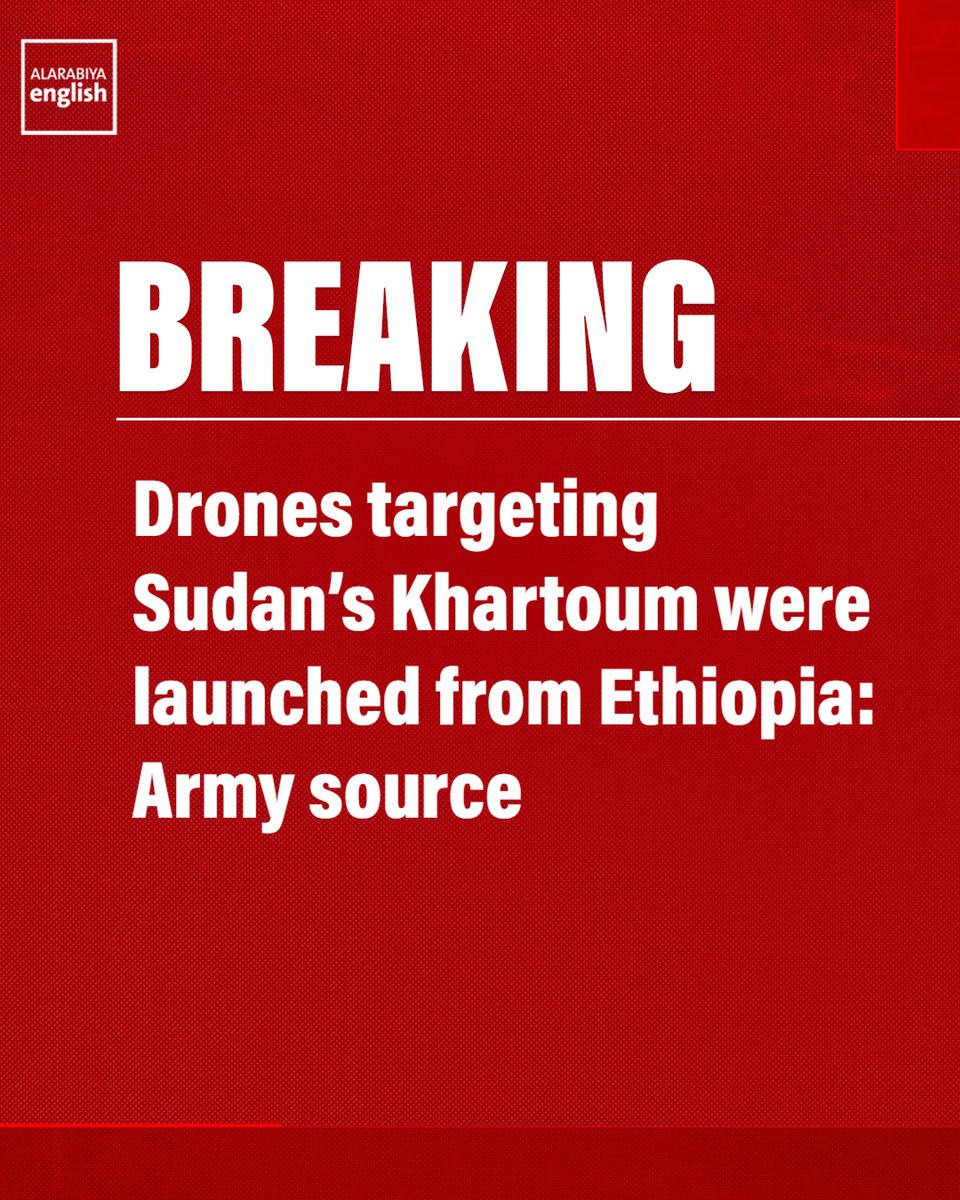
🔴 BREAKING: Drones that attempted to target Sudan’s capital Khartoum were launched from neighboring Ethiopia, a source in the Sudanese army tells Al Arabiya English.
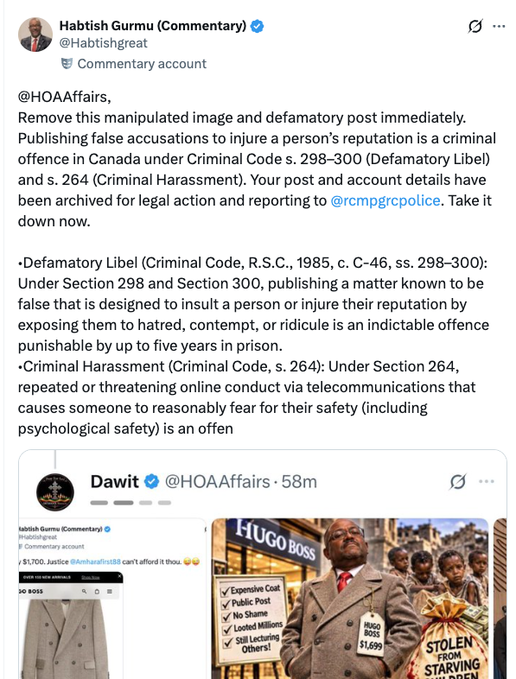
🤣 Challa, careful with that $1,699 Hugo Boss coat! Fold it gently, not a single wrinkle. The imaginary rental shop wants its luxury back! 😂 One day of borrowed elegance, a lifetime of unanswered questions. Return the coat, keep the 🤡🧥🍿#Habtamu_Challa_Gurmu@Habtishgreat
Is Abu Dhabi Behind the Uganda–Turkey Crisis? UAE Influence Expands Across Africa as Somalia Becomes a Battleground for Power and Money
A Dark Box investigation reveals geopolitical dimensions extending far beyond the official explanation for Uganda's decision to suspend military and defense cooperation with Turkey in September 2026. While the case of Ugandan opposition figure Fred Lumbuye dominated the headlines, more troubling details point to an intensifying rivalry between the UAE and Turkey over military influence in Somalia and the Horn of Africa. Reports of Emirati pressure on Kampala raise serious questions about Abu Dhabi's role in the crisis.
At the heart of the confrontation lie military and financial interests. Uganda maintains approximately 6,500 troops in Somalia, with estimates suggesting it could lose between $5 million and $6 million per month if its military deployment ends. Meanwhile, Turkey has expanded its training of Somali forces, threatening to reduce Somalia's dependence on foreign troops. This shift places Ankara's growing influence in direct competition with regional interests, particularly those of the UAE, which has built an extensive network of influence through ports, investments, and security partnerships.
Abu Dhabi is also expanding its footprint inside Uganda itself. Reported Emirati investments have reached approximately $3.5 billion, while bilateral trade stands at $2.85 billion. An additional agreement grants a UAE company a 60% stake in a Ugandan oil refinery project. These interests intersect with the Emirates' presence in Somali ports, particularly Berbera, and its escalating disputes with the federal government in Mogadishu.
The Uganda–Turkey crisis exposes how Africa has become an arena of competition for military influence, strategic ports, energy resources, and political power. The UAE's extensive interests provide opportunities to influence regional decisions, including through the use of direct pressure to push Uganda into severing its military cooperation with Turkey.
https://t.co/jGEQyfQ0yS
#UAE #AbuDhabi #Uganda #Turkey #Somalia #Africa #HornOfAfrica #UAEInfluence #Mogadishu #DarkBox
The #NoToLana campaign renewed its criticism of #UAE minister Lana Nusseibeh's bid to lead the United Nations amid allegations of Emirati support for the #RSF in #Sudan.
Campaigners cited #UN investigations into networks linked to the conflict and called for accountability over the UAE's role.
Follow #Ethioviews on TikTok--they do amazing work! There's a great effort to split up developing coalitions. Peepee's sole strategy is to widen any fissures, fuel divisions, and then eat each member alive once they are isolated. Good video. #Ethiopia
https://t.co/ES3mHxjTig
THE WISDOM OF THE ANT
ERITREA WAS NOT GIVEN. IT WAS CARRIED.
By Abraham Gebremichael | Artist & Writer
The smallest creatures often carry the greatest lessons for a nation.
Have you ever watched an ant carrying a stone larger than itself?
It does not complain.
It does not surrender.
And when the burden becomes too heavy, another ant joins.
Then another.
That is the story of ERITREA.
For thirty years, our ancestors carried the stones of liberation.
From Nakfa to Sahel, from Massawa to Asmara, they carried sacrifice, suffering, courage, and the dream of freedom.
Some never returned.
Others lived to see the nation they had carried.
They gave us independence. But what will we give our children?
A flag to admire, or a future to inherit?
History to remember, or opportunities to embrace?
Our nine peoples, our different languages, our Muslim and Christian communities, and our shared homeland are sources of strength.
Different faiths. Shared values. One Eritrea.
But unity must become action.
Our mountains remember sacrifice.
Our Red Sea holds opportunity.
Our soil awaits cultivation.
Our classrooms await tomorrow's scientists, doctors, engineers, and dreamers.
And our diaspora carries Eritrea across oceans.
But Eritrea cannot eat history alone.
Patriotism must become productive work.
Independence must create opportunity.
Sacrifice must inspire progress.
The ant teaches us a timeless lesson:
No burden is too great when many shoulders carry it together.
One ant carries water.
Another plants a seed.
Another builds a bridge.
Together, they create something greater than themselves.
Now the responsibility is ours.
Let us build a nation where our children inherit not only the memory of freedom, but the dignity, knowledge, peace, and prosperity that freedom should make possible.
Our ancestors carried the stones of liberation.
Our generation must carry the seeds of prosperity.
The greatest tribute to our martyrs is not only remembering their sacrifice.
It is building a future worthy of it.
Glory to our martyrs.
Strength to our people.
ERITREA MUST FLOURISH.
#Eritrea #Assab #RedSea #HornOfAfrica #Peace #Sovereignty
@mjoe209 This agenda will fail before it even starts. Tigray is a deeply united nation, with sacred Christian and Muslim heritage. Axum and Negash represent profound spiritual and historical significance. new generation will never fall for this traitorous agenda. @Tewodros_Tse
🤣 Challa, a $1,699 Hugo Boss coat and a desperate cry of “Look at me!” Beneath that expensive fabric, what a squalid spectacle of moral bankruptcy! A designer label cannot disguise a worthless piece of shit/turd. Luxury on the outside, depravity on display! 🤡💨🍿 @Habtishgreat
The UNSC has formally rejected the UAE’s candidacy. The female candidate is affiliated with the UAE’s ruling regime, which has been accused of fueling atrocities in Sudan, Libya, and Yemen, as well as contributing to political instability in Somalia.
Opening a YouTube channel and gaining a few followers doesn’t mean you are knowledgeable or qualified to be a professional journalist. This is the most unprofessional presenter I have ever seen. Calling his guest “a pathological liar” was extremely disrespectful and destroyed his credibility as an honest presenter. Professor Mohamed is an asset to the Horn of Africa and a first-class intellectual who knows what he is talking about. I’m sure that if he interviewed someone whose views aligned with his own, he would sit there nodding like a chicken drinking water.🤡
#Ethiopia #Tigray #Eritrea #TghatMedia @TghatMedia
@faisalroble19 recycled Siad Barre-era talking points while dodging key questions from @TghatMedia. His most striking claim: “Somali Ethiopians are outsiders; Ethiopia was imposed on us…..”He also argued that the Tigray, Somali alliance is driven by shared ambitions for autonomy
@neba_tdf They will do anything to fuel violence and please their OPDO/PP masters. Tigrayan must reject this dangerous agenda. Axum and Negash are historic holy cities of Orthodox Christianity and Islam in Africa. Tigrayan & Ethiopian must stand united against PP’s genocidal regime.
@Gafdiid7 I’ve to say “I told you so”. I warned you about trusting @RArarssa ! As you rightly pointed out his discourse is a toxic mix of historical revisionism, fabricated narratives, & inflammatory rhetoric, exploiting ethnic pride at the expense of ordinary people’s lives!